Awad Aljuaid (2022). Hypoglycemia Vehicle Detection System Using Non-Invasive Sensors Applying Both EEG And HRV Real Time Measures: Neuroergonomics Theoretical Design. In: Human Factors and Wearable Technologies. AHFE Open Access, vol. 29, pp. 101–107. https://doi.org/10.54941/ahfe1001480
During COVID 19 pandemic the global needs for online shopping, ride-sharing transportation, and food delivery services have been dramatically increased. The drivers who suffer from diabetes especially low blood sugar level (Hypoglycemia) are more likely at risk than others. Earlier literature has revealed that hypoglycemic issues in patients with diabetes are correlated with significant changes in scalp electroencephalography (EEG); signals amplitude (time domain) or power spectral density (frequency domain). In addition, Haret rate variability HRV which reflects the balance between the sympathetic and parasympathetic nervous system has been proven as one of the indicators of Hypoglycemia. The aim of this paper to propose a conceptual design of a Vehicle detection system using both EEG and HRV measures at the same time in real time feed using non-invasive sensors to reduce the potential of driver’s cognitive dysfunction.
During COVID 19 pandemic the global needs for online shopping, ride- sharing transportation, and food delivery services have been incredibly increased(Unnikrishnan and Figliozzi, 2021). To meet the growing demand, Logistics and transportation companies increased the capacity of transporta- tion and drivers. The drivers who suffer from diabetes especially low blood sugar level (Hypoglycemia) are more likely at risk than others. Hypoglyce- mia is a blood sugar (glucose ) level below normal 70 mg/dL (Association, 2020). Hypoglycemia symptoms such as hunger, sweating ,cognitive dysfu- nction, anxiety, seizures, palpitations, coma and tremor (Cryer, Davis and Shamoon, 2003). Findings have showed that cognitive function might not recover until about 40 minutes after return of normal sugar level (euglyce- mia) (Zammitt et al., 2008). Case studies showed that hypoglycemia was correlated with 130% increase in car accidents (Signorovitch et al., 2013). The raped improvements in engineering fields, was applied in developing new advanced noninvasive interface and technology on human body, that
have opened new fields and approaches for utilizing human biosignals in examining different human’s activities. These innovations allow organizati- ons to acquire human biosignals and related data, which helps to monitor and process information for extracting knowledge to study human behavior, function and disability and determine the optimal job design and working environment. Neuroergonomics is a science of two disciplines neuroscience and ergonomics (Parasuraman and Rizzo, 2008). Ergonomics is the study of interactions between human being and machine, with main purpose to incre- ase human performance and minimize interaction risks (Karwowski, 2006b; Karwowski, 2006a; Karwowski, 2005). It evaluates how well a technology matches human capabilities and limitations. Earlier literatures have revealed that hypoglycemic issues in patients with diabetes are correlated with signi- ficant changes in scalp electroencephalography (EEG); in addition, Hart rate variability (HRV) has been proven as one of the indicators of Hypoglycemia (Blaabjerg and Juhl, 2016; Jaiswal et al., 2014; Juhl et al., 2010; Koeneman et al., 2021; Ngo et al., 2021; Olde Bekkink et al., 2019; Rubega et al., 2020; Sejling et al., 2015; Vlcek et al., 2008; Diouri et al., 2021; Tobore et al., 2020).
HYPOGLYCEMIA VEHICLE DETECTION SYSTEM Hypoglycemia Related Biosignals
Emotional, physical responses and cognitive dysfunction of human body have been studied comprehensively over years. Most of recent studies are trying to discover the responses of our nervous system. The human nervous system contains two divisions: central and peripheral. The central includes the brain and spinal cord; the peripheral connects the central to the body. The peri- pheral is divided into two systems somatic and autonomic nervous system which associated with psychological mental states like stress, anxiety, anger, fear, sadness, disgust, and happiness; it regulates breathing, heart rate, etc. The autonomic system divided into two parts: sympathetic and parasympa- thetic which start stress and relaxation, respectively (Mai and Paxinos, 2011; Seo and Lee, 2010). The most interesting approaches to this information has been proven by many studies; physical , emotional and cognitive dysfunction caused by disease and their related biosignals can be acquired directly or indirectly from human nervous system (Kreibig, 2010; Cryer, 2021).
Brain’s EEG The human brain affected by the supply of the source of energy (glucose) (Alshear). Brain electrical activity or EEG is “the recording of electrical acti- vity along the scalp” also EEG is a device or instrument that measures signals of voltage oscillations occurring with ionic current flows inside the brain’s neuron. EEG bands or rhythms are classified based on frequency ranges, that are named after Greek letters delta band δ (1 to 4 Hz), theta band θ (4 to 8 Hz), alpha band α (8 to 12 Hz), beta band β (13 to 25 Hz) and gamma band γ (> 25 Hz). (Niedermeyer and da Silva, 2005; Khalifa et al., 2012). The results offered by (Juhl et al., 2010) found that there is slow wave activity and
Hypoglycemia Vehicle Detection System Using Non-Invasive Sensors Applying Both EEG 103
reduced alpha activity before a cognitive dysfunction coupled with hypogl- ycemia. Also this result is supported in the review by (Blaabjerg and Juhl, 2016) summarized multiple studies proven that delta and theta bands incre- ased during hypoglycemia. In a recent study by(Rubega et al., 2020) found similar results increase in delta and theta and decrease in alpha bands.
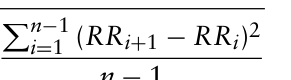
Heart Rate Variability (HRV) Back to the peripheral nervous system; the autonomic nervous system (ANS) is controlling the heart over the vagus nerve. When someone is under hypo- glycemia, the ANS is triggered: the sympathetic system is activated and the parasympathetic system is suppressed (DeRosa and Cryer, 2004; Hoffman, 2007). This changes under physiological reaction leads to several changes in heart rate HR and heart rate variability HRV(Jaiswal et al., 2014; Koene- man et al., 2021). HRV commonly can be measured using two approaches : Time domain and Frequency domain (Kreibig, 2010; Pumprla et al., 2002). In time domain HRV can be calculated from beats variation by measuring intervals between peaks of R-R interval from the Electrocardiogram ECG; then computing one of the preferred time domain variables called the root mean square of the successive differences RMSSD Equation (1)(Malik et al., 1996):
sPn−1
Equation reproduced from the original PDF.
The second approach is the frequency domain by finding the preferred ratio of LF:HF, where LF between 0.04–0.15 Hz and HF between 0.15– 0.4 Hz (Malik et al., 1996). The results offered by many studies showed that people under hypoglycemia their HRV is decreasing compared to when they are under euglycemia in terms of time domain variables like RMSSD (Koeneman et al., 2021; Olde Bekkink et al., 2019). Also several studies sho- wed that HRV is higher under hypoglycemia in terms of frequency domain ratio LF:HF (Koeneman et al., 2021; Olde Bekkink et al., 2019; Vlcek et al., 2008). Brain neuroimaging and cardiovascular measures are the most related noninvasive indicators for hypoglycemia observation in this study. The proposed system is robust and designed to measure two biosignals simul- taneously; EEG and HRV. HRV is measured using the photoplethysmogram (PPG)/ electrocardiogram ECG using heart rate sensors. The system helps to detect hypoglycemia during driving and connected to the car sub-system through On-board diagnostics OBD II minimize the potential of accidents.
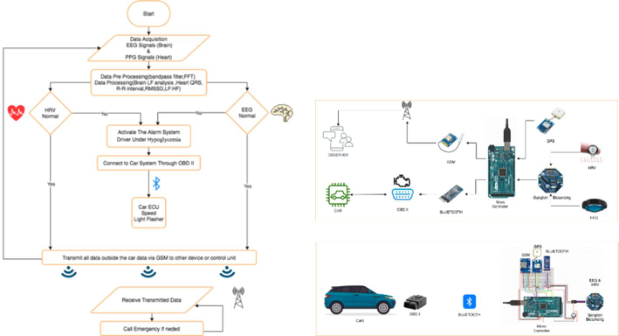
Methodology and Conceptual Design The system design, modules , configuration and the working principle flowchart are shown in block and pictorial diagrams demonstrations in figure 1.
The main components used in system design are three parts, first the user part with biosignals data acquisition, signal pre-processing and processing
104 Aljuaid
Figure 1: Working principle flowchart and pictorial diagrams including PPG/ECG and 4 channels EEG using OPENBCI Ganglion. The second part is the microcontroller Arduino Mega 2560, Ublox NEO-6M GPS Module, Bluetooth 4 (BLE) HM-10 and QuadBand GPRS-GSM SIM800L wireless transceiver. The last part is the OBD II connected to OBD II port at the vehicle.
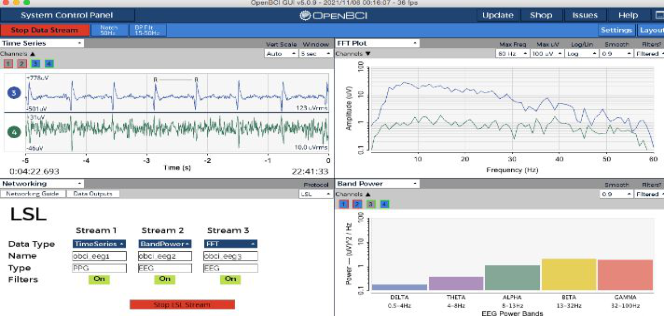
In the 1st part data acquired, pre-processed and processed using open sou- rce OPENBCI GUI V5.0.9 as shown in figure 2. EEG signals are notch filtered at 60Hz and band pass filtered between 5–50 Hz. Also, it converted into fre- quency domain using fast fourier transform FFT to classify the main bands delta δ, theta θ, alpha α, beta β and gamma γ . Heart rate is acquired using the same board then R-R interval captured to calculate RMSSD, also its conver- ted to frequency domain using FFT to classify LF (0.04–0.15 Hz) and HF (0.15–0.4 Hz) to calculate the ratio LF:HF.
Then the data will be streamed to the second part the microcontroller which control the data with conditions and algorithms using lab streaming layer (LSL). Brain waves triggers the microcontroller if the low freque- ncy bans delta and theta are active and other bands such as alpha and beta are not active for 10 seconds. In this moment the system will reco- gnize a potential of hypoglycemia. This potential will be significant if the other biosignals HRV is abnormal. The microcontroller will consider HRV represented in RMSSD is abnormal if it is 20% below the short term measurement norms 42 milliseconds or 30% above the ratio LF:HF 2.8 ms2 (Koeneman et al., 2021; Umetani et al., 1998; Shaffer and Ginsberg, 2017). If the hypoglycemia occurred the microcontroller will communicate with the third part of the system which is the OBD II to switch on the lights fla- sher and to reduce the speed via cruise control if possible(Checkoway et al., 2011; Kelarestaghi et al., 2019; Sheng et al.). Also, the microcontroller will communicate with the observers sending GPS location, speed of the vehicle and the drivers biosignals.
Hypoglycemia Vehicle Detection System Using Non-Invasive Sensors Applying Both EEG 105
Figure 2: Data processing of ECG and EEG
CONCLUSION
The proposed system is designed to measure two biosignals simultaneously; EEG and HRV. HRV is measured using the photoplethysmogram (PPG)/ electrocardiogram ECG using heart rate sensors. The system helps to detect hypoglycemia during driving and connected to the car sub-system through On-board diagnostics OBD II minimize the potential of accidents.
REFERENCES
Alshear, O. S. ’Brain Wave Sensors for Every Body’. Association, A. D. (2020) ’6. Glycemic Targets: Standards of Medical Care in Diabetes—2021’, Diabetes Care, 44(Supplement_1), pp. S73-S84. Blaabjerg, L. and Juhl, C. B. (2016) ‘Hypoglycemia-induced changes in the electro-
encephalogram: an overview’, Journal of diabetes science and technology, 10(6), pp. 1259–1267. Checkoway, S., McCoy, D., Kantor, B., Anderson, D., Shacham, H., Savage, S., Koscher, K., Czeskis, A., Roesner, F. and Kohno, T. ’Comprehensive experimen- tal analyses of automotive attack surfaces’. 20th USENIX Security Symposium (USENIX Security 11). Cryer, P. E. (2021) ‘Hypoglycemia’, Endocrine Emergencies: Springer, pp. 27–35. Cryer, P. E., Davis, S. N. and Shamoon, H. (2003) ‘Hypoglycemia in diabetes’,
Diabetes care, 26(6), pp. 1902–1912. DeRosa, M. A. and Cryer, P. E. (2004) ‘Hypoglycemia and the sympathoadrenal system: neurogenic symptoms are largely the result of sympathetic neu- ral, rather than adrenomedullary, activation’, American Journal of Physiology- Endocrinology and Metabolism, 287(1), pp. E32–E41. Diouri, O., Cigler, M., Vettoretti, M., Mader, J. K., Choudhary, P., Renard, E. and
Consortium, H. R. (2021) ‘Hypoglycaemia detection and prediction techniques: A systematic review on the latest developments’, Diabetes/Metabolism Research and Reviews, 37(7), p. e3449. Hoffman, R. P. (2007) ’Sympathetic mechanisms of hypoglycemic counterregulation’, Current diabetes reviews, 3(3), pp. 185–193. Jaiswal, M., McKeon, K., Comment, N., Henderson, J., Swanson, S., Plunkett, C.,
Nelson, P. and Pop-Busui, R. (2014) ’Association between impaired cardiovascular
106 Aljuaid
autonomic function and hypoglycemia in patients with type 1 diabetes’, Diabetes care, 37(9), pp. 2616–2621. Juhl, C. B., Højlund, K., Elsborg, R., Poulsen, M. K., Selmar, P. E., Holst, J. J., Christiansen, C. and Beck-Nielsen, H. (2010) ’Automated detection of hypoglycemia- induced EEG changes recorded by subcutaneous electrodes in subjects with type 1 diabetes—the brain as a biosensor’, Diabetes research and clinical practice, 88(1), pp. 22–28. Karwowski, W. (2005) Handbook of standards and guidelines in ergonomics and
human factors. CRC Press. Karwowski, W. (2006a) International Encyclopedia of Ergonomics and Human Factors, -3 Volume Set. Crc Press. Karwowski, W. (2006b) ’The discipline of ergonomics and human factors’, Hand-
book of human factors and ergonomics, 3. Kelarestaghi, K. B., Foruhandeh, M., Heaslip, K. and Gerdes, R. (2019) ’Intelligent transportation system security: impact-oriented risk assessment of in-vehicle networks’, IEEE Intelligent Transportation Systems Magazine, 13(2), pp. 91–104. Khalifa, W., Salem, A., Roushdy, M. and Revett, K. ’A survey of EEG based user
authentication schemes’. 2012 8th International Conference on Informatics and Systems (INFOS): IEEE, BIO-55-BIO-60. Koeneman, M., Olde Bekkink, M., Meijel, L. v., Bredie, S. and de Galan, B. (2021) ’Effect of Hypoglycemia on Heart Rate Variability in People with Type 1 Diabe- tes and Impaired Awareness of Hypoglycemia’, Journal of Diabetes Science and Technology, pp. 19322968211007485. Kreibig, S. D. (2010) ’Autonomic nervous system activity in emotion: A review’,
Biological psychology, 84(3), pp. 394–421. Mai, J. K. and Paxinos, G. (2011) The human nervous system. Academic Press. Malik, M., Bigger, J. T., Camm, A. J., Kleiger, R. E., Malliani, A., Moss, A. J. and Schwartz, P. J. (1996) ‘Heart rate variability: Standards of measurement, physiological interpretation, and clinical use’, European heart journal, 17(3), pp. 354–381. Ngo, C. Q., Chai, R., Jones, T. W. and Nguyen, H. T. (2021) ’The effect of hypo-
glycemia on spectral moments in EEG epochs of different durations in type 1 diabetes patients’, IEEE Journal of Biomedical and Health Informatics, 25(8), pp. 2857–2865. Niedermeyer, E. and da Silva, F. H. L. (2005) Electroencephalography: basic principles, clinical applications, and related fields. Wolters Kluwer Health. Olde Bekkink, M., Koeneman, M., de Galan, B. E. and Bredie, S. J. (2019) ’Early
detection of hypoglycemia in type 1 diabetes using heart rate variability measured by a wearable device’, Diabetes care, 42(4), pp. 689–692. Parasuraman, R. and Rizzo, M. (2008) Neuroergonomics: The brain at work. Oxford University Press. Pumprla, J., Howorka, K., Groves, D., Chester, M. and Nolan, J. (2002) ’Functional
assessment of heart rate variability: physiological basis and practical applications’, International journal of cardiology, 84(1), pp. 1–14. Rubega, M., Scarpa, F., Teodori, D., Sejling, A.-S., Frandsen, C. S. and Sparacino, G.
(2020) ’Detection of hypoglycemia using measures of EEG complexity in type 1 diabetes patients’, Entropy, 22(1), pp. 81. Sejling, A.-S., Kjær, T. W., Pedersen-Bjergaard, U., Diemar, S. S., Frandsen, C.
S., Hilsted, L., Faber, J., Holst, J. J., Tarnow, L. and Nielsen, M. N. (2015) ‘Hypoglycemia-associated changes in the electroencephalogram in patients with type 1 diabetes and normal hypoglycemia awareness or unawareness’, Diabetes, 64(5), pp. 1760–1769.
Hypoglycemia Vehicle Detection System Using Non-Invasive Sensors Applying Both EEG 107
Seo, S.-H. and Lee, J.-T. (2010) ’Stress and EEG’, Convergence and hybrid information technologies, 1(1), pp. 413–424. Shaffer, F. and Ginsberg, J. P. (2017) ’An overview of heart rate variability metrics
and norms’, Frontiers in public health, pp. 258. Sheng, Z., Li, C., Dixit, V., Wan, H., Wu, W. and Xu, D. ’Embedded System Based Autonomous Vehicles Action Control’. Signorovitch, J. E., Macaulay, D., Diener, M., Yan, Y., Wu, E. Q., Gruenberger, J. B.
and Frier, B. M. (2013) ‘Hypoglycaemia and accident risk in people with type 2 diabetes mellitus treated with non-insulin antidiabetes drugs’, Diabetes, obesity and metabolism, 15(4), pp. 335-341. Tobore, I., Kandwal, A., Li, J., Yan, Y., Omisore, O. M., Enitan, E., Sinan, L., Yuhang, L., Wang, L. and Nie, Z. (2020) ’Towards adequate prediction of pre- diabetes using spatiotemporal ECG and EEG feature analysis and weight-based multi-model approach’, Knowledge-Based Systems, 209, pp. 106464. Umetani, K., Singer, D. H., McCraty, R. and Atkinson, M. (1998) ’Twenty-four hour
time domain heart rate variability and heart rate: relations to age and gender over nine decades’, Journal of the American College of Cardiology, 31(3), pp. 593–601. Unnikrishnan, A. and Figliozzi, M. (2021) ’Exploratory analysis of factors affecting levels of home deliveries before, during, and post-COVID-19’, Transportation Research Interdisciplinary Perspectives, 10, pp. 100402. Vlcek, M., Radikova, Z., Penesova, A., Kvetnansky, R. and Imrich, R. (2008)
‘Heart rate variability and catecholamines during hypoglycemia and orthostasis’, Autonomic Neuroscience, 143(1-2), pp. 53–57. Zammitt, N. N., Warren, R. E., Deary, I. J. and Frier, B. M. (2008) ’Delayed recovery of cognitive function following hypoglycemia in adults with type 1 diabetes: effect of impaired awareness of hypoglycemia’, Diabetes, 57(3), pp. 732–736.
LISTED IN THE AHFE DIGITAL BOOKSTORE CATALOGUE
Explore the complete digital volume
Human Factors and Wearable Technologies
Read this individual research paper free through the original publisher, or explore the full digital proceedings book.
ISBN 978-1-958651-05-6
Explore this ISBN in the AHFE Bookstore ↗Listed in the July 2026 bookstore catalogue; search by ISBN to confirm current availability · Digital book purchase optional