Suresh Sethi (2022). Designing wearables devices to build emotional relationships. In: Human Factors and Wearable Technologies. AHFE Open Access, vol. 29, pp. 10–16. https://doi.org/10.54941/ahfe1001469
The focus of this paper is designing wearable devices to support the emotional relationship between users. The research reflects that any attempt by designers to produce outcomes aimed at helping design wearable devices must be grounded in an understanding of emotional engagement, convenient access, and intimate interaction. Emotionally positive experiences can inspire attempts to develop rich experiential devices. The case is made through several student projects that deal with particulars rooted in human relationships.
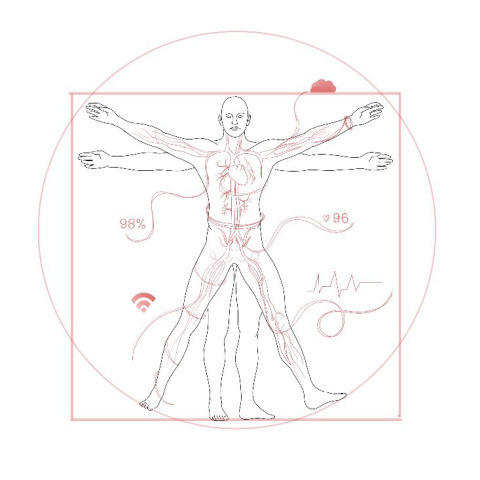
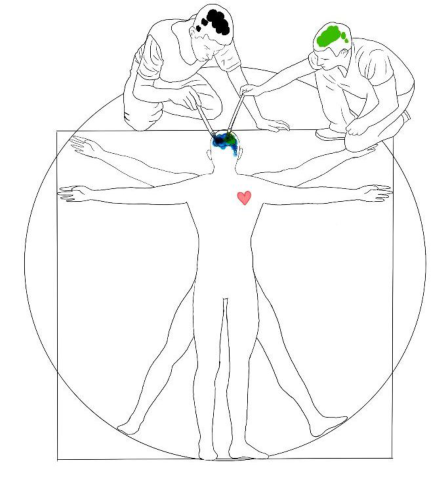
Designers “seek, express, confirm, and ascertain a sense of being through what they create. The idea that we make things a part of ourselves by creating or altering them appears to be a universal belief” (Belk, 1988). In the design of the wearables, the inner meaning behind an outer form is most important. To achieve the power of the novel design, designers have to perceive the pro- duct as a complete and comprehensive whole. This constant need to create a totality from perceived bits expresses our need to connect and understand our relationship with everything around us. Form thus emerges from desi- gners’ experience and relationships, in the degree of spontaneity, an intimate union of the features of the present existence with the values that past expe- riences have incorporated in personality” (Dewey, 2005). When one embeds a personal relationship in visualizing a concept, such a design becomes a part of the self. A user-led approach, that’s design-led, that focuses on forging relationships, embraces the inner self, the microcosm, with compassion and connects with others, promoting human connectedness in a relational space, the macrocosm (Fig. 1, 2).
Creating a wearable device is not about objectively analyzing reality – it is a subjective interpretation built around relationships. Design is about building relationships and not just an object. For Paul Rand, “design is a relationship between form and content” (Kroeger, 2008). It is a form that gives a design “its cohesive composition that gains order and clarity from the relationship between the elements” (Meggs, 1992). The creation of design is never an end in itself. Its meaning is inseparable from the need for expression and communication. The form is the essence of something;
it is all the things that give the product its character or its intellectual, practical, and emotional characteristics (Dewey, 2005). The designer must control how the product form is visualized and predict how the product form will appear.
Wearable Design through the Lens of Relationships Designers provide wearables that connect people to the wave of innova- tion transforming everyday interactions. How do the design students start the design process, given that they want to develop a non-existent weara- ble device? Students are not even aware of what they should know or what they are looking for in the first place. The students search for the design opportunity by investigating the values of relationships in everyday life. Loo- king within the context of human-centered relationships gives the student answers to design solutions. A designer’s experience, thoughts, and emoti- ons manifest in the created object. The product form is an expression at the micro and macro levels. The experience of balance, proportion, and harmony are intuitive in origin. Understanding the emotional relationship between the user and the product can organize and unify the multiplicity of forces that make up the design (Arheim, 1966, Vatsysyan 1983). An emotional rela- tionship in design adds depth and resonance and remarkably impacts the outcome. A designer’s experience, thoughts, and emotions manifest in the designed object. Lived experiences resulting from direct perception appear to be a critical factor in generating design ideas (Sethi, 2015). The students’ creative approach in their wearable design projects focused on building a relationship with their loved ones. They looked deep into their connecti- ons and considered the desires that drive engagement with the wearable. Factors linked to personal values were significant to these students wor- king on their wearable design projects. The idea of the project is wearable and emotions (merging of natural and artificial), physical proximity, and social distance (a digital reality). (Thomas et al. 2019). Using principles and exploration techniques of a human-centered design approach, these students researched the user experience, analyzed the data, and conceptualized their ideas.
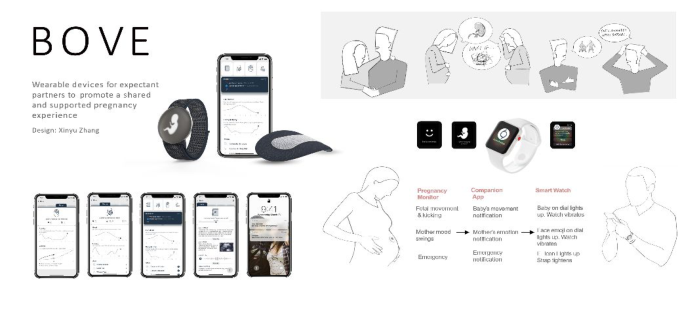
Example 1: Bove - a Wearable for Expectant Partner Bove is a wearable device (Fig. 3) for pregnancy developed by X. Zhang. Her research on wearable devices for pregnancy made her understand that a positive relationship makes one feel loved and supported; a poor one can foster negative emotions. While expectant couples share excitement and happiness, many experience anxiety and depression. She interviewed expectant parents – to understand their moments of joy and fear and how the relationship evolves during this period. She also found that most pro- ducts in the market were for recording health data and were primarily informational. There were very few products that focused on the pre- gnancy experience, on the relationship between the partners. The critical insight was that expecting a baby is a shared experience and responsibi- lity for a couple. How might we involve the expectant partners through- out the pregnancy process and make the expectant mothers feel suppor- ted? The design direction was to build bonds between the partners and design a pregnancy monitor for the mother and a smart wearable for the partner.
Designing Wearables Devices to Build Emotional Relationships 13
Figure 3: Project Bove: Wearable devices for expectant partners.
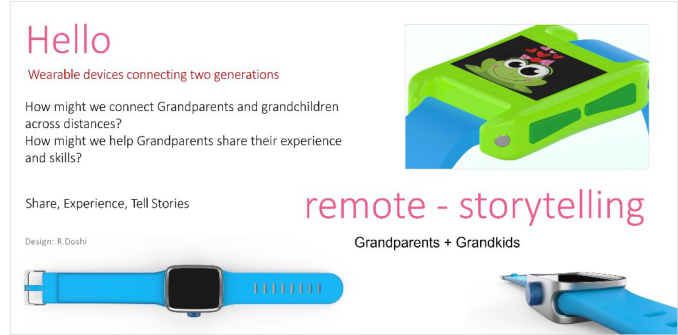
Example 2: Hello - a Wearable to Foster a Relationship With the advent of social media and new communication methods, there’s been a paradigm shift in how people interact with one another. Doshi’s project ‘Hello’ (Fig. 4) is a wearable to foster relationships between grand- parents and grandchildren. He started with these questions: How might we connect grandparents and grandchildren across distances? How might we help Grandparents share their experience and skills? This project leverages the potential of technology to bring people closer together with a focus on bringing grandparents and grandchildren together. And allow for richer com- munication between generations and across distances, ensuring that older generations’ skills, knowledge, and stories are transmitted to the younger generation. As such, it is essential to remember the real and tangible ties that bring families together and make for a healthy relationship. The wea- rable device encouraged active play between them and was meaningful to combat social isolation for elderly individuals living alone. The wearable design enabled communication by creating a platform to share stories and ideas across physical and generational distances.
Figure 4: Project Hello: Wearable devices for connecting two generations.
14 Sethi
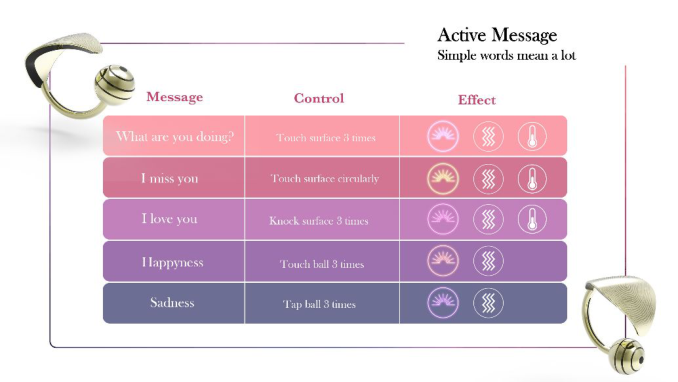
Example 3: Interactive Ring - a Wearable for a Long-Distance Relationship Interactive Ring (Fig. 5) resulted from Jiang’s long-distance relationship, as she could not interact physically or talk to her partner face to face daily. She developed the wearable to create a feeling of proximity in the distance – she sought warmth, intimacy, and a real-time sense. She investigated the com- munication needs of couples in long-distance relationships from the user’s perspective and how to mediate digital interaction through the wearable device.
Figure 5: Project Interactive Ring: Wearable for a long-distance relationship.
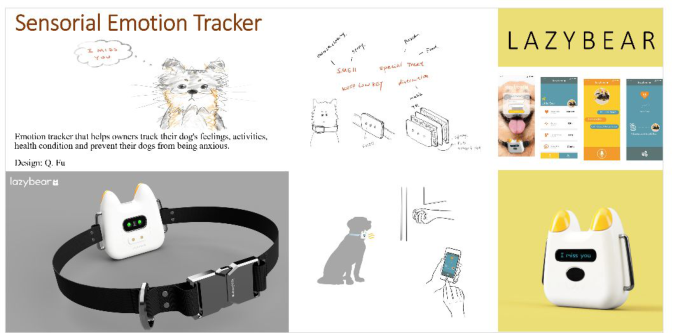
Example 4: Lazy Bear - a Sensorial Tracker for a Dog Lazy Bear is a sensorial emotion tracker (Fig. 6) that helps owners track their dog’s feelings, activities, health conditions and prevent them from being anxi- ous. In the wearable design for the dog, Fu’s own life and personal experiences influence how she interprets, connects, and develops products relevant to the
Designing Wearables Devices to Build Emotional Relationships 15
context. Just data from research cannot supply the solution. Her relation- ship with her pet became the starting point for a journey of exploration, to discover something new. As she states, “with Lazy Bear, owners will know their fluffy friend better than before.” From her project, it is clear that her experience and prior knowledge of living with a dog her love for her dog is what she drew from to clarify and reason out her solution.
Figure 6: Project Lazy Bear: Wearable devices for anxious dogs.
Looking at wearables through the lens of relationships and emoti- ons, one sees not only the superb execution of app design elements but the broader context of how its users connect. It is designed to build lasting bonds of individual-to-individual connection. These examples demon- strate how emotion and relationship—rooted in deep, human-centeredness- promote connectedness that has a remarkable impact on the design outcomes.
CONCLUSION
Our relationship signals who we are – the impulse to measure human expe- rience through the relatedness of things we can touch, see and wear comes naturally. Clues exist in our relationships. The study provides a basis for future research in developing design using relationships and experiences to support efficient creativity and realization of concepts in the design process. Design as an entity embedded in daily living, in everyday relationships, the designer will discover that designing is not set apart from daily life but springs forth from visual impressions of one’s own experiences (Sethi, 2021). In this act of exploration, there is a discovery of the self, which brings out meaning, instills ownership, brings focus, improves choice-making, and constructs new confidence. Emotional relationships provide a method for encouraging refle- ctive thinking about design by conceivably expanding the realm of issues one might consider when engaged in a purely functional form.
16 Sethi
ACKNOWLEDGMENT
The author would like to acknowledge all the participants who generously contributed to this study. I am grateful to my students, from whom I have learned a lot. Together we went into this great adventure of discovering the soul of relationships.
REFERENCES
Arnheim, R. (1966). A Review of Proportion. In G. Kepes, Module, Symmetry, Proportion (pp. 218–230). London: Studio Vista Ltd. Belk, R. (1988, September 15). Possessions and the Extended Self. Journal of
Consumer Research, 139–68. Cross, N. (2016). Design Thinking Understanding How Designers Think and Work.
London: Bloomsbury Publishing Pte. Dewey, J. (2005). Art as Experience. New York: Penguin Group (USA) Inc. Kroeger, M. (2008). Paul Rand: Conversations with Students. New York: Princeton Architectural Press. Meggs, P. B. (1992). Type and Image: The Language of Graphic Design. New York:
John Wiley & Sons Inc. Sethi, S. (2015). Every Design Tells a Story. ICERI2015 Proceedings (pp. 6529–6535). Seville: IATED Publications. Retrieved from https: //library.iated.org/publications/ICERI2015 Sethi S. (2021) Narrative—A Vehicle to Generate Product Form. In: Chakrabarti A., Poovaiah R., Bokil P., Kant V. (eds) Design for Tomorrow—Volume 3. Smart Innovation, Systems and Technologies, vol 223. Springer, Singapore. https://doi. org/10.1007/978-981-16-0084-5_12 Thomas J., Windham J., Sethi S., Arora M. (2020) Exploring a New Future in
Collaborative Design Processes in Education. In: Shin C. (eds) Advances in Inter- disciplinary Practice in Industrial Design. AHFE 2019. Advances in Intelligent Systems and Computing, vol 968. Springer, Cham. https://doi.org/10.1007/978- 3-030-20470-9_19 Vatsysyan, K. (1983). The Square and the Circle of the Indian Arts. Atlantic Highlands, N.J.: Humanities Press.
LISTED IN THE AHFE DIGITAL BOOKSTORE CATALOGUE
Explore the complete digital volume
Human Factors and Wearable Technologies
Read this individual research paper free through the original publisher, or explore the full digital proceedings book.
ISBN 978-1-958651-05-6
Explore this ISBN in the AHFE Bookstore ↗Listed in the July 2026 bookstore catalogue; search by ISBN to confirm current availability · Digital book purchase optional