The fitness bench is a crucial piece of equipment commonly found in fitness centers, serving as a cornerstone for free weight training. Novices and women often encounter heightened safety concerns when engaging in free weight training. However, despite these potential risks, free weight training offers enthusiasts superior fitness gains and a wide array of training options. This research primarily delves into the design and functionality of traditional fitness benches, specifically focusing on foundational training routines such as the bench press, incline bench press, and shoulder press.Furthermore, this study also examines the potential influence of ergonomics in shaping the future of fitness bench design. Ergonomics, with its emphasis on user comfort and safety, has the potential to revolutionize fitness bench construction to mitigate injury risks. It also investigates the market demand for such innovative designs, as fitness enthusiasts seek more effective and safer training solutions. This study highlights the crucial role that fitness benches play in the world of strength training and underscores the importance of optimizing their design to ensure both enhanced performance and user safety.
The contemporary emphasis on health and wellness has fueled a surge in gym memberships and a renewed focus on strength training. Recent research by Thompson (2023) identifies a significant rise in basic fitness routines, with free weight training ranking as the second most popular trend in 2023. This trend coincides with the observed expansion of gym facilities in recent years.
Free weight training, characterized by exercises such as bench presses, shoulder presses, and squats using barbells and dumbbells, offers distinct advantages. Studies like Schwanbeck et al. (2020) suggest that free weight exercises promote greater muscle engagement and facilitate more effective full-body workouts, making them a preferred choice for individuals seeking comprehensive training.
However, the inherent risks associated with free weight training cannot be overlooked. A significant portion of users experience injuries, particularly in the shoulder and elbow regions. Research by Kerr et al. (2010) highlights the ongoing need to identify the root causes of these injuries.
Ergonomics, a discipline renowned for successfully reducing muscle fatigue by designing ergonomic chairs in office settings (Mehrparvar et al., 2014), presents promising solutions within the fitness and health domain. Integrat- ing ergonomic principles into the design of fitness benches makes it possible to create safer and more comfortable training environments for gymgoers. This approach not only enhances the user experience but also paves the way for innovative advancements within the fitness industry.
Human-Centered Design in Optimizing Fitness Benches 131
Literature Review
Ergonomics in fitness equipment design, particularly for weight training benches, is pivotal in enhancing user safety and optimizing performance out- comes. Research indicates that mechanical variations in equipment design significantly influence muscle activation patterns and the risk of strain injuries, highlighting the necessity for ergonomic considerations that mini- mize biomechanical stress (Lavender et al., 2009).
Expanding upon these ergonomic principles, the study by Kim et al. (2015) explores the effectiveness of a posture correction exercise program in reducing musculoskeletal pain. Their research demonstrates that structured exercise regimens to correct posture significantly alleviate pain in key areas such as the shoulders, mid-back, and lower back. Recent studies like that of Lu et al. (2020) have explored how even short durations of poor posture can adversely affect muscle function before physical activities. Their findings indicate that poor posture can significantly increase muscle fatigue, affect- ing overall physical performance. This study underscores the importance of maintaining correct posture during exercise and in the moments leading up to it, highlighting the potential negative impacts of ergonomic neglect in fitness equipment design.
Further extending these considerations, Zheng, Mo, and Xu (2021) evaluate user satisfaction with public fitness equipment across dimensions including safety, practicality, and enjoyment. Their findings suggest that improvements in material design, safety features, and user interfaces can sig- nificantly enhance user engagement and satisfaction, integrating Norman’s three-level experience design theory (Zheng, Mo & Xu, 2021).
The demand for more human-centered gym equipment aligns with broader trends in health and wellness, where the emphasis is on personalized approaches that accommodate individual fitness levels and physical condi- tions (Thompson, 2023). As such, integrating ergonomic principles into the design of fitness benches is seen not only as a response to user demand but also as a proactive step towards more holistic, health-oriented fitness practices.
METHODOLOGY
Literature Review Process This stage involved a comprehensive exploration of scholarly articles, indus- try analyses, and case studies related to the design of fitness benches, the application of ergonomics in gym equipment, and user interactions within gym environments. The methodology included:
Database Exploration: Academic platforms such as PubMed, Google Scholar, and JSTOR were searched to locate pertinent peer-reviewed articles and industry insights.
Selection Criteria: Publications were chosen based on their relevance to design, ergonomics, and user experiences within the context of sports sci- ence, emphasizing studies published in the last five years to capture recent advancements and trends.
Analysis of Gathered Data: The collected literature was meticulously reviewed to distill essential findings, explore various ergonomic design strategies, and pinpoint research gaps in the current landscape.
Comparative Review: A detailed comparison of fitness bench design philosophies was conducted across different research pieces to evaluate their efficacy and user reception.
Primary Data Collection Primary data collection was conducted through structured surveys and in-depth interviews with gym users to complement the insights from the literature review.
Survey Design and Distribution
Objective: The survey’s primary purpose was to evaluate the aware- ness, experiences, and preferences regarding ergonomics in fitness benches among a diverse group of gym users. Understanding user perspectives is crucial for informing design decisions and prioritizing safety and user satisfaction.
Sample Size and Demographics: The survey was strategically distributed to a sample of 78 participants across the campus. This sample encompassed a heterogeneous group, including fitness enthusiasts, athletes, students, and gym staff. This diversity ensured a broad range of user perspectives and experiences with fitness benches.
Questionnaire Structure: The survey instrument featured a combination of quantitative and qualitative components. Using a Likert scale, quanti- tative sections measured user awareness of ergonomic design principles in gym equipment. Through open-ended questions, the qualitative sections explored user experiences with various fitness bench models and solicited preferences for improvement. This mixed-methods approach allowed for the collection of both objective data (awareness levels) and subjective experiences (personal anecdotes and preferences).
Interview Methodology
Participant Selection: Following the survey administration, 30 partici- pants were chosen for in-depth interviews. Selection criteria prioritized individuals who reported significant engagement with fitness benches or possessed relevant expertise (e.g., gym staff and personal trainers). This approach ensured a focus on participants with valuable insights and practical experiences with ergonomic considerations in fitness bench design.
Interview Format: Semi-structured interviews were conducted, allowing for a blend of pre-determined questions to guide the conversation and the flexibility to explore emerging themes organically. This approach fostered rich dialogue and captured detailed user experiences that may not have surfaced through a purely structured format.
Human-Centered Design in Optimizing Fitness Benches 133
Key Focus Areas: Conversations centered around participants’ spe- cific experiences with fitness benches, their considerations regarding ergonomic design, perceived advantages and disadvantages of current bench designs, and their recommendations for improvement. By focusing on these critical areas, the interviews aimed to gather in-depth, user- centered data that can be utilized to inform the development of more ergonomic and user-friendly fitness benches.
Data Analysis: The interview data was transcribed verbatim and subjected to thematic analysis. This analysis involved identifying prevalent patterns within the responses, capturing individual stories that illustrate broader themes, and extracting actionable insights regarding user experiences with ergonomic features in fitness benches. The thematic analysis identifies key themes from the data, providing valuable insights into user needs and preferences.
RESULTS
The results of this study, engaging a cohort predominantly composed of young adults, provide insightful revelations into the patterns, preferences, and challenges associated with free weight training among a diverse group of individuals at the University of Illinois at Urbana-Champaign. The findings underscore a significant engagement in free weight training, reflecting its pop- ularity and its perceived benefits to regular practitioners. Through a detailed analysis of participant demographics, exercise habits, and feedback on fitness equipment, particularly benches, this section delves into the nuanced under- standing of how free weight training is integrated into fitness routines, the obstacles faced by users, and the potential for enhancements in equipment design to elevate the overall training experience.
Participants were asked about their prior experience with free weight train- ing. A significant 67.39% (31 out of 46 participants) reported engaging in free weight training, highlighting its popularity and perceived importance among the group (see Table 1).
Table 1. Experience with free weight training.
Table available in the original PDF paper.
Have you ever engaged in free weight training?
Yes 31 67.39% No 15 32.61% Overall 46 100%
Demographic data revealed a young cohort, predominantly consisting of college students and university employees aged between 18–25 years (see Table 2).
Table 2. Participants demographics.
Table available in the original PDF paper.
Gender Age Count % Female Under 18 2 9.5% 18–25 16 76.19% 26–35 1 4.76% 36–45 1 4.76% Over 45 1 4.76% Male Under 18 0 0.00% 18–25 14 82.35% 26–35 2 11.76% 36–45 1 5.88% Over 45 0 0.00%
Analysis of fitness experience duration among participants indicated a strong inclination towards trying free weight training. Notably, among those with over six months of fitness experience, only 7% had not tried free weight training, suggesting its integral role in fitness routines (see Table 3).
Table 3. Duration of fitness experience.
Table available in the original PDF paper.
For how long have you been engaging in workout sessions?
Total
Free weight experience
Less than 3 months
3–6 months 6–12 months More than a year Yes 5 4 4 14 27 No 9 2 0 3 14 Total 14 6 4 17 41
The study also explored workout frequency and the duration of partic- ipants’ fitness journeys. It was found that individuals with over a year of experience worked out approximately 2.94 times weekly, significantly more than those new to fitness, who averaged 1.35 sessions per week (see Table 4).
Table 4. Workout frequency and duration.
Table available in the original PDF paper.
How long have you been participating in workout routines?
Total
Frequency/ week
Less than 3 months
3–6 months 6–12 months More than a year
7 1 0 1 9
Less than once
0 0 2 4 6
1–2 times 4 2 1 6 13 3–4 times 3 3 1 6 13 More than 5 times Total 14 6 4 17 41
Data on exercise preferences and challenges faced by participants revealed that chest presses (both barbell and dumbbell variations) and shoulder presses were the most favored exercises. Among participants with free weight train- ing experience, 95% engaged in shoulder press exercises. The main issues
Human-Centered Design in Optimizing Fitness Benches 135
highlighted were limited body support and constrained space for movement (see Table 5).
When asked about desired improvements for fitness benches, ergonomic support emerged as the top expectation, alongside the need for increased stability. These areas were identified as key opportunities for innovation in fitness equipment design (see Table 6).
Table 6. Desired bench improvements.
Table available in the original PDF paper.
Features Numbers Stability of Bench 22 Adaptability suitable for one’s physical conditions 14 Design that is easy to understand and use 13 Ergonomic support like back and neck support 26 Auxiliary and protection mechanisms, like force assist 15
Interviews focused on participants’ experiences with free weight train- ing, including safety concerns, familiarity with ergonomic fitness equipment, and suggestions for design improvements to enhance usability and safety, especially for women and beginners (see Table 7).
Table 7. Summarized overview of the interview protocol.
Table available in the original PDF paper.
Exercise Experience Bench Observation Future Suggestion Do you feel there are risks in free weight training? If yes, could you tell me what it is?
How familiar are you with ergonomics seats? Have you heard about ergonomics in fitness equipment?
Could you pinpoint certain design aspects that need attention to enhance safety and usability, particularly for women and novices? Could you pinpoint certain design aspects that do not work well for you?
Can you discuss a specific instance where different fitness benches played a vital role in your workout?
Can you share your thoughts on how incorporating ergonomics in fitness bench designs might benefit individuals focusing on sports and health?
Participants expressed concerns over safety risks associated with incorrect equipment usage and the lack of tailored support for women’s body shapes. Constructive suggestions included introducing adjustable and ergonomic fea- tures to accommodate users’ needs better and promote effective, injury-free workouts.
Table 8. Participants’ concerns and suggestions.
Table available in the original PDF paper.
Concerns
“For the hinge under the bench, only it gets old, or if the bolts are loosened, the bench wobbles, sometimes making it dangerous. Some benches have narrow support that can also be dangerous to use.”
“The curve of a woman’s body is more undulating than that of a man, so it is difficult for women to protect their waist when facing a flat stool. Additionally, excessively high benches make it more difficult for women to stabilize their posture with their legs when they work out.”
“Initially, I made a lot of mistakes since nobody told me how to use it correctly. Gripping, setting up, and putting down back weights can be risky if incorrect. Injuries happen all the time. We need professionals to assist us, or we need to watch enough tutoring videos.”
Suggestions
“Perhaps adjustable parts of the bench that can prevent strains or injuries by supporting the user in that specific point without affecting the workout’s effectiveness.”
“Ergonomic support can definitely promote a healthier body and good natural postures. It will help enhance strength and speed performance since it follows the instinct of bodies.”
“For bench press, no matter the flat or upper angle, the design of a narrow seat back is important to give flexibility to scapulas and your elbow can reach deeper to perform full range of motion which is crucial to muscle growth.”
Male student Female faculty Female student
The findings from Tables 7 & 8 underscore the need for safer, more inclu- sive free weight training practices, emphasizing the importance of ergonomic design and professional guidance to address the unique challenges faced by users, particularly in ensuring the safety and effectiveness of exercises for individuals with varying levels of experience and physical needs.
Market Insights: Opportunities in Fitness Equipment Innovation Our comprehensive market analysis has revealed significant opportunities for innovation in the fitness equipment sector, focusing on enhancing fitness benches’ comfort and ergonomic design. These insights are grounded in a robust combination of academic research and user feedback, pinpointing a critical market niche for developing fitness benches that prioritize ergonomic features.
Identification of Ergonomic Design Gaps Investigations into current fitness bench designs have identified notable ergonomic shortcomings, particularly in terms of accommodating diverse body types, such as those of female users. Academic sources, alongside user interviews, have highlighted a recurring issue with benches’ padding and
Human-Centered Design in Optimizing Fitness Benches 137
dimensions, where approximately 7% of respondents reported specific dis- comfort in the hip area due to inadequate width and cushioning support (Refer to citation 5 for detailed analysis).
Another ergonomic design flaw is observed in the approximately 4 inches gap between the seat and back pad of adjustable benches. Although this gap does not compromise the exercises’ effectiveness, it severely impacts user comfort, potentially discouraging extended use.
Preferences for Ergonomic Enhancements User feedback has strongly emphasized the preference for enhanced ergonomic features, advocating for more sophisticated and body-adaptive support, especially in the back and neck areas. This preference is supported by research, such as the studies by McKean, which highlight the critical importance of neck and spinal support during various exercises, including shoulder and bench presses. Implementing ergonomic supports that facilitate correct posture alignment and stability can significantly amplify the benefits of exercises while minimizing the risk of injuries.
A specific ergonomic concern raised pertains to the standard height of fitness benches. Many users, particularly women, find the average bench height of 20 inches problematic for achieving proper leg support, suggesting a need for adjustable height features. A comparative review of leading brands like Rogue, Life Fitness, and Hammer Strength has confirmed a widespread lack of such adjustability in bench designs, pointing to a significant area for product differentiation and innovation.
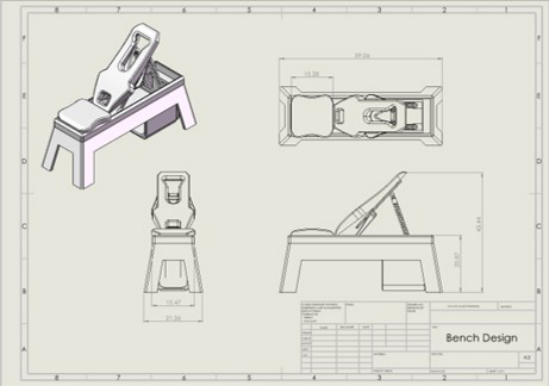
Design Concepts and Development Strategies Enhanced Stability with Reduced Bench Height: The current standard bench height often complicates force application for specific demographics, notably beginners and women, during exercises such as the bench press. A design modification (see Figure 1) proposes the reduction of bench height to a range of 13–15 inches, improving leg support and core stabilization for these groups, which could be achieved by either lowering the fixed height of benches or incorporating adjustable height mechanisms to accommodate various user needs.
Back and Neck Support Improvements: Insufficient back and neck sup- port during exercises that involve back arching, such as shoulder and bench presses, has been identified as a common issue. Enhanced design features might include an ergonomic backrest with a combination of a skeletal frame for rigidity, enveloped in memory foam and covered with a durable, woven fabric. This structure should offer support and flexibility, with a surface material that prevents slipping during use.
Adaptive Seating for Varied Body Types: The diversity in user body types necessitates a more adaptable seat design. The proposed solution is a seat cushion that mirrors the properties of MUJI’s adaptable beanbag sofas, using materials that compress underweight and shape, to the user while still pro- viding sufficient support. This adaptability ensures comfort and stability for a broader range of body sizes.
Proportion and Adjustable Gap Between Seat and Backrest: Reevaluating the gap between the seat and back pad in bench designs could significantly enhance user comfort. An adjustable backrest could cater to the various body sizes of users, making the equipment more inclusive and comfortable for all users.
Innovative Auto-Adjust Feature for Safer Workouts: A novel auto-adjust feature could significantly reduce the risk of injury for beginners or those with less stable core strength. This feature would allow the bench to tilt backward for exercises requiring a decline and return smoothly to the original position. Ideally, this mechanism would be powered by computer-controlled hydraulics or springs, ensuring seamless and safe adjustments during workouts.
Figure 1: Design concept of ergonomics fitness bench.
LIMITATIONS Our HCD analysis did not follow the expected coding and analysis of data compared to more traditional qualitative studies, an important distinction because HCD research is not scholarly-based but practitioner-based. An HCD approach allows for more flexibility and space for ethical interpre- tation, collaborative discussions, and applied contributions to prototype design. Although the convenience sampling was diverse in terms of race, aca- demic discipline, and other variables, additional interviews could have been conducted for greater saturation.
CONCLUSION
The rapid expansion of the fitness market and the increasing focus on personal health emphasize the essential role of self-managed healthcare in improving physical and mental well-being. Fitness, serving as a means to enhance life’s quality and happiness, must inherently prioritize the safety of
Human-Centered Design in Optimizing Fitness Benches 139
its users. Ergonomics, a discipline that has grown with the development of human society, has demonstrated its value in office furniture design. While applying ergonomic principles to fitness bench design in the fitness equip- ment sector is still in its early stages, our thorough academic and market research supports the belief that advancements in ergonomics can signif- icantly enhance the safety and comfort of free weight training equipment users. Additionally, potential users are interested in such improvements.
In this rapidly growing market, integrating ergonomic design into fitness equipment is a necessity and a strategic innovation that promises to transform the traditional fitness experience. By catering to the physical needs and move- ment nuances during strength training, ergonomic design has the potential to revolutionize the fitness experience, moving it towards a more user-centric approach. This paradigm shift aims to ensure users’ overall health and com- fort without compromising the quality of their training. Despite the long history of traditional fitness equipment and the transformative introduction of technologies like the Smith machine, which has made exercises such as squats less intimidating, ergonomics is set to become a key factor in enhancing fitness safety.
Looking ahead, it is clear that the concept of human-centered design will play an increasingly significant role in developing fitness equipment, ensuring that the pursuit of fitness becomes a safe, enjoyable, and sustainable journey for everyone.
REFERENCES
Kerr, Z. Y., Collins, C. L., & Comstock, R. D. (2010). Epidemiology of weight training-related injuries presenting to United States emergency departments, 1990 to 2007. The American Journal of Sports Medicine, 38(4), pp. 765–771. https://doi.org/10.1177/0363546509351560 Kim, D., Cho, M., Park, Y., & Yang, Y. (2015). Effect of an exercise program for
posture correction on musculoskeletal pain. Journal of physical therapy science 27(6), pp. 1791–1794. https://doi.org/10.1589/jpts.27.1791 Lavender, S. A., Mirka, G. A., & Schoenmarklin, R. W. (1989). The effects of preview and task symmetry on trunk muscle response to sudden loading. Human Factors 31(1), 101–115. Lu, L., Robinson, M., Tan, Y., Goonewardena, K., Guo, X., Mareels, I., & Oetomo,
D. (2020). D. (2010). Effective assessments of a short-duration poor posture on upper limb muscle fatigue before physical exercise. Frontiers in physiology, 11 541974 https://doi.org/10.3389/fphys.2020.541974. Mark R. McKean, Brendan J. Burkett, Overhead shoulder press – In front of the head or behind the head? Journal of Sport and Health Science, Volume 4, Issue 3, 2015, pp. 250–257, ISSN 2095–2546, https://doi.org/10.1016/j.jshs.2013.11.007. Mehrparvar, A. H., Heydari, M., Mirmohammadi, S. J., Mostaghaci, M., Davari,
M. H., & Taheri, M. (2014). Ergonomic intervention, workplace exercises, and musculoskeletal complaints: A comparative study. Medical Journal of the Islamic Republic of Iran, p. 28, 69. Mohammadi, M., Sadeghi, H., Sadeghi Naeini, H., Sabbaghian Rad, L., & Ghavam Bakhtiar, R. (2012). The Ergonomic Properties of Outdoor Fitness Equipment with respect to the Anthropometric Characteristics of Iranian Women: A Case Study of Chest Press Machine and Pull Chairs. European Journal of Experimental Biology, 2(6), pp. 2077–2082.
Rosenbaum M, Heaner M, Goldsmith RL, Christian Schulze P, Shukla A, Shen W, Shane EJ, Naor E, Leibel RL, Aronne LJ. Resistance Training Reduces Skeletal Muscle Work Efficiency in Weight-Reduced and Non-Weight- Reduced Subjects. Obesity (Silver Spring). 2018 Oct;26(10) pp. 1576–1583. doi: 10.1002/oby.22274. Epub 2018 Sep 27. PMID: 30260099; PMCID: PMC6905638. Schwanbeck, S. R., Cornish, S. M., Barss, T., & Chilibeck, P. D. (2020).
Effects of Training With Free Weights Versus Machines on Muscle Mass, Strength, Free Testosterone, and Free Cortisol Levels. Journal of Strength and Conditioning Research, 34(7), pp. 1851–1859. https://doi.org/10.1519/JSC. 0000000000003349 Thompson, W. R. (2023). Worldwide Survey of Fitness Trends for 2023. ACSM’s Health & Fitness Journal, 27(1), 9–18. https://doi.org/10.1249/FIT. 0000000000000834 Van Niekerk SM, Louw QA, Hillier S. The effectiveness of a chair intervention in the workplace to reduce musculoskeletal symptoms. A systematic review. BMC Mus- culoskeletal Disorder. 2012 Aug 13;13:145. doi: 10.1186/1471-2474-13-145. PMID: 22889123; PMCID: PMC3552974. Zheng, Z. Mo. J., & Xu, Y. (2021). Research on Public Fitness Equipment Experience
Based on Satisfaction. Healthcare (Basel, Switzerland), 9(5), 501 https://doi.org/ 10.3390/healthcare9050501.
LISTED IN THE AHFE DIGITAL BOOKSTORE CATALOGUE
Explore the complete digital volume
Training, Education, and Learning Sciences
Read this individual research paper free through the original publisher, or explore the full digital proceedings book.
ISBN 978-1-964867-31-1
Explore this ISBN in the AHFE Bookstore ↗Listed in the July 2026 bookstore catalogue; search by ISBN to confirm current availability · Digital book purchase optional