Joe Cecil, Miguel Pirela-Cruz, John Jeevarajan, Parmesh Ramanathan (2026). Ushering a New Era in Medical Education: Ethical Foundations and Vision for adoption of AI and XR based pedagogical frameworks. In: Human Systems Engineering and Design (IHSED2026): Future Trends and Applications. AHFE Open Access, vol. 237, pp. 959–972. https://doi.org/10.54941/ahfe1004540
This paper outlines a vision for medical education of the future, where AI and Extended Reality based cyber-human-physical environments as pedagogical foundation for immersive and experiential learning experiences. While some medical schools have started to adopt such innovative approaches, there is an urgent need to develop long term plans to ensure that physicians and doctors are prepared for the AI revolution which is poised to revolutionize the practice of medicine. Doctors must be knowledgeable and ready to work beside AI and XR based tools, while being ready to override decisions made by such tools. This paper discusses the foundational role of ethics in the adoption of such practices as well as outlines the components of such next generation cyber-human-physical tools, while emphasizing the need for medical students to be at the forefront of innovation and entrepreneurship. It concludes with a discussion of ways to address some of the challenges associated with realizing such an educational vision of the future.
Jessie is at home seated with her laptop wearing a 3D headset and tactile gloves. She interacts with an immersive Virtual Surgical Skills module which is introducing her to the basics of suturing and knot-tying. She picks up virtual suturing needles inside the Virtual Reality environment and with the help of a teaching avatar, she completes her training sessions. HCI attributes are measured to assess her concentration and awareness and to modify the user interfaces and layout in future sessions to maximize her learning and engagement. This virtual module is on a remote server and accessible 24/7. This imaginary scenario of Jessie (a medical student in the near future) depicts our vision for medical learning and training. With breakthroughs in AI, Extended Reality (XR) based Digital Twins, IoT/Networking, Robotics and Human Computer Interaction (HCI), this vision although ambitious appears to be within reach.
Received September 18, 2026 Revised September 26, 2026 Accepted September 30, 2026 Available online September 30, 2026
959
960
The medical students and residents of the future will be able to access such network connected cyber-physical-human learning and training environments (fig 1 a) anytime (24/7 ‘on-demand’ access) from remote locations; through such immersive interactions, they can improve their knowledge and skills as well as can interact with physicians in virtual surgical rooms, which mimic real-world scenarios. The key aspect of this vision is that the cyber-human-physical experiences can be personalized by cognitive centric AI components, which identify a student’s preferences and learning patterns and uses it to enhance their learning preferences. Such experiences have the potential to enhance both the effectiveness and efficiency of such learning activities.
Trainer avatar Faculty avatar
patient avatar
resident Faculty (supervisor)
Figure 1 a: A network cyber-human-physical training interaction of the future The continuing breakthroughs in AI, XR, smart robotics, Internet-of-Things (IoT), cyber-human-physical systems and related technologies have ushered in a new era referred to as Fourth Industrial Revolution (or Industry 4.0) (Cecil and Cruz, 2026). Industry 4.0 refers to ongoing digitization and automation of manufacturing and industrial practices where cyber worlds are linked with physical manufacturing factories using advanced networking, extended reality, artificial intelligence (AI), and machine learning. Equivalent models have been proposed for healthcare called Health Care 4.0 (Li and Carayon, 2021) and a more human centric model called Healthcare 5.0. However, the major drawback (and void) of these approaches and models is the lack of emphasis on adoption of these technologies to improve and impact the educational and training experiences of medical students and residents.
The objective of this paper is to address this identified void and outline a vision for medical education with a strategic emphasis on adoption of a new generation of XR, AI and HCI based methods and tools, which have the potential to support innovative pedagogies and revolutionize learning/training experiences for medical students and residents. The major emphasis of this paper is to introduce the ARAM AI model for the medical education of the future. This is an outcome of the ARAM
Ushering a New Era in Medical Education: Ethical Foundations and Vision for adoption of AI and XR based pedagogical frameworks 961
AI initiative, which focuses on two domains of interest: AI for medicine and manufacturing.
AI systems can be described as computational systems that can perceive, learn, reason, generate, communicate, and act using statistical, symbolic, or hybrid methods to achieve intelligent behavior in complex environments. XR technologies comprise of virtual (VR) augmented (AR), and mixed reality (MR) enable 3D based interactive immersive, and multisensory experiences (fig 1 b), which can serve as bridge between abstract concepts/ideas and real-world contexts. When combined with AI, such XR environments can incorporate adaptive, data- informed, and context-aware functionalities (Khuong & Duong, 2026). The convergence of AI and XR has potential to create adaptive, human-centered learning ecosystems that transcend spatial and linguistic boundaries (Meccawy, 2023).
AI and machine learning are often confused as meaning the same and erroneously these terms are used interchangeably in the media. AI is a broad multifaceted discipline aimed at mimicking human intelligence through various technical approaches. Machine Learning is simply a subset of AI and can be viewed as the data-driven branch of AI. Any system can use AI principles without utilizing any Machine Learning, relying instead on expert logic, advanced planning algorithms, structural knowledge graphs, or advanced spatial reasoning to solve an array of complex problems. This distinction is important to recognize as the thrust areas not involving machine learning do have a major role to play in developing generative AI based approaches especially in medicine. Rule-based reasoning (such as involving expert systems and symbolic reasoning) and Knowledge Representation and Reasoning (KRR) are key to generative problem solving. Machine Learning typically needs very large amounts of historical data which can be fed into algorithms (such as Deep Learning) to enable them to automatically adapt, learn, adapt, and predict outcomes (without being told exactly what to do) (Naser, 2026).
Medical doctors, surgeons and nurses need to learn work alongside AI tools and be able to override any decisions from AI based tools. They can use AI as a decision-support tool, not as a replacement for diagnosis. Physicians need to become proficient in comparing AI recommendations with clinical guidelines and evaluating such decisions including being able to detect bias and mistakes. Within the next decade, a new type of physician and specialist (such as surgeons) will need to emerge, who need to possess knowledge and skills very different from the physicians and specialists of today. These include:
Fundamental knowledge of principles and practice in Artificial Intelligence/Machine Learning, Cyber-Human-Physical Systems, Human- Computer Interaction (HCI) /Human Cantered Computing, Medical Robotics, and Systems Engineering
Understand importance of Ethics in Medicine, recognizing that AI tools can make mistakes (and exhibit bias) and ensuring that they adhere to societal and human values
962
Acquire Experience designing and using cyber-human-physical frameworks involving software tools, medical cobots and 3D digital twins for various surgical contexts
Understand the importance of HCI/HCC principles and acquire experience designing and evaluating HCI attributes of cyber-human-physical environments, digital twins and robotic systems
Gain a practical understanding of the role of Systems Engineering concepts and practices, which will be essential to working as a team as well as with engineers, computer scientists and other professionals (such as psychologists, physical therapists) in addressing new medical problems and provide AI and cyber-solutions through remote interactions.
Figure 1 b: (left) : Interacting with a VR environment; (right): interacting with a MR environment (user can see/interact with VR scene and physical world simultaneously) There is an urgency in addressing these educational and training needs. Medical education (just like engineering education) is at a very important milestone worldwide. If the preparation and knowledge of the medical doctors and specialists (such as surgeons) do not change, within a period of 5 to 10 years, graduates of medical schools will struggle to adapt to the changing medical environment, which is being driven substantially by AI, XR/Digital Twins and Medical Robotics. This presents both a significant challenge to medical programs, while underscoring the urgent need to develop a robust education plan based on an information centric vision (such as the one outlined in this paper).
This growing need to adopt new technology-based pedagogies to keep pace with this ongoing Fourth Industrial Revolution has been recognized by educational researchers (Collins and Halverson, 2018); immersive XR and AI based pedagogies need to be explored by both medical and engineering programs because of their potential benefits; without such pedagogical reforms, there is the danger of current methods becoming obsolete. In this new educational pedagogy, educators must adapt to new roles from being the primary source of knowledge (or ‘expert’) to being facilitators who can guide student learning activities. Learning experiences are going to be viewed as a personalized and independent exploration process. AI and XR tools have the potential to support such as an evolutionary migration in medical pedagogy.
963
Ushering a New Era in Medical Education: Ethical Foundations and Vision for adoption of AI and XR based pedagogical frameworks
Students are the most important actors in the experiential process and take on roles of becoming explorers and creators, who can experiment using software and technology tools which enables them to adopt a ‘what-if’ type of learning approach to understand complex scientific relationships, assumptions and outcomes. XR and AI based pedagogies enable customized, self-paced learning for students. The outdated broadcast model (followed by most medical universities) involves an expert explaining a concept to an entire classroom of students, through a lecture or demonstration. What is needed are richer, multi-sensory cyber-human-physical (CHP) learning experiences. The learning process proposed is based on the CHP framework (outlined in fig 2), which involves AI, XR, Medical robotics and a host of supporting thematic principles and technologies (HCI, Systems Engineering, Networking, Cyber Security). The design of such an integrated CHP learning process lies in the creation of an information centric process model, which serves
Affordance
Systems Engineering based CHP process
HCI Design Visual Density Criteria Modeling Foundation
Information Models (work flow)
Cognitive Load
XR based Training
Cyber Security High Gigabit
Environments
Ultrafast Networking & IoMTT
AI based surgical
AI based Assessment
planning & fixture/drilling Medical setup Robots
Fig 2: The Cyber-Human-Physical framework for Medical Education & Training as an enterprise workflow for the various C-H-P interactions (Cecil and Cruz, 2026). HCI design criteria influence the 3D digital twin-based experiences as well as interactions with cyber-physical components such as medical robots. Internet- of-Medical-Training-Things (IoMTT) protocols are needed to support communication between students/physicians, AI tools, sensors and other cyber- physical tools (Cecil et al, 2018). AI based tools can accomplish various surgical planning (and setup design for robotic tasks) and user performance assessment, among others. Robust security protocols are needed to ensure data security and privacy (CCS, 2025).
Figure available in the original PDF paper.
Cognitive scientists have proposed a Dual Coding Theory (Mayer, 2024) which states that human brains process information through two basic channels simultaneously: a verbal/auditory channel and a visual/spatial channel. For example, when a visually inclined medical student uses an Augmented Reality (AR) app or environment to study the anatomy of the heart, they can immerse themselves and see a 3D heart pumping, see the muscles thickening, read
964
augmented text annotations, and hear audio descriptions. For kinesthetic or haptic learners, they can touch and feel these dynamic changes with the help of spatial computing and haptic (force-feedback) controllers.
For purposes of brevity, cyber-security aspects and the Challenges and Approaches for achieving this vision are not discussed. We plan to address these details in a subsequent paper. The role of information modeling and information centric systems engineering is discussed in a related paper (Cecil and Cruz, 2026).
Foundational Emphasis on Aram and Ethics The design of a student centric cyber-human- physical framework for medical education is one of the long-term goals of the ARAM AI initiative. The motivation for this initiative comes from the notion of ‘aram’ in Tamil culture (Aram, 2026). The term Aram is a foundational concept in Tamil culture, which encompasses virtue, righteousness, and moral conduct; Aram is more holistic than the concept of dharma and emphasizes values of ethics, compassion, and doing good (Kural, 2026). In this AI related initiative, we recognize the importance of ethics as a foundational aspect of human-friendly decision-making by AI based systems. We assert that AI based approaches need to inculcate elements of ethics, goodness and service through their actions. In this context, the ARAM initiative recognizes several key precepts as foundation to the adoption of AI in all its activities, including Ethical behavior, Human-friendly decision-making and social responsibility. These three precepts together can be viewed as foundational pillars for the ARAM AI initiative, which focuses on creation of socially beneficial AI systems, which ultimately seeks to improve living conditions of all peoples globally. It is important for AI based systems to embrace values that benefit society and not misuse their abilities and become a danger to human existence. This includes adopting a foundation of ethical conduct which emphasizes promoting, proposing or implementing actions that support and do not hurt any aspect of the entire human-biological (natural) ecosystem.
In this ARAM AI model, the societal goals are to serve humanity through ethical, human-friendly and socially beneficial decision making in two domains: medicine and manufacturing. Human-friendly AI (or friendly AI) can be viewed as being safe and useful deeply rooted in a desire not to harm humans (Yudkowsky 2008). Other researchers have viewed socially beneficial AI (Baum 2016) as a function of the social psychology of research communities and consequently can be motivated by extrinsic and intrinsic measures. ARAM AI also identifies ‘doing no harm to humans’ as a universal and overarching requirement which cannot be violated by any AI based system.
Extrinsic measures seek to induce AI system builders to pursue beneficial AI even if they are not inclined to (such as obeying government regulations and policies). Intrinsic measures encourage tech builders to want to pursue beneficial AI and can play a key role in fostering a culture where social responsibility is the norm and is part of expected social behavior.
965
Ushering a New Era in Medical Education: Ethical Foundations and Vision for adoption of AI and XR based pedagogical frameworks
In a healthcare context, the long-term goal of this ARAM AI initiative is to explore the design of innovative AI based approaches to help address societal issues including improving medical care to living entities. Living entities include humans and animals (not just humans), which underscores preventing exploitation of animals (including testing of small animals for medical research). In this ARAM AI model, this thematic emphasis of ethics drives the accomplishment of the various activities outlined in this paper with a conscious adherence to ethical principles and human-centric values. In our vision, we underscore the commitment to ethics, which extends to addressing patient privacy and confidentiality, student/resident (trainee) performance during AI based training, preventing bias in AI algorithms and embracing human oversight of AI decision making in all aspects of medical care.
Role of CHP Simulators in medical education of the future Cyber-Human-Physical (CHP) model-based learning is arguably the most important facet and element in the medical educational practices of the future. They will play a crucial role to provide MD students with extensive experience in clinical reasoning, procedural skills, and emergency management as well as in communication (especially with patients) which will prepare them for similar situations with real patients. Such CHP pedagogies (which utilize AI, XR, HCI and other technologies and principles) can have a substantial impact on supporting exploration-based learning approaches for a large range of topics in medical education. These topics can be grouped into several clusters including Clinical Assessment and Diagnostic Reasoning, Emergency/Critical Care Medicine, Surgical / Procedural Skills and Clinical Training and Assessment.
CHP Simulator based Learning Experiences in Surgery Surgery related activities are one of the areas where AI enabled Cyber-Human- Physical (CHP) simulator-based experiences will have a substantial impact. There is a well-developed body of knowledge which discusses the impact of immersive VR based pedagogy to enrich medical learning and prepare residents effectively (Vankipuram 2010; Zhang et al., 2025; Chen et al.,2025); the potential of CHP based training experiences in improving knowledge acquisition and engagement of medical residents has been highlighted as well (Gupta 2022, 2023). Uhl et al. (2025) discussed the integration of high-fidelity 3D structural data and conversational AI improved remote training experiences for medical students. Dickinson and McIntosh (2025) introduced an interactive VR simulation tool designed for Objective Structured Clinical Examination (OSCE) training for practicing clinical history-taking and diagnostic reasoning. Ravihansa et al. (2025) discussed a multi-user VR platform with haptic interfaces which supported low- latency high-fidelity, remote medical collaboration. Medical students are not expected to perform surgery independently but do need to complete general surgery clerkship (typically 6–8 weeks in the third year); these experiences can be enriched through specially designed networked (for remote access) or co-located CHP simulator based experiences, during which they can wear VR headsets with haptic interfaces, and explore/understand anatomy, surgical rationale, procedural
966
sequence, any occurring complications and overall decision making; these immersive experiences are augmented with both text, and avatar based audio and can support immersive capabilities where students can assist in basic surgery tasks (retract tissue, close skin), recognize common complications and become proficient in postoperative care.
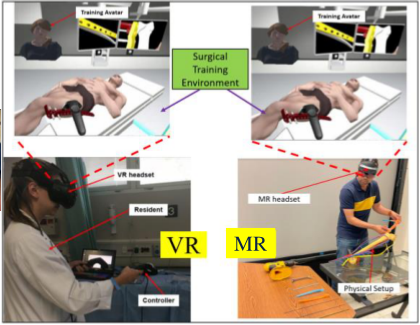
Simulators provide an important medium where students can make mistakes without hurting a patient; without making mistakes, students will not develop planning and surgical skills; there is a need to have such high-fidelity cyber- human-physical (CHP) environments, where these residents can make mistakes without hurting patients or themselves (when using tools such as drills and saws). Residents in various surgery specializations undergo different training experiences. and need to develop skills in operative planning, psychomotor skills (for manual surgery), manual workflow planning or robotics workflow planning (for robotic assisted surgery), develop skills/ knowledge for complication management, and intraoperative decision making. The AI based tools in such CHP simulators can help in preoperative planning, virtual coaching (with training avatars), conducting assessment (measuring performance of the trainee) and training session planner (based on individual progress).
WHAT USER VISUALIZES
MR
Figure 3: immersion types (a, left) Virtual Reality (VR) (b, right) Mixed Reality (MR) Partnership between medical and engineering programs The need for medical programs to work closely with engineering programs has been recognized by a small group of universities. Two of them are the Engineering Medicine program at TAMU (referred to as EnMed) and UIUC’s Carle Illinois College of Medicine’s (CI MED) Physician-Innovator programs. In CI Med, the focus is to study medicine with an engineering perspective; in EnMed, students receive a blended engineering and medicine curriculum. These are positive trends; however, more long-term planning and implementation is necessary to address this growing need to adopt AI enhanced cyber-human-physical learning experiences. Both TAMU and UIUC have strong engineering programs where Digital Twins
967
Ushering a New Era in Medical Education: Ethical Foundations and Vision for adoption of AI and XR based pedagogical frameworks
and AI related courses are offered. This is a good starting point, but they are still a long way from realizing the vision of embracing such immersive XR and AI based pedagogies, which revolve around key principles discussed earlier in this paper. Medical programs (similar to engineering programs) are beginning to realize that AI is not just another technology milestone to be reached or achieved but that they have to be part of an continuous technology-based evolution. The paucity of readily available CHP based learning environments integrated with AI based tools creates a major challenge; medical programs at universities need to address this vital need.
Need for Educational Consortiums Robots in medicine can perform high precision tasks (which are difficult for humans to perform). However, a major problem facing hospitals and medical training programs is the high cost of these robotic systems and the simulators available for training residents and budding surgeons. Medical programs have to be at the forefront of entrepreneurial activities, which emphasize creation of effective and low-cost CHP modular systems that are needed to address healthcare needs of any modern society. Medical students can only interact with simulators while residents can work with senior faculty to become familiar in real-world settings. However, this is where the importance of cyber-robotic and cyber-human- robotic simulators play a major role. Robotic Systems like the da Vinci Surgical System allow surgeons to operate through tiny incisions using miniaturized tools and 3D high-definition views. The Da Vinci system (Intuitive, 2026) translates hand movements in real-time, improving precision for urological, gynecological, and cardiac procedures (the cost is typically in the range of $1M or more). Commercial VR Simulators are available, but they are also expensive. Some medical programs may have the higher budgets for purchasing such robots and simulators for student use (especially if they have partnership with hospitals or other service affiliates); Smaller and lower budget programs need to form partnerships with other medical programs and hospitals to provide access to such educational experiences. In our model for medical education, we emphasize the formation of specially created inter-organizational consortiums which can focus on creating low-cost CHP simulators that can be shared by member medical programs.
Entrepreneurship Driven Innovation Technology-based approaches, in general, are required to revolutionize health care and must be leveraged to improve quality and make health care more equitable and accessible (RSNA 2026, Zarrin 2024). Our health care systems faces a range of challenges, including extremely high costs of care, the need for improved patient experience, and the need for rapid innovation of medical technology and approaches capable of addressing such challenges (Buntin 2021, Majmudar 2015, Arias 2021) . In the context of these challenges, the need for doctors and healthcare
968
professionals to bring an innovative mindset to actively solve problems in the medical setting has been repeatedly emphasized (Zarrin 2024) as a core part of any long-term solution.
Texas A&M’s EnMed program is a pioneer in offering such entrepreneurial experiences and offers entrepreneurial related experiences that fosters the creation of new technology-based practices and inventions. UIUC’s College of Medicine emphasizes medical training integrated with engineering principles, with immersion capstone experiences and startup ideation activities. In the United States, approximately 26 out of over 170 accredited MD programs offer integrated pathways and degree options dedicated to medical innovation and entrepreneurship (Zarrin, 2024). Offering an entrepreneurial experience can no longer be viewed as a unique but ancillary facet of any medical program. What is needed is more strategic thinking and commitment to help students establish startups and launch such next generation AI & XR products for medical fields. Rather than offering entrepreneurial activities as ancillary experiences, medical programs need to embrace it as a foundational experience; such an approach will create awareness among medical students of AI and XR’s impact and will also drive home the message about changing face of medical education and why medical and engineering students need to be working together to be at the center of such changing practices. Engineering and computer science students have a major role to develop new products to support not just medical education but also medical practices (including low-cost AI tools, robotic devices and CHP simulators. With healthcare costs continuing to rise, such a new generation of entrepreneurs (who understand, value and embrace the notion of social entrepreneurship) needs to be fostered. Medical and engineering students need to be in the forefront of such innovation to create medical new learning products based on AI, XR, HCI and related technologies.
Ethics in AI and cyber technologies Emphasizing ethical values involving AI tools in medical practices is of paramount importance. Several medical and university programs are currently offering tracks and courses dealing with Ethics Issues of AI in Medicine (such as Stanford, Mayo Clinic, UIUC, Harvard and Michigan). Medical educators and students need to recognize that bias in AI does occur. Issues related to bias in algorithms, patient data privacy, preventing misuse of data especially against economically disadvantage groups have been recognized by social and behavioral experts; immersive 3D based experiences involving positive reinforcement provides a more realistic way to prepare students to deal with ethical dilemmas and encourage socially responsible behavior. Socially beneficial AI can be motivated following a two-pronged approach: (i) through extrinsic approaches, AI community can be ‘induced’ to reduce or minimize bias and discriminatory decision making as it hurts all of us; (ii) AI builders can also be intrinsically encouraged to focus on ways to
969
Ushering a New Era in Medical Education: Ethical Foundations and Vision for adoption of AI and XR based pedagogical frameworks
improve the lives of all for societal benefits that can foster a culture where responsible and ethical AI is the norm. Government oversight is necessary to ensure that AI practises do not ignore the values of a human centric society. It is important to recognize that AI systems can be misused, and they can become a destructive force which can pose an existential threat to humanity. Guardrails need to be established to ensure AI tools do not pose a danger to humanity in general. The ARAM emphasis on ‘doing no harm to humans’ needs to be serve as a foundational requirement of all AI systems. Government policies and oversight is essential but today this is seriously lacking; this issue needs to be addressed with the highest level of urgency at the national and international levels.
Conclusion This paper delineated a vision for medical education with an emphasis on adoption of XR, AI, HCI principles and supporting technologies. The advent of major technology breakthroughs in these areas highlights the potential to explore and adopt highly innovative AI and XR based pedagogies, which emphasize experiential and immersive experiences. Such experiences will play a crucial role in ushering in a new era in the medical education process, which will benefit and improve the level of preparation of the medical students and residents. This in turn will enable them to provide better service to society, while remaining at the forefront of innovative medical practices and procedures. It is important to recognize that medical doctors have to learn work alongside AI systems. They also have a responsibility to be part of the entrepreneurial process and help develop ethically responsible AI and XR based medical tools. It is our belief that within a decade, that majority of the diagnosis and treatment by medical doctors will be assisted by AI tools and smart robotic devices. Network-based group learning and training experiences will also be the norm of the future; using such approaches will reduce the need for face-to-face interactions in medical education, which will reduce the disruptions to such educational activities. As AI based practises become ubiquitous, government oversight is needed to ensure AI practises align with our societal values and do not pose a threat to humanity.
ACKNOWLEDGMENT
Funding for research activities were funded by the US National Science Foundation (grant numbers 1256431, 1257803, 2050960), US Ignite and the Mozilla Foundation.
REFERENCES ACM Digital Library. (2025). "Big Data: Past, Present, and Future Insights." Association f or Computing Machinery. DOI: 10.1145/3685767.3685777. Alaa, M., et al., Virtual Reality in Endoscopic Neurosurgery Training and Education, Proceedings of the 27th International Conference on Mobile Human-Computer Interaction (MobileHCI '25 Adjunct), Sharm El-Sheikh, Egypt, September 22-25, 2025, Art No. 54.
960
Alsairefi S, Alawadhi R, Abdulaziz S, Al Hashemi R, Alqallaf N, Mohammad J, Albutti B. Use of Artificial Intelligence in Preoperative Planning in Surgery: A Narrative Review. Cureus. 2026 Jan 24;18(1):e102187. doi: 10.7759/cureus.102187. Aram, https://en.wikipedia.org/wiki/Aram_(Kural_book) Baum, S.D. On the promotion of safe and socially beneficial artificial intelligence. AI &
Soc 32, 543–551 (2017). https://doi.org/10.1007/s00146-016-0677-0 Belcastro, L., et al. , Navigating the Edge-Cloud Continuum: A State-of-Practice Survey, IEEE Access, vol. 14, pp. 40622-40647, 2026. CCS 2025, Proceedings of the 7th Joint Workshop on CPS & IoT Security and Privacy,
CCS '25: ACM SIGSAC Conference on Computer and Communications Security, Taipei, Taiwan, October 13 - 17, 2025 Cecil, J., Pirela-Cruz, M., An Information-centric and AI-based Digital Twin framework for the design of Human-Robotic Interactions (HRI) in orthopedic surgery, 7th International Conference on Applied Human Factors and Ergonomics, Istanbul, July 20–24, 2026 Cecil, J., Vasavi Gannina, Tentu Sriram Kumar, Study of Perception and Cognition in
Immersive Digital Twins for Robotic Assembly Processes, 2024 International Conference on Human-Computer Interaction, Washington DC, June 29 - July 4, 2024. Cecil, J., Gupta, A., Pirela-Cruz, M., & Ramanathan, P. (2018). An IoMT-based cyber training framework for orthopedic surgery using next generation internet technologies. Informatics in Medicine Unlocked, Vol. 12, 2018, pp. 128-137. Cecil, J., Gupta, A., Pirela-Cruz, M., (2018), Virtual Reality based Training Environments
for Orthopedic Surgery, Surgical Research and Reports, November 2018, Vol. 1 (1), pp. 1-6. Cecil, J., Gupta, A., Pirela-Cruz, M., An Advanced Simulator for Orthopedic Surgical Training, International Journal for Computer Assisted Radiology and Surgery, February 2018, Volume 13, Issue 2, pp 305–319. Collins, A., and Halverson, R., 2018, Rethinking Education in the Age of Technology:
The Digital Revolution and Schooling in America, Second Edition, Teachers College Press, April 2018. Chen, C., Wang, Y., Wang, J., Zhang, W., Li, Q., Sha, K., Research on Classification of Medical VR Resources Based on Knowledge Graph, Proceedings of the 4th Asia- Pacific Artificial Intelligence and Big Data Forum (AIBDF '24), Chengdu, China, April 2-4, 2025, pp. 440-444. Dickinson, S., McIntosh, M. K., Integrating Virtual Reality into OSCE Training: A
Novel Simulation Tool for Canadian Medical Education, 2025 47th Annual International Conference of the IEEE Engineering in Medicine and Biology Society (EMBC), Houston, TX, USA, July 15-19, 2025, pp. 1-4. Gannina, V., Cecil, J., Pirela-Cruz, M., Kennison, S., Study of Perception and Cognition in Mixed Reality Training Environments, Proceedings of the 2024 IEEE SeGAH, Funchal, Portugal, August 7-9, 2024. Gupta, A., Cecil, J., & Pirela-Cruz, M., A Multi-Level HXRI-Based Approach for XR-
Based Surgical Training, Proceedings of the IEEE Systems Man Cybernetics (SMC) conference, Hawaii, USA, Oct 1 - 4, 2023. Gupta, A., Cecil, J., Pirela-Cruz, M., and Kennison, S., "Identification of Human Centered Design Factors and their impact on Design of Cyber-Human training environments for orthopedic surgery," 2022 IEEE 10th International Conference on Serious Games and Applications for Health (SeGAH), Sydney, Australia, 2022, pp. 1-7.
961
Ushering a New Era in Medical Education: Ethical Foundations and Vision for adoption of AI and XR based pedagogical frameworks
Iftikhar M, Saqib M, Zareen M, Mumtaz H. Artificial intelligence: revolutionizing robotic surgery: review. Ann Med Surg (Lond). 2024 Aug 1;86(9):5401-5409. doi: 10.1097/MS9.0000000000002426. PMID: 39238994; PMCID: PMC11374272. Intuitive, 2026, the da vinci system, https://www.intuitive.com/en-us/products-and-
services/da-vinci Keoh, S.I., Kumar, S.S., and H. Tschofenig, “Securing the Internet of Things: A Standardization Perspective,” IEEE Internet Things J., vol. 1, no. 3, pp. 265–275, 2014. Khuong, P.D., Duong, L.T., 2026, Assessing teachers’ readiness for AI-driven XR
integration: Scale development and multigroup validation in ethnic minority boarding high schools in Viet Nam, Computers & Education: X Reality, Vol 8, 2026, 100144, ISSN 2949-6780 Kural, https://en.wikipedia.org/wiki/Kural Li J, Carayon P. Health Care 4.0: A Vision for Smart and Connected Health Care. IISE Trans Healthcare Syst Eng. 2021;11(3):171-180. doi: 10.1080/24725579.2021.1884627. Epub 2021 Feb 15. PMID: 34497970; PMCID: PMC8423174. Majeed, H., Iftikhar, T. (2026). Industry 6.0 and the Digital Transformation of Healthcare
and Pharmaceuticals. In: Intelligent Manufacturing in Industry 6.0. Springer, Cham. https://doi.org/10.1007/978-3-032-07278-8_12 Mayer, R.E. The Past, Present, and Future of the Cognitive Theory of Multimedia Learning. Educ Psychol Rev 36, 8 (2024). https://doi.org/10.1007/s10648-023- 09842-1 Marwaha, J.S., Raza, M.M. & Kvedar, J.C. The digital transformation of surgery. npj
Digit. Med. 6, 103 (2023). https://doi.org/10.1038/s41746-023-00846-3. Meccawy, M. (2023). Teachers' prospective attitudes towards the adoption of extended reality technologies in the classroom: Interests and concerns. Smart Learning Environments, 10, 36. https://doi.org/10.1186/s40561-023-00256-8. Naser, M.Z. A review of machine learning with small and limited data. J Big Data 13, 18 (2026). https://doi.org/10.1186/s40537-025-01346-9. Ravihansa, V., Sandeepa, C., Vasilapostolos, O., McAuliffe, F., Mangina, E., Liyanage,
M., Real-Time Medical Training in Virtual Reality over 5G Open RAN: A Performance Study, 2025 IEEE 50th Conference on Local Computer Networks (LCN), Caen, France, October 13-16, 2025, pp. 1-6. Rather, I.H., Kumar, S. & Gandomi, A.H. Breaking the data barrier: a review of deep learning techniques for democratizing AI with small datasets. Artif Intell Rev 57, 226 (2024). https://doi.org/10.1007/s10462-024-10859-3. RSNA, 2026, Engineering based medicine, https://www.rsna.org/news/2022/march/engineering-based-medical-training. Uhl, J. F., Reyes, P., Quihuis, C., Belchior, P., Jorge, J., XR for educational anatomy: an
Immersive human atlas with chatbot, 2025 IEEE Conference on Virtual Reality and 3D User Interfaces Abstracts and Workshops (VRW), Yokohama, Japan, March 8- 12, 2025, pp. 1016-1020. Vankipuram, M., Kahol, K., McLaren, A., & Panchanathan, S. (2010). A virtual reality simulator for orthopedic basic skills: A design and validation study. Journal of biomedical informatics, 43(5), 661-668. Varghese, C., Harrison, E.M., O’Grady, G. et al. Artificial intelligence in surgery. Nat
Med 30, 1257–1268 (2024). https://doi.org/10.1038/s41591-024-02970-3. Yudkowsky, E., (2008). "Artificial Intelligence as a Positive and Negative Factor in Global Risk" (PDF). In Nick Bostrom; Milan M. Ćirković (eds.). Global
960
Catastrophic Risks. pp. 308–345. Archived (PDF) from the original on October 19, 2013. Retrieved October 19, 2013. Zarrin DA, Zhou L. A Clinically Immersive Medical Innovation Program for US MD Students: Curricular Description and Program Outcomes. Adv Med Educ Pract. 2024;15:783-793 https://doi.org/10.2147/AMEP.S450781 Zhang, L., Wang, X., Liu, Y., Analysis of VR Virtual Simulation Design Enabling Medical Education, Proceedings of the 2025 ACM International Conference on Computer Science and Educational Technology, Tokyo, Japan, January 10-12, 2025, pp. 215-219.
FIND THE COMPLETE VOLUME IN THE AHFE DIGITAL BOOKSTORE
Explore the complete digital volume
Human Systems Engineering and Design (IHSED2026): Future Trends and Applications
Read this individual research paper free through the original publisher, or explore the full digital proceedings book.