Joshua D’Souza, Jisun Kim (2026). Bridging the Gap Between Human Factors and Autonomous Vehicle Decision-Making and Control: A Conceptual Framework for Behavioural Acceptance. In: Human Factors in Design, Engineering, and Computing. AHFE Open Access, vol. 238, pp. 1216–1226. https://doi.org/10.54941/ahfe1008351
Autonomous vehicles (AVs) have emerged as a promising technology with the potential to improve road safety, efficiency, transport accessibility, and traffic flow. These anticipated advantages have motivated substantial investment in the research, development, and deployment of AVs. Considerable progress has been made in decision-making and motion control strategies, that govern the AV behaviour, with hierarchical architectures coordinating the two. Existing assessment and feedback mechanisms have largely been limited to safety and performance related considerations, while research in human factors has established constructs determining acceptance without considering the layers that play a significant role in generation of AV behaviour being judged. To bridge this gap, this paper proposes a conceptual framework for acceptance within the context of AV behaviour. The framework comprises three main elements within a unified structure: the high-level decision-making, low level motion control, and the human factor acceptance layer. The decision-making layer establishes planning and initiation of candidate actions, while motion control layer executes the desired decision, with their combined operation producing the observable AV behaviour. This resulting behaviour forms the input to the acceptance layer, which appraises it and returns an assessment to the layers that generated it. By establishing this linkage between the three layers, the proposed architecture provides a conceptual interface for incorporating human-centred dimensions into the model-based design, modelling, simulation, and evaluation workflows of the AV systems.
Autonomous vehicles (AVs) have emerged as a promising technology with the potential to improve road safety, efficiency, transport accessibility, and traffic flow (Ullah et al., 2025). A primary motivation for their development is driven by the prospect of reducing road accidents, as human error accounts for more than 90% of the traffic accidents (Bonnefon et al., 2016). Additional projected benefits include reduction in congestion, and cost of public transportation through the replacement of current taxis with shared AVs (Krueger et al., 2016; Milakis et al., 2017; Malokin et al., 2019).
Bridging the Gap Between Human Factors and Autonomous Vehicle 1217 These anticipated advantages have motivated substantial investment in the research, development and deployment of AVs. Considerable progress has consequently been made in enhancing AV architectures, in particular, the decision-making and control strategies that govern AV behaviour, which are coordinated within a hierarchical framework. As progress meets testing and deployment, the behaviour these vehicles exhibit becomes consequential to the passengers and surrounding road users who encounter AVs, and whether it is deemed acceptable depends on how that behaviour is judged. Assessment and feedback between these layers have largely been limited, while human factors research has characterised constructs determining acceptance without considering the inherent effects of the vehicle’s decision making and control strategies that generate the behaviour being judged.
Hence, this paper proposes the conceptual design of a framework that provides the basis of human-centred evaluation of AV behaviour. At the heart of the framework is the decision-making and control layers that establish the governing AV behaviour. The key contribution lies in establishing behavioural acceptance as an explicit evaluation layer within the AV architecture, feeding back an assessment to the layers that generate the behaviour being judge. By positioning acceptance as an integral consideration in the AV architecture, this framework provides a foundation for more human-centric approaches to AV development.
The remainder of the paper is organised as follows. Section 2 outlines the problem formulation. Section 3 presents the state of the art, and Section 4 presents the proposed conceptual framework. Section 5 discusses the main research challenges, with Section 6 detailing the conclusions and directions for future work.
Problem Formulation This section determines the underlying problem that motivates this work. The operation of an AV relies on a hierarchical architecture, which includes the vehicle’s perception, decision-making, and motion control layers (Huang et al., 2020; Abdallaoui et al., 2023). Perception and localisation provide information regarding the surrounding traffic environment and operating conditions. Based on this information, the AV’s decision-making layer determines appropriate high-level manoeuvres. The chosen decision is subsequently translated into a motion reference, which must be realised by the control layer to ensure accurate execution while respecting the vehicle dynamics, physical limitations, and operational constraints. Although these functions perform distinct roles, the overall behaviour of the AV is governed by the coordination between the decision-making and control layers. A high-level decision is only appropriate if it reflects the surrounding traffic situation and can be translated into feasible vehicle motion. However, a manoeuvre that appears suitable at the decision-making level may require excessive steering, acceleration, or braking during execution, potentially resulting in undesirable motion. Conversely, an effective motion-control system cannot compensate for a high-level decision that is inappropriate for the prevailing traffic conditions. The capability of an AV therefore depends
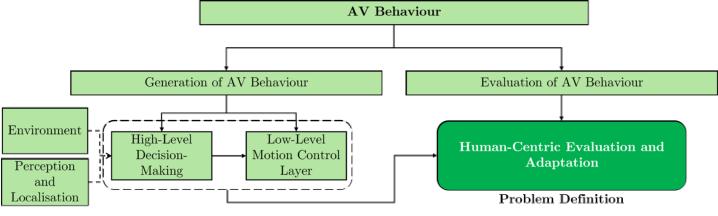
1218 D’Souza and Kim on the consistency between the action selected and the manner in which that action is executed. The significance of the resulting behaviour extends beyond technical performance, passengers experience the observable vehicle behaviour produced through their combined operation rather than the individual effects of perception, decision, and control. Furthermore, the transfer of responsibility to the automated systems creates a dependence on the AV’s ability to behave in a manner that is not only technically competent but also regarded as favourable by those affected by its actions. This raises the question of what constitutes favourable behaviour and how is it to be determined. In AV research this concern is acceptance, which is the degree to which a user’s and the public are willing to adopt the technology as a whole (Kaye et al., 2021). In this paper, behavioural acceptance refers to the extent to which the behaviour generated by the decision-making and control strategies are judged favourable to the situation in which it occurs by those who experience it. The ability to produce such behaviour is important in shaping confidence in AVs and, ultimately, their broader public acceptance. Hence the problem definition, see Figure 1 lies in the human-centric evaluation and adaptation of the resulting AV behaviour.
Figure 1: Hierarchical architecture for autonomous vehicles and the problem definition.
State of the Art This section reviews the current state of the art in the layers that generate AV behaviour and in the evaluation of that behaviour. They are considered in turn, followed by the research gap that motivates the framework proposed in this paper.
Decision-making approaches span rule based, state transition, and game-theoretic methods. Rule-based systems select actions on the basis of predefined rules and logic (Hu et al., 2025). These include if-then rules to select the optimal driving strategy based on the traffic scenario and potential risk assessment, and collision probability-based decision-making logic (Zhao et al., 2021; Noh and An, 2018). State transition formulations represent the driving task as a state space, where the actions are selected based on optimising transitions, with partially observable variants accounting for uncertainty in the surroundings (Liu et al., 2015; Schorner et al., 2019). Game-theoretic formulations select actions based on anticipated responses of road users, which are treated as interacting agents (Fisac et al., 2019;
Bridging the Gap Between Human Factors and Autonomous Vehicle 1219 Li et al., 2022b). Learning-based approaches instead derive policies from interactions without explicitly encoding rules (Codevilla et al., 2018; Kuefler et al., 2017). Across these formulations, the criteria governing the selection of appropriate decisions is mainly consistent with collision risk, safety margins, and rule compliance. Such criteria establish the correctness of the selected action as opposed to the experience of the resulting behaviour.
The control layer realises the reference, subject to the vehicle dynamics and actuator constraints. Control strategies are categorised into model- based, non-model-based, geometric, adaptive, and learning based methods (Albhaisi et al., 2026). Among model-based strategies, the linear quadratic regulator (LQR) is often employed due to its computational simplicity, while model predictive control (MPC) is widely utilised due to its explicit handling of multivariable dynamics and constraints (Falcone et al., 2007; Wang et al., 2022; Li et al., 2022a; Lin et al., 2019). Non-model-based and geometric approaches, including proportional-integral-derivative (PID) (Moreno- Gonzalez et al., 2022), sliding mode control (Bei et al., 2022) and pure-pursuit formulations (Sui et al., 2024), while adaptive (Lee and Chen, 2022) and learning-based methods (Xiao, 2024; Mihály et al., 2024) tune the control parameters online or derive policies from data. Performance at this layer is primarily assessed against control system criteria. This includes tracking accuracy, stability, constraint satisfaction, and computational demand. These criteria establish that a reference has been realised, rather than how its realisation is experienced. The coordination between decision-making and control structure follows hierarchical structure. Some approaches include Markov decision process (MDP) for high level decision making alongside low level controllers; upper level scheduling and low level optimal control for coordinated connected AV motion, and two level MPC with a planning and feedback correction for collision avoidance and rule compliance; finite state machine to determine reasonable driving manoeuvres clustered with LQR and double PID controller for lateral and longitudinal control (Zhou et al., 2017; Chalaki and Malikopoulos, 2022; Aasi et al., 2024; Wang et al., 2023). In particular, feedback based on AV safety performance was established in (Aasi et al., 2024), where collision or traffic violation information were fed back to the upper layers in the form of correction constraints. Overall, the papers described thus far provide the basis for a hierarchical structure for AV behaviour, with evidence of feedback between the two levels based on performance requirements.
Alongside the development in AV decision making and control, the current state of the art has also examined AV acceptance by those who use and encounter them. Acceptance in the literature has been predominantly considered through the lens of technology acceptance models (TAMs), which was initially formulated by (Davis, 1989) to predict adoption of a technology through constructs such as perceived ease of use and perceived usefulness. TAMs have since been extended with additional constructs including perceived trust, perceived risk, attitude, and environmental concern (Acharya and Mekker, 2022; Staab and Liebherr, 2024; Yang and Kim, 2025; Vafaei- Zadeh et al., 2026). While constructs have been extensively characterised,
1220 D’Souza and Kim the vehicle behaviour that gives rise to them is rarely examined, with the technology treated as a whole rather than as a system whose subsequent layers generate the behaviour being judged. Other studies consider the role of driving styles in AVs have also been studied, where different styles were evaluated through the lens of comfort and naturalness (Bellem et al., 2018; Peng et al., 2024; Ekman et al., 2021) further evaluated the effect of driving style on user trust, finding that trust is highly dependent on driving style, with defensive driving styles generating greater trust in AVs. Further trust dependencies were associated with the traffic situation, where perceived task difficulty and risk were constructs that influenced user trust. Collectively, these studies demonstrate the effect of different constructs as a result of different driving styles, though the relationship between these variations and layers that generate in the resultant driving behaviour remains underexplored. Based on the current state of the art, immense progress has been made in each of these fields. In particular, the application of hierarchical architectures and consideration of feedback for safety objectives. Conversely, human factor studies have succeeded in establishing constructs that are determining factors for acceptance, suggesting that acceptance requires more than safety considerations. Hence, the existent gap is twofold, from a standpoint hierarchical studies considering decision making and control, there requires a broader feedback mechanism encompassing more that safety considerations the second comes from a human factor’s standpoint, where it lacks the consideration of acceptance based on high level decision making and low-level control. Filling this gap is the aim of the framework proposed in the following section.
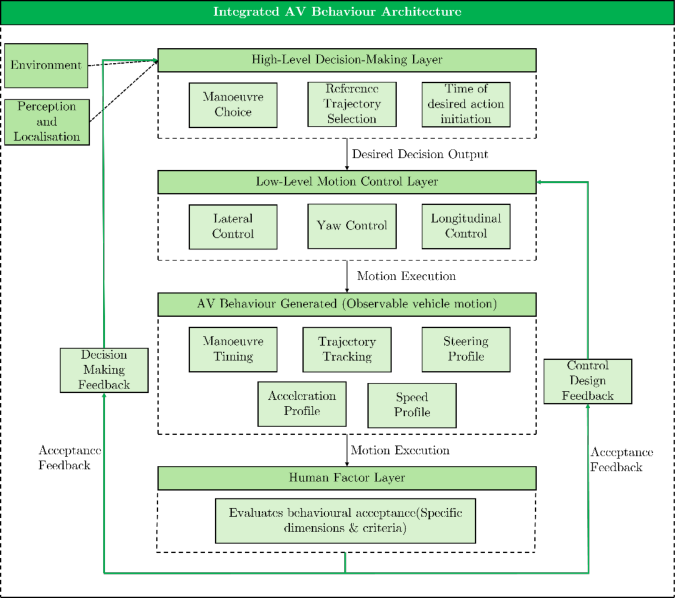
Conceptual Framework Design The proposed conceptual framework is illustrated in Figure 2. The framework consists of the top two layers: high-level decision making and low-level motion control. Together, these produce the resulting behaviour, following the hierarchical structures described in Section 3. The third layer is the human factor layer, which establishes the base for behavioural acceptance evaluation, and provides feedback based on that evaluation to the other two layers. The decomposition follows the distinction between what the vehicle is to do and how that intention is realised, thus assuming a modular architecture in which these functions are distinguishable.
Environmental information, together with perception and localisation information, acts as inputs to the high-level decision-making layer. On the basis of this information, this layer is responsible for three functions: the manoeuvre choice which establishes the intention of the AV; the reference generation, comprising the trajectory to be followed and the desired speed profile; and the initiation of the desired action. The output of the decision- making layer is therefore a desired decision, specifying what the AV is to do and when it is to begin.
This output acts as the input to the lower-level motion control layer, which realises the desired decision. At its base, it consists of the control of three degrees of freedom governing the vehicle’s planar motion: lateral, longitudinal,
Bridging the Gap Between Human Factors and Autonomous Vehicle 1221 and yaw dynamics. Three subsequent control strategies is required in this case: lateral control relating to steering, longitudinal control relating to forward and backward motion, and yaw control that is based on the angular motion about the vertical axis. The execution of the AV’s desire is bounded by the vehicle’s dynamics and by the limits associated with its actuation capabilities. Furthermore, the realised motion is therefore generated from its reference to a degree determined by the capability of the controller. This also applies equally to the timing of the manoeuvre, as the decision-making layer generates the desired initiation, and the instant at which motion begins depends on the controller and response of the actuators.
The behaviour generated by the AV is therefore shaped by the two layers together. Consequently, the AV behaviour thus far is based on the manoeuvre timing, the trajectory tracking performance, the steering profile, the acceleration profiles, and the velocity profiles through which the manoeuvre is executed. As established in Section 2, this behaviour constitutes the observable output of the vehicle and is what those who experience the AV encounter. It is therefore represented as a distinct element of the framework, forming the third layer.
Figure 2: A conceptual framework for behavioural acceptance.
The output AV behaviour then plays a role as the input into the human factor layer. The observable behaviour is evaluated through a set of human factor dimensions, the aggregate of which constitutes the behavioural acceptance.
1222 D’Souza and Kim This yields an assessment of the extent to which the appropriateness of the behaviour is determined. The output comprises this assessment together with its attribution across the dimensions, indicating not only whether the behaviour was accepted but in which respects it was not. At the decision- making layer, the acceptance feedback is established to allow the human factor layer evaluation to inform, alter, and adapt the criteria with respect to the desired manoeuvre selection and initiation. At the motion control layer, the acceptance feedback is established to adapt the parameters through which the reference is executed. These could include the controller tuning parameters, cost function variables in the case of MPC and LQR, and constraint adaptation. The acceptance layer is intended to operate online, estimating the behavioural acceptance of the vehicle’s motion and adapting the preceding layers that generated it during the journey. This requires the assessment to be produced by a model derived from human evaluation rather than by human judgement in the loop; the identification of the dimensions constituting that model, and its derivation. The following section will address the challenges and opportunities related to implementing this framework.
DISCUSSION
The proposed conceptual framework in Section 4 establishes behavioural acceptance within the AV architecture and the interfaces through which its assessment is fed back. While the framework provides a solution, operationalising such a structure, however, presents several research challenges within each of the domains of human factors, AV decision making, and AV control. These are identified and discussed as follows:
Determining the dimensions that constitute the evaluation layer. Based on state of the art, see Section 3, studies have characterised various constructs make up the extended frameworks. The dimensions required here must be both comprehensible from human judgements and derivable from the observed behaviour that the AV produces. Not all established constructs may fulfil the latter requirement.
Determining what constitutes acceptable behaviour within those dimensions. If the constructs resolve the preceding challenge, determining what constitutes acceptance in this context becomes a subsequent challenge. Acceptance levels are variable, which are inherently dependent on the situation and the observer, so no fixed threshold can be specified in advance. This requires an adaptative solution for acceptance levels based on comparative analysis rather than a fixed basis for evaluation.
Translating the assessment into parameter adaptation. The current framework establishes the feedback loop. However, the parameter adaption required based on the feedback evaluation is not specified, since the relationship between a given decision making or control parameter and the passenger judgement is not known in advance. Addressing this requires either the estimation of the assessment’s sensitivity to each parameter or a learned adaptation policy.
Reconciliation of acceptable behaviour with the vehicle’s dynamics and actuator limits. In certain situations, the assessment feedback may require for a change in the behaviour that the AV cannot realise, since the feedback is bounded by the feasible set based on the capabilities of the vehicle dynamics and actuation.
The feasibility and stability of the closed loop feedback mechanism. Introducing an adaptive feedback mechanism such as this introduce unique challenges at the control level. If the control design feedback based on the acceptance feedback may demand a conservative control strategy or rapidity varying control parameters, the relevant controller may not be able produce a feasible solution. Hence, the feasibility of the adapted control problem and its subsequent stability of the resultant adaptation require establishing.
Overall, the framework presented in this paper is a conceptual design contribution and is not validated. Addressing the challenged outlined in this section requires human judgement against the varied AV behaviour, alongside maintaining consistency with the limits of the decision making and control layers.
CONCLUSION
This paper has presented a conceptual framework to address the disconnect between the layers that generate autonomous vehicle (AV) behaviour and the evaluation of that behaviour by those who experience it. By positioning behavioural acceptance as an explicit evaluation layer within a widely considered hierarchical architecture of decision making and control, the framework provides a broader human-centric assessment and feedback mechanism. As a result, it establishes acceptance as an evaluation applied to the behaviour those layers produced jointly, rather than a consideration external to them. Future work will address the identification of these dimensions and its effects on acceptance and examined feasibility, stability, and robustness of the closed loop mechanism. This will be initially developed and implemented using low- and high-fidelity simulation environments, including MATLAB, Simulink, and RoadRunner.
REFERENCES
Aasi, E. et al. (2024) ‘A two-level control algorithm for autonomous driving in urban environments’, IEEE Transactions on Intelligent Transportation Systems, 26(1), pp. 410–424.
Abdallaoui, S. et al. (2023) ‘Advancing autonomous vehicle control systems: An in-depth overview of decision-making and manoeuvre execution state of the art’, The Journal of Engineering, 2023(11), p. e12333. Available at: https://doi. org/10.1049/tje2.12333.
Acharya, S. and Mekker, M. (2022) ‘Public acceptance of connected vehicles: An extension of the technology acceptance model’, Transportation Research Part F: Traffic Psychology and Behaviour, 88, pp. 54–68. Available at: https://doi. org/10.1016/j.trf.2022.05.002. 1224 D’Souza and Kim Albhaisi, M.S. et al. (2026) ‘Trajectory tracking control for autonomous vehicles: A systematic PRISMA review of models and strategies’, Annual Reviews in Control, 61, p. 101047. Available at: https://doi.org/10.1016/j.arcontrol.2026.101047.
Bei, S. et al. (2022) ‘Research on the Trajectory Tracking of Adaptive Second-Order Sliding Mode Control Based on Super-Twisting’, World Electric Vehicle Journal, 13(8). Available at: https://doi.org/10.3390/wevj13080141.
Bellem, H. et al. (2018) ‘Comfort in automated driving: An analysis of preferences for different automated driving styles and their dependence on personality traits’, Transportation Research Part F: Traffic Psychology and Behaviour, 55, pp. 90–100. Available at: https://doi.org/10.1016/j.trf.2018.02.036.
Bonnefon, J.-F., Shariff, A. and Rahwan, I. (2016) ‘The social dilemma of autonomous vehicles’, Science, 352, pp. 1573–1576. Available at: https://doi.org/10.1126/ science.aaf2654.
Chalaki, B. and Malikopoulos, A.A. (2022) ‘Time-Optimal Coordination for Connected and Automated Vehicles at Adjacent Intersections’, IEEE Transactions on Intelligent Transportation Systems, 23(8), pp. 13330–13345. Available at: https://doi.org/10.1109/TITS.2021.3123479.
Codevilla, F. et al. (2018) ‘End-to-End Driving Via Conditional Imitation Learning’, 2018 IEEE International Conference on Robotics and Automation (ICRA), pp. 4693–4700. Available at: https://doi.org/10.1109/ICRA.2018.8460487.
Davis, F.D. (1989) ‘Perceived Usefulness, Perceived Ease of Use, and User Acceptance of Information Technology’, MIS Quarterly, 13(3), pp. 319–340.
Ekman, F. et al. (2021) ‘Trust in what? Exploring the interdependency between an automated vehicle’s driving style and traffic situations’, Transportation Research Part F: Traffic Psychology and Behaviour, 76, pp. 59–71. Available at: https://doi. org/10.1016/j.trf.2020.10.012.
Falcone, P. et al. (2007) ‘A model predictive control approach for combined braking and steering in autonomous vehicles’, 2007 Mediterranean Conference on Control & Automation, pp. 1–6. Available at: https://doi.org/10.1109/ MED.2007.4433694.
Fisac, J.F. et al. (2019) ‘Hierarchical Game-Theoretic Planning for Autonomous Vehicles’, 2019 International Conference on Robotics and Automation (ICRA), pp. 9590–9596. Available at: https://doi.org/10.1109/ICRA.2019.8794007.
Hu, J. et al. (2025) ‘A survey of decision-making and planning methods for self- driving vehicles’, Frontiers in Neurorobotics, Volume 19-2025. Available at: https://doi.org/10.3389/fnbot.2025.1451923.
Huang, Y. et al. (2020) ‘A Novel Local Motion Planning Framework for Autonomous Vehicles Based on Resistance Network and Model Predictive Control’, IEEE Transactions on Vehicular Technology, 69(1), pp. 55–66. Available at: https://doi. org/10.1109/TVT.2019.2945934.
Kaye, S.-A. et al. (2021) ‘Users’ acceptance of private automated vehicles: A systematic review and meta-analysis’, Journal of Safety Research, 79, pp. 352–367. Available at: https://doi.org/10.1016/j.jsr.2021.10.002.
Krueger, R., Rashidi, T.H. and Rose, J.M. (2016) ‘Preferences for shared autonomous vehicles’, Transportation Research Part C: Emerging Technologies, 69, pp. 343–355. Available at: https://doi.org/10.1016/j.trc.2016.06.015.
Kuefler, A. et al. (2017) ‘Imitating Driver Behavior with Generative Adversarial Networks’. Available at: https://arxiv.org/abs/1701.06699.
Li, H. et al. (2022) ‘Safety research on stabilization of autonomous vehicles based on improved-LQR control’, Aip Advances, 12(1). Bridging the Gap Between Human Factors and Autonomous Vehicle 1225
Li, N. et al. (2022) ‘Game-Theoretic Modeling of Multi-Vehicle Interactions at Uncontrolled Intersections’, IEEE Transactions on Intelligent Transportation Systems, 23(2), pp. 1428–1442. Available at: https://doi.org/10.1109/ TITS.2020.3026160.
Lin, F. et al. (2019) ‘Path tracking of autonomous vehicle based on adaptive model predictive control’, International Journal of Advanced Robotic Systems, 16(5), p. 1729881419880089. Available at: https://doi.org/10.1177/17298814198 80089.
Liu, W. et al. (2015) ‘Situation-aware decision making for autonomous driving on urban road using online POMDP’, 2015 IEEE Intelligent Vehicles Symposium (IV), pp. 1126–1133. Available at: https://doi.org/10.1109/IVS.2015.7225835.
Malokin, A., Circella, G. and Mokhtarian, P.L. (2019) ‘How do activities conducted while commuting influence mode choice? Using revealed preference models to inform public transportation advantage and autonomous vehicle scenarios’, Transportation Research Part A: Policy and Practice, 124, pp. 82–114. Available at: https://doi.org/10.1016/j.tra.2018.12.015.
Mihály, A., Vu, V.T., Do, T.T. and Gáspár, P. (2024) ‘Supervised reinforcement learning based trajectory tracking control for autonomous vehicles’, IFAC-PapersOnLine, 58(10), pp. 140–145.
Milakis, D. et al. (2017) ‘Development and transport implications of automated vehicles in the Netherlands: scenarios for 2030 and 2050’, European Journal of Transport and Infrastructure Research, 17(1). Available at: https://doi. org/10.18757/ejtir.2017.17.1.3180.
Moreno-Gonzalez, M. et al. (2022) ‘Speed-Adaptive Model-Free Lateral Control for Automated Cars’, IFAC-PapersOnLine, 55(34), pp. 84–89. Available at: https:// doi.org/10.1016/j.ifacol.2022.11.312.
Noh, S. and An, K. (2018) ‘Decision-Making Framework for Automated Driving in Highway Environments’, IEEE Transactions on Intelligent Transportation Systems, 19(1), pp. 58–71. Available at: https://doi.org/10.1109/TITS.2017.2691346.
Peng, C. et al. (2024) ‘Drivers’ evaluation of different automated driving styles: Is it both comfortable and natural?’, Human factors, 66(3), pp. 787–806.
Schörner, P. et al. (2019) ‘Predictive Trajectory Planning in Situations with Hidden Road Users Using Partially Observable Markov Decision Processes’, 2019 IEEE Intelligent Vehicles Symposium (IV), pp. 2299–2306. Available at: https://doi. org/10.1109/IVS.2019.8814022.
Staab, V. and Liebherr, M. (2024) ‘Perception and Acceptance of Autonomous Vehicles: Influencing Factors and the Relevance of Subjective Knowledge’, International Journal of Human–Computer Interaction, 40(24), pp. 8463–8475. Available at: https://doi.org/10.1080/10447318.2023.2295687.
Sui, Y. et al. (2024) ‘A Fuzzy Pure Pursuit for Autonomous UGVs Based on Model Predictive Control and Whole-Body Motion Control’, Drones, 8(10). Available at: https://doi.org/10.3390/drones8100554.
Ullah, I. et al. (2025) ‘Assessing the barriers and implications of autonomous vehicles: Implementation in sustainable cities’, Sustainable Futures, 9, p. 100564. Available at: https://doi.org/10.1016/j.sftr.2025.100564.
Vafaei-Zadeh, A. et al. (2026) ‘Modeling Behavioral Intentions Toward Autonomous Vehicles: Expanding the Technology Acceptance Model’, Transportation Research Record, 0(0), p. 03611981261447269. Available at: https://doi. org/10.1177/03611981261447269.
Wang, T. et al. (2023) ‘A Hierarchical Framework of Decision Making and Trajectory Tracking Control for Autonomous Vehicles’, Sustainability, 15(8). Available at: https://doi.org/10.3390/su15086375. 1226 D’Souza and Kim Wang, Z. et al. (2022) ‘Improved linear quadratic regulator lateral path tracking approach based on a real-time updated algorithm with fuzzy control and cosine similarity for autonomous vehicles’, Electronics, 11(22), p. 3703.
Xiao, W. (2024) ‘Construction of Autonomous Vehicle Trajectory Tracking System Under Artificial Intelligence Technology’, 2024 Third International Conference on Distributed Computing and Electrical Circuits and Electronics (ICDCECE), pp. 1–6. Available at: https://doi.org/10.1109/ICDCECE60827.2024.10548177.
Yang, Y. and Kim, M.-Y. (2025) ‘Promoting Sustainable Transportation: How People Trust and Accept Autonomous Vehicles—Focusing on the Different Levels of Collaboration Between Human Drivers and Artificial Intelligence—An Empirical Study with Partial Least Squares Structural Equation Modeling and Multi-Group Analysis’, Sustainability, 17(1). Available at: https://doi.org/10.3390/su17010125.
Zhao, C. et al. (2021) ‘A comparative study of state-of-the-art driving strategies for autonomous vehicles’, Accident Analysis & Prevention, 150, p. 105937. Available at: https://doi.org/10.1016/j.aap.2020.105937.
Zhou, S. et al. (2017) ‘A hierarchical planning and control framework for structured highway driving’, IFAC-PapersOnLine, 50(1), pp. 9101–9107. Available at: https://doi.org/10.1016/j.ifacol.2017.08.1705.
SEARCH THE AHFE DIGITAL BOOKSTORE BY ISBN
Explore the complete digital volume
Human Factors in Design, Engineering, and Computing
Read this individual research paper free through the original publisher, or explore the full digital proceedings book.