Rodrigo Domínguez, María Paz Cáceres, Fanny Modaca, Sebastián Amaro (2026). Beyond the Employer: Solar UV Risk Profiles of Self-Employed Farmers and Artisanal Fishers. In: Human Factors in Design, Engineering, and Computing. AHFE Open Access, vol. 238, pp. 1327–1336. https://doi.org/10.54941/ahfe1008361
Occupational exposure to solar ultraviolet (UV) radiation causes nearly one in three deaths from non-melanoma skin cancer worldwide, according to WHO/ILO joint estimates. Most sun-safety frameworks, however, rely on employers to provide shade, organize work schedules, and supply protective equipment, leaving self-employed outdoor workers outside this model. This study compared the sun-safety risk of two self-employed occupations in central Chile, small-scale farmers (n = 138) and artisanal fishers from four coastal communities (n = 148). Data were collected in 2018–2019, before the COVID-19 pandemic. The Solar UV Risk Assessment for Outdoor Workers (Sun Safety at Work Canada) was administered in person. It scores three dimensions, environment, operational factors, and personal protection, whose sum gives an overall risk score (high risk > 98 points). Fishers were assessed in two work positions, navigation at sea and shore-based tasks. Both occupations scored high on environment (farmers 44, fishers 46; high > 38). Farmers had a mean overall score of 109.8 ± 7.9, with 91.3% at high risk. Their risk was exposure-driven: the operational score was high (43.4 ± 6.5; high > 37) and the personal protection score was medium (22.4 ± 4.2). All farmers worked in the sun throughout the day even though nearly all reported being able to reschedule tasks, 62% lacked shade during work, 47% reported regular sunburn, and 97% reported regular exposure to photosensitizing agrochemicals. Fishers showed the opposite profile, protection-driven risk: operational scores were medium (20.4 at sea, 25.0 on shore) and personal protection scores were high (25.8 and 31.3; high > 25). None used UV-protective clothing or UV-filtering eyewear, and 75% never or rarely used sunscreen. Shore-based work raised the overall score from 92.2 ± 10.2 to 102.3 ± 7.9 (p < 0.001), the proportion at high risk from 30% to 66%, and peak-hour exposure from 18% to 41%. These contrasting profiles show that sun-safety needs differ by occupation and task, and that autonomy over work schedules does not translate into protective behavior. Protecting self-employed outdoor workers requires occupation-specific, human-centered strategies delivered through cooperatives, unions, fishing communities, and primary health care.
Solar ultraviolet (UV) radiation is classified as carcinogenic to humans (Group 1) and is the main environmental cause of skin cancer (IARC, 2012). Outdoor workers accumulate far higher doses than indoor workers:
measured daily exposures in agriculture, construction and other outdoor activities range from about 1 to more than 28 standard erythemal doses (SED), and annual occupational doses are estimated to be two to three times those of indoor workers, frequently exceeding recommended occupational limits (Modenese et al., 2018). The first WHO/ILO joint estimates attributed 18,960 deaths from non-melanoma skin cancer in 2019 to occupational solar UV exposure, nearly one in three of all such deaths, with 1.6 billion people, 28% of the working-age population, exposed while working outdoors (Pega et al., 2023).
Despite this burden, sun protection among outdoor workers remains inadequate. A systematic review concluded that outdoor workers’ protective behaviors are insufficient across countries and occupations, even when knowledge of the risks is reasonable (Reinau et al., 2013). Among rural Australian farmers, fewer than half consistently wore wide-brimmed hats, long-sleeved shirts or collared shirts, although most rated these behaviors as important (Woods et al., 2019). Studies of fishers have shown that exposure depends strongly on the task and the vessel, with a large share of daily measurements exceeding occupational limits and relevant ocular doses from water reflection (Modenese et al., 2019). Evidence from Latin America is scarce and mostly focused on urban informal workers such as beach vendors (Lucena et al., 2014).
Most occupational sun-safety programs are designed around the workplace. Their components (shade structures, scheduling of outdoor work away from peak UV hours, provision of protective clothing and sunscreen, training) are implemented by employers through occupational health and safety programs and policies (Kramer et al., 2015). International standards follow the same logic. The ILO Safety and Health in Agriculture Convention requires employers to assess risks and adopt preventive and protective measures, and mentions self-employed persons only in relation to cooperating with employers on shared workplaces (ILO, 2001); international guidance on protecting workers from UV radiation likewise relies on engineering, administrative and personal controls implemented within the workplace (ICNIRP, 2010). Yet a large share of the world’s outdoor workforce has no employer: more than 60% of the employed population works in the informal economy, a proportion that is highest in agriculture (ILO, 2018). Small-scale farmers and artisanal fishers are typical examples. They decide their own working hours and equipment, and no workplace program reaches them. From a human factors perspective, this raises a question that employer- based frameworks do not address: when workers control their own work organization, do they use that control to protect themselves?
This study addressed that question by comparing the sun-safety risk profiles of two self-employed outdoor occupations in central Chile, small-scale farmers and artisanal fishers, using a standardized risk assessment instrument. Specifically, it aimed to (i) characterize the environmental, operational and personal protection components of risk in each occupation, (ii) compare risk between two work positions within artisanal fishing (navigation at sea and shore-based work), and (iii) identify the levers on which prevention for self- employed outdoor workers should focus.
MATERIALS AND METHOD Study Design and Setting
A cross-sectional study was conducted in the Valparaíso Region of central Chile, which combines a coastline with artisanal fishing communities and inland agricultural valleys. Data were collected in 2018–2019, before the COVID-19 pandemic, as part of two applied occupational risk assessments carried out at Universidad Técnica Federico Santa María. For the present study, individual-level data from both assessments were harmonized and reanalyzed to compare risk profiles across occupations and tasks.
Participants Farmers. Participants were small-scale, self-employed farmers working in open fields in the municipality of Llay-Llay. Work performed under sheds or greenhouses was not considered representative of outdoor exposure and was excluded. The sample size was estimated with the STATS method (95% confidence level, 5% margin of error) from a population of 214 farmers, giving 138 participants.
Artisanal fishers. Participants were fishers registered in the unions of four artisanal fishing coves: Portales (n = 54), Quintay (n = 39), Higuerillas (n = 34) and El Membrillo (n = 21). The sample size was estimated with the same method from a population of 241 registered fishers, and 148 fishers were assessed. Following the instrument’s guidance on assessing distinct job positions, each fisher was assessed in two positions: navigation (fishing at sea, mostly at dawn, and in some coves daytime tourist or diving trips) and shore-based work (boat preparation, landing and sale of the catch, and other activities in the cove).
Instrument Risk was assessed with a Spanish version of the Solar UV Radiation Risk Assessment for Outdoor Workers (Sun Safety at Work Canada, 2016), developed by the School of Occupational and Public Health at Ryerson University and used within the Sun Safety at Work Canada program (Kramer et al., 2015). The instrument assigns points to risk factors in three dimensions (Table 1). Environment covers the season in which work is performed, altitude and the reflectivity of the work surface. Operational factors cover time working in the sun, shade availability during work and rest periods, history of sunburn at work, the ability to reschedule work to non-peak UV times (outside 10:00–15:00) and exposure to photosensitizing chemicals. Personal protection covers the type and frequency of use of hats, shirts, trousers, UV-protective clothing, UV-filtering eyewear and sunscreen. Higher scores indicate higher risk. Each dimension and the overall score (the sum of the three) are rated as low, medium or high risk using the instrument’s thresholds.
Questionnaires were administered face to face by trained interviewers at the workplace, taking about six minutes per worker. Participation was voluntary and all participants gave informed consent. After the assessments, participants received training and informational material on sun protection.
Table 1: Structure of the solar UV radiation risk assessment for outdoor workers and risk thresholds.
Table available in the original PDF paper.
Dimension Risk Factors Low Medium High Environment Season; altitude; work surface < 18 19–37 > 38
< 18 19–36 > 37
Operational factors
Time in the sun; shade (work, rest); sunburn history; ability to reschedule; photosensitizing chemicals
< 12 13–24 > 25
Personal protection
Hat; shirt; trousers; UV clothing; UV eyewear; sunscreen Overall risk Sum of the three dimensions < 48 49–97 > 98
Data Processing and Harmonization Subtotals and overall scores were recalculated from the item scores for every participant, correcting summation and classification errors found in the original spreadsheets (11 overall scores and 12 risk classifications among farmers). For fishers, the environment score (46 points: year-round work, sea level, sea and beach surfaces) was common to all participants and positions, and no participant reported photosensitizing chemical exposure; these values were added to obtain overall scores. The fisher shade item was recorded as a combined score for work and rest periods, so lack of shade during work was derived from combined scores of 10 or more. To compare occupations, eight binary indicators common to both datasets were defined: working in the sun all day; exposure during peak UV hours (all day or 10:00–15:00); no shade during work; any history of sunburn at work; inability to reschedule to non-peak times; no UV-protective clothing; no UV-filtering eyewear; and sunscreen use never or less than 25% of the time.
Statistical Analysis Scores are presented as mean ± standard deviation and median (interquartile range), and proportions with Wilson 95% confidence intervals (CI). Farmers and fishers were compared with Pearson’s chi-square test or Fisher’s exact test when expected frequencies were below five. The two fisher positions were compared with the Wilcoxon signed-rank test for scores and the exact McNemar test for paired proportions. Subgroups were compared with the Mann-Whitney U test (sex) and the Kruskal-Wallis test (age group, cove). All tests were two-sided with α = 0.05. Analyses were performed in Python 3 with SciPy.
RESULTS
Participants The farmer sample comprised 126 men (91.3%) and 12 women (8.7%). The largest age group was 57 years or older (n = 47, 34.1%), followed by 44–56 (n = 39), 31–43 (n = 36) and 18–30 years (n = 16), reflecting the migration of younger people out of the municipality. The fisher sample was predominantly male, with the 44–56 age group being the most frequent; individual demographic data were not available for this group.
Beyond the Employer: Solar UV Risk Profiles of Self-Employed Farmers 1331 Risk Profiles by Dimension
Table 2 summarizes the scores by dimension. Both occupations scored high on environment, which reflects year-round outdoor work and cannot be modified. The other two dimensions showed opposite profiles. Farmers had high operational scores (67.4% above the high-risk threshold) and mostly medium personal protection scores (15.9% high). Fishers had medium operational scores in both positions (3.4% high) but high personal protection scores, with 49.3% of fishers at high risk during navigation and 91.2% during shore-based work. Overall, 91.3% of farmers were at high risk, compared with 29.7% of fishers during navigation and 66.2% during shore work.
Table 2: Solar UV risk scores by dimension and occupation (mean ± SD; % of workers above the high-risk threshold).
Note: Environment scores were constant within each occupation. Overall scores differed between farmers and fishers in both positions (Mann-Whitney U, p < 0.001) and between fisher positions (Wilcoxon signed-rank, p < 0.001).
Farmers: Exposure-Driven Risk All farmers reported working in the sun throughout the day, which placed every farmer in peak UV hours. In contrast, 137 of 138 reported being able to reschedule their work to non-peak times, which they attributed to their self-employed status. Sixty-two percent had no shade while working and 37.7% had no shade during rest periods. Sunburn at work was common: 47.1% reported regular and 47.1% irregular occurrence. Almost all farmers (97.1%) reported regular exposure to photosensitizing chemicals, related to the application of pesticides; only one farmer, who grew organic crops, reported none. Personal protection was partial: 70.3% used no UV-protective clothing and 46.4% no UV-filtering eyewear, whereas only 10.1% used sunscreen never or less than 25% of the time.
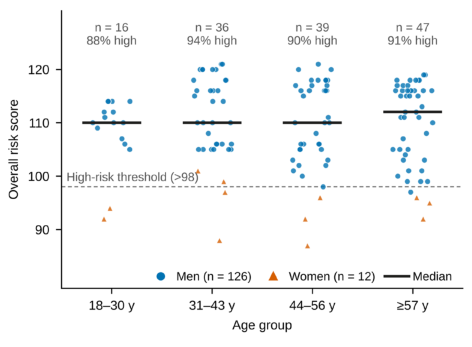
Overall scores did not differ by age group (Kruskal-Wallis, p = 0.60), but their composition did (Figure 1). Operational scores increased with age (from 37.6 in the 18–30 group to 44.8 in the 57+ group; p = 0.004), while personal protection scores decreased (from 26.8 to 21.1; p < 0.001), indicating that older farmers worked longer in the sun but used more covering clothing, whereas younger farmers more often wore short sleeves and short trousers in summer. Women scored lower than men (94.1 ± 4.1 vs. 111.3 ± 6.3; p < 0.001) and fewer were at high risk (16.7% vs. 98.4%), mainly because of lower personal protection scores (13.2 vs. 23.3).
Figure 1: Overall risk score of farmers by age group and sex. Horizontal bars show medians; the dashed line marks the high-risk threshold.
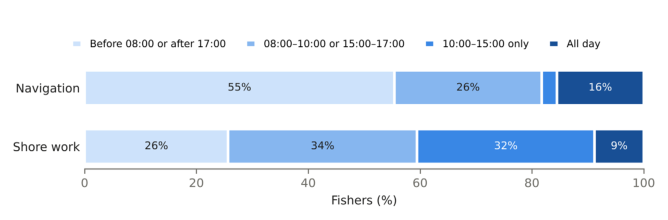
Fishers: Protection-Driven Risk and Task Differences No fisher used UV-protective clothing or UV-filtering eyewear in either position, 54.1% never used sunscreen and a further 20.9% used it less than 25% of the time. During navigation, 55.4% of fishers worked only before 08:00 or after 17:00, consistent with dawn fishing, whereas shore-based tasks shifted exposure toward the middle of the day (Figure 2). Exposure during peak UV hours rose from 18.2% during navigation to 40.5% during shore work (exact McNemar, p < 0.001), and lack of shade during work rose from 50.0% to 76.4%. Operational scores increased from 20.4 to 25.0 (p < 0.001), and personal protection scores from 25.8 to 31.3, because lighter clothing was worn on shore. Sunburn history was reported by 20.9% of fishers, all as irregular occurrence.
Risk differed markedly among coves (Table 3; Kruskal-Wallis, p < 0.001 for both positions). Quintay was the only cove where navigation was high risk for all fishers, because fishers there target conger eel during daytime trips and carry tourists and divers throughout the day. During shore work, the proportion at high risk ranged from 38.1% in El Membrillo to 94.1% in Higuerillas, where no fisher had shade while working. Portales, the cove with the most roofed work areas, had the lowest proportion without shade during shore work (59.3%).
Figure 2: Time of day spent working in the sun by artisanal fishers in the two work positions (n = 148).Table 3: Overall risk score of artisanal fishers by cove and work position (mean; % at high risk).
Table available in the original PDF paper.
Cove n Navigation Shore Work No Shade During Shore Work (%) Portales 54 87.2 (9.3%) 99.5 (50.0%) 59.3
El Membrillo 21 86.7 (0%) 96.7 (38.1%) 100 Total 148 92.2 (29.7%) 102.3 (66.2%) 76.4
Comparison of Farmers and Fishers
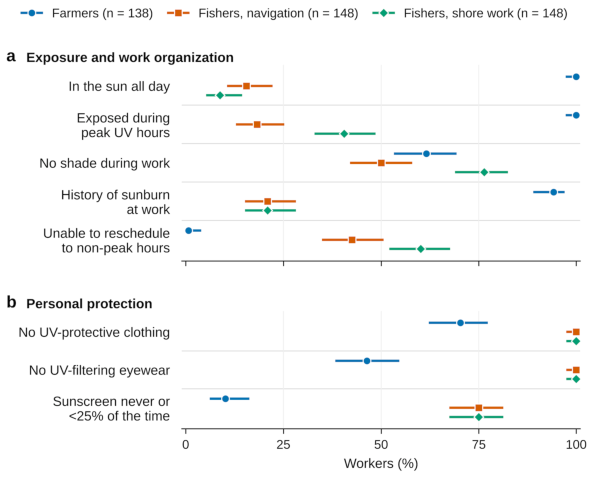
Figure 3 compares the harmonized indicators. Farmers were more exposed (all day in the sun, peak-hour exposure and sunburn history; all p < 0.001), whereas fishers were less protected (no UV clothing, no UV eyewear and infrequent sunscreen use; all p < 0.001). Lack of shade during work was similar between farmers and fishers at sea (61.6% vs. 50.0%; p = 0.064) but more frequent among fishers on shore (76.4%; p = 0.010). Inability to reschedule was almost absent among farmers (0.7%) but reported by 42.6% and 60.1% of fishers in the two positions.
Figure 3: Exposure and protection profiles of self-employed farmers and artisanal fishers. (a) Exposure and work organization indicators. (b) Personal protection indicators. Points show the percentage of workers and horizontal lines Wilson 95% confidence intervals; fishers were assessed during navigation and shore-based work.
DISCUSSION
This study found that two self-employed outdoor occupations working under the same regional UV conditions reach high solar UV risk through opposite routes. Farmers’ risk was driven by exposure and work organization, with all-day work in the sun, limited shade and frequent sunburn, while their use of personal protection was comparatively better. Fishers’ risk was driven by protection deficits, with no use of UV clothing or eyewear and low sunscreen use, while their time in the sun was shorter and concentrated outside peak hours during navigation. This distinction matters for prevention: a generic sun-safety message is unlikely to address both profiles, and the priority control differs by occupation.
The farmers’ results illustrate a human factors issue that employer-based frameworks rarely confront. Nearly all farmers reported that they could reschedule their work, yet all of them worked in the sun throughout the day. Autonomy over the work schedule therefore did not translate into protective work organization. Economic pressures, crop cycles and habits are plausible explanations, and the gap between perceived control and actual behavior resembles the knowledge-practice gap reported among Australian farmers (Woods et al., 2019) and outdoor workers in general (Reinau et al., 2013). For self-employed workers, administrative controls such as scheduling cannot be imposed; they have to be designed into the work itself, for example by organizing harvest and pesticide application in the early morning, and supported by shade structures near the fields. The near-universal exposure to photosensitizing agrochemicals adds a second hazard that interacts with UV exposure and deserves specific attention in agricultural extension and health programs.
Among fishers, the comparison between positions shows that risk is a property of tasks rather than of occupations alone. Navigation took place mostly at dawn, but shore-based tasks such as selling the catch and preparing boats shifted exposure into peak UV hours and increased the proportion at high risk from 30% to 66%. Risk assessments of fishers that consider only time at sea would therefore underestimate their exposure. The differences between coves point to the role of infrastructure and activity mix: the cove with the most roofed work areas had the lowest lack of shade, and the cove where fishers offered daytime tourist trips was the only one with high-risk navigation. The complete absence of UV-filtering eyewear is notable given the ocular doses produced by reflection from the water surface (Modenese et al., 2019).
These findings have implications beyond Chile. Sun-safety programs such as Sun Safety at Work Canada are built on workplace policies, risk assessment and control by the employer (Kramer et al., 2015), and international standards assign responsibility in the same way (ILO, 2001). Self-employed farmers and artisanal fishers, who form a large part of the outdoor workforce in low- and middle-income countries (ILO, 2018), fall outside this model. Prevention for them needs other delivery channels that already reach these workers: fishers’ unions and cove infrastructure for shade and the provision of eyewear and sunscreen; agricultural cooperatives and extension services
Beyond the Employer: Solar UV Risk Profiles of Self-Employed Farmers 1335 for work scheduling and the management of photosensitizing chemicals; and primary health care for skin examination and early detection. The instrument used here, designed for employers, proved useful for this purpose because its dimension scores identify which type of control should be prioritized.
LIMITATIONS This study has several limitations. Data were collected in 2018–2019, and protective practices may have changed since then; the results should be read as a baseline, although the structural conditions of exposure in both occupations remain the same. Fieldwork took place mainly in spring rather than at the summer UV peak, which makes the exposure findings conservative. The instrument relies on self-report and on expert-based point allocation, has not been formally validated in Chile, and does not measure individual UV doses; dosimetry would strengthen future studies. The fisher dataset did not include individual demographic data, and its shade item combined work and rest periods. The number of women farmers was small (n = 12), so the sex difference should be interpreted with caution. Finally, both samples come from one region, which may limit generalization to other climates and production systems.
CONCLUSION
Self-employed farmers and artisanal fishers in central Chile face high solar UV risk, but through opposite mechanisms: farmers through prolonged exposure and limited shade despite control over their schedules, and fishers through an almost complete absence of personal protection, which is aggravated during shore-based tasks performed at midday. Because these workers have no employer to implement sun-safety measures, prevention must be occupation- and task-specific and delivered through the organizations that already reach them, such as unions, cooperatives, fishing communities and primary health care. Future work should combine questionnaire-based assessment with personal UV dosimetry, extend the analysis to other self-employed outdoor occupations, and evaluate interventions co-designed with workers.
ACKNOWLEDGMENT
The authors thank the farmers of Llay-Llay and the artisanal fishers of Portales, Quintay, Higuerillas and El Membrillo for their participation.
REFERENCES
IARC. (2012). Radiation. IARC Monographs on the Evaluation of Carcinogenic Risks to Humans, Volume 100D. International Agency for Research on Cancer. ICNIRP. (2010). ICNIRP statement – Protection of workers against ultraviolet
radiation. Health Physics, 99(1), 66–87. ILO. (2001). Safety and Health in Agriculture Convention, 2001 (No. 184).
International Labour Organization.
ILO. (2018). Women and men in the informal economy: A statistical picture (3rd ed.). International Labour Office. Kramer, D. M., Tenkate, T., Strahlendorf, P., Kushner, R., Gardner, A., & Holness, D.
L. (2015). Sun Safety at Work Canada: A multiple case-study protocol to develop sun safety and heat protection programs and policies for outdoor workers. Implementation Science, 10(1), 97. Lucena, E. E. S., Costa, D. C. B., Silveira, É. J. D., & Lima, K. C. (2014). Occupation and factors associated with exposure to the sun among beach workers. Ciência & Saúde Coletiva, 19(4), 1171–1178. Modenese, A., Korpinen, L., & Gobba, F. (2018). Solar radiation exposure and
outdoor work: An underestimated occupational risk. International Journal of Environmental Research and Public Health, 15(10), 2063. Modenese, A., Ruggieri, F. P., Bisegna, F., Borra, M., Burattini, C., Della Vecchia, E., Grandi, C., Grasso, A., Gugliermetti, L., Manini, M., Militello, A., & Gobba, F. (2019). Occupational exposure to solar UV radiation of a group of fishermen working in the Italian North Adriatic Sea. International Journal of Environmental Research and Public Health, 16(16), 3001. Pega, F., Momen, N. C., Streicher, K. N., et al. (2023). Global, regional and national
burdens of non-melanoma skin cancer attributable to occupational exposure to solar ultraviolet radiation for 183 countries, 2000–2019: A systematic analysis from the WHO/ILO Joint Estimates of the Work-related Burden of Disease and Injury. Environment International, 181, 108226. Reinau, D., Weiss, M., Meier, C. R., Diepgen, T. L., & Surber, C. (2013). Outdoor workers’ sun-related knowledge, attitudes and protective behaviours: A systematic review of cross-sectional and interventional studies. British Journal of Dermatology, 168(5), 928–940. Sun Safety at Work Canada. (2016). Solar UV radiation risk assessment for outdoor
workers: Operational review. School of Occupational and Public Health, Ryerson University, Toronto. Woods, C., O’Shea, E., Barrett, F., Bookallil, L., East, L., & Usher, K. (2019).
Occupational exposure: Rural Australian farmers’ sun-protective behaviours. Journal of Public Health, 28(6), 675–684.
SEARCH THE AHFE DIGITAL BOOKSTORE BY ISBN
Explore the complete digital volume
Human Factors in Design, Engineering, and Computing
Read this individual research paper free through the original publisher, or explore the full digital proceedings book.