Sayaka Noda, Toshihisa Doi (2026). Unraveling the Process of Consummatory Engagement to Enable Fulfilling Personal Experiences. In: Human Factors in Design, Engineering, and Computing. AHFE Open Access, vol. 238, pp. 1093–1101. https://doi.org/10.54941/ahfe1008339
Recent discourse on human wellbeing has shifted from objective indicators such as economic prosperity and social status toward subjective dimensions, particularly eudaimonic wellbeing (EWB), a state concerned with self-realization, meaning, and purposeful living. Among the conditions that foster EWB, consummatory activity, engagement whose value resides intrinsically within the process itself rather than in external rewards, has been identified as a potentially significant contributor. Yet cultivating EWB requires individuals to identify and engage in activities consummatorily, which requires a deeper understanding of the motivational process through which consummatory engagement emerges, a process that remains insufficiently understood. This study aimed to clarify the motivational structure and developmental process underlying the emergence of consummatory value in personal activity. Nine adults who demonstrated consummatory engagement across activities such as cycling, swimming, cooking, driving, and map exploration were recruited through snowball sampling and interviewed individually using a semi-structured format. Data were analyzed using the Modified Grounded Theory Approach (M-GTA), a qualitative methodology in which concept generation and theory building proceed simultaneously. Analysis revealed two experiential tendencies underlying consummatory engagement: a self-realization tendency involving mastery pursuit, goal setting, and life integration, and a hedonic tendency involving novelty seeking and stress-free continuation. These tendencies were not mutually exclusive; individuals moved fluidly between or combined elements of both. These findings offer a process-level understanding of how consummatory engagement emerges and sustains itself, providing a foundation for design principles that help individuals cultivate fulfilling, meaningful experiences.
Recent discourse on human wellbeing has increasingly moved beyond objective indicators such as economic prosperity, social status, or material comfort, toward a focus on subjective and psychological dimensions of a good life. Among these, eudaimonic wellbeing (EWB) has drawn particular attention as a state concerned not merely with feeling good, but with living well: exercising one’s own potential, pursuing meaning, and engaging purposefully with one’s life. The concept traces back to Aristotle’s (1925) notion of eudaimonia, and was later developed into a psychological
1094 Noda and Doi construct by Ryff (1989), who characterized it through dimensions such as personal growth, purpose in life, and self-acceptance. Ryan and Deci (2001) further distinguished this eudaimonic view of wellbeing from a hedonic view centered on pleasure and the avoidance of pain, establishing a now well- established contrast between two distinct, though not mutually exclusive, routes to wellbeing.
A further consideration concerns how one’s present actions relate to this eudaimonic sense of purpose. Mita (2018) describes contemporary society as having entered a “plateau,” a state of stable equilibrium following the earlier era of rapid economic growth. Where growth-oriented societies once encouraged individuals to treat the present primarily as a means toward some future gain, Yamaguchi (2020) argues that this plateau calls for a different orientation toward one’s own life: rather than deferring fulfillment to a future goal, value can instead be found in the present activity itself. Living a life of purpose and meaning, in this sense, does not mean working toward a distant end point. It can also be found in how one engages with the present, moment by moment.
Among the conditions thought to foster EWB, engagement in consummatory activity, activity whose value resides intrinsically within the process itself rather than in some external reward or future outcome, has been identified as a potentially significant contributor. Unlike instrumental activity, which is undertaken as a means to an end, consummatory activity is experienced as an end in itself: the doing of the activity is itself the point. Such activity is often associated with deep, self-directed leisure and hobby engagement, and intuitively appears well-suited to fostering the kind of purposeful, self- realizing experience that EWB describes.
However, for individuals to actively cultivate EWB in their own lives through this route, they must first be able to identify and engage in activities consummatorily, that is, to recognize which of their pursuits (or potential pursuits) hold this kind of intrinsic, process-oriented value, and to sustain their engagement with them over time. This requires an understanding not only of what consummatory activity is, but of the motivational mechanisms and developmental process through which consummatory engagement emerges, deepens, and is sustained. While the general link between such engagement and wellbeing has been proposed at a conceptual level, the concrete process by which a person comes to experience an activity consummatorily, from initial trigger through to sustained, long-term engagement, remains insufficiently understood at the level of lived individual experience.
This study aims to clarify the motivational structure and developmental process underlying the emergence of consummatory value in personal activity, examining both the process shared across individuals and the distinct tendencies through which different individuals experience and sustain this engagement.
METHOD
Nine adults participated in this study (see Table 1 for participant characteristics). Participants were recruited through snowball sampling and were required to complete a screening survey designed to determine whether
Unraveling the Process of Consummatory Engagement 1095 the activity they engaged in could be considered consummatory, that is, an activity pursued as an end in itself rather than for external outcomes. The activities represented spanned diverse domains, reflecting a deliberate effort to examine consummatory engagement across varied activity contexts rather than within a single domain.
Table 1: Overview of participants and their consummatory activities.
Table available in the original PDF paper.
ID Age Gender Activity #1 25 Male Cycling
#2 23 Male Window shopping #3 22 Female Swimming
#4 22 Female Cheerleading #5 60 Female Swimming
#6 42 Female Map gazing #7 63 Male Mountain climbing
#8 21 Female Cooking #9 21 Female Driving
Semi-structured interviews were conducted individually with each participant and lasted approximately 60 minutes. Rather than following a fixed sequence, the interviews flexibly explored the reason the participant began the activity, how the value of the activity had changed over time, how the participant felt after engaging in it, the nature of their motivation to engage, and what they thought about during the activity itself, allowing the conversation to follow the natural flow of each participant’s narrative. Interviews were audio-recorded and transcribed verbatim for analysis.
Data were analyzed using the Modified Grounded Theory Approach (M-GTA; Kinoshita, 2007), a qualitative methodology suited to analyzing human behavior and social processes in naturalistic contexts. M-GTA requires the researcher to explicitly define an analytic focus person and an analytic theme prior to analysis, both of which anchor concept generation and guard against interpretive drift. In this study, the analytic focus person was defined as an individual who engages in an activity considered consummatory, and the analytic theme was defined as the process through which consummatory activity is carried out and becomes positively integrated into one’s life, with the potential to enhance eudaimonic wellbeing.
For each concept, a concept generation worksheet was created, recording the concept name, its definition, and supporting excerpts from the interview data. Concepts were iteratively compared within and across participants’ data through constant comparison, and data collection and analysis proceeded concurrently. Emerging concepts and open questions from earlier interviews informed which type of participant to seek out next and which topics to probe more deeply in subsequent interviews (theoretical sampling). By around the seventh participant, the two experiential tendencies described below had begun to stabilize; the remaining two interviews were conducted to confirm this pattern, and as no substantially new concepts emerged, data collection concluded at nine participants.
1096 Noda and Doi Analysis was conducted primarily by the first author. Generative AI tools (ChatGPT, Claude) were used at points during the analysis process to support brainstorming and to solicit alternative interpretive perspectives, but all analytic decisions, including concept naming, category structure, and theoretical integration, were made by the first author. Interim findings were discussed with the supervising researcher and with peers, including several interview participants, in semi-formal review sessions to check the plausibility and grounding of emerging concepts.
In total, 87 concepts were generated from the data. Of these, 41 concepts that were supported by data from more than two participants were retained to construct the final storyline presented below.
RESULTS
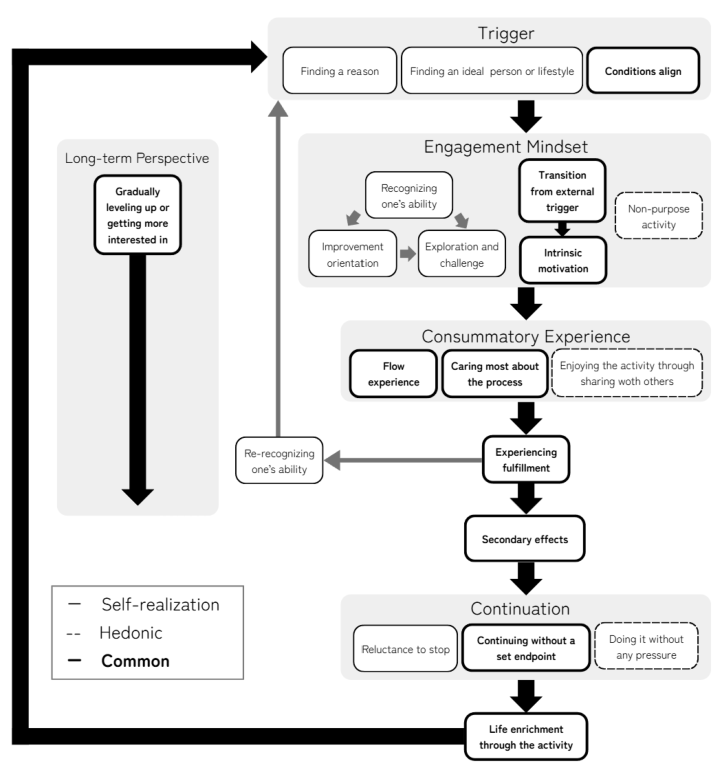
Analysis of the interview data yielded a process common across participants in their consummatory engagement, within which two broader tendencies, a self-realization tendency and a hedonic tendency, could be observed (as shown in Figure 1). Importantly, these tendencies did not function as discrete, mutually exclusive categories. Rather, individuals’ engagement leaned toward one tendency or the other to varying degrees, and in some cases combined elements of both within a single activity. Concepts that appeared consistently across participants regardless of this leaning are treated below as common elements of the process, while concepts specific to one tendency are identified accordingly.
At the broadest level, engagement began with a trigger that led participants into an engagement mindset, through which they came to experience the activity consummatorily. This consummatory engagement produced a sense of fulfillment, which in turn, for those on the self-realization side, prompted participants to re-recognize their own ability, and more generally produced secondary effects extending beyond the activity itself. Alongside this immediate cycle, a long-term perspective operated in parallel, in which participants gradually deepened their level of skill or interest over time. Together, these processes supported continuation of the activity, through which, over time, the activity came to enrich participants’ lives more broadly.
Trigger Across participants, activity onset was frequently described in terms of conditions aligning: the activity became possible because the surrounding environment happened to be right, because participants already owned something related to the activity, or because their life circumstances were stable enough to allow them to begin.
On the self-realization side, two further pathways into the activity were identified. The first, finding a reason, involved starting the activity out of an awareness that time was limited, or out of a wish to try something the participant was not yet good at or had never learned. The second, finding an
Unraveling the Process of Consummatory Engagement 1097 ideal, involved meeting someone the participant admired, perceiving value in a particular lifestyle, or being inspired by witnessing someone else’s effort.
Engagement Mindset Once participants had begun the activity, their manner of engaging with it diverged along the two tendencies.
Figure 1: Process model of consummatory engagement, showing a shared process (common) alongside self-realization and hedonic tendencies.
On the self-realization side, participants often described recognizing their own ability, a mixed sense of feeling motivated by a perceived talent, feeling that “I could do this too,” or conversely, becoming aware that their ability was not yet sufficient. This recognition fed into two related orientations: an improvement orientation, characterized by a drive to grow and a wish for
1098 Noda and Doi one’s effort to be recognized, and exploration and challenge, characterized by serious commitment to the activity and enjoyment of figuring things out through trial and error.
A concept common to both tendencies was the transition from an external trigger to intrinsic motivation. Several participants had originally taken up the activity because of an external circumstance, such as a school club, a family member’s recommendation, or an accidental encounter, rather than out of a spontaneous impulse of their own. Through repeated contact with the activity, however, they began to notice enjoyment or interest in it, and their engagement gradually became self-directed. A related pattern involved participants continuing or expanding an activity specifically because of a positive experience gained through it, whether a feeling of accomplishment, a sense of one’s own talent, or simple enjoyment, which then motivated further engagement or the pursuit of new but related activities. Once engagement became self-directed in this way, it was often sustained by an intrinsic motivation to engage in the activity simply because participants wanted to, found it enjoyable, or were curious about it, independent of any external obligation or defined goal. This intrinsic motivation also encompassed a seeking of novelty and new experiences, in which participants valued encountering something unfamiliar over repeating something already known, finding the encounter with the unfamiliar itself rewarding regardless of the specific object or outcome. As one participant, who enjoys window shopping, put it: “It’s not that I have a specific item in mind. It’s more that the surprise of finding something like ‘oh, this exists’ is what’s fun” (#2).
On the hedonic side, engagement was instead frequently described as non- purposive. Participants did not feel the activity needed to serve any particular reason, and it was often carried out simply during spare or free time.
Consummatory Experience This stage represents the core of consummatory engagement. Once engaged, participants across both tendencies commonly reported a flow experience, becoming fully absorbed in the activity. Within this, some participants specifically emphasized enjoying the activity even when engaging in it entirely alone, suggesting that shared participation, while valuable to some, was not a necessary condition for this absorption. As the participant who likes looking at the map says, “I don’t really need someone to look at the map with me. I mostly look at it on my own... but I also like looking at it together. It’s just that the places I want to see are the places I want to see, so I can look on my own too, and I still enjoy it that way” (#6).
Relatedly, participants across both tendencies described caring most about the process of the activity rather than its outcome, a defining feature of consummatory engagement.
On the hedonic side, some participants instead emphasized enjoying the activity through sharing it with others, in which the pleasure of the activity was heightened by exchanging discoveries, reactions, or emotions with another person.
Unraveling the Process of Consummatory Engagement 1099 Fulfillment and Re-recognizing One’s Ability
Following consummatory engagement, participants across both tendencies described experiencing fulfillment, a sense of accomplishment following each session of the activity, often continuing until this sense of satisfaction was reached.
On the self-realization side, this fulfillment frequently led participants to re-recognize their own ability: seeing visible results, feeling a sense of having grown, and wanting this effort to be recognized. This renewed recognition, in turn, often fed back into the improvement orientation described above, deepening participants’ desire to continue improving or finding a new role model or lifestyle.
Secondary Effects Beyond the immediate experience of the activity, participants across both tendencies described secondary effects extending into their broader lives: a refreshed mood, other unexpected positive effects, and the acquisition of abilities through the activity that proved useful beyond the activity itself. As participants described:
“I’ve become quite a bit more able to endure things, I think.” (#1) “[Through the activity] I’ve gained confidence in a lot of things... even if a huge earthquake hit, I feel like I’d be the one who survives.” (#7)
Long-Term Perspective Operating alongside this immediate cycle, participants described a longer- term trajectory in which their level of skill, frequency of engagement, or degree of interest gradually increased over time: the more they learned about the activity, the more interested they became, which in turn fed back into the trigger stage, sustaining renewed engagement with the activity over an extended period.
Continuation Continued engagement itself took different forms depending on tendency. On the self-realization side, participants described a reluctance to stop: a desire that was felt almost physically, that had become habitual, and that was tied to a sense of belonging with others who engaged in the same activity. Common to both tendencies was a pattern of continuing without a set endpoint, in which participants did not define a specific achievement or stopping point in advance, instead valuing the ongoing possibility of continued exploration itself. On the hedonic side, continuation was instead characterized by engaging without any pressure, free of obligation or external expectation.
Life Enrichment Finally, across both tendencies, sustained engagement in the activity was described as contributing to a broader enrichment of participants’ daily lives, extending beyond the activity itself into their mood, physical condition, and the smoothness of daily routines.
DISCUSSION
Theoretical Implications The findings extend existing theorizing on eudaimonic wellbeing (EWB) by offering a process-level account of how consummatory engagement unfolds over time. The concept of eudaimonia originates in Aristotelian philosophy, where it denotes living well through the exercise of one’s own excellence and potential (Aristotle, 1925). Ryff (1989) later operationalized this idea within psychology, framing EWB in terms of dimensions such as personal growth, purpose in life, and self-acceptance. Building on this, Ryan and Deci (2001) distinguished eudaimonic wellbeing, oriented toward self- realization and meaning, from hedonic wellbeing, oriented toward pleasure and the absence of pain. The two experiential tendencies identified in this study, a self-realization tendency and a hedonic tendency, closely parallel this distinction, suggesting that the well-established hedonic/eudaimonic contrast in the wellbeing literature also structures how consummatory engagement is experienced at the level of individual activity.
At the same time, the present findings suggest these tendencies are not fixed traits or categories but graded and situational leanings, with a shared process, immersion, fulfillment, and continuation, running underneath both. This is consistent with work linking flow, a state of complete absorption in an activity, to eudaimonic wellbeing; Mikus and Grant-Smith (2021), for instance, draw on flow and self-determination theory in proposing Eudaemonic Design, an approach to shaping the built environment to support human flourishing. The present study’s “flow experience” and “caring most about the process” concepts, both found to be common across tendencies, offer qualitative, process-oriented support for this proposed link between flow and EWB, describing concretely how such immersion is experienced and sustained in everyday consummatory activity.
Design Implications More broadly, this model offers a foundation for designing tools and experiences that help individuals identify and engage in consummatory activity in their own lives, in order to cultivate their own eudaimonic wellbeing. Rather than treating wellbeing as a byproduct of achievement or self-improvement, such designs could draw on the process identified here, from initial trigger through to continuation, to help individuals recognize what draws them into an activity and what sustains their motivation over time.
Limitations and Future Work This study has several limitations. First, the sample was limited to nine participants engaged in largely self-directed leisure activities. While some participants described enjoying their activity through sharing it with others, the present model remains centered on an individually-oriented conception of self-realization, mastery, personal growth, and goal pursuit, largely as they unfold within a single person’s relationship to their activity. Sustainable eudaimonic wellbeing, however, has also been argued to be cultivated through
Unraveling the Process of Consummatory Engagement 1101 relationships with others and with society more broadly (Chen, 2023), suggesting a boundary of the current model that future work should address by interviewing individuals whose consummatory engagement is more explicitly altruistic or prosocial in nature. Second, analysis was conducted primarily by a single researcher, which, while supplemented by regular discussion with a supervisor and peers, may introduce interpretive bias inherent to M-GTA’s researcher-centered analytic approach. Future research should extend this model to a broader range of activity types, including explicitly altruistic and prosocial activities, and examine how the proposed process and tendencies generalize across cultural and demographic contexts.
CONCLUSION
This study examined the motivational structure and developmental process underlying consummatory engagement in personal activity. Through M-GTA analysis of interviews with nine adults, we identified a shared process, encompassing trigger, engagement mindset, immersive consummatory experience, fulfillment, and continuation, alongside two graded experiential tendencies, self-realization and hedonic, through which this process is differently expressed. Rather than treating consummatory engagement as an all-or-nothing trait of certain activities, this process-level model offers a way of understanding how such engagement emerges, deepens, and sustains itself over time across a wide range of everyday activities. In doing so, it provides a foundation for helping individuals identify and cultivate consummatory activity in their own lives, in the pursuit of more fulfilling, meaningful personal experience.
REFERENCES
Aristotle. (1925). Nicomachean Ethics (W. D. Ross, Trans.). Oxford: Oxford University Press. Chen, D. (2023). Wellbeing no Tsukurikata [How to Create Wellbeing]. Tokyo:
NewsPicks Publishing. Kinoshita, Y. (2007). Shuseiban Grounded Theory Approach (M-GTA) no bunseki gihou [Analytic techniques of the Modified Grounded Theory Approach]. Toyama Daigaku Kango Gakkai Shi, 6(2), 1–10. Mikus, J., Grant-Smith, D. (2021) “Advancing eudaemonic design as an approach
to amplify health and well-being in the built environment”, in: Environments by Design: Health, Wellbeing and Place, Lindahl, Goran & An, Eric (Eds.). AMPS, United Kingdom, pp. 100–112. Mita, S. (2018). Gendai shakai wa doko e mukau ka: Kōgen no miharashi o kirihiraku koto [Where is contemporary society heading? Opening up a view from the plateau]. Tokyo: Iwanami Shoten. Ryan, R.M., Deci, E.L. (2001). On happiness and human potentials: A review of
research on hedonic and eudaimonic well-being. Annual Review of Psychology, 52, 141–166. Ryff, C.D. (1989). Happiness is everything, or is it? Explorations on the meaning of psychological well-being. Journal of Personality and Social Psychology, 57(6), 1069–1081. Yamaguchi, S. (2020). Bijinesu no mirai: Ekonomī ni hyūmaniti o torimodosu [The
future of business: Restoring humanity to the economy]. Tokyo: President Inc.
SEARCH THE AHFE DIGITAL BOOKSTORE BY ISBN
Explore the complete digital volume
Human Factors in Design, Engineering, and Computing
Read this individual research paper free through the original publisher, or explore the full digital proceedings book.