Weiyang Luo, Sayaka Noda, Toshiki Kuroda, Toshihisa Doi, Sayaka Yamane, Masahiro Kuwa, Shun Ando (2026). UX Research for Designing Plastic Household Products—Perspectives of Time Efficiency, Mindful Living, and Environmental Awareness. In: Human Factors in Design, Engineering, and Computing. AHFE Open Access, vol. 238, pp. 1102–1110. https://doi.org/10.54941/ahfe1008340
This study explored design opportunities for plastic household products by focusing on two lifestyle perspectives: time performance and mindful living, and environmental awareness and circularity. A screening survey was conducted to identify participants who represented these lifestyle values, followed by semi-structured interviews with nine participants. The interviews explored concrete everyday behaviors and product use related to activities such as food preparation, storage, organization, cleaning, and waste disposal. The interview data were hierarchically analyzed by organizing relationships among concrete behaviors (Have), underlying goals and needs (Do), and higher-level values (Be). The results showed that participants did not simply seek to maximize efficiency or environmental performance, but balanced these values with personal preferences, effort, and priorities in everyday life. Three design opportunities were derived from the identified relationships: reducing unnecessary effort in everyday life、preserving personally meaningful experiences while supporting efficiency and integrating circularity into everyday choices and product use. These findings provide a basis for translating lifestyle values into product concepts and user experiences for plastic household products.
Household products are closely associated with everyday activities such as cooking, storage, cleaning, and waste disposal. Therefore, designing new household products requires an understanding not only of product-related needs but also of how people’s lifestyle values are reflected in their everyday behaviours and product use. In this study, preliminary desk research identified two perspectives relevant to the exploration of new plastic household products: time performance and mindful living, and environmental awareness and circularity.
UX Research for Designing Plastic Household Products 1103 The first perspective concerns how people allocate time and effort in everyday life. While time performance emphasizes making effective use of limited time, mindful living involves devoting time and effort to activities that people personally value. These orientations are not necessarily contradictory; people may seek efficiency in some activities in order to devote more time to others they consider important. Time-saving technologies can also influence how people allocate their time in everyday life (Mizobuchi, 2024). Thus, understanding not only where people seek efficiency but also where they are willing to invest time and effort may reveal opportunities for household product design.
The second perspective concerns environmental awareness and circularity and is particularly relevant to plastic household products. Supporting circularity involves not only materials and product structures but also user behaviours such as product selection, use, reuse, and disposal (Wastling, 2018). Previous research has also shown that consumer acceptance of products made from recycled plastics is related to environmental consciousness as well as perceptions of product quality, functionality, and trust (Ruokamo, 2022) (Polyportis, 2023). Therefore, understanding how environmental considerations are translated into everyday choices and behaviours is important when exploring new forms of value for plastic household products.
However, translating these lifestyle trends into product proposals requires more than understanding people’s attitudes toward them. It is necessary to examine what people actually do in everyday life, how they use and select products, and what goals and values underlie these behaviours. Therefore, this study conducts UX research with people who embody these lifestyle perspectives and analyses the relationships between concrete everyday behaviours, product use, underlying goals, and higher-level values. The aim is to identify latent user needs and derive insights for the planning and design of new plastic household products.
METHODS
Research Procedure This study was conducted through a sequence of desk research, a screening survey, semi-structured interviews, and interview data analysis to derive insights for the planning and design of new plastic household products based on lifestyle trends.
First, desk research was conducted to investigate trends in people’s values and lifestyles, from which two perspectives were identified: time performance and mindful living, and environmental awareness and circularity. A screening survey was then conducted based on these lifestyle values, and participants who met the screening criteria were selected for semi-structured interviews. The interviews explored participants’ concrete behaviours and product use in everyday life, as well as the thoughts and goals underlying these behaviours.
The interview data were subsequently organized hierarchically, from concrete behaviours to their underlying goals and, further, to fundamental values, and the hierarchical relationships among these elements were analysed. Through this process, latent user needs were identified and translated into insights for the planning and design of new plastic household products.
Screening and Participant Recruitment Participants for the interviews were selected through a preliminary online screening survey. The screening focused on three perspectives: time performance, mindful living, and environmental awareness and circularity, and assessed participants’ orientations and behaviours in everyday life. Each item was rated on a five-point scale ranging from 1 (“not applicable at all”) to 5 (“highly applicable”).
The main screening items for each perspective are shown in Table 1.
Table 1: Screening items for each perspective.
Table available in the original PDF paper.
Perspective Screening Item Criterion 4-5 Time performance I engage in everyday activities that I complete efficiently and within a short period of time.
4-5
Mindful living There are activities in my daily life that I consider important enough to devote time and effort to.
4-5
Environmental awareness and circularity
I consider environmental impacts and take actions in my daily life, such as reuse, recycling, and environmentally conscious purchasing and product selection.
For time performance, participants were asked whether they engaged in everyday activities that they completed efficiently and within a short period of time. For mindful living, they were asked whether there were activities in their daily lives to which they devoted time and effort because they considered them important. For environmental awareness and circularity, participants were asked whether they considered environmental impacts and translated this awareness into everyday actions, such as reuse, recycling, and environmentally conscious purchasing and product selection. Participants who selected 4 or 5 were also asked to provide concrete examples of relevant behaviours, including activities in the kitchen and the management, storage, and organization of household items.
Respondents who selected 4 or 5 for the respective screening items were considered eligible for the interviews, and their open-ended responses were also reviewed to confirm concrete examples of the relevant behaviours. The three perspectives were not mutually exclusive; therefore, some participants met the criteria for more than one perspective. A total of nine participants were interviewed. Their ages and corresponding lifestyle orientations are presented in Table 2.
Table 2: Participant characteristics and screening results.
Table available in the original PDF paper.
Participant Age Time Performance
Mindful Living
Environmental/ Circular Practices P1 21 2 4 2
P2 23 4 2 2 P3 22 4 2 3
(Continued)
Table 2: Continued.
Table available in the original PDF paper.
Participant Age Time Performance
Mindful Living
Environmental/ Circular Practices P4 22 5 2 3
P5 31 4 4 4 P6 21 4 4 4
P7 22 4 3 4 P8 21 4 4 2
P9 39 4 4 4
Semi-Structured Interviews Semi-structured interviews were conducted either face-to-face or online via Zoom. In principle, each interview was conducted by one researcher with one participant, while another researcher attended the session and recorded notes. With the participants’ consent, the interviews were also audio-recorded.
The interviews focused on concrete behaviours and product use in participants’ everyday lives, particularly activities in the kitchen and the management, storage, and organization of household items. Specific experiences related to time performance, mindful living, and environmental awareness and circularity, as identified through the screening survey, were used as starting points for the interviews. Participants were asked about the situations in which these experiences occurred, the products they used, and the reasons behind their behavio画rs. Follow-up questions were asked flexibly based on participants’ responses to explore the thoughts and goals underlying their everyday behaviours.
Interviews lasted approximately 30 minutes when one lifestyle perspective was explored and approximately 60 minutes when two perspectives were explored.
Data Analysis The interview data were analysed collaboratively by four researchers involved in the study. First, statements describing concrete everyday behaviours and product use were extracted from the interview data. For each behaviour, the researchers examined the underlying goals and needs by considering why the behaviour was performed and what the participant sought to achieve through it. The higher-level values underlying these goals and needs were then identified.
Through this process, the extracted elements were progressively organized into a hierarchical structure based on means–end relationships, from concrete behaviors and product use, to underlying goals and needs, and further to higher-level values. The relationships among these elements were examined by referring back to participants’ statements during the interpretation process.
The four researchers jointly examined the extracted elements and their hierarchical relationships. Separate hierarchical structures were developed for the two lifestyle perspectives addressed in this study: time performance and mindful living, and environmental awareness and circularity. These structures were then examined to identify characteristic relationships between everyday behaviors, underlying goals and needs, and higher-level values.
RESULTS
Selected hierarchical relationships identified from the analysis of time performance and mindful living are shown in Figs. 1 and 2.
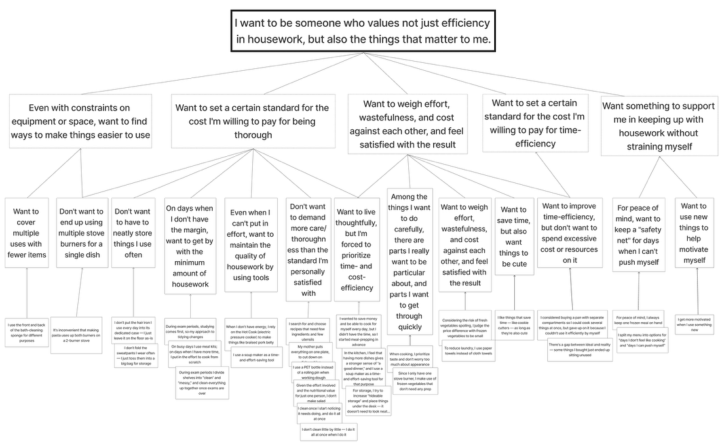
As shown in Fig. 1, participants’ everyday behaviours were associated with a higher-level value of prioritizing not only efficiency in household activities but also aspects of everyday life that they personally considered important. Under this value, needs were identified related to balancing time, effort, and cost, maintaining personal standards, and saving time without excessive cost or burden.
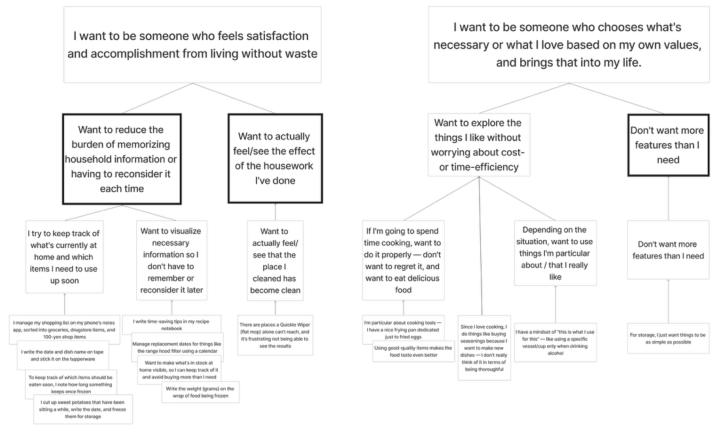
As shown in Fig. 2, the higher-level value of gaining satisfaction and accomplishment from living without waste was associated with a need to reduce the burden of remembering household information or reconsidering it each time. A need to perceive or see the effects of completed housework was also identified. Another higher-level value concerned choosing what was necessary or personally preferred based on one’s own values. Within this structure, a need to avoid unnecessary product features was identified.
Figure 1: Hierarchical relationships associated with balancing time efficiency and personally meaningful aspects of everyday life.Figure 2: Selected relationships between higher-level values and characteristic household needs.
Overall, four characteristic relationships were identified in relation to time performance and mindful living: reducing the burden of remembering and repeated decision-making, perceiving the outcomes of household activities, valuing personally meaningful aspects of everyday life in addition to efficiency, and avoiding unnecessary product features.
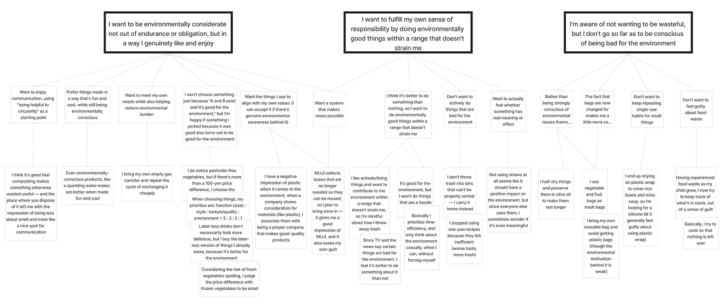
The hierarchical structure identified for environmental awareness and circularity is shown in Fig. 3. Three higher-level values were identified.
The first concerned engaging in environmentally conscious behaviour in ways that participants genuinely liked or enjoyed, rather than out of obligation or endurance. This value was associated with combining environmental consideration with enjoyment, personal needs, and individual preferences.
The second concerned fulfilling a sense of environmental responsibility within a range that did not impose excessive burden. Related needs included taking environmentally beneficial actions within manageable limits and avoiding actions perceived as environmentally harmful.
The third reflected an intention to avoid waste in everyday life without necessarily maintaining a strong awareness of environmental issues. This value was associated with behaviours such as reuse, reducing single-use items, and preventing food waste.
Overall, the environmental awareness and circularity analysis revealed three characteristic values: engaging in environmentally conscious behaviour in personally desirable ways, taking such actions within an acceptable level of effort, and engaging in circular or waste-reducing behaviours without necessarily being strongly motivated by environmental concerns.
Figure 3: Hierarchical structure of needs related to environmental awareness and circularity.
DISCUSSION
The findings suggest that lifestyle values were not translated into everyday behaviors in a straightforward manner. Participants did not simply seek to minimize effort or maximize environmental performance. While some forms of effort were regarded as burdens to be reduced, others were preserved because they were associated with personally meaningful activities or a sense of accomplishment. Similarly, some environmentally beneficial behaviors emerged from everyday motivations, such as avoiding waste, rather than from explicit environmental concerns. These findings provide several perspectives for exploring future household product concepts.
Reducing Cognitive Burden in Everyday Activities One practical finding concerns the cognitive burden involved in managing everyday household activities. Participants expressed a need to reduce the burden of remembering household information or reconsidering it repeatedly. This suggests that efficiency in everyday life may involve not only shortening the time required to perform a task but also reducing less visible forms of effort, such as remembering, checking, and making repeated decisions.
This finding broadens the notion of time efficiency from task execution itself to the cognitive processes surrounding everyday activities. This perspective may be useful when exploring household product concepts that support everyday management.
Distinguishing Effort to Reduce From Effort to Preserve A more notable finding was that effort itself was not always regarded as undesirable. Although participants sought efficiency in some household activities, they were also willing to spend time and effort on activities that they personally valued. In addition, perceiving the outcomes of completed housework was associated with feelings of satisfaction and accomplishment. These findings suggest that the relationship between efficiency and effort is not simply one of minimization.
UX Research for Designing Plastic Household Products 1109 From a design perspective, an important question may therefore be which forms of effort users wish to reduce and which they wish to preserve. Rather than assuming that all time and effort spent on household activities should be minimized, future product exploration could consider how efficiency can coexist with activities and experiences that users personally value.
Embedding Circularity in Everyday Motivations Another notable finding was that environmentally beneficial behaviors were not necessarily driven primarily by environmental awareness. Some participants described behaviors such as reuse and reducing food waste in relation to an intention to avoid waste in everyday life rather than to explicit environmental concerns. This suggests that circular behaviors may emerge from ordinary personal values and motivations that are not primarily environmental.
Participants also preferred environmentally conscious behaviors that were compatible with what they liked or enjoyed. This raises another perspective for future product exploration: rather than treating environmental consideration as an independent requirement or obligation, circularity could be considered in relation to motivations already present in everyday life, such as avoiding waste, personal preference, or enjoyment.
Taken together, the findings suggest that opportunities for future product exploration may lie not simply in reducing effort or emphasizing environmental performance, but in understanding which forms of effort users wish to reduce or preserve and how circular behaviors relate to motivations already embedded in everyday life. These findings are exploratory and are intended to provide starting points for the development of new plastic household product concepts rather than prescriptive design requirements.
CONCLUSION
This study explored opportunities for the design of new plastic household products by focusing on two lifestyle perspectives: time performance and mindful living, and environmental awareness and circularity. Through screening and semi-structured interviews with nine participants, relationships among concrete everyday behaviors and product use, underlying goals and needs, and higher-level values were analyzed hierarchically.
The findings highlighted three perspectives for future product exploration. First, time efficiency involved not only reducing task execution time but also reducing cognitive burdens such as remembering and repeated decision- making. Second, effort was not always regarded as undesirable; participants sought to reduce some forms of effort while preserving others associated with personally meaningful activities and a sense of accomplishment. Third, some environmentally beneficial behaviors emerged from everyday motivations such as avoiding waste rather than from explicit environmental concerns. These findings provide exploratory starting points for developing new plastic household product concepts. Future work will translate these perspectives into concrete product concepts and examine their relevance through further design development and evaluation.
ACKNOWLEDGMENT
This work was supported by Sanko Plastic Co., Ltd. through a collaborative research agreement.
REFERENCES
Mizobuchi, K., & Yamagami, H. (2024). Impact of time-saving technology on household electricity consumption: An automatic vacuum cleaner distribution experiment in Japan. Ecological Economics, 223, 108231. Polyportis, A., Magnier, L., & Mugge, R. (2023). Guidelines to Foster Consumer
Acceptance of Products Made from Recycled Plastics. Circular Economy and Sustainability, 3(2), 939–952. Ruokamo, E., Räisänen, M., & Kauppi, S. (2022). Consumer preferences for recycled plastics: Observations from a citizen survey. Journal of Cleaner Production, 379, 134720. Wastling, T., Charnley, F., & Moreno, M. (2018). Design for Circular Behaviour:
Considering Users in a Circular Economy. Sustainability, 10(6), 1743.
SEARCH THE AHFE DIGITAL BOOKSTORE BY ISBN
Explore the complete digital volume
Human Factors in Design, Engineering, and Computing
Read this individual research paper free through the original publisher, or explore the full digital proceedings book.