Activity-Based Working (ABW) and hot desking have spread, but which spatial features promote employee creativity, and how, remains unclear. We surveyed 1,000 Japanese office workers on spatial/environmental features, psychological variables, workplace satisfaction, and creativity, using regression and path analysis. Psychological variables (R² = .481) and satisfaction items (R² = .285) explained considerable variance in creativity, with communication, personal control, and openness as key predictors. An exploratory path model (CFI = .816, RMSEA = .115) showed communication as the strongest direct predictor (β = .499, p < .001), followed by openness (β = .246) and personal control (β = .097, p < .05). The number of shared facilities had the largest indirect effect on creativity (β = .115, via communication), and seating arrangement a smaller indirect effect via personal control (β = .043). These results suggest spatial features may be associated with creativity indirectly, via communication and personal control.
Activity-Based Working (ABW) and hot-desking arrangements, in which employees choose where to work depending on the task at hand rather than being assigned a fixed seat, have spread rapidly across offices in recent years, driven in part by workstyle reform initiatives and the need to use office space more flexibly (e.g., Senbon et al., 2021; Maruyama and Watanabe, 2020). The degree of choice employees have over where and how they work has increasingly been recognized as an important factor in workplace outcomes: prior studies suggest that allowing workers to select and adjust their own environments may contribute to creativity and performance (Inamizu, 2019; Lee and Brand, 2010), while studies of open-plan offices point to a trade-off between concentration and opportunities for collaboration (Seddigh et al., 2014; de Been and Beijer, 2014). Among the outcomes of particular interest is employee creativity: as economies shift toward knowledge-based work, the ability to generate novel and useful ideas is increasingly recognized as a key driver of organizational competitiveness (Dul et al., 2011).
Exploring Spatial and Psychological Factors Associated With Creativity 2625 ABW environments generally provide different types of workspaces suited to different activities. For example, individual booths or other enclosed spaces may be considered suitable for tasks requiring high levels of concentration and creativity. However, providing dedicated workplace settings for every type of activity also creates practical constraints in office planning, particularly when a limited amount of floor space must accommodate a given number of employees. Addressing this challenge requires moving beyond a simple one-to-one correspondence between activities and workspace types—for example, assuming that highly focused creative work should always be performed in an enclosed room. Instead, it is necessary to understand the specific environmental factors that influence creativity and work performance and to explore spatial design strategies that may mitigate the trade- offs among different workplace requirements.
However, it remains unclear which factors promote creativity, or how. Office creativity is shaped not only by workers’ personality traits and internal motivation, but also by the physical environment – layout, sound and sightlines, privacy, and related features. Recent work suggests that what matters is not merely the freedom to choose one’s seat, but a broader “degree of choice” to select an environment suited to the task at hand (Inamizu, 2019). A number of studies point to specific physical features – seating layout, the availability of shared spaces, and the distance to others (proximity, sightlines, and screening) – as potentially relevant to creativity, but findings remain scattered, and it is seldom examined how these features translate into creative outcomes through workers’ everyday psychological experience of the workplace, such as personal control, privacy, and team communication (e.g., Orfield et al., 2005; Kim and de Dear, 2013).
The purpose of this study was to clarify what office spatial layout contributes to enhancing employee creativity. In particular, we focus on distance to others – proximity, sightlines, and screening – and, building on the trade-off whereby proximity facilitates collaboration while excessive interference or interruption impairs concentration, we examine the relationship between collaboration (interaction, conversation, and mutual engagement) and creativity.
METHOD
Participants and Procedure An online survey was administered to office workers in Japan via Freeasy, a Japanese web-based research panel, using a two-stage, self-administered questionnaire: a screening survey followed by the main survey, both single time-point administrations. This study was approved by the Institutional Review Board of Osaka Metropolitan University.
The screening survey (conducted May 22–23, 2026) identified respondents who (a) had worked at their current office for at least one year, (b) attended the office at least three days per week, and (c) worked on a floor/in a room with at least 11 occupants, corresponding to an open-plan office as defined by Bodin Danielsson and Bodin (2009); 8,060 respondents met these criteria (4,047 men, 4,013 women). Eligible respondents were further screened for the extent to which their job involved creative work, using a short, reverse- coded composite item, and those who met this criterion were invited to the main survey. The main survey (conducted May 27–30, 2026) yielded 1,000
complete responses (500 men, 500 women, quota-sampled to an even gender split), which were used in all analyses reported in this paper. Age, job type, and other demographic details were obtained from Freeasy’s panel profile data.
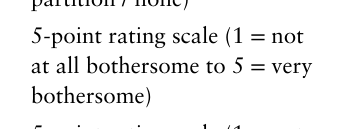
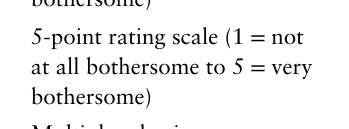
Measures Unless otherwise noted, all scale items used Likert-type response formats; composite scores were computed as the mean of the constituent items. A full listing of the main-survey items is provided in Table 1.
Example items included “I often come up with new ideas” (creativity) and “I can personalize/customize my workspace” (personal control). Personality items (openness, extraversion) were used as control variables. Privacy items were partly reverse-scored.
Workplace satisfaction (ease of interaction) Workplace satisfaction (furniture comfort/adjustability)
Data Analysis First, to examine the relationships between individual spatial/ environmental features and creativity, one-way analyses of variance (ANOVAs) were conducted for categorical variables, while correlation coefficients with creativity were calculated for continuous variables. In addition, a multiple regression analysis was conducted with all spatial/ environmental features as explanatory variables and creativity as the dependent variable.
For these analyses, responses for several variables were processed as follows. For frequency of seat selection, responses from participants who were unable to choose their seats were treated as missing values (NA). For shared facilities, the number of selected facility types was treated as a continuous variable. The presence of other people around the respondent was assessed separately in four directions (left, right, front, and back),
with each direction coded as 2 = “present,” 1 = “sometimes present,” and 0 = “not present.” The scores for the four directions were summed and treated as a continuous variable. For partition, high partitions were coded as 2, low partitions as 1, and no partitions as 0. The sum of these scores was divided by the number of adjacent people, and the resulting value was treated as a continuous variable. When there were no adjacent people, the value was treated as missing (NA).
Two further multiple regression models examined creativity as predicted separately by (a) the psychological variables and (b) workplace satisfaction.
In addition, because spatial/environmental features were assumed to influence workers’ psychological experiences, which in turn may affect creativity and workplace satisfaction, path analysis was conducted to simultaneously examine the relationships among these variables. Including all measured variables would have resulted in an excessively complex model; therefore, only spatial/environmental variables with theoretically plausible relationships to the psychological variables examined in this study were included in the path model.
RESULTS
Descriptive/simple tabulations were computed in Excel; multiple regression, correlation, and path analyses were conducted in R.
Effects of Spatial/Environmental Features on Creativity We first examined univariate and bivariate associations between each spatial/environmental feature and creativity (N = 1,000). Seating policy, seat-change frequency, and view from one’s seat were significantly associated with creativity (one-way ANOVAs; η² = .011-.029, small to small-moderate effect sizes), whereas passerby frequency and neighbor density were not. The number of shared facilities and the partition score were also significantly, though weakly, correlated with creativity (r = .27 and .10, respectively). A multiple regression using only the spatial/ environmental features (i.e., without the psychological and satisfaction variables) was significant overall, though modest in explanatory power (R² = .092), with the number of shared facilities, seating policy, and view from one’s seat as significant predictors.
Descriptive Statistics and Correlations Among Psychological Variables
Table 2 presents correlations among the psychological variables, personality controls, and creativity (N = 1,000). All variables were significantly and positively correlated with creativity (r = .26-.61, p < .001), with the three communication subscales showing the strongest associations. The three communication subscales were highly intercorrelated with one another (r = .86, p < .001 for each pair), and personal control was strongly correlated
Exploring Spatial and Psychological Factors Associated With Creativity 2629 with degree of choice (r = .69, p < .001); these associations were taken into account when interpreting the regression results below.
Table 2: Correlations among psychological variables, personality controls, and creativity (N = 1,000).
Regression Analysis of Psychological Variables As shown in Table 3, the model explained a substantial proportion of variance in creativity, adjusted R² = .477. Spontaneous communication (β = .352, p < .001), openness (β = .223, p < .001), and personal control (β = .151, p < .001) were significant positive predictors. Focused communication (β = .098, p = .058) and knowledge sharing (β = .083, p = .109) approached but did not reach significance; degree of choice, privacy, and extraversion were not significant predictors.
Table 3: Multiple regression predicting creativity from psychological variables and personality (N = 1,000).
Table available in the original PDF paper.
Variable B SE ß t p VIF Personal control 0.081 0.018 .151 4.481 <.001 2.17 Degree of choice 0.023 0.015 .050 1.538 .124 2.00
Table 4 presents correlations among the ten workplace-satisfaction items (N = 1,000). All items were significantly and positively correlated with one another (r = .42-.77, p < .001).
Table 4: Correlations among workplace-satisfaction items (N = 1,000).
Regression Analysis of Satisfaction Items Model (b), predicting creativity from the ten workplace-satisfaction items, also explained a significant, though smaller, proportion of variance, adjusted R² = .278. As shown in Table 5, satisfaction with ease of interaction with colleagues (β = .257, p < .001), the scope for adjusting furniture to one’s needs (β = .094, p = .032), and brightness (β = .101, p = .026) were significant positive predictors; the remaining satisfaction items (temperature, general lighting, noise level, acoustic privacy, personal/storage space, visual privacy, and furniture comfort) were not significant.
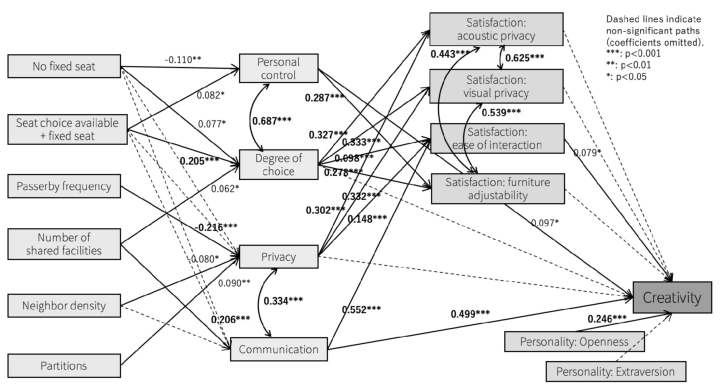
Path Analysis We estimated a hypothesized structural model linking spatial/environmental features, the psychological variables, workplace satisfaction, and creativity using path analysis (structural equation modeling) in R. Team communication was entered as a single composite (the mean of all nine items) rather than as the three subscales used in the regression above, to keep the path model parsimonious. Model fit fell short of conventional thresholds (CFI = .816, TLI = .716, RMSEA = .115, SRMR = .149); because the aim of this analysis was to explore plausible mediating pathways rather than to confirm a fully specified model, the model was revised iteratively based on modification indices, and the resulting fit was judged adequate for interpreting the pattern of effects reported below.
As shown in Figure 1, communication, openness, personal control, and satisfaction with ease of interaction had significant direct effects on creativity; the remaining three satisfaction facets (acoustic privacy, visual privacy, and furniture adjustability) did not.
Table 6 presents the total standardized indirect effects of each spatial/ environmental feature on creativity. The number of shared facilities had by far the largest indirect effect (β = .115, p < .001), operating mainly through communication (both directly, shared facilities → communication → creativity, and via satisfaction, shared facilities → communication → satisfaction with ease of interaction → creativity). A seating policy that allows a choice of seats while retaining a fixed seat also showed a smaller but significant indirect effect (β = .043, p < .05), operating mainly through personal control. Indirect effects of having no fixed seat at all, neighbor density, passerby frequency, and the presence of partitions were not significant. Indirect pathways through privacy were not significant, consistent with privacy’s non-significant direct effect on creativity in the psychological-variable regression (Table 3).
Table 6: Standardized total indirect effects on creativity.
Table available in the original PDF paper.
Predictor ß p Number of shared facilities 0.115 < .001 Seat choice available + fixed seat 0.043 < .05
No fixed seat –0.031 n.s.
Neighbor density 0.006 n.s.
Passerby frequency –0.001 n.s.
Partitions 0.000 n.s.
Figure 1: Path model linking spatial features, psychological variables, workplace satisfaction, and creativity.
DISCUSSION
This study examined which spatial/environmental features of the office are associated with employee creativity, and through which psychological pathways these associations may operate. Consistent with the framing set out in the Introduction, the path analysis indicated that spatial features were not directly associated with creativity; instead, their associations with creativity were primarily observed via two psychological variables: team communication and personal control. This pattern echoes the trade-off between proximity-driven collaboration and interference/interruption that motivated this study, and offers a more specific picture of which side of that trade-off was more strongly reflected in the present, cross-sectional sample.
Team communication had by far the strongest direct association with creativity (β = .499, p < .001), and the number of shared facilities available near one’s seat showed the largest indirect association with creativity of any spatial feature (β = .115, p < .001), an association that appeared to run mainly through communication. This is broadly consistent with prior work suggesting that proximity to shared spaces and opportunities for spontaneous interaction are linked to creative activity (Xu and Nishide, 2016): in the present data, shared facilities were associated less with distraction and
Exploring Spatial and Psychological Factors Associated With Creativity 2633 more with the kind of collaboration – interaction, conversation, and mutual engagement – that the Introduction identified as central to the proximity side of the trade-off.
Personal control also had a significant, if smaller, direct effect on creativity (β = .097, p < .05), and a seating policy that allowed workers to choose a seat while still retaining a fixed one showed a small but significant indirect effect via personal control (β = .043, p < .05). This is consistent with the idea, raised in the Introduction, that what matters for creativity is not simply the freedom to move around, but a “degree of choice” that lets workers select an environment or seat suited to the task at hand (Inamizu, 2019); in the regression analysis as well, personal control was one of only three variables – alongside communication and openness – with a significant, positive association with creativity.
The interference side of the proximity trade-off was less clearly supported by the present data. Privacy showed no significant association with creativity in either the regression or the path analysis, and among the workplace- satisfaction facets entered into the path model only satisfaction with ease of interaction had a significant direct effect (β = .079, p < .05); satisfaction with acoustic privacy, visual privacy, and furniture adjustability were not significant. One possible explanation is that the present measures captured workers’ average experience of interference rather than the specific instances of disruption that the trade-off argument concerns; another is that, in this sample, the benefits of proximity for collaboration outweighed its costs for concentration, consistent with the overall pattern of direct and indirect effects reported above.
Taken together, these results point to two factors worth considering for office layouts intended to enhance creativity: designing for opportunities to communicate – for example, through the placement and number of shared facilities – and preserving workers’ sense of control over where and how they work, for example through seat-choice policies. Both appeared to be associated with creativity indirectly, through workers’ everyday psychological experience of the workplace, rather than through the physical features themselves.
Limitations This study has several limitations. First, the path model’s fit fell short of conventional thresholds (CFI = .816, RMSEA = .115), so the reported pathways should be interpreted as exploratory rather than confirmed; alternative model specifications were not formally compared. Second, the cross-sectional design means that the direction of these associations cannot be established: for example, workers who are already more creative may perceive more opportunities for communication or greater personal control, rather than communication and control driving creativity. Third, all measures were self-reported by the same respondents, which may have inflated the observed associations through common method bias. Future research using longitudinal or experimental designs, and multiple data sources, is needed to clarify the direction and robustness of these relationships.
CONCLUSION
This study examined which office spatial/environmental features are associated with employee creativity, and through which psychological pathways. Spatial features were related to creativity indirectly, chiefly through team communication and personal control: shared facilities mainly via communication, and seat-choice policies mainly via personal control. These findings suggest that office layouts intended to enhance creativity may benefit from considering opportunities for communication and workers’ sense of control over their workspace, rather than treating physical features as factors on their own.
ACKNOWLEDGMENT
This work was supported by ITOKI Corporation through a collaborative research agreement.
REFERENCES
Bodin Danielsson, C., and Bodin, L. (2009). Difference in satisfaction with office environment among employees in different office types. Journal of Architectural and Planning Research, 26(3), 241–257. De Been, I., and Beijer, M. (2014). The influence of office type on satisfaction and
perceived productivity support. Journal of Facilities Management, 12(2), 142–157. Dul, J., Ceylan, C., and Jaspers, F. (2011). Knowledge workers’ creativity and the role of the physical work environment. Human Resource Management, 50(6), 715–734. Hartner-Tiefenthaler, M., Loerinc, I., Hodzic, S., and Kubicek, B. (2022). Development
and validation of a scale to measure team communication behaviors. Frontiers in Psychology, 13, 961732. Inamizu, N. (2019). [The effect of choosing office environments according to activities on individuals and organizations]. The Japanese Journal of Labour Studies, 61(8), 52–62. (in Japanese) Kim, J., and de Dear, R. (2013). Workspace satisfaction: The privacy-communication
trade-off in open-plan offices. Journal of Environmental Psychology, 36, 18–26. Laurence, G., Fried, Y., and Slowik, L.H. (2013). “My space”: A moderated mediation model of the effect of architectural and experienced privacy and workspace personalization on emotional exhaustion at work. Journal of Environmental Psychology, 36, 144–152. Lee, S.Y., and Brand, J.L. (2010). Can personal control over the physical environment
ease distractions in office workplaces? Ergonomics, 53(3), 324–335. Maruyama, K., and Watanabe, A. (2020). [Consideration of information processing work that focuses on the desk layouts 1: The effects of the desk layouts of opposite system, same direction system and left and right opposite system on information processing work]. Bulletin of Japan Society of Interior Design, 30, 49–56. (in Japanese) Orfield, S., Brand, J., and Pakkarainen, P. (2005). Effects of control over office
workspace on perceptions of the work environment and work outcomes. Journal of Environmental Psychology, 25(3), 323–333. Oshio, A., Abe, S., and Cutrone, P. (2012). [Development, reliability, and validity of the Japanese version of Ten Item Personality Inventory (TIPI-J)]. Japanese Journal of Personality, 21(1), 40–52. (in Japanese)
Exploring Spatial and Psychological Factors Associated With Creativity 2635 Seddigh, A., et al. (2014). Concentration requirements modify the effect of office type
on indicators of health and performance. Journal of Environmental Psychology, 38, 167–174. Senbon, Y., Ukai, M., Kanie, A., Ono, S., Okamura, S., Nakamura, D., and Tanabe, S.
(2021). [Study on worker satisfaction and intellectual productivity in mega plate offices adopting Activity-Based Working]. Journal of Environmental Engineering (Transactions of AIJ), 86(788), 818–828. (in Japanese) Wężiak-Białowolska, D., Dong, Z., and McNeely, E. (2018). Turning the mirror on the architects: A study of the open-plan office and work behaviors at an architectural company. Frontiers in Psychology, 9, 2178. Xu, H., and Nishide, K. (2016). Effects of layout and communication on the creativity
and psychological evaluation. Journal of Architecture and Planning (Transactions of AIJ), 81(722), 831–839. Zagreus, L., Huizenga, C., Arens, E., and Lehrer, D. (2004). Listening to the occupants: A Web-based indoor environmental quality survey. Indoor Air, 14(s8), 65–74.
SEARCH THE AHFE DIGITAL BOOKSTORE BY ISBN
Explore the complete digital volume
Human Factors in Design, Engineering, and Computing
Read this individual research paper free through the original publisher, or explore the full digital proceedings book.