Salim Zenasni, Tanguy Marqueste, Richard Kronland-Martinet, Sølvi Ystad, Mitsuko Aramaki, Erick Dousset (2026). A Better Understanding of Vibrations: First Insights on the Influence of Vibratory Stimuli on Postural Adjustments in the Sitting Posture Context. In: Human Factors in Design, Engineering, and Computing. AHFE Open Access, vol. 238, pp. 1083–1092. https://doi.org/10.54941/ahfe1008338
Prolonged static sitting causes discomfort, neuromuscular fatigue and poor blood flow that can lead to health problems. Nevertheless, even slight changes in posture can improve comfort and spinal health. However, individuals who sit for long periods often fail to perform these adjustments due to task engagement or lack of awareness. While vision dominates task-oriented contexts, the tactile modality, particularly vibrations, remains underexplored as an intervention medium to induce postural changes. This study proposes to integrate a vibratory stimulation system in a seat to trigger postural adjustments and alleviate neuromuscular fatigue. To this aim, we implemented carefully configured dynamic vibrations, following results of our previous study that showed the positive influence of vibrations on postural muscle tone (Zenasni et al., 2025). The influence of vibratory stimuli on seated posture and perceived discomfort has so far been little examined. We therefore investigated this relationship by measuring objective parameters such as centre of pressure displacement as well as neck and torso joint angles using sensor mats and cameras. For several conditions, neck and trunk inclination angles varied significantly over time. Vibratory stimulations significantly influenced postural activity, with effects varying across multiple seat regions, particularly under the same experimental conditions. These results reveal that vibratory stimuli, depending on their dynamic parameters, can induce specific postural micro-adjustments during seated posture. Going further, we aim at investigating the influence of additional modalities, such as auditory stimulations on postural adjustments to assess whether combining tactile and auditory cues enhances postural adjustment efficiency across a wide range of contexts (transportation means, workplaces, gaming …).
Sedentary lifestyles have made prolonged sitting increasingly common, which can lead to a range of adverse health consequences. While ergonomic chairs and sit-stand desks offer partial relief, neither static sitting nor static standing solves the underlying problem: held postures limit spinal mobility and are associated with poor blood circulation, neuromuscular fatigue,
discomfort and back pain (Al-Dirini, Reed & Thewlis, 2015). In seated activities, such as office work, spontaneous postural adjustments are limited because users prioritize task performance over unnecessary movements (Witchel et al., 2016). Minor shifts in posture are known to have beneficial effects by promoting nutrient transport (Wilke et al., 2001) while clear directional movements can relieve the sitting interface pressure (Sundaram et al., 2025). These findings support the need for interventions that elicit postural readjustments without disrupting the primary task.
One candidate mechanism is vibrotactile stimulation, which draws on a sensory channel that is typically underused (Myles and Binseel, 2009) and can therefore deliver information without interfering with the cognitive or visual demands of a primary task. This modality has been increasingly leveraged to trigger postural responses in seated users (Zheng and Morrell, 2010). How such stimulation is perceived, and how the body responds to it, depends on several parameters at once: frequency, amplitude, waveform, duration, and the part of the body it is applied on. Perception itself relies jointly on proprioceptive muscle spindles and cutaneous mechanoreceptors, mainly through Meissner and Pacinian corpuscles (Bolanowski et al., 1988). Despite this, most existing work has targeted whole-body vibration rather than localized stimulation, leaving the latter comparatively underexplored even as it becomes more relevant to human-machine interaction. Mechanical vibration effects on postural regulation, neuromuscular responses and comfort have been widely studied, with outcomes strongly dependent on stimulus characteristics (Mansfield, 2004). Methodological heterogeneity in vibration parameters, body location, duration and participant profile, limits comparability and explains the variability reported across studies (Morioka et Griffin, 2008). Designing an effective vibrotactile pattern is not simply a matter of adding more information: amplitude, frequency, direction, spatial position and the temporal structure of a pattern all shape how it is perceived (Self et al., 2008), and richer combinations of these dimensions do improve discriminability up to a point. Beyond that point, however, added complexity makes patterns harder to tell apart, so both the number of dimensions varied and the number of levels within each should be kept modest (Oakley et al., 2006), with no more than two or three actuators active at once (Geldard and Sherrick, 1965).
Beyond perception, vibration also acts directly on postural control through proprioceptive and cutaneous pathways, with the direction and size of the resulting adjustment shaped by where the stimulus is applied, its frequency, and how often it repeats (Bove et al., 2009). Vibrating lower-limb muscles, for example, can bias perceived body orientation via proprioceptive illusions, sometimes in a direction matching the stimulus itself (Kavounoudias et al., 1999). Much of this evidence, however, comes from standing postures since seated responses to vibration have received far less attention. In earlier work, we found that localized vibration, between 45–65 Hz, increased muscle activity relevant to repositioning without raising perceived discomfort while seated (Zenasni et al., 2025), an important result suggesting that carefully designed vibratory stimuli could actively encourage postural repositioning in seated users.
A Better Understanding of Vibrations 1085 Pressure mapping is the standard tool for capturing these seated adjustments, offering a continuous, non-invasive readout of center-of-pressure at the body- seat interface (Andreoni et al., 2002). In this study, we pair it with markerless kinematic tracking (MediaPipe) for further evidence of postural change. The present study investigates which temporal and spatial characteristics of vibration are most effective at seated postural repositioning, using an instrumented vibratory seat following scientific guidelines. We expected that repeating a stimulus would amplify postural adjustment, and that the direction of postural responses would track the direction of the stimulation itself. Sitting pressure, postural kinematics, and perceived discomfort were recorded throughout to test these predictions.
MATERIALS & METHODS Ethical Approval
Ethical approval was granted by the CERSTAPS ethics committee (IRB00012476-2026-19-03-476). Participants were enrolled between April and May 2026 and gave written informed consent prior to the experiment.
Participants Twenty-one healthy volunteers were recruited (29.3 ± 10.3 years; 15 men, 6 women), aged ≥ 20 and naive to the study’s purpose. Exclusion criteria were cognitive or locomotor illness/disability, back pain or musculoskeletal disorders within the previous six months, pregnancy/breastfeeding (per French Public Health Code art. L1121-5), and alcohol consumption within 24h of the experiment.
MEASURES Sitting Pressure Activity
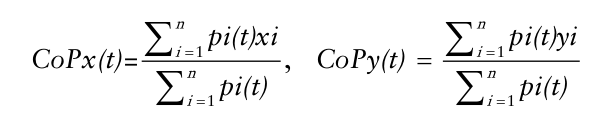
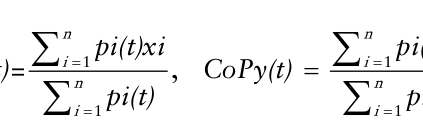
Pressure data were recorded at 5 Hz (Perrotte et al., 2024) using two XSENSOR® X3 LX100 mats (XSENSOR Pro V8 software) characterizing body-seat pressure distribution: one on the backrest (40 × 64 sensors, 50.8 × 81.2 cm) and one on the seat cushion (40 × 40 sensors, 50.8 × 50.8 cm; Fig. 2), with a working range of 0.07–2.70 N/cm². As the software only outputs CoP coordinates per mat, each mat was subdivided into 4 zones (8 zones total), with zone-specific CoP computed following (Marenzi, Bertolotti and Cristiani, 2013):
Equation reproduced from the original PDF.
1 1
i i n n
Equation reproduced from the original PDF.Equation reproduced from the original PDF.
where Pi(t) is the pressure at sensor i at time t, xi/yi its matrix position, and n the total sensor count.
Cinematic Measures Two lateral Logitech® cameras recorded the Neck and torso movements which angles were extracted frame-by-frame using MediaPipe Pose (Google, v0.10). As a paired t-test revealed a systematic side-related bias in Neck Angle (t(178) = −12.57, p < 0.001) and Torso Angle (t(178) = −2.13, p = 0.035), likely due to perspective distortion, the two camera views were averaged per participant and condition before analysis. These landmarks were used to compute neck and torso inclination angles characterizing upper-body posture.
Overall, these measures provided complementary information. CoP displacement characterized sitting postural adjustments, while neck and torso inclination angles captured upper-body postural strategies. Together, these measures allowed us to quantify postural responses to the stimuli.
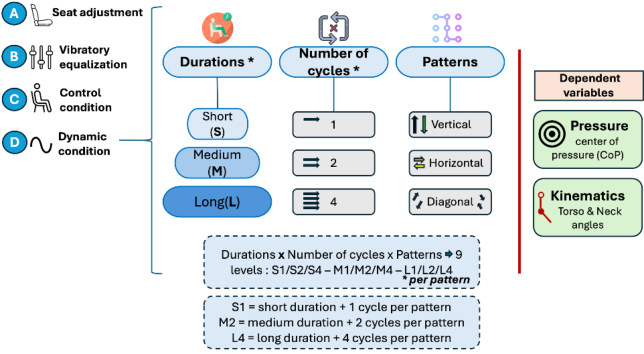
Experimental Synopsis The experiment was conducted at the PRISM laboratory in two phases: calibration (equalization) and the main experimental part (detailed in Fig. 1), following signature of informed consent.
Figure 1: Schematic diagram of the experimental protocol.
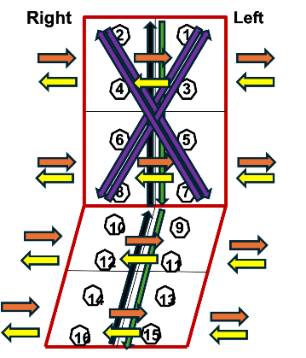
Participants sat on an instrumented seat, with both height and depth adjustable, fixed to a rigid platform. The setup comprised an adjustable footrest preventing excess anterior loading. The seat (Peugeot 208) was equipped with 16 HapCoil-Plus HC171785P actuators, arranged in two vertical rows of four behind the backrest and the cushion (cf. Fig. 2) with 12 cm horizontal / 10 cm vertical spacing on the backrest and 10 cm / 9 cm on the cushion (Elsayed et al., 2020). Actuators were individually controlled via Max/MSP 9 through an HSD-mk3 board; participants wore Sennheiser HD 650 headphones playing pink noise to mask external sounds. Vibration delivery, pressure recording, and video capture were synchronized via a custom Python program (Zenasni et al., 2025).
A Better Understanding of Vibrations 1087 Phase 1: Calibration Phase
After being seated, participants remained still for 60 s to record resting pressure activity, then adjusted their position comfortably and followed instructions displayed on a table-mounted screen, adjusted to eye level, with forearms resting on the table. Calibration harmonized perceived vibration across actuators relative to Actuator 16 (perceived latest in pretesting). With Actuator 16 running at constant intensity, a second, randomly selected actuator was activated above threshold, and participants adjusted its intensity until perceived equal to the reference. Adjusted levels (G, normalized 0–1) were converted to amplitude in decibels via V = 20log10(G) with V expressed in decibels and G the normalized intensity value (0–1) derived from the raw Max9 output (0–127); 0 dB corresponds to maximum vibration amplitude and –65 dB to minimum amplitude.
Phase 2: Main Experiment Participants were seated with no assigned task throughout. Each session began with 60 s of stillness to record basal pressure, followed by pressure recordings during the main experimental part.
In the main experiment, vibratory stimulations (≥3 s; (Ji, Lee and Hwang, 2011)) were delivered sequentially to the actuators at 50 Hz with a 2.5 s inter-stimulus interval (Kirman, 1974) following eight patterns (see Fig. 2): vertical (downward: P1; upward: P2), horizontal (rightward: P3; leftward: P4), and four backrest diagonals (P5–P8, covering all corner-to-corner directions).
The experiment comprised nine conditions labeled S1,S2,S4; M1,M2,M4; L1,L2,L4: each condition presented all 8 patterns at short (S), medium (M) or long (L) duration, played once (1), twice (2) or four times (4). For example, condition S1 corresponded to short-duration (S) patterns and played once (1) each. The experiment lasted 24 min in average. Conditions and pattern order were randomized across participants.
Figure 2: Position of the 16 actuators (numbers) and the 8 vibration patterns: diagonal (purple arrows), lateral (orange and yellow) and vertical (green and black) vibrations.
DATA PROCESSING AND STATISTICAL ANALYSES Video recordings were analysed with MediaPipe Pose to extract neck and torso inclination angles from anatomical landmarks. Within-condition timestamps were normalized to [0,1] for cross-condition comparison. Analyses used linear mixed models (R v4.4.2, lme4/lmerTest) with participant as random intercept; post-hoc comparisons used emmeans with Bonferroni correction (α = .05).
Pressure data were processed via custom Python scripts to compute per- frame CoP coordinates (CoPx, CoPy). Temporal CoP evolution during each stimulation quantified the magnitude and direction of postural adjustment. CoP data were pooled across participants, conditions and patterns (~200,000 timestamped observations), each frame coded by Participant, Condition, Pattern, anatomical Group and elapsed time within pattern (second, mean- centered for numerical stability). The eight groups: right/left thigh (RT/ LT), right/left buttock (RB/LB), lower-back left/right (LBL/LBR), top-back left/right (TBL/TBR) reflected the two pressure-sensing mats’ four zones each. All variables were coded as factors. CoP coordinates were modelled separately using linear mixed-effects models (REML; lme4/lmerTest), with complementary specifications addressing distinct questions.
The ‘Dynamic model’ tested the main and interactive effects of Condition (9 levels), Pattern (8 levels) and anatomical Group (8 levels), with centered time (Time) as covariate for linear temporal drift, a Pattern × Time term for pattern-specific dynamics, and Participant as random intercept. The ‘Advanced model’ added Group × Pattern and Group × Condition interactions, testing whether condition/pattern effects were uniform across anatomical zones or spatially localized. Fixed effects were assessed via Type III ANOVA with Satterthwaite approximation; post-hoc comparisons used emmeans with Tukey correction and asymptotic z-approximation given the large sample size (α = .05).
RESULTS AND DISCUSSION
We investigated the influence of dynamic 50 Hz vibratory stimuli on seated posture, hypothesizing that postural responses would vary by pattern and duration, and assessed this via CoP coordinate variation over time as a function of Condition, Group and Pattern. Postural strategies were also characterized by neck and torso inclination angles over time, as a function of Condition.
SITTING PRESSURE ACTIVITY CoPx
Condition, Pattern and their interaction had no significant effect on CoPx displacement in either model (p > 0.06), indicating no systematic mediolateral shift from stimulus nature or complexity. The Advanced model revealed a significant Condition × Group interaction (F(56,225564) = 9.05, p < 0.001): upper- back (TBL,TBR) and upper-cushion (LBL,LBR) zones showed condition- dependent lateral shifts absent elsewhere. No Pattern × Group interaction emerged (p >.05), indicating pattern direction did not differentially engage lateral zones.
A Better Understanding of Vibrations 1089 CoPy
Condition significantly affected CoPy (F(8,225669) = 63.66, p < 0.001), with a clear repetition driven hierarchy: L2, L4 and M4 produced the largest displacement, L4 being most disruptive overall (all |z|>7.08, p < 0.001; e.g., L2 vs L4: z = −17.0; M1 vs L4: z = −12.6).
Condition × Pattern was significant (F(56,225669) = 2.79, p < 0.001): pattern effects emerged selectively under demanding conditions. In M4, patterns 3–4 produced greater anterior displacement than 1–2 (e.g., p1 vs p3: z = −4.83, p < 0.001). In L4, pattern 5 produced the largest displacement, differing from patterns 6–8 (all z >5.25, p < 0.001). No pattern differences appeared under simpler conditions (M1,S1,S2), suggesting the perturbing effect of pattern requires sufficient stimulation complexity coupled with directional information.
The Pattern × Time interaction approached significance (F(7,225669) = 1.83, p = 0.076); only pattern 2 (bottom-to-top vibration) showed a significant negative temporal slope (β = −0.00192, t = −2.06, p = 0.039), indicating gradual upward CoPy drift aligned with stimulation direction, consistent with prior literature (Kavounoudias et al.,1999).
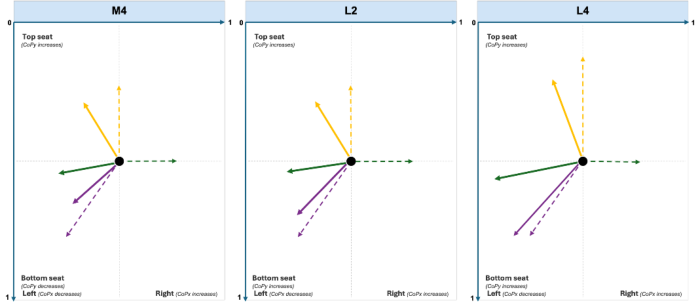
CoP(X,Y) Comparing observed displacement to expected pattern direction, patterns 2 and 5 showed directionally congruent responses: pattern 2 (bottom-to-top) produced an upward shift, and pattern 5 (top-left to bottom-right diagonal) a downward-rightward shift consistent with its vector. Conversely, pattern 3 (lateral, left-to-right) produced significant anteroposterior displacement under M4 notably. This incongruent response suggests an active sensorimotor compensation from the participants depending notably on the directional content of the stimuli.
Figure 3: Theoretical (dotted arrows) vs practical (solid arrows) CoP vector displacement on average for backseat and cushion seat for P2 (yellow), P3 (green) and P5 (violet) patterns and for M4, L2 and L4 conditions. The length of the arrows represents the strength of the statistical effects. The CoP origin is at the center (black dot).
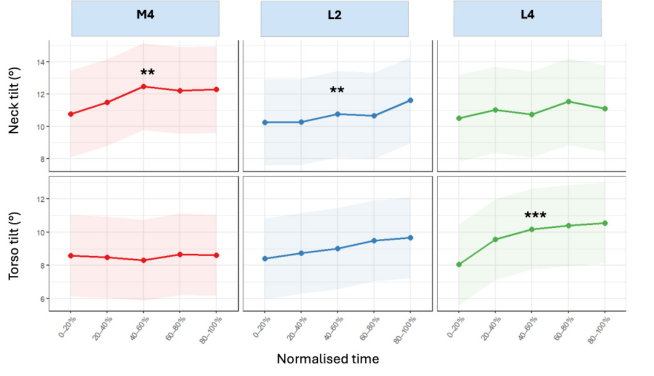
Cinematic Activity Condition significantly affected both angles (NeckAngle: F(8,117405) = 67.24; TorsoAngle: F(8,117406) = 143.74; both p < 0.001). M4 and S1 elicited the highest neck flexion (p < 0.001 vs most conditions), while S1 showed the lowest torso inclination (EMM = 7.03°) versus L4’s greatest forward lean (EMM = 9.77°, p < 0.001).
A significant Condition × Normalized-Time interaction emerged for both NeckAngle (F(8,117392) = 10.77) and TorsoAngle (F(8,117391) = 24.31; p < 0.001), indicating non-parallel trajectories (Fig. 4). NeckAngle increased over time in M4 (+1.17°) and L2 (+1.61°); TorsoAngle drifted upward most in L4 (+2.97°). Within-condition variability decreased from early to late phase across all conditions (NeckAngle: F(2,1056) = 23.25; TorsoAngle: F(2,1056) = 68.77; p < 0.001), suggesting progressive postural stabilization with time.
Figure 4: Temporal evolution of neck and torso inclination angles for M4, L2 and L4 conditions.
CONCLUSION
This study showed that dynamic vibration patterns induce measurable postural responses while seated: greater stimulation complexity and repetition produced larger antero-posterior adjustments, with directional effects emerging mainly under longer conditions. The coexistence of directionally congruent (P2,P5) and incongruent (P3) CoP responses suggests active sensorimotor compensation and engaged neuromuscular control throughout the experiment. Complementary MediaPipe-based kinematic measures captured postural adaptations undetected by pressure mats alone, highlighting the need for complementary measurement means. These findings support the feasibility of dynamic vibrotactile stimulations for modulating seated posture. Discomfort measures may provide additional insight into whether the observed postural adjustments are associated with perceived discomfort.
A Better Understanding of Vibrations 1091 However, a limitation of this study is the potential for habituation to repeated vibration patterns, which may have attenuated the observed effects over time as participants became increasingly familiar with the stimuli. Future work should investigate the effect of sound dynamics combined with vibrations on postural activity in order to amplify the observed effects of our present study.
ACKNOWLEDGMENT
The authors express their sincere thanks to COMMUTE Project (ANR- 22-CE-33-0009) supported by the French Agence Nationale de la Recherche (ANR) and the automotive motion OpenLab Stellantis.
REFERENCES
Al-Dirini, R.M.A., Reed, M.P. and Thewlis, D. (2015) ‘Deformation of the gluteal soft tissues during sitting’, Clinical Biomechanics, 30(7), pp. 662–668.
Andreoni, G. et al. (2002) ‘Method for the analysis of posture and interface pressure of car drivers’, Applied Ergonomics, 33(6), pp. 511–522.
Bolanowski, S.J. et al. (1988) ‘Four channels mediate the mechanical aspects of touch’, The Journal of the Acoustical Society of America, 84(5), pp. 1680–1694.
Bove, M. et al. (2009) ‘Interaction between vision and neck proprioception in the control of stance’, Neuroscience, 164(4), pp. 1601–1608.
Callaghan, J.P. and McGill, S.M. (2001) ‘Low back joint loading and kinematics during standing and unsupported sitting’, Ergonomics, 44(3), pp. 280–294.
Davis, K.G. and Kotowski, S.E. (2014) ‘Postural Variability: An Effective Way to Reduce Musculoskeletal Discomfort in Office Work’, Human Factors, 56(7), pp. 1249–1261.
El Falou, W. et al. (2003) ‘Evaluation of driver discomfort during long-duration car driving’, Applied Ergonomics, 34(3), pp. 249–255.
Elsayed, H. et al. (2020) ‘VibroMap: Understanding the Spacing of Vibrotactile Actuators across the Body’, Proc. ACM Interact. Mob. Wearable Ubiquitous Technol., 4(4), p. 125:1-125:16.
Geldard, F.A. and Sherrick, C.E. (1965) ‘Multiple Cutaneous Stimulation: The Discrimination of Vibratory Patterns’, The Journal of the Acoustical Society of America, 37(5), pp. 797–801.
Griffin, M.J., Whitham, E.M. and Parsons, K.C. (1982) ‘Vibration and comfort I. Translational seat vibration’, Ergonomics, 25(7), pp. 603–630.
Ji, Y.G., Lee, K. and Hwang, W. (2011) ‘Haptic perceptions in the vehicle seat’, Human Factors and Ergonomics in Manufacturing & Service Industries, 21(3), pp. 305–325.
Kamijo, K. et al. (1982) Evaluation of Seating Comfort. SAE International.
Kavounoudias, A. et al. (1999) ‘From balance regulation to body orientation: two goals for muscle proprioceptive information processing?’, Experimental Brain Research, 124(1), pp. 80–88.
Kirman, J.H. (1974) ‘Tactile apparent movement: The effects of interstimulus onset interval and stimulus duration’, Perception & Psychophysics, 15(1), pp. 1–6.
Mansfield, N.J. (2004) Human Response to Vibration. Boca Raton: CRC Press.
Marenzi, E., Bertolotti, G.M. and Cristiani, A. (2013) ‘Design and Development of a Monitoring System for the Interface Pressure Measurement of Seated People’, IEEE Transactions on Instrumentation and Measurement, 62(3), pp. 570–577.
Messing, K. and Dautel, J.-P. (2025) ‘Is Sitting Really the New Smoking? Health of North American Workers Exposed to Prolonged Static Standing’, NEW SOLUTIONS: A Journal of Environmental and Occupational Health Policy, 35(2), pp. 125–136.
Morioka, M. and Griffin, M.J. (2008) ‘Absolute thresholds for the perception of fore-and-aft, lateral, and vertical vibration at the hand, the seat, and the foot’, Journal of Sound and Vibration, 314(1), pp. 357–370.
Myles, K.P. and Binseel, M.S. (2009) ‘Exploring the tactile modality for HMDs: (614362011-019)’.
Oakley, I. et al. (2006) Determining the Feasibility of Forearm Mounted Vibrotactile Displays.
Perrotte, G. et al. (2024) ‘Monitoring driver drowsiness in partially automated vehicles: Added value from combining postural and physiological indicators’, Transportation Research Part F: Traffic Psychology and Behaviour, 100, pp. 458–474.
Self, B. et al. (2008) ‘Human factors issues of tactile displays for military environments’, Tactile Displays for Orientation, Navigation and Communication in Air, Sea and Land Environments, TR-HFM-122, pp. 1–4.
Sundaram, S.A. et al. (2025) ‘Relationship of Seat Interface Pressure to Change in Center of Pressure During Manual Wheelchair Pressure Redistribution Maneuvers’, Sensors, 25(21), p. 6507.
van Deursen, D.L. et al. (2000) ‘Mechanical effects of continuous passive motion on the lumbar spine in seating’, Journal of Biomechanics, 33(6), pp. 695–699.
Wilke, H. et al. (2001) ‘Intradiscal pressure together with anthropometric data--a data set for the validation of models’, Clinical Biomechanics (Bristol, Avon), 16 Suppl 1, pp. S111–126.
Witchel, H.J. et al. (2016) ‘Non-Instrumental Movement Inhibition (NIMI) Differentially Suppresses Head and Thigh Movements during Screenic Engagement: Dependence on Interaction’, Frontiers in Psychology, 7.
Zenasni, S. et al. (2025) ‘Influence of vibratory stimuli on postural muscle tone adjustments and sensation of discomfort in seated posture’, Results in Engineering, 27, p. 106622.
Zheng, Y. and Morrell, J.B. (2010) ‘A vibrotactile feedback approach to posture guidance’, 2010 IEEE Haptics Symposium. 2010 IEEE Haptics Symposium, pp. 351–358.
SEARCH THE AHFE DIGITAL BOOKSTORE BY ISBN
Explore the complete digital volume
Human Factors in Design, Engineering, and Computing
Read this individual research paper free through the original publisher, or explore the full digital proceedings book.