Sayuki Kondo, Tamaki Mitsuno (2023). A pilot study of posture change when wearing high-heeled shoes and pantyhose. In: Human Factors for Apparel and Textile Engineering. AHFE Open Access, vol. 86, pp. 39–46. https://doi.org/10.54941/ahfe1003638
Women desire to be taller and to make their legs look longer, so they often wear high-heeled shoes and pantyhose. Our ultimate goal is to develop a pantyhose that reduces muscle fatigue when wearing high-heeled shoes. We applied the panty part of the support half pants that we developed in 2016 to the development of this sample and designed two types of pantyhose based on the appropriate pressure value that changes for each body part. (Mitsuno et al., 2018, 2022). When myoelectric potentials were measured at 8 points in the lower extremities at this time, there was a significant positive correlation between muscle activity in bare feet and muscle activity when wearing high heels and pantyhose B/when wearing low heels and pantyhose A. From this, even if we wear high-heeled shoes, we can reproduce muscle activity close to that of bare feet by wearing pantyhose that matches the shoes. We thought that this change was related to the change in posture when wearing shoes and pantyhose and investigated the change in posture and the use of muscles. Two-dimensional postural images of the right half of the participant's body were taken. To define the orientation of the participant's head and trunk, a 50 cm square was drawn on the floor and a vertical line was added through the midpoint of top side. The participant was instructed to stand across this line so that the front-back median plane of the participant was projected onto the floor, and to look forward. In addition, a guide rod was worn on the top of the participant's head along the anteroposterior median plane, and the line passing through the vertical midpoint of the square at the foot and the guide rod on the top of the head was aligned with the position which they were so as to always overlap or be in equilibrium. The standing position was corrected using two mirrors so that the head and body would not twist. Reflectors (10 mm diameter hemisphere made own) are placed at 10 points: the vertex of the head, acromion, lateral malleolus, the midpoint of the waist/groin/knee/calf, pelvic head, anterior superior iliac spine, and posterior superior iliac. The participant's posture was photographed under 12 conditions when wearing two types of stockings: barefoot, running, low-heeled shoes, and high-heeled shoes. We assumed that the angles formed by the body axis I connecting the acromion point and the waist, the body axis II connecting the acromion point and the calf, and the line connecting the iliac crest and the anterior superior iliac spine are angles a and b, respectively. In addition, the horizontal distance between the lateral malleolus and the vertex/acromion was determined. When correlation coefficients between these four observation items were calculated, there was a significant positive correlation between angles a and b, and there was also a significant positive correlation between the horizontal movement distance of the top of the head and the acromion point. There was also a significant negative correlation between the angle a/b and the horizontal movement distance of the vertex. From that, the smaller the angles a and b, then the more the pelvis rotates forward, and the more the head moves forward. When wearing pantyhose, angles a and b become smaller, that is, the pelvis rotates forward and the posture of the lower leg changes, but the balance is achieved by changing the position of the head and shoulders. When the participant wore high heels and become taller, her shoulder moved back to balance the forwardly moving head. In the future, it is necessary to increase the number of subjects and classify them according to their standing posture while barefoot and investigate these relationships.
Women desire to be taller and to make their legs look longer and thus often wear high-heeled shoes and pantyhose (Kim et al., 2013). Our final goal is to develop pantyhose that reduce muscle fatigue (Wiedemeijer and Otten, 2018; Barkema et al., 2012; Simonsen, 2014; Blanchette et al., 2011) when wearing high-heeled shoes. We previously applied the panty part of support half-pants that we developed in 2016 to the design (Mitsuno and Hibino, 2016) of two types of pantyhose that provide pressure that varies appropriately for each body part (Kondo and Mitsuno, 2022; Mitsuno and Kondo, 2022). The measurement of myoelectric potentials at eight points on the lower extremities showed positive correlation between muscle activity for bare feet and muscle activity when wearing high heels (Mitsuno and Sugawara, 2022) and pantyhose B/when wearing low heels and pantyhose A (Mitsuno and Kondo, 2022a). Therefore, even in the case of wearing high-heeled shoes, we can reproduce muscle activity close to that of bare feet by wearing pantyhose that match the shoes (Mitsuno and Kondo, 2022b). We consider that this result relates to the change in posture when wearing shoes and pantyhose, and we thus investigated the changes in posture and the use of muscles in the present study.
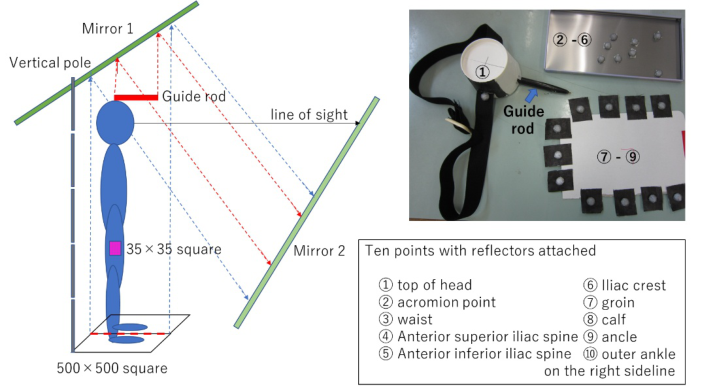
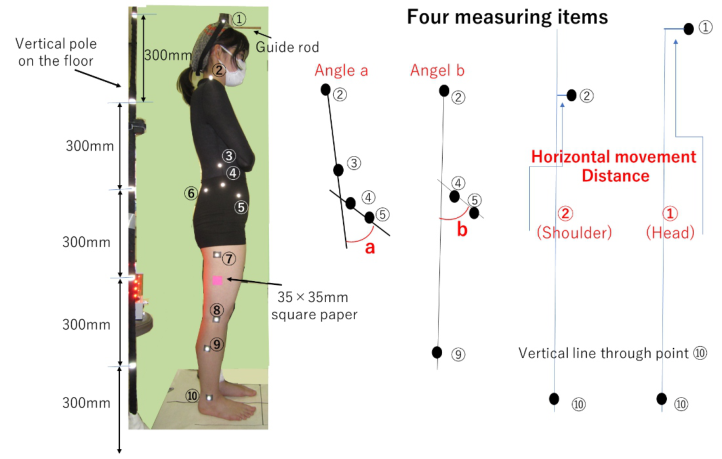
EXPERIMENT Participants and experimental pantyhose and shoes: The participants were three Japanese women in their twenties, whose physical characteristics were typical of Japanese females in their twenties, although somewhat slender (height: 158.8 ± 1.4 cm, weight: 50.5 ± 5.3 kg, waist girth: 66.9 ± 2.8 cm, hip girth: 90.3 ± 3.4 cm). Two sizes of pantyhose were examined in this study, namely sizes M and L. Eight-eight percent of Japanese women are covered by the JIS standards for sizes S, M and L (corresponding to heights of approximately 150, 158 and 166 cm). The pantyhose used in this study were sized M. The material and knitting structures of the two experimental pantyhose comprised a single covered yarn of 20D (2.2 tex) polyurethane/12D (1.3 tex) nylon in the legs. In the panty part, the thickness of the nylon yarn varied from 12D (1.3 tex) to 30D (3.3 tex), and wooly nylon yarn was added to increase the strength in pantyhose A. Using the design of pantyhose A as a baseline, the single covered yarn was partially doubled in pantyhose B to change the supporting pressure of the panty part (Mitsuno and Kondo, 2023a). The participants wore three types of shoes with different heel heights; i.e., running shoes with a heel height of 9.8 ± 10.3 mm, low-heeled shoes with a heel height of 37.4 ± 8.3mm and high-heeled shoes with a heel height of 79.9 ± 7.8 mm. All shoes belonged to the participants. Measurement of posture from a two-dimensional image: The layout of the participant and experimental equipment is shown in Figure 1, and a typical experimental image is shown in Figure 2. The left diagram in Fig. 1 shows the arrangement of the equipment used to confirm that the participant was standing perpendicular to the camera. The participants were asked to wear the 10 reflective markers shown in the photograph of Fig. 1 at the target positions in advance (see the left figure of Fig. 2). A small cap with a reflective marker and a guide rod was attached to the top of the head with a hair elastic band (see Fig. 1, right figure x and Fig. 2, left figure).
Figure 1: Layout of the participant and experimental equipment.
A Pilot Study of Posture Change When Wearing High-Heeled Shoes and Pantyhose 41
Figure 2: Typical experimental image and the four measuring items.
A hand-made reflector on a hemisphere with a diameter of 10 mm was used. Reflectors y to } were taped to measurement points from the acromion to the pelvis. Reflectors ~ to were taped to measurement points from the groin to the outer ankle (see the photograph in Fig. 2). Distances were determined using a 35-mm-square piece of paper attached to the thigh and a vertical pole with a length of 1800 mm and marked 300-mm intervals in the image.
Two mirrors, a 500-mm square at the foot, and the guide rod set on top of the head were used to confirm that the right side of the participant’s body was perpendicular to the camera, i.e., the participant’s body was not twisted. The 500-mm-square on the floor was drawn horizontally across a bisector (see the red dotted line in the left diagram of Fig. 1). The angle of mirror 1 was adjusted and the twist of the participant’s body axis was eliminated such that the guide rod on the top of the head (red solid line) and the bisector of the foot (red dashed line) overlapped in mirror 2. Postures were then photographed under four experimental conditions, namely being barefoot, wearing three types of shoes with different heel heights without pantyhose, wearing only the two types of pantyhose, and wearing a combination of the three types of shoes and two types of pantyhose. The photography was conducted three times interrupted standing posture by sometimes stepping on per each condition. The four measurement items are shown at the right of Fig. 2. The angle a between line y–z and line {–| and the angle b between line y– and line {–|, which are indices of the rotation of the pelvis, were obtained. Additionally, the distances that the head x and shoulder y moved horizontally with reference to the outer ankle was measured.
42 Kondo and Mitsuno
RESULTS AND DISCUSSION
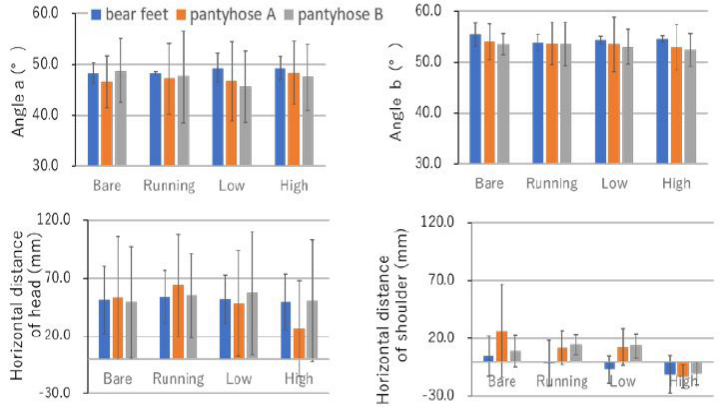
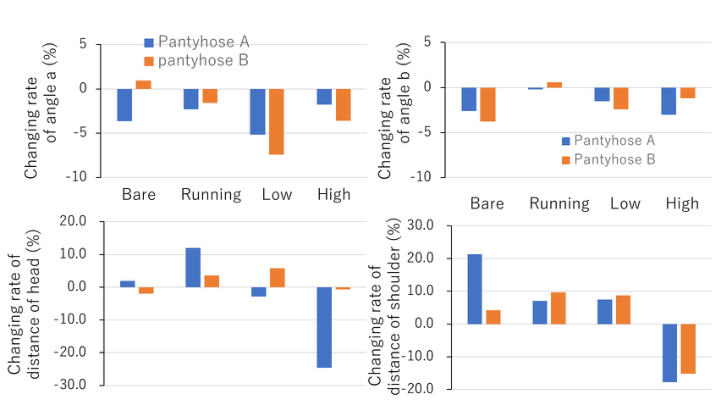
We took the angles formed by the body axis I connecting the acromion point and the waist (line y–z in Fig. 2), the body axis II connecting the acromion point and the calf (line y– in Fig. 2), and the line connecting the iliac crest and the anterior superior iliac spine (line {–|) as angles a and b. Additionally, the horizontal distances between the outer ankle and the top of the head/acromion were determined. These four observation items are shown in Figure 3, and the changing rates are shown in Figure 4.
Owing to the small number of participants, a significant difference test was not possible, but the horizontal movements of the head and shoulders and the angles a and b did not change greatly when wearing shoes without pantyhose and when barefoot (see blue bars graph in the figure). However, when pantyhose A (orange bars) and B (gray bars) were worn, the differences among the three bars of the angles a and b in Fig. 3 were smaller, and the positions of the head and shoulders moved horizontally behind the outer ankle. These results need to be investigated further for a greater number of participants.
The coefficients of correlation between the four observation items, namely angles a and b and the horizontal movements of x the head and y the shoulder (see Fig. 2), showed a significant positive correlation between angles a and b and a significant positive correlation between the horizontal movements of x the head and y the shoulder. There was also a significant negative correlation between the angle a/b and the horizontal movement of x the head. Therefore, smaller angles a and b corresponded to greater forward rotation of the pelvis and forward movement of the head.
Furthermore, the coefficients of correlation between the four observation items mentioned above and the participants’ height, girth, and body
Figure 3: Results of the four observation items.
A Pilot Study of Posture Change When Wearing High-Heeled Shoes and Pantyhose 43
Figure 4: Change rates for the four observation items with reference to the results for bare feet.
composition were calculated. There was no significant correlation between the angle a/b and the horizontal movement of x the head/y the shoulder under the conditions of being barefoot and wearing shoes with the three different heel heights. We therefore calculated the correlation coefficient when wearing only pantyhose and when wearing pantyhose and the three types of shoes. Table 1 gives the coefficients of correlation between angle a and the participants’ physical characteristics. There were significant negative correlations between angle a when wearing shoes/pantyhose and the height items, whereas there were significant positive correlations between angle a and the girth and body composition items.
There was a significant negative correlation between angle a when wearing pantyhose A/B without shoes and the height items (height/groin), in that there was a greater forward tilt of the pelvis when pantyhose were worn by a participant who was taller or had longer legs. Additionally, there was a greater backward tilt of the pelvis when the participant had a thicker trunk or was fatter. These correlations remained significant under the experimental conditions of wearing running shoes and pantyhose A, low-heeled shoes and pantyhose B, and high-heeled shoes and pantyhose A/B. It was thus found that taller participants tilted their pelvis forward more when wearing pantyhose than when barefoot, and, especially in the case of wearing pantyhose B, it was found that the participants leaned forward when the inguinal meridian was higher. However, no significant difference was observed when the participants were barefoot and when the three types of shoe were worn without pantyhose. It is thus considered that this result was due to the wearing of pantyhose. Previous reports showed that the height of the groin was 2 cm higher and the legs thus looked longer when pantyhose B was worn than when pantyhose B was not worn. The reason for this is that
Table 1. Coefficients of correlation between the participants’ physical characteristics and rotation angle of the iliac crest when wearing
Table available in the original PDF paper.
pantyhose A and B.
Shoes Pantyhose Height item Girth item Body composition
Bare A −1.000 ** −0.998 * 0.994 0.997 * 0.999 * 0.992 B −0.998 * −1.000 ** 0.999 * 0.990 0.993 0.998 * Running A −0.994 −0.999 * 1.000 ** 0.984 0.988 1.000 ** B −0.986 −0.973 0.962 0.996 0.993 0.957 Low A −0.969 −0.983 0.990 0.948 0.956 0.993 B −0.998 * −0.992 0.986 1.000 ** 1.000 ** 0.982 High A −0.991 −0.998 * 1.000 * * 0.979 0.983 1.000 ** B −1.000 ** −0.997 * 0.993 0.998 * 0.999 * 0.990
A Pilot Study of Posture Change When Wearing High-Heeled Shoes and Pantyhose 45
pantyhose B has the same leg design as pantyhose A, but only the panty part has a double structure for the abdomen and back, which has the effect of tilting the pelvis forward.
Angles a and b were larger when wearing shoes than for bare feet and were smaller when wearing pantyhose, i.e., the pelvis rotated backward when wearing high heels. When wearing pantyhose, the pelvis rotated forward, which potentially explains why the muscle activity for bare feet was similar to that when wearing pantyhose B with high heels. Additionally, the posture of the lower leg changed, but balance was achieved by changing the position of the head and shoulders. When a participant wore high heels and became taller, her shoulders moved back to balance the head moving forward. In future work, it will be necessary to increase the number of participants and classify them according to their standing posture while barefoot to investigate these relationships.
CONCLUSION
Women desire to be taller and to make their legs look longer and thus often wear high-heeled shoes and pantyhose. Three participants of 20’s women who wore designed two types of pantyhose A/B with three kinds of height heels shoes. The measurement of myoelectric potentials at eight points on the lower extremities showed positive correlation between muscle activity for bare feet and muscle activity when wearing high heels and pantyhose B/when wearing low heels and pantyhose A. Therefore, even in the case of wearing high-heeled shoes, we can reproduce muscle activity close to that of bare feet by wearing pantyhose that match the shoes. We consider that this result relates to the change in posture when wearing shoes and pantyhose, and we thus investigated the changes in posture and the use of muscles in the present study. Participants’ postures were then photographed under four experimental conditions, namely being barefoot, wearing three types of shoes with different heel heights without pantyhose, wearing only the two types of pantyhose, and wearing a combination of the three types of shoes and two types of pantyhose. The angle a between line shoulder to waist points and line anterior superior iliac spine to anterior inferior iliac spine points, and the angle b between line shoulder to calf points and line anterior superior iliac spine to anterior inferior iliac spine points, which are indices of the rotation of the pelvis, were obtained. Angles a and b were larger when wearing shoes than for bare feet and were smaller when wearing pantyhose, i.e., the pelvis rotated backward when wearing high heels. When wearing pantyhose, the pelvis rotated forward, which potentially explains why the muscle activity for bare feet was similar to that when wearing pantyhose B with high heels. Additionally, the posture of the lower leg changed, but balance was achieved by changing the position of the head and shoulders. When a participant wore high heels and became taller, her shoulders moved back to balance the head moving forward. In future work, it will be necessary to increase the number of participants and classify them according to their standing posture while barefoot to investigate these relationships.
46 Kondo and Mitsuno
ACKNOWLEDGMENT
Part of this work was supported by the Japanese Society for the Promotion of Science, KAKENHI Grant Number 17H01954/22K02111. We thank Edanz (https://jp.edanz.com/ac) for editing a draft of this manuscript.
REFERENCES
Barkema, D. D., Derrick, T. R., Martin, P. E. (2012) Heel height affects lower extremity frontal plane joint moments during walking. Gait Posture. 35, 483–8. Blanchette, M. G., Brault, J. R., Powers, C. M. (2011) The influence of heel height
on utilized coefficient of friction during walking. Gait Posture. 34, 107–10. Kim, Y., Koo, J., Oh, D. (2013) Influence of Shoe Heel Height and Muscle Fatigue on Static and Dynamic Balance in Healthy Young Women. Phys. Ther. Kor. 20, 36–44. Kondo, S., Mitsuno, TT (2022) Effect of Wearing Pantyhose on Lower Limb Muscle
Activity, Textile Bioengineering and Informatics Symposium Proceedings 2022, 128–135 ISBN:19423438. Mitsuno T., Sugawara A. (2022) Effect of the Shoe Heel Height on Lower-Limb Muscle Activity Physical Ergonomics and Human Factors, Vol. 63, 13–20. https://doi.org/10.54941/ahfe1002591 Mitsuno TT, Kondo S. (2022b) Clothing pressure gradient for comfortable
pantyhose, Journal of Fiber Bioengineering and Informatics, Vol. 15, 243–257. https:// doi.org/10.3993/jfbim03643. Mitsuno, T., Hibino, A. (2016) Which Support Pants are the Most Effective for Burning Body Fat? Journal of Fiber Bioengineering and Informatics 9:4 (2016) 187–199 doi:10.3993/jfbim00255. Mitsuno, TT, Kondo, S. (2022a) Comfortable Pantyhose Pressure and Muscle
Activity in the Legs, Textile Bioengineering and Informatics Symposium Proceedings 2022, 169–176 ISBN:19423438. Simonsen, E. B. (2014) Contributions to the understanding of gait control. Dan Med J. 61, B4823. Wiedemeijer, M. M., Otten, E. (2018) Effects of high heeled shoes on gait. A review.
Gait Posture. 61, 423–430.
LISTED IN THE AHFE DIGITAL BOOKSTORE CATALOGUE
Explore the complete digital volume
Human Factors for Apparel and Textile Engineering
Read this individual research paper free through the original publisher, or explore the full digital proceedings book.
ISBN 978-1-958651-62-9
Explore this ISBN in the AHFE Bookstore ↗Listed in the July 2026 bookstore catalogue; search by ISBN to confirm current availability · Digital book purchase optional