Tamaki Mitsuno, Sayaka Moriya (2023). Pilot Study on the Effect of Bathing Time on Thermal Sensation for Improved Sleep. In: Health Informatics and Biomedical Engineering Applications. AHFE Open Access, vol. 78, pp. 57–65. https://doi.org/10.54941/ahfe1003455
In Japan, cold sensitivity is an indefinite complaint that affects many women. However, since it is not a life-threatening serious condition, it is difficult to treat or research the target. However, women who are aware of sensitivity to cold feel the cold most when they go to bed, and there are many people who suffer from the coldness that it is difficult to fall asleep even in a heated environment in winter. In this study, we investigated the effects of bathing, which is likely to raise body temperature, core temperature, skin temperature, and thermal sensation, and prevented coldness. The method of getting a good night's sleep was proposed without a cold sensation.The subject was a 21-year-old healthy woman who has heavy sensitivity to coldness. Experiment I: Room temperature and core temperature (oral temperature) were measured every 60 minutes from 7:00 to 23:00. Experiment II: After taking bath at 20:00, the room temperature, her core temperature, skin temperature of instep/toe, and the thermal sensation of the feet were measured every 20 minutes from 21:00 to 23:00. Experiment III: Two bath times were set from 20:00 or 22:00. The skin temperature of the instep/toe, core temperature, and thermal sensation were measured before and after bath time. Experiment IV: When she felt a cold sensation, core temperature, skin temperature of the instep/toe, and thermal sensation were measured before and after taking the 10 minutes foot bath at 23:00.<Results and Discussion> Result I: From the correlation coefficient between body temperature and room temperature, which had a significant positive correlation, indicating that the higher the room temperature, the higher the body temperature. Room temperature increased significantly from morning to noon and decreased significantly in the evening. However, body temperature increased temporarily from evening to night and decreased significantly in the middle of the night. Result II: The oral temperature was significantly higher than before bathing until 21:20, and then significantly decreased from 22:00. Skin temperature of the instep was significantly higher until 22:00 and one of the toes was significantly higher until 21:40 than before bathing. The thermal sensation was significantly higher until 21:40 compared to before bathing and was evaluated as ``warm''. We calculated the relationship between the skin temperature of the instep/toe and the coldness sensation. The skin temperature (X1: instep, X2: toe) was explained by the equations: Y1 = 0.20X1-5.92 (R2 = 0.518) and Y2 = 0.14X2-3.67 (R2 = 0.667). The skin temperature of the instep/toe (X1/X2) was comfortable thermal sensations, Y1 = 0 (instep) and Y2 = 0 (toe), these skin temperatures were 29.6°C/26.2°C. Result III: Both oral and skin temperatures and their thermal sensations were increased significantly after bathing at 20:00 or 22:00. Although the increasing rate of core temperature at 20:00 bath time was significantly higher than at 22:00, however, there was no difference in the skin temperature of the insteps/toes and the thermal sensation. Result IV: Oral temperature increased after 22:00 bathing (Experiment III), but not after foot bathing. However, both thermal sensations of taking bath or footbath increased. The rate of skin temperature of toes in the footbath was increased significantly higher than taking bath and was maintained until bedtime. Therefore, taking a footbath at 23:00 would make it possible to sleep comfortably.
In Japan, cold sensitivity is a common complaint (Uzunköprü et al., 2019; Carlsson et al., 2010; Compton et al., 2000), particularly among women. However, because this is not a serious or life-threatening condition, it is a difficult issue to treat or research (Carlsson et al., 2014). Women who expe- rience sensitivity to cold often feel the cold most intensely when they go to bed. Additionally, many women feel the cold to such a degree that it is diffi- cult to fall asleep in winter, even in a heated environment. In the current study, we investigated the effects of bathing, which can raise body temperature; core temperature, skin temperature, and thermal sensation, for preventing feelings of cold at bedtime. We hypothesized that this method would improve sleep.
EXPERIMENTAL SCHEDULES Our study participant was a healthy, 21-year-old woman with intense sen- sitivity to cold. The participant conducted the following four experiments by herself. The experimental schedules are shown in Table 1. Experiment I: Room temperature (using a thermometer: DRETEC, China) and core tem- perature (oral temperature measured using a thermometer specifically for women: MC-172L, OMRON, Japan) were measured every 60 minutes from
Table 1. Schedules and conditions of Experiments I–IV.
Table available in the original PDF paper.
7:00 to 23:00 for 7 days in May. Experiment II: Japanese-style bathing, which involves soaking in hot water up to the shoulders in deep bathtubs for a long time in the evening to night, is unique (Tochihara, 2022). In this study, we employed a shower instead of a Japanese-style bathing. After bathing at 20:00, room temperature, core temperature, and skin temperature of the arch and toes were measured using an electronic thermometer (TOAMIT, TOA). The skin temperature of the arch/toes, core temperature, and thermal sen- sation were measured before and after bathing. Experiment III: The bathing time was changed from 20:00 to 22:00. The participant’s core and skin tem- peratures were measured with thermal sensation before and after taking a bath. Experiment IV: When the participant felt a cold sensation, she mea- sured her core temperature, skin temperature of the arch/toes, and thermal sensation before and after taking a 10-minute foot bath at approximately 23:00.
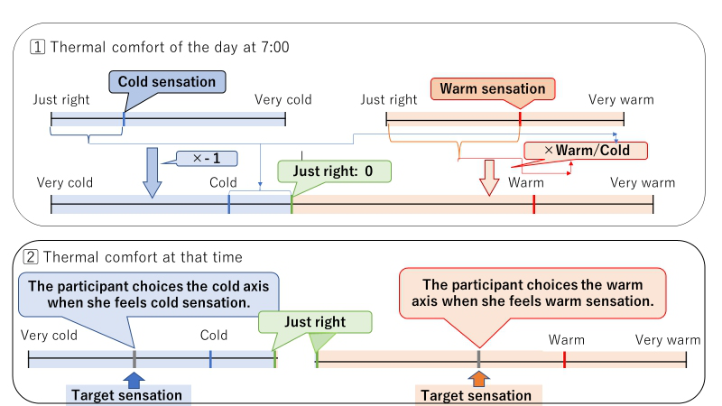
EVALUATION OF THERMAL SENSATION Foot thermal sensation was evaluated using a ratio scale, shown in Figure 1, divided into two steps showing how the reference thermal sensation for each day was obtained and how the thermal sensation was received at the target times in Experiments II to IV, but not in Experiment I. The first step was to integrate the magnitude of the sensation of warmth and the sensation of coldness on the same axis. Warmth and coldness were assessed at 7:00 on the morning of each day. The participant rated “cold” or “warm” sensations, with the left end of the axis representing “just right,” and the right end of
Pilot Study on the Effect of Bathing Time on Thermal Sensation for Improved Sleep 59
Figure 1: Evaluation of thermal sensation.
the axis representing “very cold” or “very warm.” Because the participant is sensitive to cold, the distance from “just right” to “cold” or “warm” on the two scales was unequal. The “warm” sensation then was corrected by multi- plying the coefficient, which was the warm value divided by the cold value. The “cold” sensation was expressed by multiplying the absolute value by a negative value. The warm sensation and the cold sensation were represented on a single straight line, with “0” indicating “just right.”
In the second step, when evaluating the thermal sensation at the desired measurement time, the participant chose either the warm axis or the cold axis and recorded the sensation at that time. For example, when the participant felt a cold/warm sensation, she selected the cold/warm axis. Target cold/warm sensations are indicated by the arrows below the left/right lines.
RESULTS AND DISCUSSION
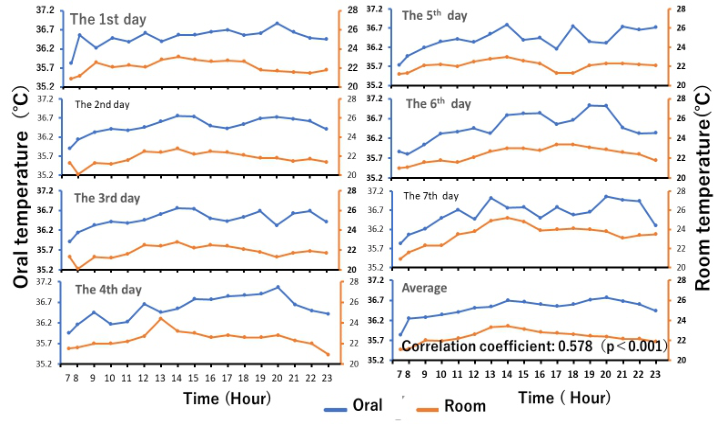
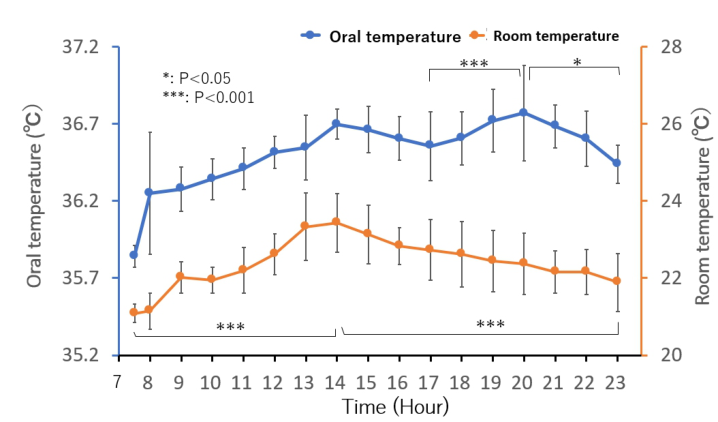
Result I: The room temperature and participant’s core temperature over one week in May are shown in Figure 2, and the average values are shown in Figure 3. The core and room temperatures changed each day. The correlation coefficient was calculated between both. The correlation coefficient between core and room temperatures showed a significant positive correlation (0.578, p < 0.001), indicating that a higher room temperature was associated with a higher body temperature in the participant. The room temperature increased significantly from morning to noon and decreased significantly in the evening. However, body temperature increased temporarily from evening to nighttime and was significantly decreased in the middle of the night.
The participant normally ate dinner at approximately 18:00 and took a bath at approximately 20:00. Because body temperature increases following the ingestion of food owing to specific dynamic effects and, when bathing, heat is conducted to the body by immersion in water that is warmer than
60 Mitsuno and Moriya
Figure 2: Room and core temperatures over one week in May.Figure 3: Average room and core temperatures.
the body temperature, both eating and bathing have been found to elevate body temperature. However, because eating before bedtime is considered to be unhealthy, bathing was used in the following experiments.
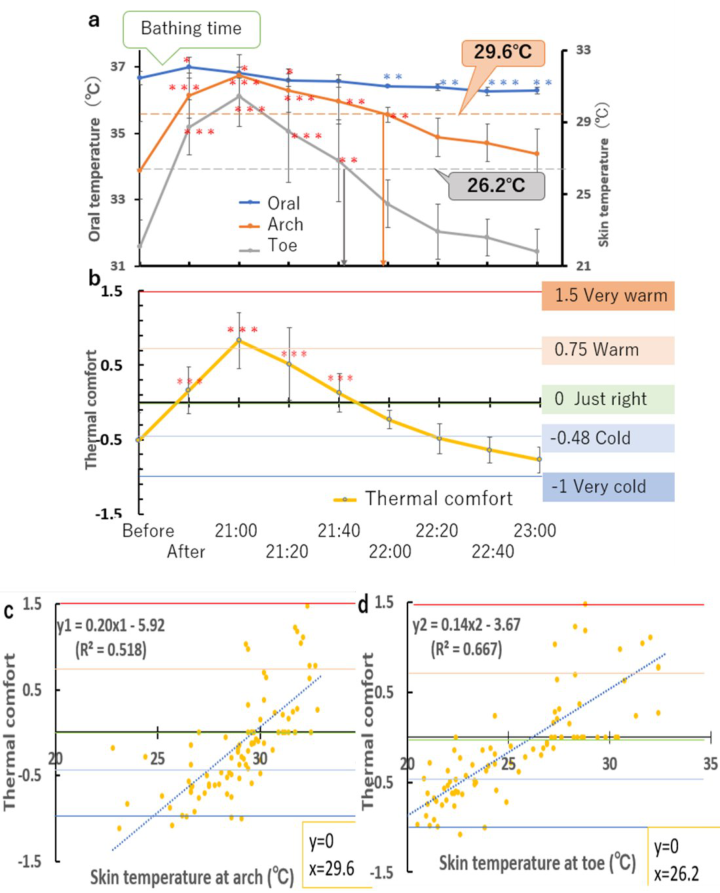
Result II: Changes in core and skin temperature after bathing are shown in Figure 4. Oral temperature was significantly higher after bathing com- pared with before bathing until 21:20, then decreased significantly from 22:00. The skin temperature of the foot arch was significantly higher after bathing until 22:00 and the skin temperature of one toe was signi- ficantly higher until 21:40 compared with before bathing (Figure 4a).
Pilot Study on the Effect of Bathing Time on Thermal Sensation for Improved Sleep 61
Figure 4: Changes in core and skin temperatures according to bathing time a, b) Chan- ges in core and skin temperatures/thermal comfort by bathing time. c, d) Relationships between thermal comfort and skin temperature at the arch and toes. Skin temperatures of 29.6 ◦C and 26.2 ◦C in Figure 4a were calculated from Figure 4c and 4d.
The thermal sensation was significantly higher after bathing until 21:40, compared with that before bathing, and was evaluated by the partici- pant as “warm” (Figure 4b). We calculated the relationships between skin temperature of the arch/toes and sensations of coldness. The skin tem- perature (X1: arch, X2: toes) was calculated with the following equ- ations: Y1 = 0.20X1 −5.92 (R2 = 0.518) and Y2 = 0.14X2−3.67 (R2 = 0.667). The skin temperature of the arch/toes (X1/X2) was at a
62 Mitsuno and Moriya
comfortable thermal sensation, with Y1 = 0 (arch) and Y2 = 0 (toes); these skin temperatures were 29.6
C and 26.2
C, respectively (see Figure 4c, 4d). In other words, a warm sensation in the feet was maintained for approxima- tely 40 minutes after bathing; however, the oral temperature decreased from 1 hour after bathing. We then changed the bathing time from 20:00 to 22:00 and compared the results with those of Experiment II.
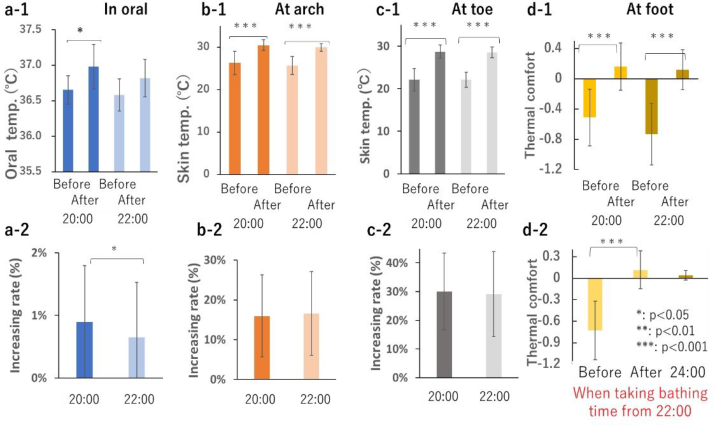
Result III: Core (oral) and skin temperatures and their thermal sensations are shown in Figure 5. Both oral and skin temperatures and their thermal sensations were significantly increased after bathing at 20:00 and 22:00. The rate of increase in the core temperature with bathing at 20:00 was signifi- cantly higher than that at 22:00; however, there was no difference in the skin temperature of the arch/toes and the thermal sensation. That is, core tempera- ture decreased from 20:00 to 22:00, according to the participant’s circadian rhythm. However, the effect of a warm bath on the skin temperature of the foot was maintained regardless of whether a bath was taken at 20:00 or 22:00. We found that with bathing at 22:00, the sensation of warmth in the feet remained comfortable until 0:00, or bedtime (see Fig. 4d-2). Next, we investigated the effects of a 10-minute foot bath at 23:00.
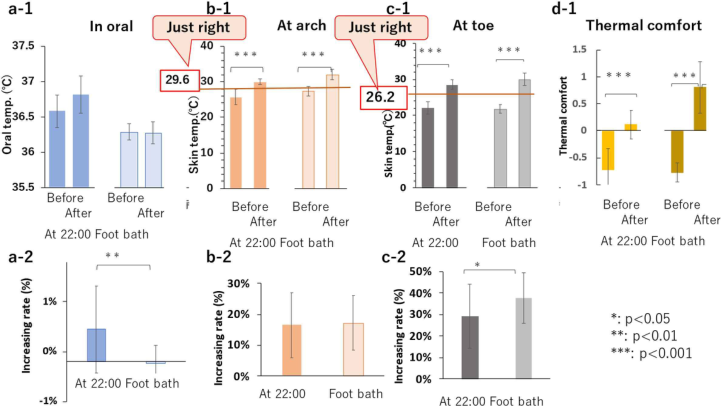
Result IV: Core and skin temperature and the thermal sensations before and after bathing at 22:00 or after a 10-minute foot bath at 23:00 are shown in Figure 6. Oral temperature increased after bathing at 22:00 (Experiment III), but not after a foot bath. However, thermal sensations were increased after taking a bath and after a foot bath. The rate of increase in skin temperature of the toes after a foot bath was significantly higher than the rate after taking a bath, and this increase was maintained until bedtime.
Figure 5: Core and skin temperature and its thermal sensation before and after bathing at 20:00 or 22:00 a-1 shows oral temperature, and its rate of increase is shown in a-2; b/c-1 shows skin temperature and its rate of increase is shown in b/c-2; d-1 shows thermal comfort and its change from 20:00 to bedtime at 0:00 is shown in d-2.
Pilot Study on the Effect of Bathing Time on Thermal Sensation for Improved Sleep 63
Figure 6: Core and skin temperature and thermal sensations before and after taking a bath at 22:00 or a 10-minute foot bath at 23:00.
Therefore, having a foot bath at 23:00 would be expected to make it possible to sleep more comfortably.
DISCUSSION
Comfortably falling asleep requires a decrease in core body temperature and an increase in limb skin temperature. If the room temperature is maintai- ned at 20
C for 30 minutes before awakening, the skin temperature of the limbs will stay warmer during the daytime (Mitsuno et al., 2008a, 2008b). Comfortable sleep is not considered to be possible if the hands and feet feel cold at bedtime (Home Economics Society Clothing Hygiene Subcommittee, 2016). Therefore, we examined changes in core body temperature throughout the day (Experiment I). Although the core temperature at 20:00 should nor- mally be lower than that at 17:00, according to one’s circadian rhythm, it was significantly increased in our participant (see Result I). Core temperature rises owing to the specific dynamic effect of eating dinner (at approximately 18:00 in our participant) and owing to heat conduction with bathing (at 20:00 in our participant). We opted to investigate warming the skin temperature by bathing to avoid the negative health effects of eating before going to bed. And many experimental and epidemiological studies and surveys have shown that taking bath improve sleep quality, especially shortens sleep onset latency of elderly (Tochihara, 2022; Yagi et al., 2019). When we examined the core tem- perature, skin temperature, and thermal sensation of the feet after bathing at 20:00 (Experiment II), the core temperature was significantly increased for up to 1 hour after bathing, then decreased significantly until 23:00. The skin temperature of the feet peaked at 21:00, then decreased. However, the ther- mal comfort level that felt “just right” changed to coldness at 22:00, 2 hours after bathing (see Result II). Therefore, we shifted the bathing time by 2 hours
64 Mitsuno and Moriya
from 20:00 and compared the effects of bathing at 22:00 and at 20:00 (Expe- riment III). The core temperature did not rise significantly after taking a bath at 22:00; however, the skin temperature of the feet was significantly increased after bathing. This result confirmed that the rate of increase was comparable to that with bathing at 20:00. We also found that with bathing at 22:00, our participant was able to stay comfortable until 0:00, at which time she went to bed (see Result III). In Experiment IV, the participant took a 10-minute foot bath at 23:00 to warm the skin temperature, which had decreased. The core temperature did not change before and after the foot bath, but the skin temperature of the feet increased significantly, and a comfortable thermal sen- sation was maintained until bedtime. Thus, the results indicated that more comfortable sleep can be achieved by bathing 2 hours before going to bed or having a foot bath just before going to bed. In the future, we plan to increase the number of participants and verify our experimental findings.
CONCLUSION
In Japan, it is thought that comfortable sleep cannot be achieved if the hands and feet are cold at bedtime, and cold sensitivity affects many peo- ple, especially women. We examined one participant’s changes in core body temperature throughout the day and found that core temperature rose owing to the specific dynamic effect of eating and heat conduction when bath- ing. The participant’s core temperature was significantly increased up to 1 hour after bathing; the skin temperature of her feet peaked 1 hour after bathing and then decreased. However, the participant’s sensation of ther- mal comfort changed from just right to cold at 2 hours after bathing. When bathing time was shifted later by 2 hours, the participant’s core tempera- ture did not rise significantly after bathing; however, the skin temperature of her foot increased significantly, and she was able to stay comfortable until bedtime. A 10-minute foot bath before bedtime also increased the skin temperature of the feet, and the participant was able to maintain a comfor- table thermal sensation until bedtime. Thus, we found that sleep could be improved by bathing 2 hours before bedtime or having a foot bath before going to bed.
ACKNOWLEDGMENT
Part of this work was supported by the Japanese Society for the Promotion of Science, KAKENHI Grant Number 17H01954/22K02111. We thank Analisa Avila, MPH, ELS, of Edanz (https://jp.edanz.com/ac) for editing a draft of this manuscript.
REFERENCES
Carlsson I. K., Dahlin, L. B. (2014) Self-reported cold sensitivity in patients with traumatic hand injuries or hand-arm vibration syndrome - an eight year fol- low up, Musculoskeletal Disorders, 15:83 http://www.biomedcentral.com/1471- 2474/15/83
Pilot Study on the Effect of Bathing Time on Thermal Sensation for Improved Sleep 65
Carlsson, I. K., Rosén, Dahlin, L. B. (2010) Self-reported cold sensitivity in normal subjects and in patients with traumatic hand injuries or hand-arm vibration syn- drome, Musculoskeletal Disorders 2010, 11:89 http://www.biomedcentral.com/ 1471-2474/ 11/89 Compton, P. RN, Charuvastra, V. C, Kintaudi, K, Ling, W. (2000) Responses in
Methadone-Maintained Opioid Abusers, Journal of Pain and Symptom Mana- gement, 20:237–245. Home Economics Society Clothing Hygiene Subcommittee ed. (2016) Apparel and Health (Japanese text), Inoueshoin. pp. 89–91. Mitsuno T, Naito Y., Seki M. (2008a) Effect of some factors on skin temperature of
the palm in daytime: in special reference to the relation between skin temperature of palm and temperature of rising in bedroom (English abstract and Japanese text), JPA: 13, 179–183. Mitsuno T, Naito Y., Seki M. (2008b) Effect of the temperature of rising in bedroom on skin temperature of the palm in daytime (English abstract and Japanese text), JPA: 13, 131–136. Tochihara Y. (2022) A review of Japanese-style bathing: its demerits and merits, Jour-
nal of Physiological Anthropology, 41:5 https://doi.org/10.1186/s40101-022- 00278-0 Uzunköprü, C., Beckmann, Y. (2019) Flammer syndrome in multiple sclerosis: diagnostics, prediction, and personalization of treatments, EPMA Journal, 10:437–444 https://doi.org/10.1007/s13167-019-00179-w Yagi A., Hayasaka S, Ojima T, Sasaki Y, Tsuji T, Miyaguni Y, Nagamine Y, Namiki
T, Kondo K (2019) Bathing Frequency and Onset of Functional Disability Among Japanese Older Adults: A Prospective 3-Year Cohort Study From the JAGES, J Epidemiol, 29(12):451–456.
LISTED IN THE AHFE DIGITAL BOOKSTORE CATALOGUE
Explore the complete digital volume
Health Informatics and Biomedical Engineering Applications
Read this individual research paper free through the original publisher, or explore the full digital proceedings book.
ISBN 978-1-958651-54-4
Explore this ISBN in the AHFE Bookstore ↗Listed in the July 2026 bookstore catalogue; search by ISBN to confirm current availability · Digital book purchase optional