Sheau Farn Max Liang, Kai Xuan Luo, Ren Ming Zhang, Tu Sheng Lee (2023). Combination of tall-man lettering and symbol prefixing to improve drug identification by pharmacists. In: Health Informatics and Biomedical Engineering Applications. AHFE Open Access, vol. 78, pp. 11–21. https://doi.org/10.54941/ahfe1003450
Similar drug names can confuse pharmacists and lead to dispensing errors. A well-accepted solution to the problem is tall-man lettering, a typographic alteration to drug names. However, studies of its effectiveness have yielded mixed results. Furthermore, the potential of orthographic alterations to drug names has not been explored. Therefore, this study aims to examine the usefulness of the combination of tall-man lettering and a simple but new orthographic alteration, symbol prefixing. Twenty-six outpatient pharmacists were recruited to participate in an experiment on drug identification. The results showed that first, the accuracy of drug identification increased with tall-man lettering. Next, the response time and the number of eye fixations for the identification decreased with tall-man lettering and symbol prefixing. Finally, the number of eye fixations decreased with symbol prefixing when there was no tall-man lettering. The findings support that tall-man lettering and symbol prefixing are effective techniques for helping pharmacists identify drugs. Further research could assess the impacts of different types of typographic and orthographic alterations for alleviating the problem of drug name confusion and ultimately minimizing medication errors and ensuring patient safety.
Confusion between similar drug names has been identified as a primary pro- blem for medication safety as it often leads to medication errors (World Health Organization, 2017). Specifically, the confusion was the main source of wrong drug dispensing errors in pharmacies (Reiner et al., 2020; Tseng et al., 2018).
Drug names are confusing because they are spelled and/or pronounced similarly, the so-called look-alike-sound-alike (LASA) drug names (Insti- tute for Safe Medication Practices, ISMP, 2019). A predominant solution to this problem is tall-man lettering, which capitalizes the letters that are not shared between confusing drug names to emphasize their difference. For example, a pair of confusing drug names such as “Nexavar” and “Nexium” would be written as “NexAVAR” and “NexIUM,” respectively (ISMP, 2019).
Table 1. Experimental studies of tall-man lettering with pharmacists as participants.
Table available in the original PDF paper.
Reference Participant Task Effect of TML Filik et al. (2010) Whether TDN appears on the list
127 healthcare professionals (77 with a pharmacy background)
Accuracy in verifying the absence of TDN increased Darker et al. (2011)
Which of the two is TDN
Accuracy in identifying TDN increased
144 healthcare professionals (36 pharmacists; 45 pharmacy technicians) Or and Wang (2014)
40 student pharmacists
Whether the two drug names are identical Detect the change of 16 drug labels
Accuracy in the verification increased DeHenau et al. (2016)
Accuracy increased and response time decreased
40 healthcare professionals (some with a pharmacy background)
Not significant
Whether the drug name is TDN
Schell (2009) 11 practicing pharmacists and technicians
Not significant
Irwin et al. (2013)
26 pharmacists and 2 pharmacy technicians
Whether TDN appears on one of 20 drug labels
TDN: target drug name; TML: tall-man lettering
Experimental studies that recruited pharmacists as participants were revi- ewed and summarized in Table 1, while studies without experiments (e.g., Gabriele, 2006; Zhong et al., 2016) or non-pharmacist participants (e.g., Filik et al., 2004; 2006; Liu et al., 2019; Wang and Or, 2020) were excluded.
Filik et al. (2010) recruited 127 healthcare professionals, of whom 77 had a pharmacy background. For each trial, a target drug name was first displa- yed on the computer screen, then replaced by a list of five drug names. The target drug name was present or absent from the list. When the target drug name was absent from the list, its corresponding confusing name would be on the list instead. Participants were asked to verify whether the target name appeared on the list. The results showed that tall-man lettering, compared to lowercase lettering, increased the accuracy in verifying the absence of target drug names.
Another study by this research group recruited 144 healthcare professi- onals that included 36 pharmacists and 45 pharmacy technicians as par- ticipants (Darker et al., 2011). For each trial, a target drug name was first displayed on a computer screen, then replaced by two drug names, one of which was the target and the other its corresponding confusing name. Participants were asked to select the target drug name from the two alternatives. It was found that tall-man lettering, compared to lowercase let- tering, increased the accuracy in identifying the target drug names from their distractors.
Combination of Tall-man Lettering and Symbol Prefixing to Improve Drug Identification 13
Or and Wang (2014) recruited 40 student pharmacists to participate in an experiment to verify whether pairs of drug names displayed on the screen were identical or different. The results showed that, compared to lowercase lettering, tall-man lettering increased the accuracy of the verification.
Finally, DeHenau et al. (2016) recruited 40 healthcare professionals, some of them having a pharmacy background. For each trial, 16 drug labels arran- ged as a 4-by-4 square array were displayed on the screen in tall-man lettering or lowercase format and one of the 16 labels was designed as the target drug name. The screen was then changed to the next page with all labels being the same except that the target drug name switched to its correspon- ding confusing name. Participants were asked to detect the change as soon as possible. The results showed that tall-man lettering, compared to lowe- rcase lettering, increased the correct rate of change detection and reduced the detection response time.
However, Schell (2009) recruited 11 practicing pharmacists and techni- cians to participate in an experiment to determine whether the drug name displayed on the screen was the target name displayed on the previous page. There was a 3-second black mask between the two display pages. The results showed that the effect of tall-man lettering was not significant and the author argued that such results could be due to the insufficient statistical power caused by the small sample size.
Irwin et al. (2013) recruited 26 pharmacists and two pharmacy technicians to participate in an experiment to find the target drug name among 20 alter- natives displayed as labels on boxes arranged as a 4-by-5 rectangle array. The results showed that tall-man lettering did not affect accuracy and response time. These results contradicted an earlier similar study (Filik et al., 2004), and the authors argued that the non-significant effect of tall-man lettering in their study could be attributable to the unfamiliarity of the participants with tall-man lettering.
In summary, tall-man lettering appears to improve the accuracy and effi- ciency of identifying confusing drug names by pharmacists who are familiar with tall-man lettering. However, this conclusion requires more research to be strengthened.
The chances of wrong drug errors were positively correlated with the degrees of similarity between drug names (Lambert et al., 1999). An online software tool that applied string-matching algorithms is available to measure the similarity between any two drug names (US Food and Drug Admini- stration, US FDA, 2021). However, these algorithms suggest that tall-man lettering does not affect the degree of similarity between confusing drug names since it does not change any letter or sequence of letters in the names. Therefore, in addition to tall-man lettering, we proposed an orthographic alternation, symbol prefixing, by simply adding a symbol before the initial let- ter of a drug name to make it less similar to its corresponding confusing drug name. Note that the symbol was prefixed but not suffixed since the initial eye fixation typically lands around the first quarter of a word (Dunn-Rankin, 1978; Rayner, 1979), and readers pay more attention to the information from the right of the fixation than from the left (McConkie and Rayner, 1976). Since about three-quarters of the confusing drug names listed by ISMP have
the same initial letters (ISMP, 2019), a prefixed symbol on one of a pair of confusing drug names should be able to facilitate differentiation between each other.
Overall, this study aims to investigate the effectiveness of tall-man lettering and symbol prefixing for pharmacists to identify drugs.
METHODS
A 2×2 repeated-measures factorial experiment was designed. The first inde- pendent variable was whether a pair of confusing drug names were altered with tall-man lettering (TML), and the second independent variable was whe- ther one of the names was altered with hash symbol prefixing (HSP). To take the two confusing drug names, “Daivonex” and “Daivobet”, as an example, the four conditions of the experiment are presented in Table 2. Note that the name without TML was in lowercase format with a capital initial letter, and one of the two names was randomly chosen as the target name to prefix with the hash symbol (#). In this example, “Daivonex” was the target name.
Table 2. An example of the experimental design.
Table available in the original PDF paper.
TML No (lowercase) Yes
HSP No Daivonex Daivobet DaivoNEX DaivoBET Yes #Daivonex Daivobet #DaivoNEX DaivoBET TML: tall-man lettering; HSP: hash symbol prefixing
Three dependent variables were error rate, response time, and the number of eye fixations. The experimental task was to select the target drug name from two alternatives, similar to the task of Darker et al. (2011). The error rate was defined as the number of trials for which a participant selected the wrong drug names divided by the total number of trials. The response time was the time that participants took to select the target drug name. An eye fixation was defined as the fixation with more than 200 milliseconds during the selection. Note that the number of eye fixations was found to be positively correlated with task difficulty (Lin et al., 2019) and negatively correlated with the efficiency of performing tasks (Goldberg and Kotval, 1999).
Participants Twenty-six outpatient pharmacists (18 women and eight men) from a regi- onal hospital participated in data collection. Their ages averaged 29.9 years with a standard deviation of 4.9 and ranged from 22 to 40 years, and their pharmacy work experiences averaged 5.6 years with a standard deviation of 3.9 and ranged from half to 18 years.
Materials and Apparatus Forty-eight pairs of confusing drug names that have been used in the hospital were selected as materials in the experiment. Each pair of confusing drug
Combination of Tall-man Lettering and Symbol Prefixing to Improve Drug Identification 15
names was randomly assigned as the target and the distractor. The average length of these names was 7.2 letters with a standard deviation of 1.4 and ranged from four to 11 letters. Most (77%) of these drug names were six, seven, and eight letters long. Since there were four experimental conditions for each of the 48 drug pairs, the participants would perform 192 trials.
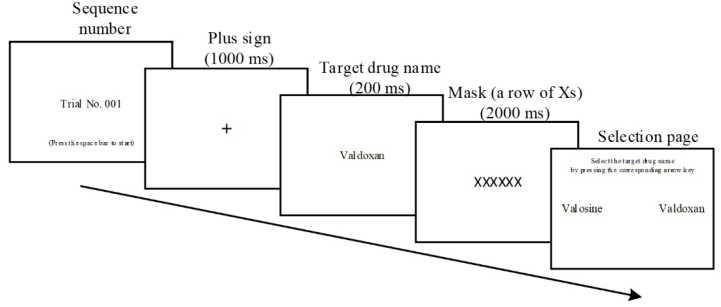
Figure 1: Illustration of the page sequence of each trial.
A self-developed data collection software tool built in PsychoPy (Peirce & MacAskill, 2018) was run on a 15-inch notebook computer. As shown in Figure 1, five pages would be presented sequentially on the computer screen in each trial. The first page displayed the trial sequence number at the center of the page and a “Press the space bar to start” instruction at the bottom. When the participant pressed the space bar on the keyboard, the screen turned to the second page. A plus sign was displayed at the center and participants were asked to keep their eyes on the plus sign. After a thousand milliseconds (ms), the second page was replaced by the third page. The target drug name was displayed at the center for 200 ms., then the screen changed to the fourth page. A row of six Xs was displayed at the center as a mask pattern for 2000 ms to roughly simulate the latency for pharmacists from reading a drug name on a drug bag to the beginning of reading the labels of drug names on medication cabinets.
Finally, the fifth page appeared after the mask pattern. The target drug name was randomly displayed on the left or right side of the page, whereas its distractor was on the opposite side. At the top of the page, the instruction “Select the target drug name by pressing the corresponding arrow key” was displayed. Participants selected a drug name they thought was the target drug name by pressing the corresponding left or right arrow key on the keyboard. Once the arrow key was pressed, the screen turned to the first page of the next trial. Note that the text formats of the target drug names on the target drug name page were identical to those shown on the selection page.
Prior to the first trial, a practical version was provided to familiarize par- ticipants with the user interface of the data collection tool. Three extra pairs of confusing drug names without tall-man letters and a prefixed hash symbol were used for the practice.
While the data on the error rate and response time of the participants were collected using the self-developed software tool, the data on the number of eye fixations were collected using the Tobii Pro Glasses 2, a wearable eye-tracking system.
Procedures After signing a consent form, the participant was asked to sit in front of a 15-inch screen of a notebook computer. The distance between the participant and the screen was about 50 centimeters. The participant was then instru- cted to practice with the practice version of the data collection tool until he or she felt ready to start the experiment. The sequence of 192 trials was randomized for each participant. The duration of the experiment for each participant was about 15 minutes. The study protocol was approved by the local research ethics committee (National Taiwan University, approval No 201806ES078).
RESULTS
The effects of tall-man lettering and hash symbol prefixing on the error rate, the response time, and the number of eye fixations are presented below.
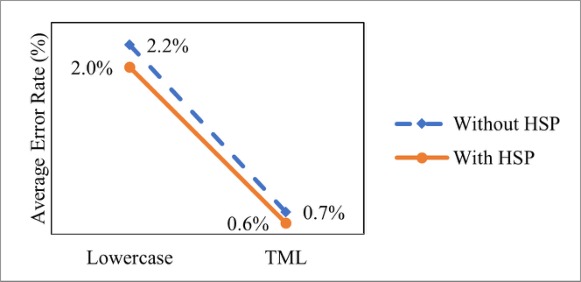
Error Rate The Wilcoxon signed-ranks test was applied since the data violated the nor- mality assumption. The main effect of TML on the error rate was significant, Z = −3.36, p = 0.001, indicating that the error rate decreased significantly when the drug names were altered with TML (M =0.7%, SD = 0.9%) than when they remained lowercase (M = 2.1%, SD = 1.8%). However, the main effect of HSP on the error rate was not significant, Z = −0.55, p = 0.585, and the interaction effect was not significant, as shown in the profile plots in Figure 2.
Figure 2: Profile plots of the error rate (TML: tall-man lettering; HSP: hash symbol prefixing).
Combination of Tall-man Lettering and Symbol Prefixing to Improve Drug Identification 17
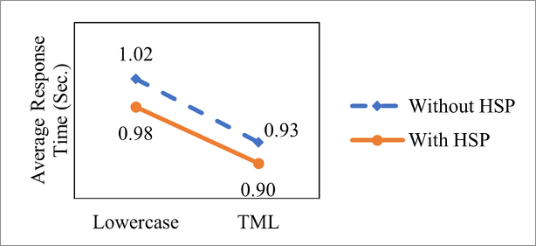
Response Time The two-way repeated measures ANOVA was used since the data met the normality assumption. The main effect of TML on the response time was significant, F(1, 25) = 19.48, p < 0.001, η2
p = 0.44, indicating that the response time decreased significantly when the drug names were altered with TML (M = 0.92, SD = 0.13) than when they remained lowercase (M = 1.00, SD = 0.16).
Equation reproduced from the original PDF.
p = 0.15, indicating that the response time decreased significan- tly when the target drug names were prefixed with a hash symbol (M = 0.94, SD = 0.15) compared to when the names without the prefixed symbol (M = 0.98, SD = 0.14). However, the interaction effect was not significant, F(1, 25) = 0.44, p = 0.515. The profile plots are shown in Figure 3.
Figure 3: Profile plots of the response time (TML: tall-man lettering; HSP: hash symbol prefixing).
Number of Eye Fixations The two-way repeated measures ANOVA was applied since the data met the normality assumption. The main effect of TML on the number of eye fixati- ons was significant, F(1, 25) = 259.71, p < 0.001, η2
p = 0.91, indicating that the number of eye fixations decreased significantly when the drug names were altered with TML (M = 2.0, SD = 0.1) than when they remained lowercase (M = 2.3, SD = 0.1).
The main effect of HSP on the number of eye fixations was significant, F(1, 25) = 38.48, p < 0.001, η2 p = 0.61, indicating that the number of eye fixati- ons decreased significantly when the target drug names were prefixed with a hash symbol (M = 2.0, SD = 0.1) compared to when the names without the prefixed symbol (M = 2.2, SD = 0.1).
Equation reproduced from the original PDF.
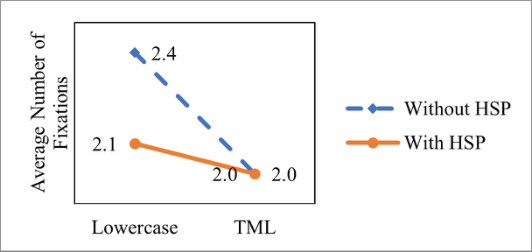
p = 0.54. To decompose this interaction, a simple-effects analysis showed that the simple effect of HSP on the number of eye fixations was signifi- cant when the drug names remained lowercase, F(1, 25) = 42.13, p < 0.001, η2
p = 0.63, indicating that, as the drug names were not altered with TML, the number of eye fixations decreased significantly when the target drug names were prefixed with a hash symbol (M = 2.1, SD = 0.2) compared to when
the names without the prefixed symbol (M = 2.4, SD = 0.2). In contrast, the simple effect of HSP on the number of eye fixations was not significant when the drug names were altered with TML, F(1, 25) = 0.35, p = 0.559. The profile plots are shown in Figure 4.
Figure 4: Profile plots of the number of eye fixations (TML: tall-man lettering; HSP: hash symbol prefixing).
DISCUSSION
The findings provide evidence that confusing drug names differentiated by both tall-man lettering and symbol prefixing could facilitate the dispensing work of pharmacists. With tall-man lettering alone, the error rate, response time, and the number of eye fixations for drug name identification could be reduced by 67%, 8%, and 13%, respectively. Furthermore, with symbol prefixing alone, the response time and the number of eye fixations could be reduced by 4% and 6%, respectively. Finally, when there was no tall-man let- tering, having symbol prefixing could reduce the number of eye fixations by 11%. In summary, tall-man lettering and symbol prefixing could complement each other well in helping pharmacists identify confusing drug names.
To our knowledge, this study was the first attempt to propose an orthogra- phic alteration method, symbol prefixing, with the popular typographic alte- ration method, tall-man lettering, to improve the identification of confusing drug names.
Although the orthographic alteration method proposed in this study has not been found in previous research. Its impact needs more research. Several possible explanations exist for the non-significant effect of symbol prefixing on the identification error rate. While it could be due to the moderate sample size that limited statistical power (Irwin et al., 2013), it could be attributa- ble to the relatively low error rate that led to a floor effect (Wang and Or, 2020). Another explanation is that symbol prefixing was relatively new to pharmacists who were familiar with the purpose and application of tall-man lettering (Filik et al., 2004). Future work may focus on the effect of pharma- cists’ familiarity with various text enhancement modifications on their drug identification performance.
Moreover, the orthographic alteration method applied in this study might come with the caveat that a prefixed symbol could be used as a shortcut to
Combination of Tall-man Lettering and Symbol Prefixing to Improve Drug Identification 19
identify drugs. That is, pharmacists could identify drugs only by their prefixed symbols without looking at drug names. This side effect has been found when using color as a cue to identify drugs and has led to errors (Filik et al., 2005). Further studies on this issue are recommended.
In practice, drug names or brand names are usually displayed with addi- tional information on medication lists, drug cabinet labels, and/or drug packages, such as their generic names, names in the second language, dosage strengths, and/or dosage forms. These various orthographic sources can influence the identification of drugs. It is worth investigating the effects of these different types of information on the impact of differentiating confusing drug names.
In addition to tall-man letters, other typographic attributes have been studied to understand their effects on the differentiation of confusing drug names, such as boldface letters (Gabriele, 2006; Liu et al., 2019; Or and Chan, 2014; Or and Wang, 2014; Wang and Or, 2020), colored (e.g., red) let- ters (Filik et al., 2005; 2006; Or and Chan, 2014; Or and Wang, 2014; Schell, 2009; Wang and Or, 2020), white letters on a black rectangle (Gabriele, 2006; Liu et al., 2019; Or and Wang, 2014; Wang and Or, 2020), reverse tall- man letters (Wang and Or, 2020) and enlarged letters (Or and Chan, 2014). However, the findings of previous research were not conclusive. More syste- matic studies seem necessary to justify the effectiveness of these attributes individually and collectively.
CONCLUSION
This study has shown that the combination of tall-man lettering and symbol prefixing could reduce confusion between drug names and help pharmacists identify drugs. While the findings strengthen the idea that tall-man lettering is an effective technique for differentiating drug names, this study has demon- strated, for the first time, that symbol prefixing is also a useful method for the differentiation of drug names.
Since confusion between drug names is one of the main causes of medica- tion errors and therefore affects patient safety, continued efforts are needed to explore and examine any approach that can solve the problem. A natural progression of this work is to investigate possible typographic and orthogra- phic alterations to drug names for mitigating the confusion and ultimately improving patient safety.
ACKNOWLEDGMENT
This work was supported by the National Science and Technology Council of Taiwan, ROC, under grant no. MOST 107-2221-E-027-063-MY3.
REFERENCES
Bryan, R., Aronson, J. K., Williams, A. J., & Jordan, S. (2021). A systematic literature review of LASA error interventions. British Journal of Clinical Pharmacology, 87(2), 336–351.
Darker, I. T., Gerret, D., Filik, R., Purdy, K. J., & Gale, A. G. (2011). The influence of ‘Tall Man’lettering on errors of visual perception in the recognition of written drug names. Ergonomics, 54(1), 21–33. DeHenau, C., Becker, M. W., Bello, N. M., Liu, S., & Bix, L. (2016). Tallman lettering
as a strategy for differentiation in look-alike, sound-alike drug names: the role of familiarity in differentiating drug doppelgangers. Applied ergonomics, 52, 77–84. Dice, L. R. (1945). Measures of the amount of ecologic association between species. Ecology, 26(3), 297–302. Dunn-Rankin, P. (1978). The visual characteristics of words. Scientific Ameri-
can, 238(1), 122–131. Filik, R., Price, J., Darker, I., Gerrett, D., Purdy, K., & Gale, A. (2010). The Influence of tall-man lettering on drug name confusion. Drug safety, 33(8), 677–687. Filik, R., Purdy, K., & Gale, A.(2005). The use of colour on the labelling of medicines.
In: D. E. Waard, et al. (Eds.). Human Factors in Design, Safety and Management. Aachen: Shaker. Filik, R., Purdy, K., Gale, A., & Gerrett, D. (2004). Drug name confusion: evaluating the effectiveness of capital (“Tall Man”) letters using eye movement data. Social science & medicine, 59(12), 2597–2601. Filik, R., Purdy, K., Gale, A., & Gerrett, D. (2006). Labeling of medicines and
patient safety: evaluating methods of reducing drug name confusion. Human Factors, 48(1), 39–47. Gabriele, S. (2006). The role of typography in differentiating look-alike/sound-alike drug names. Healthcare Quarterly, 9, 88–95. Goldberg, J. H., & Kotval, X. P. (1999). Computer interface evaluation using
eye movements: methods and constructs. International journal of industrial ergonomics, 24(6), 631–645. Institute for Safe Medication Practices. (2019). ISMP List of Confused Drug Names. Irwin, A., Mearns, K., Watson, M., & Urquhart, J. (2013). The effect of proximity, Tall-man lettering, and time pressure on accurate visual perception of drug names. Human factors, 55(2), 253–266. Lambert, B. L., Lin, S. J., Chang, K. Y., & Gandhi, S. K. (1999). Similarity as a risk
factor in drug-name confusion errors: the look-alike (orthographic) and sound- alike (phonetic) model. Medical care, 1214–1225. Larmené-Beld, K. H., Alting, E. K., & Taxis, K. (2018). A systematic literature review on strategies to avoid look-alike errors of labels. European journal of clinical pharmacology, 74(8), 985–993. Lin, C. J., Prasetyo, Y. T., & Widyaningrum, R. (2019). Eye movement measures for
predicting eye gaze accuracy and symptoms in 2D and 3D displays. Displays, 60, 1–8. Liu, K., Or, C. K., & Li, S. Y. (2019). Visual differentiation and recognition memory of look-alike drug names: effects of disfluent format, text enhancement and exposure time. Ergonomics, 62(10), 1289–1300. McConkie, G. W., & Rayner, K. (1976). Asymmetry of the perceptual span in
reading. Bulletin of the psychonomic society, 8(5), 365–368. Or, C. K., & Chan, A. H. (2014). Effects of text enhancements on the differentiation performance of orthographically similar drug names. Work, 48(4), 521–528. Or, C. K., & Wang, H. (2014). A comparison of the effects of different typogra-
phical methods on the recognizability of printed drug names. Drug safety, 37(5), 351–359. Peirce, J., & MacAskill, M. (2018). Building experiments in PsychoPy. Sage. Rayner, K. (1979). Eye guidance in reading: Fixation locations within words. Perception, 8(1), 21–30.
Combination of Tall-man Lettering and Symbol Prefixing to Improve Drug Identification 21
Reiner, G., Pierce, S. L., & Flynn, J. (2020). Wrong drug and wrong dose dispensing errors identified in pharmacist professional liability claims. Journal of the American Pharmacists Association, 60(5), e50–e56. Schell, K. L. (2009). Using enhanced text to facilitate recognition of drug names:
evidence from two experimental studies. Applied ergonomics, 40(1), 82–90. Tseng, H. Y., Wen, C. F., Lee, Y. L., Jeng, K. C., & Chen, P. L. (2018). Dispensing errors from look-alike drug trade names. European Journal of Hospital Pharmacy, 25(2), 96–99. U. S. Food and Drug Administration (2020). US FDA name differentiation project
(2020). Website: https://www.fda.gov/drugs/medication-errors-related-cder-regul ated-drug-products/fda-name-differentiation-project#1 Wang, H., & Or, C. K. (2020). Effects of text enhancement, identical prescriptionpackage names, visual cues, and verbal provocation on visual searches of look- alike drug names: a simulation and eye-tracking study. Human factors, 62(7), 1102–1116. World Health Organization. (2017). Medication without harm (No. WHO/HI-
S/SDS/2017.6). World Health Organization. Zhong, W., Feinstein, J. A., Patel, N. S., Dai, D., & Feudtner, C. (2016). Tall-man lettering and potential prescription errors: a time series analysis of 42 children’s hospitals in the USA over 9 years. BMJ quality & safety, 25(4), 233–240.
LISTED IN THE AHFE DIGITAL BOOKSTORE CATALOGUE
Explore the complete digital volume
Health Informatics and Biomedical Engineering Applications
Read this individual research paper free through the original publisher, or explore the full digital proceedings book.
ISBN 978-1-958651-54-4
Explore this ISBN in the AHFE Bookstore ↗Listed in the July 2026 bookstore catalogue; search by ISBN to confirm current availability · Digital book purchase optional