Chelsea Edwards, Fuad Abujarad (2023). Digital Informed Consent for Older Adults in Emergency Department Research. In: Health Informatics and Biomedical Engineering Applications. AHFE Open Access, vol. 78, pp. 1–10. https://doi.org/10.54941/ahfe1003449
The objective of the informed consent (IC) process is to inform potential participants about the purpose, procedures, risks, and benefits associated with clinical research and medical procedures. Traditional paper consent processes are generally long and confusing, especially in busy settings for research such as the emergency department (ED). We describe how we used a tablet-based digital IC process to recruit (N=1,002) older adults for an elder mistreatment study in the ED. Methods: The Virtual Multimedia Interactive Informed Consent (VIC) consent tool was previously developed and tested in an AHRQ-funded R21 study and was found to be usable, acceptable, and it enhanced participants’ comprehension and satisfaction when compared to a traditional paper-based IC process (Abujarad et al., 2021a). VIC was developed using a user-centered design (UCD) approach, incorporating digital coaching, multimedia features such as animated videos to explain research procedures, automated text-to-speech audio, and automated teach-back to emphasize key concepts. The VIC digital consent tool was used to recruit patients for an NIA-funded R01 study evaluating the feasibility of the VOICES Elder Mistreatment Intervention, a self-administered digital health intervention to increase identification of elder mistreatment in ED settings. Due to the complexities of elder mistreatment identification, we recognized the need for an IC process that ensures participant privacy, autonomy, and comprehension, with particular focus on the risks and benefits of recognizing and disclosing mistreatment. A total of 1,002 participants ages 60 and older were consented and enrolled during their visit in the ED. Results: A total of 1,204 of eligible participants agreed to participate in the study and started the consent, of whom 1,012 (84%) participants completed the consent process and enrolled in the VOICES study. Of the 192 (16%) participants who were not enrolled in the study: 158 (13%) did not complete the IC process for varying reasons, the most common reason being due to pain, and 34 (3%) completed the IC fully and chose not to participate in VOICES study. Of the consented participants, 99% fully completed the VOICES study and filled all surveys. Consented participants included older adults from 60 to 102 years old with a mean age of 73.5. Most participants were female, white, and high school educated or higher.Discussion: We believe that the use of digital IC process benefitted the participants who were able to complete the IC process on their own and with minimal help from the study coordinators. We received a high study completion rate among consented participants, and we believe that emphasizing key concepts and using multimedia to explain the more complicated research topics helped better educate potential participants to make a true informed decision about their participation in the VOICES study. It is likely that research participants who have a better understanding of the nature of the study are more likely to finish study procedures, increasing study retention. For the patients who did not complete the IC, they associated that to their chief complaint and medical reasons related to the nature of their visit to the ED. More research is needed to compare traditional and digital consent processes to better evaluate the effectiveness of digital consent.
Informed consent (IC) is a critical component of conducting research with human subjects in an ethical manner, providing essential details related to the study’s purpose, procedures, risks, benefits, and rights of the potential participant. The process, codified into law, is upheld by the wider scien- tific community as a pillar of facilitating ethical conduct in research and maintaining a foundation of trust between the research and participants (Baz- zano et al., 2021, Hall et al., 2012). It is meant to not only better inform the participant of their responsibilities and what to expect, but also main- tain study integrity and prevent conflict due to misunderstanding related to the nature of the research, reducing issues between the research team and the participant. Historically, the public perception of research has faced ongoing challenges with fostering trust in ethical participation due to a complex past among other factors, particularly affecting minority and under- served populations (Smirnoff et al., 2018, Scharff et al., 2010). Trust is a key element in facilitating research, and the informed consent process can be a formative moment which can further develop or disrupt that trust in research.
Traditionally, the IC process is delivered in paper format, requiring a bin- ding signature to participate in the described research. However, studies can have complicated procedures necessitating a wealth of information that can further complicate the IC process—participants may have a hard time under- standing scientific language that is difficult to convey in layman’s terms, become confused by certain descriptors of procedures or risks, or overwh- elmed by the sheer amount of information to read (Bazzano et al., 2021, Hall et al., 2012, Pietrzykowski and Smilowska, 2021). Lengthiness can lead to participants not fully understanding essential parts of the consent and par- ticipants may spend too little time reading compared to length of consent (Emanuel and Boyle, 2021, Berger et al., 2009, Baren et al., 2010). It is common for research assistants to facilitate the process, providing answers to questions the potential participant may have, but their presence cannot guarantee full attention and comprehension of the IC (Baren et al., 2010, Nusbaum et al., 2017).
These compounded barriers to truly informed consent further perpetu- ate distrust in research and challenge advancements in science. There is a need to enhance the traditional method of administering the IC, with many possibilities for improvement arising in technological adaptation.
Digital Consent to Improve Health Literacy and Decision Making Studies have shown that the lack of sufficient comprehension of informa- tion included in the IC can contribute to the misinformation and mistrust of participating in research (Bergler et al., 1980, Cassileth et al., 1980, Graham, 2003, Lavelle-Jones et al., 1993, Parker, 2000, Saw et al., 1994, Wadey and Frank, 1997, Krumholz, 2010, Hartgerink et al., 1998, Bazzano et al., 2021). Multiple studies have called for providing more efficient and effective patient-centered IC processes (Saag et al., Caldwell et al., 2010, Donovan et al., 2009, Baer et al., 2011).
Digital Informed Consent for Older Adults in Emergency Department Research 3
Technology has advanced significantly during the initial adoption and use of traditional informed consent, and can be used to enhance the methods of obtaining IC through digital tools that capitalize on participant preferences such as learning styles, culture, and language with text-alternative meth- ods (digital coaching, video, animation, voice-over, etc.) (Entwistle et al., 2012, Gesualdo et al., 2021). In addition, decision aid tools have become more common (Stacey et al., 2017, Gillies and Campbell, 2019). These tools provide a myriad of benefits, which include informing about options, clarifying values, supporting preference construction process, and enabling increased active engagement in shared decision-making (Stacey et al., 2017, Swierenga et al., 2013, Sepucha et al., 2010).
Research has shown that the addition of audio and visual elements to the IC process increases participant interest and motivation, which can enha- nce comprehension, recall, and satisfaction with the IC process (Jimison and Sher, 1995, Hung et al., 2011). Studies have also explored the use of visual aids to enhance participant IC experiences and have found that participants demonstrated increased knowledge (Enzinger et al., 2020). Evidence suggests that technology to improve the IC process has been explored in many various ways, and that interactive interventions appear to be most effective (Glaser et al., 2020).
Challenges in the Emergency Department Setting The emergency department (ED) setting can be a challenging environment to introduce IC to potential participants. The window for consenting and recruiting participants is small due to the priority in addressing patient needs and discharging patients to maintain an optimal patient flow and decrease ED waiting times (Kendrick et al., 2007). If the consent is too long, there can be challenges in participants being able to complete the research proce- dures. In addition, several other factors can impede in the IC process, such as unpredictable interruptions, fluctuations in patient health and mental sta- tus, and prevention of participation by the patient’s visitor or healthcare team (Schmidt et al., 2004, Miller et al., 2021, White et al., 2008, Cofield et al., 2010, Southerland et al., 2022). Due to the increased vulnerability of this population, particularly older adults visiting the ED (Southerland et al., 2022), it is crucial that participants fully understand the nature of the IC process while addressing major environmental challenges.
METHODS
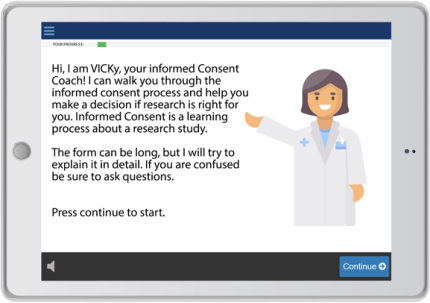
The Virtual Multimedia Interactive Informed Consent (VIC) consent tool was developed and tested in an AHRQ-funded real-world study to address described barriers to obtaining effective, comprehensive IC (Abujarad F, 2018) (See Figure 1). VIC conducts a digital interview (e.g. using a digital coach) with participants using adaptable media devices (e.g. tablet, smart- phones, computers) with a comprehensive multimedia library (e.g. video clips, animations, presentations, etc.) that enhances participant comprehen- sion and improves the IC process (Abujarad et al., 2021a, Abujarad et al.,
4 Edwards and Abujarad
Figure 1: VIC Introduction Screen.
2021b, Abujarad F, 2018). The VIC tool uses novel, interactive, and perso- nalized digital coaching and teach-back processes to further motivate and engage the participant in research, building upon growing evidence of uti- lizing technology for superior consenting methods (Gesualdo et al., 2021, Glaser et al., 2020).
Consenting Older Adults with the VOICES Study The VIC digital consent tool was used to consent patients for an NIA-funded R01 study evaluating the feasibility of the VOICES Elder Mistreatment Intervention, a self-administered digital health intervention to increase iden- tification of elder mistreatment in ED settings (Abujarad et al., 2021c). Due to the complicated nature of elder mistreatment identification, we recognized the need for an IC process that ensured participant privacy, autonomy, and comprehension, with particular focus on the risks and benefits of recognizing and disclosing abuse. This study population, in addition to facing the unique challenges of recruitment in the ED setting, faced higher risk for health com- plications and potential interruptions thus necessitating a time-sensitive, yet fully informed IC process (Dufour et al., 2019, Samaras et al., 2010).
For the VOICES study, each section of the consent (including text and multimedia content) required viewing before the patient was able to ele- ctronically sign their signature. The VIC consent tool’s teach-back process contained questions related to the risks, benefits, voluntary withdrawal and specific study procedures. These questions could not be skipped, and pati- ents who answered these questions incorrectly had the ability to go back and re-read the section and re-submit their answer, or have the section verbally explained in detail by the research assistant. The research assistant was aler- ted of any incorrect answers by monitoring study progress on their own iPad and had the ability to reject participation based on personal judgement of comprehension.
Participants Study participants were older adult ages 60 and older who were approached during their ED visit to the Saint Raphael Campus Emergency Department
Digital Informed Consent for Older Adults in Emergency Department Research 5
Table 1. Demographic information of patients who completed the consent process.
Table available in the original PDF paper.
Consented Patients (n = 1,012) Gender, n (%) Female 599 (59.2) Male 413 (40.8) Race, n (%) White 680 (67.2) Black or African American 302 (29.8) Native American or American Indian 3 (0.3) Asian or Pacific Islander 10 (1) Other 16 (1.6) Refused/Unknown 1 (0.1) Ethnicity, n (%) Non-Hispanic or Latino 949 (93.8) Hispanic or Latino 49 (4.8) Education, n (%) High school not completed 94 (9.3) High school graduate or GED 294 (29.1) Some college or associate’s degree 286 (28.3) College degree (bachelor’s program) 196 (19.4) Graduate or professional degree 138 (13.6) Other 2 (0.2) Refused/Unknown 2 (0.2)
in New Haven, Connecticut, USA (see Table 1). Patients who visit the Saint Raphael Campus Emergency Department reflect the representation of the New Haven USA Census: 42% White alone, 35% Black or African Ame- rican alone; 13% some other race; 5% Asian alone; 4% 2 or more races, <1% American Indian and Alaska native alone, <1% Native Hawaiian and other Pacific native alone, with 27% Hispanic or Latino. The participants were eligible for the study if they (1) spoke English, (2) were 60+ years old, and (3) were willing to use an iPad. Computer literacy was not required for eligibility.
Study participants were consented and recruited by trained research assi- stants over a 16-month period. Participants were given an iPad tablet to consent, followed by taking part in the VOICES study privately in their room without caregivers or visitors present. The research assistant remained nearby in the room to assist with any questions or technical difficulties.
RESULTS
Overall, 1,204 eligible participants showed interest in participating in the VOICES study and agreed to take part in the informed consent process. Con- sented participants included older adults from 60 to 102 years old with a mean age of 73.5. Most participants were female, white, non-Hispanic or Latino, and high school educated, and 37.5% of patients who completed the consent belonged to a minority population (see Table 1).
6 Edwards and Abujarad
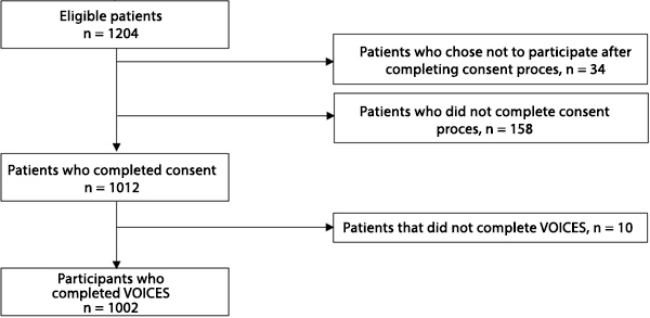
Figure 2: Diagram of eligible patients in VOICES study.
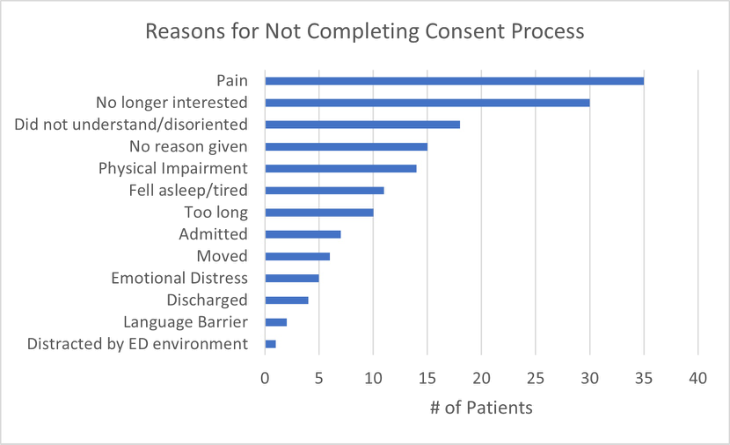
Out of the 1,204 participants who started the consent process a total of 1,012 (84%) participants were fully consented and were enrolled in the VOICES study (see Figure 2). Of the fully consented participants, 99% fully completed the VOICES study and completed all study surveys. The other 192 (16%) participants who were not enrolled in the VOICES study were distri- buted as follows: a total of 158 (13%) did not complete the consent process for varying reasons, the most common reason being due to pain (see Figure 3), and 34 (3%) completed the consent fully and chose not to participate.
The average time it took to complete the consent was 14.7 minutes. Appro- ximately, 95.1% of participants (962/1,012) answered at least 3 out of 4
Figure 3: Reasons for not completing consent process, VOICES study.
Digital Informed Consent for Older Adults in Emergency Department Research 7
questions correctly regarding key factors of the study (purpose, voluntary withdrawal, risks and benefits) in VIC’s teach-back comprehension questions.
LIMITATIONS This study was not evaluated with ED providers, nurses, or other mem- bers of the healthcare team. Since this was not a randomized controlled trial focusing on the effects of digital IC, we did not compare effectiveness with a traditional paper IC process. While our findings generally reflected the patient population who visited the study site, representation of Hispanic or Latino population was low, potentially due to inclusion criteria for the study requiring English-speaking participants.
CONCLUSION
Our findings suggest that with a significantly high study completion rate (99%) in a challenging ED setting, the use of a digital IC process benefit- ted both patients and the VOICES study team. In addition, less time spent in the room conducting research-related tasks may have benefitted the health- care team by reducing transitional burden between interrupted research tasks and patient care.
Participants were able to complete the IC process on their own and with minimal help from the study coordinators. We believe that emphasizing key concepts and using multimedia to explain complicated research topics assi- sted in improving health literacy of potential participants to obtain a true informed decision about their participation in the VOICES study. It is likely that research participants who have a better understanding of the nature of the study are more likely to finish study procedures, increasing study reten- tion. Discharge (2.5%) was one of the lowest categories for not completing the consent, suggesting that the entire study process may have aligned well with ED patient flow. For patients who did not complete the IC, the majority associated that to medical reasons related to the nature of their visit to the ED, rather than the content of the consent and study procedures.
More research is needed to compare traditional and digital consent proces- ses with this population to evaluate the effectiveness of digital consent, and in alternative ED settings.
ACKNOWLEDGMENT
The VIC tool was funded by grant R21HS023987 from the Agency for Healthcare Research and Quality. The VOICES study was funded by the National Institute on Aging of the National Institutes of Health, Grant/Award Number: R01AG060084.
REFERENCES
Abujarad F, A. S., Bright TJ, et al. 2018. Building an Informed Consent Tool Starting with the Patient: The Patient-Centered Virtual Multimedia Interactive Informed Consent (VIC). AMIA... Annual Symposium proceedings. AMIA Symposium, 2017, 374–383.
8 Edwards and Abujarad
Abujarad, F., Lizbinski, R. L. & Ibrahim, H. 2021a. Digital solutions to improve the informed consent process for clinical trials. Health Policy and Technology, 10, 10–12. Abujarad, F., Peduzzi, P., Mun, S., et al. 2021b. Comparing a Multimedia Digi-
tal Informed Consent Tool With Traditional Paper-Based Methods: Randomized Controlled Trial. JMIR Form Res, 5, e20458. Abujarad, F., Ulrich, D., Edwards, C., et al. 2021c. Development and usability evaluation of VOICES: A digital health tool to identify elder mistreatment. J Am Geriatr Soc, 69, 1469–1478. Baer, A. R., Good, M. & Schapira, L. 2011. A New Look at Informed Consent for
Cancer Clinical Trials. Journal of Oncology Practice, 7, 267–270. Baren, J., Campbell, C. F., Schears, R. M., et al. 2010. Observed behaviors of subjects during informed consent for an emergency department study. Ann Emerg Med, 55, 9–14. Bazzano, L. A., Durant, J. & Brantley, P. R. 2021. A Modern History of Informed
Consent and the Role of Key Information. Ochsner J, 21, 81–85. Berger, O., Gronberg, B. H., Sand, K., et al. 2009. The length of consent documents in oncological trials is doubled in twenty years. Ann Oncol, 20, 379–85. Bergler, J. H., Pennington, A. C., Metcalfe, M., et al. 1980. Informed consent: How
much does the patient understand? Clinical Pharmacology and Therapeutics, 27, 435–440. Caldwell, P. H. Y., Hamilton, S., Tan, A., et al. 2010. Strategies for increasing recruitment to randomised controlled trials: Systematic review. PLoS Medicine, 7. Cassileth, B. R., Zupkis, R. V., Sutton-Smith, K., et al. 1980. Informed consent --
why are its goals imperfectly realized? N Engl J Med, 302, 896–900. Cofield, S. S., Conwit, R., Barsan, W., et al. 2010. Recruitment and retention of patients into emergency medicine clinical trials. Acad Emerg Med, 17, 1104–12. Donovan, J. L., Athene Lane, J., Peters, T., et al. 2009. Development of a com-
plex intervention improved randomization and informed consent in a randomized controlled trial. Journal of Clinical Epidemiology, 62, 29–36. Dufour, I., Chouinard, M. C., Dubuc, N., et al. 2019. Factors associated with frequent use of emergency-department services in a geriatric population: a systematic review. BMC Geriatr, 19, 185. Emanuel, E. J. & Boyle, C. W. 2021. Assessment of Length and Readability of Infor-
med Consent Documents for COVID-19 Vaccine Trials. JAMA Netw Open, 4, e2110843. Entwistle, V. A., Cribb, A. & Watt, I. S. 2012. Shared decision-making: Enhancing the clinical relevance. Journal of the Royal Society of Medicine, Supplement, 105, 416–421. Enzinger, A. C., Uno, H., Mccleary, N., et al. 2020. Effectiveness of a Multime-
dia Educational Intervention to Improve Understanding of the Risks and Benefits of Palliative Chemotherapy in Patients With Advanced Cancer: A Randomized Clinical Trial. JAMA Oncol, 6, 1265–1270. Gesualdo, F., Daverio, M., Palazzani, L., et al. 2021. Digital tools in the informed consent process: a systematic review. BMC Med Ethics, 22, 18. Gillies, K. & Campbell, M. K. 2019. Development and evaluation of decision aids for
people considering taking part in a clinical trial: a conceptual framework. Trials, 20, 401. Glaser, J., Nouri, S., Fernandez, A., et al. 2020. Interventions to Improve Patient Comprehension in Informed Consent for Medical and Surgical Procedures: An Updated Systematic Review. Med Decis Making, 40, 119–143.
Digital Informed Consent for Older Adults in Emergency Department Research 9
Graham, P. 2003. Type of consent does not influence patient recall of serious potential radiation toxicity of adjuvant breast radiotherapy. Australas Radiol, 47, 416–21. Hall, D. E., Prochazka, A. V. & Fink, A. S. 2012. Informed consent for clinical
treatment. CMAJ, 184, 533–40. Hartgerink, B., Mcmullen, P., Mcdonough, J., et al. A guide to understanding informed consent. 1998. 128. Hung, S.-Y., Huang, K.-L. & Yu, W.-J. 2011. An empirical study of the effectiveness
of multimedia disclosure of informed consent: A technology mediated learning perspective. Information & Management, 48, 135–144. Jimison, H. B. & Sher, P. P. 1995. Consumer health informatics: Health information technology for consumers. Journal of the American Society for Information Science, 46, 783–790. Kendrick, D., Lyons, R., Christie, N., et al. 2007. Recruiting participants for injury
studies in emergency departments. Inj Prev, 13, 75–7. Krumholz, H. M. 2010. Informed Consent to Promote Patient-Centered Care. JAMA: The Journal of the American Medical Association, 303, 1190–1191. Lavelle-Jones, C., Byrne, D. J., Rice, P., et al. 1993. Factors affecting quality of
informed consent. BMJ, 306, 885–90. Miller, J., Costa, S. G., Taylor, D. A. & Buntine, P. 2021. Rethinking consent processes for research in emergency departments. Emerg Med Australas, 33, 753–755. Nusbaum, L., Douglas, B., Damus, K., et al. 2017. Communicating Risks and Bene-
fits in Informed Consent for Research: A Qualitative Study. Glob Qual Nurs Res, 4, 2333393617732017. Parker, R. 2000. Health literacy: A challenge for American patients and their health care providers. Health Promotion International, 15, 277–283. Pietrzykowski, T. & Smilowska, K. 2021. The reality of informed consent: empirical
studies on patient comprehension-systematic review. Trials, 22, 57. Saag, K. G., Mohr, P. E., Esmail, L., et al. Improving the efficiency and effectiveness of pragmatic clinical trials in older adults in the United States. Contemporary Clinical Trials. Samaras, N., Chevalley, T., Samaras, D. & Gold, G. 2010. Older patients in the
emergency department: a review. Ann Emerg Med, 56, 261–9. Saw, K. C., Wood, A. M., Murphy, K., et al. 1994. Informed consent: An evaluation of patients’ understand and opinion (with respect to the operation of transurethral resection of prostate). Journal of the Royal Society of Medicine, 87, 143–4. Scharff, D. P., Mathews, K. J., Jackson, P., et al. 2010. More than Tuskegee: under-
standing mistrust about research participation. J Health Care Poor Underserved, 21, 879–97. Schmidt, T. A., Salo, D., Hughes, J. A., et al. 2004. Confronting the ethical challenges to informed consent in emergency medicine research. Acad Emerg Med, 11, 1082–9. Sepucha, K. R., Fagerlin, A., Couper, M. P., et al. 2010. How does feeling informed
relate to being informed? The DECISIONS survey. Medical decision making : an international journal of the Society for Medical Decision Making, 30, 77S-84S. Smirnoff, M., Wilets, I., Ragin, D. F., et al. 2018. A paradigm for understanding trust and mistrust in medical research: The Community VOICES study. AJOB Empir Bioeth, 9, 39–47. Southerland, L. T., Benson, K. K., Schoeffler, A. J., et al. 2022. Inclusion of older
adults and reporting of consent processes in randomized controlled trials in the emergency department: A scoping review. J Am Coll Emerg Physicians Open, 3, e12774.
10 Edwards and Abujarad
Stacey, D., Legare, F., Lewis, K., et al. 2017. Decision aids for people facing health treatment or screening decisions. Cochrane Database Syst Rev, 4, CD001431. Swierenga, S. J., Abujarad, F., Dennis, T. A., et al. 2013. Improving Patient Safety
through User-Centered Healthcare Background Check System Design. HFES Wadey, V. & Frank, C. 1997. The effectiveness of patient verbalization on informed consent. Canadian Journal of Surgery, 40, 124-128. White, C., Gilshenan, K. & Hardy, J. 2008. A survey of the views of pallia-
tive care healthcare professionals towards referring cancer patients to participate in randomized controlled trials in palliative care. Support Care Cancer, 16, 1397–405.
LISTED IN THE AHFE DIGITAL BOOKSTORE CATALOGUE
Explore the complete digital volume
Health Informatics and Biomedical Engineering Applications
Read this individual research paper free through the original publisher, or explore the full digital proceedings book.
ISBN 978-1-958651-54-4
Explore this ISBN in the AHFE Bookstore ↗Listed in the July 2026 bookstore catalogue; search by ISBN to confirm current availability · Digital book purchase optional