Irina Kurnikova, Shirin Gulova, Natalia Danilina, Ikram Mokhammed, Artyom Yurovsky (2023). Mathematical analysis of daily ECG in assessing the effectiveness of obesity treatment in young patients. In: Health Informatics and Biomedical Engineering Applications. AHFE Open Access, vol. 78, pp. 103–110. https://doi.org/10.54941/ahfe1003461
Mathematical analysis of the ECG in medicine has been used for a long time, since in 1932 Fleisch and Beckmann first applied the mathematical assessment of the heart rate using the standard deviation of the R-R intervals to assess fluctuations. Mathematical analysis technologies are constantly developing and improving and are the method of choice in the analysis of heart rate variability (HRV). HRV analysis is based on the measurement of time intervals between adjacent ECG R-waves with the construction of a dynamic series - a cardiorhythmogram (CRG). Evaluation of HRV allows to obtain data not only on the functioning of the patient's cardiovascular system, but also on the tension (or exhaustion) of regulatory mechanisms (the state of autonomic regulation), and hence on the preservation of adaptation reserves and rehabilitation capabilities of the body. And this opens opportunities for predicting and monitoring the effectiveness of therapy. At present, the leading direction of research is the development of practical aspects of applying the results of daily HRV analysis.Purpose. To evaluate the possibilities of HRV analysis in monitoring the effectiveness of treatment in young patients with obesity.Materials and methods. Patients with exogenous constitutional obesity underwent 24-hour monitoring of heart rate (Holter monitoring - HM) with software computer analysis of the wave spectrum of the obtained data and selection of frequencies - 0.004–0.08 Hz (very low frequencies - VLF); 0.09-0.16 Hz (low frequencies - LF); 0.17-0.5 Hz (high frequencies - HF); more than 0.5 Hz (Ultra Low Frequency Waves - ULF). Two coefficients were calculated - LF/HF (coefficient of vagosympathetic balance) - the ratio of the power of low frequency waves (LF) to the power of high frequency waves (HF) and the index of centralization (CI) - the ratio of the activity of the central circuit of regulation to the autonomous one (LF+VLF/HF).Results. In total, 14 young patients (from 17 to 26 years old) who were admitted to the medical center with a diagnosis of exogenous constitutional obesity were examined. The survey complex included an analysis of HRV. The initial indicator of autonomic balance was determined by the coefficient LF/HF and the degree of tension of regulatory systems by the index of centralization (CI). In young people, parasympathetic activity prevailed in the wave spectrum - % of high frequency waves (HF) characterizing parasympathetic activity exceeded % of low frequency waves (LF) characterizing sympathetic activity. The follow-up period ranged from 8 months to 1.5 years.In the examined patients, at the beginning of the observation, the predominance of parasympathetics was noted in all, and the value of the coefficient below 0.7 was found in 14 people. (85.7%), which confirmed the predominance of parasympathetics with a significant violation of the autonomic balance (in healthy individuals, the ratio of sympathetic/parasympathetic in terms of LF/HF is from 0.7 to 1.5.). Since the treatment of obesity is a long process, to assess the adequacy of the therapy, after 1 month all patients underwent a second HRV study and the correlation with the effectiveness of the therapy was evaluated. Treatment of obesity was effective in those patients who had their LF/HF increased to a level above 0.7, and the index of centralization increased by more than 50% of the initial level after 1 month. For these patients (11 people - 78.6%), the appropriate treatment tactics were chosen, and the treatment should be continued without additional correction. In patients who did not reach the level of eutonia, the effect of therapy on weight loss was unsatisfactory and relapse of the disease was noted in all cases.Conclusion. Mathematical analysis of HRV in young patients with exogenous constitutional obesity makes it possible to control the state of vegetative balance and, on this basis, to predict the effectiveness of the complex of therapy in a particular patient. If after a month we observe that the predominance of parasympathetics persists (especially during daytime), as well as the high tension of regulatory systems, the complex of therapeutic measures requires immediate correction
Mathematical analysis of the ECG in medicine has been used for a long time, since in 1932 Fleisen and Beckmann first applied the mathematical asses- sment of the heart rate using the standard deviation of the R-R intervals to assess fluctuations (Fleisen et al., 1932).
Mathematical analysis technologies are constantly developing and impro- ving, and are the main ones in the analysis of heart rate variability (HRV). HRV analysis is based on the measurement of time intervals between adjacent ECG R-waves with the construction of a dynamic series - cardiorhythmogram (CRG). In 1996, a working group of the European Society of Cardiology and the North American Society of Pacing and Electrophysiology develo- ped the basic nomenclature and terminology used to describe fluctuations in the duration of cardiac cycles (Task Force of the European Society of Cardiology, 1996). According to accepted standards, the term “heart rate variability” (HRV) is currently used in the literature. The rhythm of the heart is determined by the property of automatism, i.e., the ability of the
cells of the conduction system of the heart to spontaneously activate and cause myocardial contraction. Regulation of the heart rate is carried out by the autonomic nervous system and humoral-metabolic influences. In turn, the ANS is under the modulating influence of the CNS and impulses ari- sing in response to irritation of various intero- and exteroreceptors (reflex regulation).
The central regulation of the heart rate is represented by the nerve cen- ters of three levels: the brain stem, the diencephalon, and the cerebral cortex. Each level of HR regulation is characterized by a certain periodicity of gene- rated oscillations: the higher the level of control, the longer the period and the lower the frequency. An increase in the activity of the parasympathetic nervous system in the periphery causes changes in the heart rhythm with a frequency of 0.40-0.15 Hz, forming the so-called fast or respiratory high- frequency waves (HF). Waves caused by fluctuations in the activity of the sympathetic division of the autonomic nervous system have a frequency in the range of 0.15-0.04 Hz and are called low-frequency(LF) (Task Force of the European Society of Cardiology, 1996). The humoral-metabolic system (renin-angiotensin system, pituitary and thyroid hormones, electrolyte con- tent, etc.) causes heart rate fluctuations with a frequency of 0.04-0.0033 Hz, forming very low frequency waves (VLF). It is customary to consider VLF waves as a marker of activation of the central ergotropic systems and a vegetative correlate of anxiety.
Spectral analysis data (frequency wave range) make it possible to assess both the state of the cardiovascular system and the functioning of the body’s main regulatory system - autonomous. Evaluation of HRV allows obtaining data not only on the functioning of the patient’s cardiovascular system, but also on the tension (or exhaustion) of regulatory mechanisms (the state of autonomic regulation), and hence on the preservation of adaptation reserves and rehabilitation capabilities of the body. And this opens opportunities for predicting and monitoring the effectiveness of therapy.
Due to the rapid progress of electronic technologies, computer proces- sing of the ECG signal has become widespread. Along with other dia- gnostic methods, HRV analysis has become widely used throughout the world. To date, the analysis of HRV is developing in the following main directions:
Development of practical aspects of application of the results of daily analysis of HRV.
Integration of HRV analysis with other high-precision non-invasive meth- ods (‘normal’ ECG, analysis of QT interval dispersion, analysis of late ventricular potentials, etc.) and development of multivariate ECG analysis systems.
Investigation of some specific applications (analysis of HRV in the fetus, in patients after heart transplantation, etc.).
Introduction of HRV analysis programs into various systems of pre- nosological diagnostics of cardiovascular diseases (home diagnostic systems, remote ECG analysis systems, including ECG via phone app, etc.).
Mathematical Analysis of Daily ECG in Assessing the Effectiveness of Obesity Treatment 105
At present, the leading direction of research is the development of practical aspects of applying the results of daily HRV analysis.
In our study, we used software computer analysis of the wave spectrum in young patients with obesity. The development of obesity in a person can be observed at any age, but recently, more and more experts have expressed concern about the growth of obesity among children, adolescents, and young people. More than 340 million children and adolescents aged 5 to 19 were reported to be overweight or obese in 2016 (Farooq et al., 2018). Disclo- sure of the mechanisms of development of obesity in young people, as well as the search for criteria for monitoring the effectiveness of treatment and prognosis, is a promising area of research using methods of mathematical analysis.
Purpose of the Study To evaluate the possibilities of computer analysis of the wave spectrum of the electrocardiogram in monitoring the effectiveness of the treatment in young patients with obesity.
MATERIALS AND METHODS
Patients with exogenously constitutional obesity underwent 24-hour heart rate monitoring (HRM) using the Valenta MN-02-8 hardware-software com- plex with the calculation of generally accepted temporal and spectral HRV indicators according to the recommendations of the European Society of Car- diology and the North American Electrophysiological Society. The analysis of the wave spectrum of the obtained data was performed with the sele- ction of frequencies - 0.004–0.08 Hz (very low frequencies - VLF); 0.09-0.16 Hz (low frequencies - LF); 0.17-0.5 Hz (high frequencies - HF); more than 0.5 Hz (Ultra Low Frequency Waves - ULF). Two coefficients were calculated - LF/HF (coefficient of vagosympathetic balance) - the ratio of the power of low frequency waves (LF) to the power of high frequency waves (HF) and the index of centralization (CI) - the ratio of the activity of the central circuit of regulation to the autonomous one (LF+VLF/HF).
Data interpretation:
1. 0.15-0.40 Hz - reflect parasympathetic influences; 2. 0.07-0.15 Hz - reflect sympathetic influences; 3. 0.01-0.07 Hz - reflect the influence of humoral blood factors; 4. 0.003-0.01 Hz - reflect the influence of higher suprasegmental centers of autonomic regulation.
In total, 14 young patients (from 17 to 26 years old) who applied to the medical center with a diagnosis of exogenous constitutional obesity (BMI - 34±5.3 kg/m2) were examined. The study was conducted at the Cen- tral Clinical Hospital of Civil Aviation (Moscow). The norms of biomedical ethics were confirmed by the conclusion of the Ethics Committee of the Medi- cal Institute of the RUDN University (Moscow, Russia) - Protocol no. 5 of 17th of March, 2022.
In addition to anamnestic and physical examination, all patients were set for lipid profile test (CL, VLDL-C, LDL-C, TG) and glucose metabolism pro- file test (fasting and postprandial glycemia, HOMA index, insulin). The key research method was the mathematical analysis of HRV according to the data of 24-hour ECG monitoring. The initial indicator of autonomic balance was determined by the LF/HF coefficient and the degree of tension of regulatory systems by centralization index (CI). The follow-up period ranged from 8 months to 1.5 years.
Data Analysis Procedures Processing of received data - Program STATISTIC 10,0 (Matematica®, Matlab®, Harvard Graphics®) Stat Soft). Descriptive statistical measures including frequency and percentages were used to describe.
RESULTS
In all young patients, the predominance of hyperparasympathicotonia during the day was noted. The correlations of the effectiveness of the therapy with the coefficient of vagosympathetic balance (r = 0.39) and the index of cen- tralization (r = 0.41) were deemed as most significant. Weight loss was successfully achieved in those patients (66.7% of patients) who received treatment and showed an improvement in autonomic balance indicators - eutonia (r = 0.47), which allowed us to consider indicators of vagosympath- etic balance and CI to be effective in controlling treatment and even expected efficiency forecast.
In the examined patients, the predominance of parasympathetics was noted in all, and the value of the coefficient below 0.7 was found in 14 people at the beginning of the observation, (85.7%), which confirmed the predo- minance of parasympathetics with a significant violation of the autonomic balance (in healthy individuals, the ratio of sympathetic/parasympathetic in terms of LF/HF is from 0.7 to 1.5.). Since the treatment of obesity is a long process, to assess the adequacy of the therapy, after 1 month, all patients underwent a second HRV study and the correlation with the effectiveness of the therapy was evaluated. Treatment of obesity was effective in those patients in whom, when re-examined after 1 month, LF/HF increased to a level above 0.7, and the index of centralization increased by more than 50% of the initial level. For these patients (11 people - 78.6%), the correct tactics were chosen and the treatment should be continued without additional corre- ction. In patients who did not reach the level of eutonia, the effect of therapy on weight loss was unsatisfactory and relapses of the disease were noted in all cases.
The results obtained were confirmed by clinical examples, of which we present two in this publication.
Clinical case 1. Indicators of heart rate variability of the patient M., 19 years old. Height - 180 cm, weight - 173 kg, BMI 53.4 kg/m2, blood pressure - 140/85 mm Hg., heart rate - 90 beats per minute. The appearance of excess weight is associated with the onset of puberty. From the age of 16, their blood pressure periodically rises (not higher than
Mathematical Analysis of Daily ECG in Assessing the Effectiveness of Obesity Treatment 107
150/90 mm Hg). With an increase in blood pressure, patient normally took 1 tablet of Physiotens 0.2 mg. They attempted to eliminate the “excess” weight on their own – adhered to a diet, increased physical activity - however, the effect was insignificant and after returning to their old way of life, they gained their weight back, and even exceeding the starting number.
Patient is conscious and comfortable, and indicators are excellent. Height - 180 cm, weight - 173 kg, BMI 53.4 kg/m2. Body type — hypersthe- nic. The skin is pale, hydrated, on the anterior surface of the abdominal wall there are narrow pale pink striae (width 4–5 mm). There is no edema. Waist circumference 170 cm, hip circumference 150 cm (WC/HC - 1.13). The pati- ent was diagnosed with Exogenously constitutional obesity of the III degree, metabolically unhealthy phenotype. Complications: Arterial hypertension stage I, grade 1, risk of CVC (cardiovascular complications) 2.
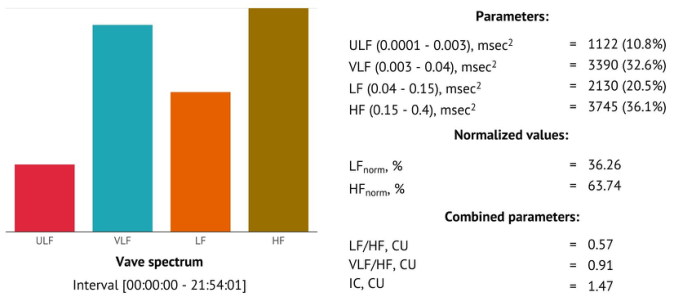
A laboratory and instrumental study was performed including daily moni- toring of the heart rate (Fig. 1).
According to the results of the daily ECG, a predominance of parasym- pathetic (HF> LF) activity in the wave frequency spectrum was revealed not only at night (the predominance of parasympathetics at night is the norm!) - HF - 32.1% (against LF - 20.2%), but also in the daytime - HF - 40% (against LF - 21%), and during the day - HF - 36.1% (against LF - 20.5%) (Fig. 1). Although it is generally accepted that hypersympathicotonia predominates in overweight patients, high values of indicators in the structure of the spectrum of very low (VLF) and ultra-low (ULF) frequencies were found - a total daily rate of more than 40% (Fig. 1). The coefficient of vagosympathetic balance was 0.57 per day, but especially the predominance of parasympathetic acti- vity was manifested in the daytime - the LF/HF index was 0.52. The index of centralization per day is 1.47, and in the daytime - 1.2.
The patient was prescribed treatment - an individual diet with a daily calo- rie content of 1700–1900 kcal/day, and moderate physical activity – brisk walks 45 minutes per day, group classes in swimming pool. To increase sym- pathetic activity and achieve eutonia, treatment with Reduxin at a daily dose of 15 mg was prescribed. Within 3 months, the patient noted an improvement
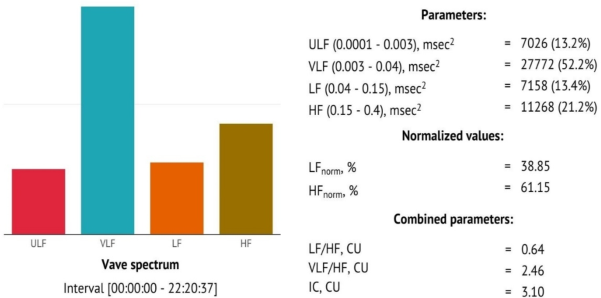
Figure 1: Heart rate variability (daily indicators) of patient M., 19 years old, before the start of obesity therapy.Figure 2: Heart rate variability (daily indicators) of patient M., 19 years old, 3 months after the start of obesity therapy.
in general well-being and a decrease in body weight by 19 kg (from 178 kg to 159 kg.).
After the course of treatment, the patient was re-conducted daily monito- ring of heart rate (Fig. 2). There was a decrease in HF to 21.2% (daily rate), especially in the daytime - 22.2% (40.7% at the initial examination). The coefficient of vagosympathetic balance approached the norm and amoun- ted to 0.64. Although this was done at the expense of additional stress on regulatory systems (confirmed by an increase in the level of indicators chara- cterizing the transition of regulation to a more energy-consuming level - the level of centralization with the involvement of central energy-tropic mecha- nisms, and these are VLF and ULF indicators). The centralization index per day is 3.10. At the same time, during the daytime, the CI is 2.5. There was an increase in sympathetic activity during the daytime hours.
Conclusion. In a 19-year-old patient with exogenous constitutional obesity, as in healthy individuals of this age group, parasympathetic activity in general prevailed in the processes of autonomic regulation, but, unlike a healthy body, it persists during the daytime, regardless of physical and intellectual activity of a patient. Against the background of treatment with drugs that activate sympathetic activity (reduxin), there was a change in the ratio of sympathe- tic/parasympathetic activity and autonomic balance (eutonia) was restored, the coefficient of vagosympathetic balance increased from 0.57 to 0.64 and approached the norm (normal 0.7-1.5), and the centralization index increa- sed from 1.47 to 3.1 (by 1.63, more than 2 times). Against this background, a significant decrease in body weight was noted.
Clinical case 2. Patient V., 21 years old. On an outpatient visit, patient complained of an increase in blood pressure up to 160/90 mm Hg., uncon- trolled weight gain (10 kg in the last 6 months), daytime sleepiness, decreased ability to work. Progressive weight gain coincided with the onset of puberty. At the age of 14, an oral glucose tolerance test (OGTT) was performed: glyce- mia 4.9–7.8–6.3 mmol/l. From the same time, they noted a periodic increase in blood pressure up to 160/90 mm Hg. Patient did not receive regular tre- atment; in case of high blood pressure, they took 1 tablet of Lazortan with a good therapeutic effect. Repeatedly tried to reduce weight on their own
Mathematical Analysis of Daily ECG in Assessing the Effectiveness of Obesity Treatment 109
by restricting food, and while following a low-calorie diet, they managed to reduce body weight, but the effect was short-lived – patient gained weight back after returning to their habitual way of life.
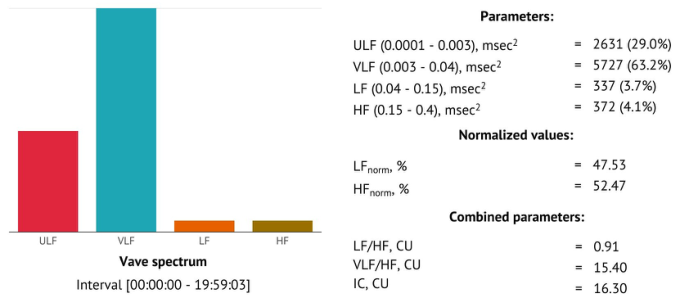
Initial examination - patient is conscious and comfortable, and indicators are excellent. Height - 170 cm, weight - 118 kg, BMI 40.8 kg/m2. Waist circumference 120 cm, hip circumference 115 cm (WC/HC - 1.03). BP - 140/85 mm Hg., heart rate - 90 per minute. Prior to the start of treatment, the patient underwent laboratory and instrumental tests with an emphasis on 24-hour heart rate monitoring data to determine the state of regulatory systems (Fig. 3).
The patient presented with hyperparasympathicotonia (LF index is almost equal to HF - 8,), not only at night (normal), but also during the day (Fig. 3). There is also a tension in the mechanisms of regulation and a transition from the control level to the managment level (an increase in the proportion of the presence of ULF waves to 29% of the wave spectrum, and VLF - up to 63.2% of the wave spectrum during the day). A similar structure persisted both during the day and at night.
The patient was prescribed treatment - combination therapy, including diet therapy, dosed physical activity (brisk walking daily for 45 minutes, water procedures - swimming, group classes in swimming pool) and drug therapy (Reduxin). The patient refused to take prescribed medication but agreed instead to take Metformin 500mg x 2 times daily and decided to follow a stricter diet of 1100–1400 kcal/day (comparing to the prescribed diet 1700–1900 kcal/day), as well as to cut the amount of physical activity to walks for 30 minutes. After three months, there was a decrease in body weight by 4 kg (BMI 39.4).
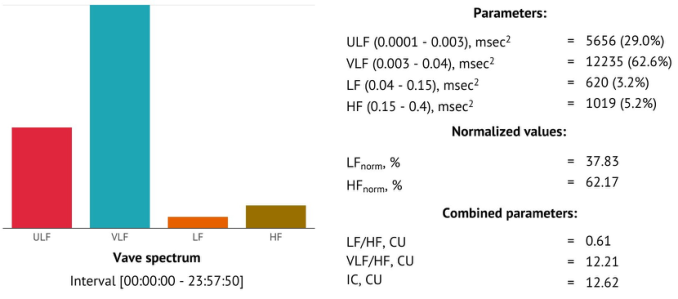
HRV indicators without significant dynamics (Fig. 4). The predominance of the parasympathetic activity remains, as well as the high tension of the regulatory systems. The risk of “failure of adaptation” increases. Despite the fact that the patient was on a hypocaloric diet, parasympathetic activity indi- cators increased, which indicates that there is no positive dynamics from the
Figure 3: Heart rate variability (daily indicators) of patient V., 21 years old, before the start of obesity therapy.Figure 4: Heart rate variability (daily indicators) of patient V., 21 years old, three months after the start of therapy.
treatment, which is confirmed by the absence of a decrease in the patient’s body weight.
Conclusion. Strict diet therapy, low level of physical activity and unsuitable choice of drug therapy method for this patient was insufficient. It needs cor- rection of treatment with the connection of centrally acting drugs (activating the production of serotonin and sympathetic activity).
CONCLUSION
HRV in young patients with exogenous constitutional obesity is an indicator of the effectiveness of the selected therapy for metabolic obesity. If the desi- red result is not achieved in the process of treatment after the control period, then mathematical analysis of HRV will allow medical professionals to qui- ckly assess the state of autonomic nervous system. If the predominance of parasympathetics persists (especially during the daytime), as well as the high tension of regulatory systems, treatment plan requires immediate correction.
REFERENCES
Farooq M. A., Parkinson K. N., Adamson A. J., Pearce M. S., Reilly J. K., Hughes A. R., Janssen H., Busterfield L., Reilly J. J. Timing of the decline in phy- sical activity in childhood and adolescence: Gateshead Millennium Cohort Study. Br. J. Sports Med. 2018; 52:1002–1006. DOI: 10.1136/bjsports-2016-096933. Fleisen A., Beckmann R. Die raschen Schwankungen der Pulsfrequensregistiert mit
dem Pulsfettschreiber // Ztsch. Ges. exp. Med. — 1932. — Bd. 80. — S. 487–510. Task Force of the European Society of Cardiology and the North American Society of Pacing and Electrophisiology. Heart Rate Variability. Standarts of measurements, Physiological Interpretation, and Clinical Use. Circulation 1996; 93:1043–1065.
LISTED IN THE AHFE DIGITAL BOOKSTORE CATALOGUE
Explore the complete digital volume
Health Informatics and Biomedical Engineering Applications
Read this individual research paper free through the original publisher, or explore the full digital proceedings book.
ISBN 978-1-958651-54-4
Explore this ISBN in the AHFE Bookstore ↗Listed in the July 2026 bookstore catalogue; search by ISBN to confirm current availability · Digital book purchase optional