Julie Waldron, Laura E. Olaya, Alvaro Muñoz, Marco A. Giraldo (2022). Study of Body Postures Adopted in Public Spaces to Define Furniture Design Principles. In: Advances in Ergonomics In Design, Usability & Special Populations: Part II. AHFE Open Access, vol. 19. https://doi.org/10.54941/ahfe1001279
1 National Faculty of Public Health, University of Antioquia, Medellin, Calle 62 No.52-59, Colombia ↗
2 Group of Biophysics, Institute of Physics, Faculty of Exact and Natural Sciences, University of Antioquia, Medellin, Calle 70 #52-21, A.A.1226, Colombia ↗
In this study, Intermediate Body Positions refers to a group of spontaneous gestures assumed by people interacting with surrounding objects, which are in between biped-erect and sitting-standard. Furniture that motivates the sitting-standard posture is usually found in outdoors as the only option to rest; therefore users adopt different objects to rest their body. In this study, we observed the common postures adopted in public spaces while spontaneously using objects which were not designed to rest the body. The study conducted the evaluation of three Intermediate Body Positions and two control postures (sitting and standing) with two different finishing surfaces (rough and smooth), and the registration of the angles and forces in the points of support with a Dinagoniometer. The posture’s performance was evaluated in terms of time of permanence, energy expenditure and subjective perceived exertion measured in five male models in laboratory conditions. These results were compared with the angles and forces measured at each point of support. We have found that the interaction of the body with different types of materials and at different positions is crucial, since they specify not only the biophysical reaction of the body, but the individual perception. These results permitted to establish a number of design principles for furniture and public spaces.
Most of the furniture found in public spaces has been designed to fulfill the aesthetical requirements posed by the available resources. Certain issues, such as the nature of the activities taking place in the spaces, the characteristics of the surroundings, the optimisation of the public space, the anthropometric characteristics of the users and the biomechanical conditions, are rarely part of the creative process of most spaces and furniture.
Aiming to evaluate the interaction of the body with the furniture, we have the concept of posture as the starting point, understood as “the action, shape, situation or mode in which a person is exposed with respect to the surround- ing space and how this person relates to it. [Concisely], posture is the general shape adopted by the body during a set time” (Estrada, 2000).
In their chapter about healthy postures, (Kroemer & Kroemer, 2001) reviewed a number of investigations of the last century about standard postures. Such studies recommended as the optimum postures to be the ones with 90o angles between the supporting surfaces and the segments of the body, for all activities.
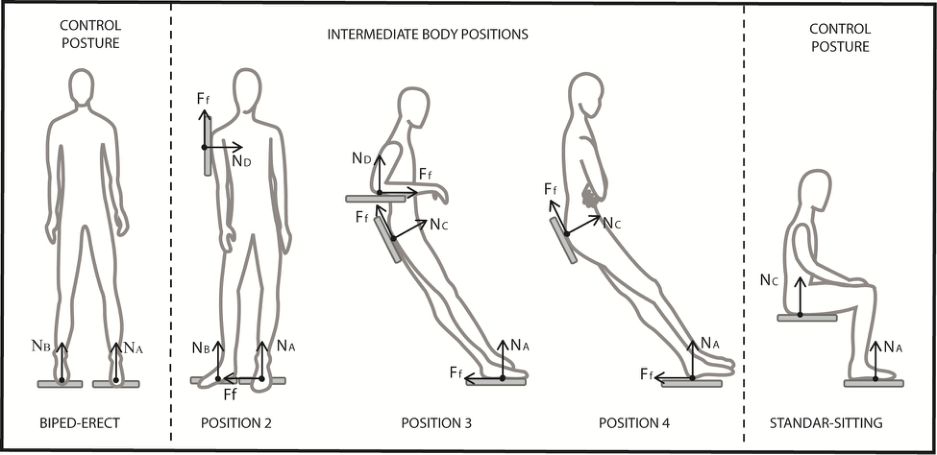
The Intermediate Body Positions, or corporal gestures adopted between the biped-erect and sitting-standard (Fig. 1), Ergonomics In Design, Usability & Special Populations II https://openaccess.cms-conferences.org/#/publications/book/978-1-4951-2107-4 are determined by the relationship of the body with objects, space and perception of the person. Although this group of positions is significantly diverse, only a few of them are adopted frequently in public spaces. Furthermore, in the different activities taking place in public spaces, it is presumed that the spontaneous gestures are aiming to achieve the well-being and equilibrium of the body.
Figure 1. Set of postures and positions selected for testing. Control postures: biped-erect (in position of anthropometric attention to measuring) and sitting-standard (with the hands over the lap´s distal third). The intermediate positions of the body are: Position 2: semi-biped with the arm supported by a vertical. Position 3: semi-sitting with the right upper limb raised to acromion level. Position 4: semi-sitting with ischium bilateral symmetrical. The arrows represent the forces on each point of support and are called NA, NB, NC y ND according to the axes specified in the Dinagoniometer (Fig. 2a). In the con- trol postures, the sum of the normal forces (NA, NB y NC) for each position equals the mass of the subject, since they are applied perpendicular to the surface. Furthermore, the friction forces, Ff , that ap-
pear in the intermediate positions, are depicted.
During the design process, premises based on criteria relating to the physiology, biomechanics and perception of users should be adopted. Those factors will allow the designers to taking decisions regarding materials, geometry, dimensions, textures, costs, finishing and structures of the furniture and spaces.
Most of the urban furniture seems not to be designed taking into account that waiting for someone, or a bus, or being in a queue, requires spontaneous postural changes due to the duration, the perception and the physical reaction of the body to each activity. In this article three non-standard positions are being evaluated, referred as intermediate posi- tions, and will be compared to the two control postures. For this purpose, the energy expenditure, time of perma- nence and subjective perceived exertion will be measured for each of the five situations. It should permit identify de- sign principles that includes floor surfaces and finishing materials, intending to provide comfort to users.
METHODS
In order to evaluate intermediate positions, three variables were measured: energy expenditure, time of permanence and perceived exertion (Manero Alfert, 2005). For the purpose of this study, the Intermediate Body Positions were classified as the body gestures adopted between biped-erect and sitting-standard. The previous classification defines the extent of a diverse group of spontaneous positions adopted by the human body.
Selection of Postures In this study, three places within the city of Medellin were chosen: Botero Square, El Poblado Central Park and Lleras Park. It was based on certain criteria: places for public gathering, waiting areas, constant transit of people, di- versity in urban furniture and finishing surfaces. Data collection was gathered during different days of the week at
Ergonomics In Design, Usability & Special Populations II https://openaccess.cms-conferences.org/#/publications/book/978-1-4951-2107-4 sunset, in order to avoid the direct solar radiation on the urban furniture and people. Raining days were excluded, since a modified interaction of people with the wet surfaces would be expected.
The sample corresponded to 25 people being observed adopting any of the intermediate positions during at least 2 minutes, in the three places mentioned above. These users were observed while performing different activities such as street selling, awaiting, resting and entertaining, all interacting with the urban furniture (benches, lamps, bus stops, bins, walls and garden fences). Photographs of the lateral and frontal axes were taken of each individual and data such as age, perceived time of permanence, activity, gender, clothing, characteristics of the furniture (materials, texture and dimensions) were registered.
For the photographic registration made in public spaces, people with obvious musculoskeletal or neurological defi- ciency or outside the range of 16-60 years old, or with obesity were excluded. Accordingly, the study focused on the adult healthy population from Medellin city.
All the collected data were analyzed according to determine criteria for the simulation of postures in the laboratory. The observed characteristics were: 1) the recurrent contact points are the hips, arms and shoulders, 2) men adopted those positions more frequently than women, and 3) jeans were more popular than any other garment. Consequently, the three most common and notable intermediate positions were chosen to be simulated in the laboratory (Fig. 1). Position 2 corresponds to semi-biped position with a lateral slight inclination of the torso (according to individual body gesture), resting the arm on the proximal third over a hard, rigid and solid vertical surface, with the legs ex- tended and the feet supported on a horizontal surface. Position 3 corresponds to semi-sitting position over a hard, rigid and solid surface with a specific angle and the arms raised until the acromion level supporting the elbow over a horizontal surface; the buttocks with bilateral and symmetrical ischium support with the left foot sole over a hori- zontal surface and the right foot crossing above the instep. Position 4, corresponds to semi-sitting posture over a hard, rigid and solid surface with bilateral and symmetrical ischium support; the left foot sole over a horizontal sur- face and the right foot crossing above the instep.
Recording in frontal and lateral view For the study, the anthropometrical chamber from the EMAT Group - National University of Colombia was required to record the measure process. This chamber has two cameras located on frontal and lateral view with the possibility of capturing videos of the angles and positions of the body in measurable pictures; due to its grid pattern in the verti- cal planes. Five male models were recruited, with similar body proportions. The age range selected was 24-30 years old (considered as a young-adult), since during this period of life the human body achieves the maximum muscular development. In order to discard non-evident pathologies, the models were medically evaluated and a physical effort test was conducted to measure their maximum functional capacity, heart rate performance and arterial pressure.
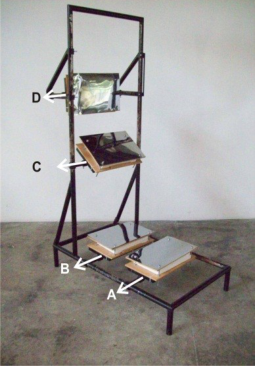
Measure of Angles and Strengths The Dinagoniometer (DGM) is a tool designed by the research team to measure angles and strengths (kg) on each body support point (Fig. 2). The lower axes A and B were designed to support lower limbs, while the upper axes C and D to support upper limbs and buttocks.
The axes A, B and C have three degrees of freedom (two linear and one rotational). Axis D has four degrees of free- dom (three linear and one rotational). The DGM allows different materials to be tested by changing the surface with smooth or rough laminae (e.g. sand paper, wood, plastic, stainless steel). In this study, we chose sand paper and stainless steel to simulate the roughest and smoothest surfaces present in furniture, respectively (Prat Pastor, 1988).
The points of support have been designed to register strengths (in kilograms) and the angle that generates stability in the models postures. Consequently, this permitted to find the entire vector force; that is, the direction of application and its magnitude.
The DGM allowed the models to simulate the chosen postures in the laboratory and to obtain controlled measures of time of permanence and heart rate for each posture (Fig. 2). To the heart rate, a Polar R400 pulsimeter and a chronometer have been used. This data were collected and the energy expenditure was calculated according to the method mentioned in ISO/CD 8996 (Malchaire, 2001).
Finally, the effort perception on each posture was evaluated with the Borg´s perceived exertion test (Borg, 1998) This test evaluates the effort perceived through a 1 to 20 scale, where 1 represents the lowest exertion and 20 the highest.
Ergonomics In Design, Usability & Special Populations II https://openaccess.cms-conferences.org/#/publications/book/978-1-4951-2107-4
Figure 2. Dinagoniometer (DGM): A prototype designed to measure forces and angles on each axis where the points of support will be located: A and B, for feet; C, for hips; D, for shoulder, arm and back.
The axes have up to three translational degrees of freedom and a one rotational degree of freedom. On the right photo, the model adopts position 4 on steel surface, by using points of support A and C.
Procedures The basal heart rates in lying down and sitting postures were registered to each model, this data were necessary to calculate the energy expenditure accordingly to ISO/CD 8996 (Malchaire, 2001). Anthropometric data of the main body segments of each participant were collected to identify dimensional proportions between the models. This di- mensions allowed to calibrate the DGM corresponding to anthropometrical individual sizes (de Leva, 1996).
Before starting, a pre-test was followed in order to familiarize the models with the DGM, the materials used and the cameras. Furthermore, the models observed pictures of the postures that they should adopt (Olaru et al., 2006). Each participant was instructed to wear jeans and sport shoes to minimize the differences between textures and the points of support.
The Dinagoniometer was located in the laboratory, with lateral and frontal cameras pointing at it. Two tests were conducted for each posture and control positions: First with the rough texture (sand paper) and later with the smooth texture (stainless steel).
The participants remained sitting before the test to guarantee heart rate at rest. Time was also recorded for each pos- ture and model. The strengths and the angles were measured when the model adopted the posture. According to their body response, each model decided when they would like to stop or change the posture. Therefore, the time was reg- istered and the research team asked the model about the effort level according to Borg´s perceived exertion test.
Consequently, the model simulated the same posture to register the strengths at each point of support to calculate the average with the first results registered. While staying in that posture, the movable parts of the DGM, at each point of support, were tightened at the angle that balanced the position, so that the force was perpendicular to the surface and, hence, the direction of the vector (force) was measured. The measuring sessions were developed during three days with a total of 50 evaluations (5 postures, 2 materials, 5 models).
Finally, the energy expenditure (calculated with the heart rate), time of permanence and the perception of exertion were analyzed by posture (Fig. 3).
RESULTS
The test provided data regarding the time of permanence, energy expenditure and subjective effort perception of each model. The data were averaged in order to establish the results of the five postures on both surfaces: steel (light grey) and sandpaper (dark grey).
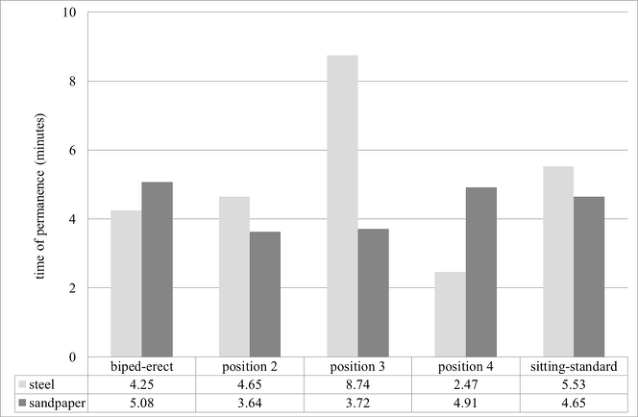
Regarding the time of permanence (Fig. 3), it can be seen that the longest time of permanence correspond to position Ergonomics In Design, Usability & Special Populations II https://openaccess.cms-conferences.org/#/publications/book/978-1-4951-2107-4
3 on the steel surface, while the shortest to position 4 on the same material. Furthermore, the time of permanence on sandpaper did not show significant variations for the 5 postures, achieving an average of 4.4 minutes. There is more than 100% difference in the time of permanence between position 3 and 4, on the steel surface.
Figure 3. Plotted resulting data for Time of Permanence (in minutes) When comparing position 3 and 4, it can be observed that the time of permanence varies more than double accord- ing to the material. For position 3, it was found that the time on steel exceeded the time on sandpaper by 5 minutes. Conversely, the time for position 4 on sandpaper exceeds the one for steel surface by 2.4 minutes, which is twice the time.
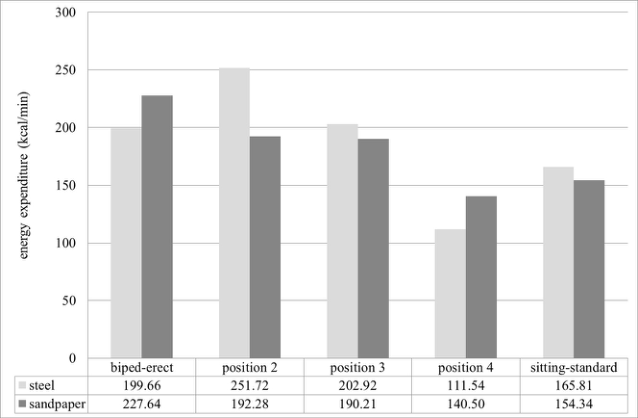
Figure 4 shows the results of energy expenditure for each position and, again, for both surfaces. It was observed that during positions 2, 3 and sitting-standard there is higher energy consumption on the steel surface, which is the oppo- site for biped-erect and position 4 (higher energy consumption on sandpaper).
The obtained values for the three intermediate positions, for both materials, are reduced when the posture is gaining closer resemblance to the sitting-standard posture. Nonetheless, the lowest energy consumption value did not corre- spond to sitting-standard posture, but position 4 with the average value of 111.54 Kcal/min on steel and 140.5 Kcal/min on sandpaper. The highest energy consumption was reached during position 2, with an average of 251.72 Kcal/min on steel. This position also had the highest difference between materials, where the energy expenditure on steel exceeds that for sandpaper by 59 Kcal/min, which represents a 23% disparity.
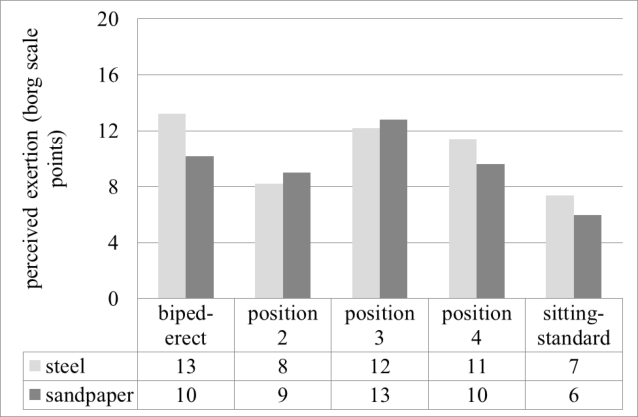
The results displayed in Figure 5, of subjective effort perception, show that although the maximum value in the Borg Scale is 20 points, the higher value given by the models was averaged to 13 points, which corresponds to the posture biped-erect on the steel surface. It was observed that the value given for this same posture on sandpaper surface was 3 points below, that is 10 points for sandpaper. This difference in the perception (the highest observed between ma- terials) takes place despite the fact that the partial weight and the normal force on each foot, constitutes a completed vertical action-reaction couple and no horizontal friction forces appear, which could generate a difference in muscu- lar effort. The lowest score, of 6 points, was given to the posture sitting-standard on sandpaper, while the equivalent on steel exceeds it only by 1 point.
Ergonomics In Design, Usability & Special Populations II https://openaccess.cms-conferences.org/#/publications/book/978-1-4951-2107-4
Figure 4. Plotted resulting data for Energy Expenditure (in Kcal/min)Figure 5. Plotted resulting data for Perceived Exertion (in Borg Scale Points) The behavior of the values in the intermediate positions does not show a gradual reduction as it was expected ac- cording to the described results in the previous paragraph, where the biped-erect achieved the highest score in per- ception and standard-sitting the lowest.
When comparing the results of position 3 on both materials, it can be noticed that even though the time difference of permanence is more than double, the energy expenditure does not vary significantly (Fig 3 and 4). Nonetheless, the perception of effort is higher amongst the intermediate positions, which suggests that the sandpaper increases the en- ergy consumption and reduces the time of permanence. The previous observations are also valid for position 4, be- ing the steel the one that increases the energy expenditure and reduces the time of permanence.
The control postures present significant differences. It can be observed that the posture sitting-standard shows a bet- ter behavior in terms of time, energy expenditure and effort perception.
Ergonomics In Design, Usability & Special Populations II https://openaccess.cms-conferences.org/#/publications/book/978-1-4951-2107-4
DISCUSSION
According to Prat (1988), a study developed by Brattgard in 1976 shows the existence of local variations in pressure at different points of support of a seat, when modifying the characteristics of the materials and the type of furniture used. Brattgard used pressure sensors to register those changes. Brattgard’s results support the results shown in Fig- ure 3, 4 and 5; that is, the changes of the materials on the supporting surfaces generate variations in the physical re- sponses of the body to achieve the equilibrium. As a result, the physical responses and perception of people are also modified (Fig. 4 and 5).
Despite of the similarity between position 3 and 4, the time of permanence on each of them is notably different on steel, which can be explained due to a third emerging point of support in the forearm, D, for position 2, as well as to the smoothness that characterizes steel. On the other hand, if each position is analyzed separately, it could be said that the opposite results in the time of permanence (higher for steel in 3 and higher for sandpaper in 4) could also be explained for the support point in the forearm, which offers more stability to the person. Here, the plane of support is horizontal, which helps to support the total weight of the body and explains the long permanence time (8.74 ± 2.7 minutes) (Fig. 3). At the end of the trial, the models expressed their discomfort with the sandpaper on this support- ing point D; which was reflected in the results of energy expenditure and subjective perception of the effort (Fig. 4 and 5).
On the other hand, the point of support at the feet, A, in positions 3 and 4, deserves special attention. The lower time of permanence in position 4, on steel, is due to the low friction coefficient for this material. A higher time is ob- tained on sand paper, which is similar to that of the control postures. A higher energy consumption that was regis- tered on the sand paper surface seems to contradict the previous observation. However, considering the sliding effect on the steel surface, a lower time of permanence (Fig. 3) implies a lower muscular effort.
Again, the effort perceived for both materials agrees with the time of permanence. An extra point of support at the upper part of the body permits diminishing the force at the point of support on the foot, A, allowing a more stable position. That is precisely the case of the intermediate position 3. The inclination of the body, higher in position 4 than in 3 (Fig. 1), will produce a larger reaction force at the hip, NC. Its vertical component adds to the reaction force on the feet, NA, to support the total weight. A lower reaction force on the feet produces lower energy expendi- ture (Fig. 4).
Furthermore, by comparing position 4 with the control posture sitting-standard, there can be observed similar values of energy expenditure and time of permanence on sand paper, although with a lower subjective perceived exertion for the control posture. This result agrees with the study developed by Kroemer and Kroemer (2001), where is ar- gued that activities with high permanence time and low physical effort should be developed at sitting-standard pos- ture.
The extreme values of energy expenditure obtained for the control postures (Fig. 4) confirm why they were chosen as a reference when comparing with the intermediate body postures. They present a tendency to decrease from biped-erect to sitting-standard posture. However, the lower energy consumption was registered for position 4 and not for the sitting-standard posture, while the highest corresponded to position 2 and biped-erect, as mentioned in the results.
The difference between these two biped-stationary positions lays on one more point of support at shoulder level. The variation in the results corresponding to the two materials used can be explained for position 2, but it is unexpected for the control posture. Here, the forces at support points A and B, are applied perpendicularly to the plane (floor surface), which means that the sum of the forces at this points are equivalent to the body mass of the subject (NA + NB = Body_Mass in Figure 1). The subjective perception results also show differences respect to the material, al- though in opposition to the one discussed before (larger effort for steel than for sand paper), which is evidence of the difficulty to compare this results with the physiological ones. On the other hand, position 2 allows the individual to have a third point of support, D (a vertical one), that generates a slight inclination to one side. As a consequence, the reaction force NB of the floor at the point of support B, diminishes, whilst the reaction force NA of the pint of sup - port A, increases. Furthermore, a larger reaction force NA will produce a larger friction force, which is just what is needed for a stable equilibrium to exist when the inclination is produced. In this position, the body behaves as a rigid bar, where the friction force on the foot farther from point D, diminishes the reaction force on the shoulder. As a Ergonomics In Design, Usability & Special Populations II https://openaccess.cms-conferences.org/#/publications/book/978-1-4951-2107-4 consequence, an intense muscular activity is generated, since it is necessary to maintain the backbone and the hips rigid, by applying a greater force on the floor.
A tendency to gradual diminishing for the perception effort was not observed, contrary to the energy expenditure case, which suggests that there is no direct relation between those two variables for relatively small changes. That is, the physiological response of the body is not related to the subjective exertion perception, perhaps due to the small variations registered for energy expenditure.
CONCLUSIONS
Two control postures have been compared to three intermediate positions that are frequently adopted in public spa- ces. The variables measured permitted to evidently distinguish the differences according to the number of points of support and the finishing materials. The laboratory tests that evaluated the intermediate positions for short duration (adopted in transition spaces such as metro stations, bus stops, waiting rooms, gathering places, and even fast food restaurant).
According to the obtained results, the biped-erect posture appeared to be one of the least comfortable, although fre- quently adopted in public spaces, since there are limited furniture options that allow different positions to the stan- dard postures.
A possible solution to the dilemma faced when designing furniture in transition places is the construction of interme- diate furniture, understood as that allowing adopting positions between biped-erect and sitting-standard.
The analysis of the results permitted to define some principles of design for intermediate furniture in the public space:
1. The finishing materials with high friction coefficient used on floors, reduce the muscular activity.
2. Smooth finishing materials used in the points of support at the elbow and the arms prevent the increase in energy expenditure and improve subjective exertion perception.
3. The point of support at the hip permits a distribution of the rest of the body weight on the central area. The finish- ing materials with high friction coefficient at this point reduce the load on the lower limbs, reducing also the energy consumption of the body and augmenting the time of permanence.
In general terms and taking into account the three tested intermediate positions, position 4 represents the highest comfort. For this reason, it would be recommended for intermediate furniture, directed to people with reduced mo- bility, since by generating comfort conditions similar to that of sitting-standard, the effort experienced by the person when passing from sit to stand (STS) could be reduced (Dall & Kerr, 2010).
In order to identify the main variables related to groups with different physiological responses, this study should be repeated with a broader group of people such as children, women, elderly, impaired and overweight people. It would also be interesting to vary the textures at the points of support and diversify the materials with different friction coef- ficient as well as controlling the time of permanence in each position.
The Dinagoniometer has demonstrated to be accurate, trustable and innovative equipment for laboratory measures. We shall continue improving the machine and developing new tests for studying intermediate body positions in pub- lic spaces.
ACKNOWLEDGEMENTS
We are very thankful with the Group EMAT of the National University of Colombia (Medellín) for lending us their installations. We recognize the work of the five male models for their time, effort and patience: Cristian Arenas, Alejandro Valderrama, Julian Olaya, Alberto Lafaurie and Julian Muñoz. The anthropologist Jesus Camacho helped us with the anthropometric measures. Mercedes Saenz, Ader Garcia, Mabel Matamoros and Diana Waldron read the manuscript and gave us useful comments.
Ergonomics In Design, Usability & Special Populations II https://openaccess.cms-conferences.org/#/publications/book/978-1-4951-2107-4
REFERENCES
Borg, G. (1998). Borg's Perceived Exertion and Pain Scales. Champaign IL: Human Kinetics. Dall, P. M., & Kerr, A. (2010). Frequency od the sit to stand task: An observational study of free-living adults. Applied Ergonomics, 41(1), 58-61. de Leva, P. (1996). Adjustments to Zatsiorsky-Seluyanov's segment inertia parameters. Journal of
Biomechanics, 29(9), 1223-1230. Estrada, J. (2000). Ergonomía. Medellín: Editorial Universidad de Antioquia. Kroemer, K., & Kroemer, A. (2001). Office Ergonomics. Taylor & Francis. Malchaire, J. (2001). Ergonomics of the thermal enviroment - Determination of metabolic heat production. In ISO/CD 8996. Belgium: International Organization Standardization. Manero Alfert, R. (2005). Un modelo simple para la evaluación integral del riesgo a lesiones músculo-
esqueléticas (MODSI). Mapfre Medicina, 16(2), 86-94. Olaru, Á., Parra Farré, J., & Balius, R. (2006). Estudio de validación de un instrumento de evaluación postural (SAM, spinal analysis machine). Apunts. Medicina de l'Esport, 41(150), 51-59. Prat Pastor, J., & Vera, P. (1988). Ergonomía y Mueble. Técnicas de Estudio. Valencia.
Ergonomics In Design, Usability & Special Populations II https://openaccess.cms-conferences.org/#/publications/book/978-1-4951-2107-4
LISTED IN THE AHFE DIGITAL BOOKSTORE CATALOGUE
Explore the complete digital volume
Advances in Ergonomics In Design, Usability & Special Populations: Part II
Read this individual research paper free through the original publisher, or explore the full digital proceedings book.
ISBN 978-1-4951-2107-4
Explore this ISBN in the AHFE Bookstore ↗Listed in the July 2026 bookstore catalogue; search by ISBN to confirm current availability · Digital book purchase optional