Yaojiong Yu (2026). Tangible Card Topologies or Text Prompts? Comparing AI-Human Co-Creative Story Writing Methods. In: Human Factors in Design, Engineering, and Computing. AHFE Open Access, vol. 238, pp. 1396–1406. https://doi.org/10.54941/ahfe1008368
Most AI-driven storytelling tools rely on text-prompt interaction that conceals narrative structure within the model. We developed a tangible card-topology method: users arrange story-element cards into spatial configurations, photograph them, and the AI generates text from the recognized topology. In a within-subjects experiment (N = 48) across four story contexts (multi-thread plot, emotional arc, goal-directed narrative, learning module), the tangible method yielded higher creative quality [F(1, 47) = 38.72, p < 0.001, ηp² = 0.45], 19–27% lower cognitive load, and stronger perceived creativity support (d = 1.1–1.6).
Creativity support is a defining objective of interactive storytelling systems (Jenkins, 2003; Murray, 1997; Zarei et al., 2020). As generative AI enables open-ended co-creation, whether interface design can augment—rather than automate—human creativity has become urgent (Riedl & Young, 2014).
Conventional AI storytelling tools remain text-based: users interact through prompts, while narrative structure—plot logic, character relationships, causal chains—stays concealed inside the model. Users must repeatedly reformulate prompts to steer structure indirectly, a cognitively demanding and creatively constraining process (Tredinnick & Laybats, 2023; Yang et al., 2022).
To address this, we developed a card-based paradigm decomposing narratives into modular story-element cards, making structure visible and editable (Hsieh et al., 2023; Biskjaer et al., 2019).
However, no study has systematically compared tangible card-topology interaction against the text-prompt baseline under controlled conditions: existing comparisons contrast card modalities (Yu, 2026a) or evaluate card systems in isolation. Does visible, embodied, editable tangible structure yield better creative outcomes than typing prompts, and does this advantage hold across story contexts?
This paper addresses this gap through a controlled within-subjects experiment. The tangible method employs the Nara-Card system (Yu, 2026b): users arrange color-coded cards into topological configurations, photograph
Tangible Card Topologies or Text Prompts? Comparing AI-Human 1397 the arrangement, and the AI generates text from the recognized topology; the text-prompt method uses a conventional chat interface, both using the same LLM (Doubao) and prompts. A 2 × 4 design tests whether tangible interaction yields higher creative quality, lower cognitive load, and stronger perceived creativity support across story contexts and expertise.
RELATED WORKS Creativity Support in Interactive Storytelling
Creativity support tools (CSTs) augment creative capacity by externalizing mental models, constraining exploration spaces, and providing iterative feedback (Frich et al., 2019; Remy et al., 2020; Chung et al., 2021). In interactive storytelling, support must balance narrative coherence against user agency (Goldfarb-Tarrant et al., 2019; Kreminski et al., 2020). Shneiderman (2007) argued that CSTs should support the full creative lifecycle, and that interaction modality shapes which stages receive support—the premise examined here.
Text-Prompt Human-AI Co-Writing: The Invisible Structure Problem Recent human-AI co-writing systems remain anchored in text-prompt interaction, where narrative structure stays opaque and users steer generation only indirectly through iterative reformulation (Yang et al., 2022; Antony & Huang, 2023; Tredinnick & Laybats, 2023). Studies reveal a consistent ‘control gap’: users influence surface-level content but struggle to shape deeper structural properties (Yang et al., 2022). This aligns with cognitive load theory (Sweller, 1988): invisible structure forces users to maintain it in working memory while composing prompts, imposing extraneous load that competes with creative processing.
Tangible and Card-Based Interaction for Storytelling Our innovative card-based interaction offers a structurally distinct alternative: cards decompose complex problems into modular units, support embodied and spatial thinking, and relevent studies show this correlation fosters divergent idea generation (Roy & Warren, 2019; Sylla et al., 2022; Lomas et al., 2021). Tangible user interfaces (TUIs) amplify these benefits through embodied cognition (Ishii & Ullmer, 1997; Sylla et al., 2022). Our research program has validated this paradigm against text-prompt baselines. Across four diverse modalities—GUI (Yu, 2025b), tangible cards (Yu, 2026b), VR (Yu, 2025c), AR (Yu et al., 2024)—card-based interfaces outperform text-prompt tools across three key metrics: creativity, narrative control, and cognitive load (Yu, 2025a). Specifically, tangible cards further improve structural understanding (Yu, 2026a).
TWO CO-CREATION METHODS AND THEIR AFFORDANCES This study compares two co-creative storywriting methods differing in how narrative structure is represented to the AI; creative quality is enhanced when narrative structure is visible, embodied, and directly editable through tangible
1398 Yu spatial interaction rather than invisible text prompts—drawing on cognitive load theory (Sweller, 1988) and embodied cognition theory (Lakoff & Johnson, 1980; Johnson, 1987).
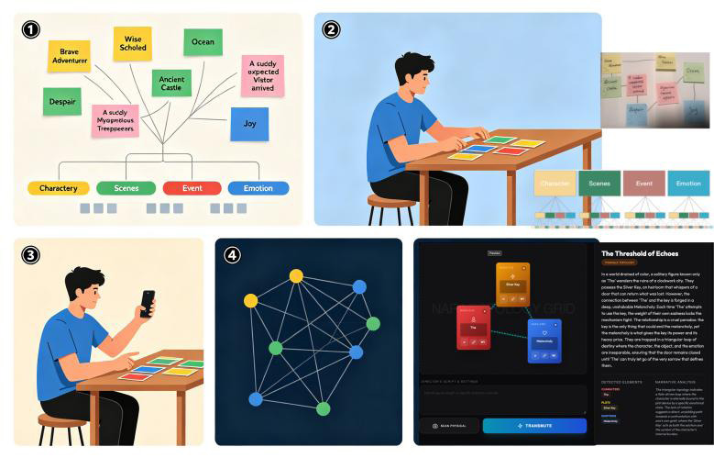
Method 1: Tangible Card-Topology Interaction In the tangible method, users interact with the Nara-Card system (Yu, 2026b): physical color-coded cards (character = yellow, scene = green, event = red, emotion = blue), a tabletop workspace, and a tablet capture interface. Users arrange cards into topologies embodying narrative structure—triangular for causal relations, linear for temporal sequences, network for associative connections (Figure 1)—photograph the arrangement, and the system recognizes the topology, transmitting a structured representation to the AI, such as, Doubao LLM, which generates narrative text.
Figure 1: The creativity support framework: story context creative demands mapped to topology affordances, with the Nara-Card tangible system translating card arrangements into AI generation.
This method offers four core characteristics:
Structural visibility: the topology is literally visible on the tabletop;
Direct editability: users physically move cards to modify the narrative structure;
Clear labor division: the user designs the structure, and the AI generates the text.
Tangible Card Topologies or Text Prompts? Comparing AI-Human 1399 Method 2: Classified and Editable Text-Prompt Interaction
In the classified and editable text-prompt method, users interact with a conventional chat-based AI writing interface powered by the same AI LLM (Doubao), typing natural-language instructions describing story elements and desired narrative properties; the AI generates narrative text, and users revise prompts iteratively.
This direct text-prompt method offers three key characteristics: (1) expressive flexibility: natural language can describe any narrative
property; (2) fluency: typing is a familiar, rapid form of interaction; (3) direct content specification: users can define exact wording or thematic elements explicitly.
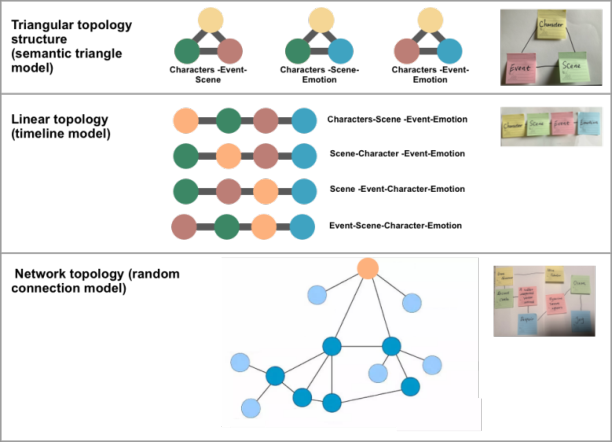
Figure 2: Nara-Card system: physical color-coded cards, tabletop workspace, and tablet capture interface for the three topologies.
The triangular topology (semantic triangle model) organizes three elements into a closed relational structure, suiting cause-to-consequence type arcs (Figure 2). The linear topology (timeline model) arranges all four element types into a sequential chain, affording explicit temporal and causal ordering for goal-directed narratives and learning modules. The network topology (random connection model) permits arbitrary, multi-directional connections, providing the flexibility needed for multi-thread plots where parallel strands intersect.
Across all topologies, this card topology arrangement method serves as the translation layer between physical manipulation and input prompts to computational generation: users compose structures by arranging cards, the tablet recognizes the configuration, and the LLM generates topology-aware narrative text respecting the implied structural constraints.
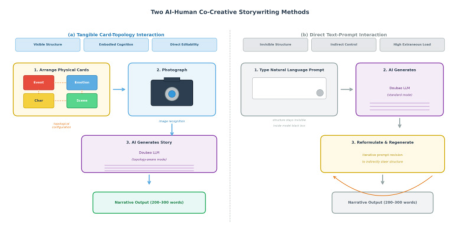
Figure 3: The two co-creative story writing methods: (left) tangible card-topology interaction with Nara-Card physical cards and tablet capture; (right) direct text-prompt interaction with a chat-based interface.
Figure 3 illustrates the two methods: in the tangible method, users arrange color-coded cards into topological configurations captured via image recognition and translated into structured input for the Doubao LLM, producing a 200–300 word story outline; in the text-prompt method, users type and iteratively reformulate prompts, the model’s opaque structure entailing invisible structure, indirect control, and high extraneous load. Both methods produce comparable outputs.
EVALUATIONS The experiment tested the core hypothesis: tangible interaction produces higher creative quality, lower cognitive load, and stronger perceived creativity support than text prompting. We used a 2 (method) × 4 (story context) fully within-subjects design; each participant completed all 8 conditions, with order counterbalanced via a Latin square.
Participants Forty-eight participants (24 male, 24 female; Mage = 27.6, SD = 6.8) were stratified by narrative expertise: 16 novices (≤3 creations/year), 16 intermediates (4–11), and 16 advanced (≥12). Sample size was determined via G*Power 3.1 (Faul et al., 2007; f = 0.35, α = 0.05, power = 0.95, minimum N = 42). All had used AI writing tools within the past 6 months and provided informed consent.
Materials and Procedure The tangible condition used the Tangible Topological method: participants arranged four card types into topologies on a tabletop, photographed the arrangement, and received AI-generated text from the Doubao AI LLM (ByteDance).
The direct text-prompt condition used a conventional chat-based interface on the same tablet: participants typed natural-language instructions and received AI-generated text from the same Doubao LLM. Both conditions used
Tangible Card Topologies or Text Prompts? Comparing AI-Human 1401 the same model, temperature (0.7), and maximum output length (maximam 300 words), leaving the interaction method as the sole systematic difference.
Each story context was operationalized with a standardized prompt, developed via expert mapping, pilot rating, and revision until representativeness ≥ 4.0/5 with no difficulty difference across contexts (F(3, 27) = 0.82, p = 0.49).
Each session began with 10 minutes of training on both methods. Participants completed all 8 conditions (≈70 minutes), developing a 200–300 word outline per condition (10-minute limit, up to 3 refinement cycles), then completing the NASA-TLX and creativity support scale.
Measures and Analysis Creative quality was rated on a 5-point composite scale (structural coherence, context appropriateness, originality, overall quality). Cognitive load used NASA-TLX (0–100); perceived creativity support used a 3-item 7-point scale (α = 0.89) adapted from Remy et al. (2020); creation time was system-logged.
Two-way repeated-measures ANOVAs were conducted in SPSS 27 with Greenhouse-Geisser correction, followed by Bonferroni-corrected simple- effects tests; effect sizes are reported as ηp² and Cohen’s d. An exploratory mixed ANOVA with expertise as a between-subjects factor tested for aptitude- treatment interactions.
RESULTS
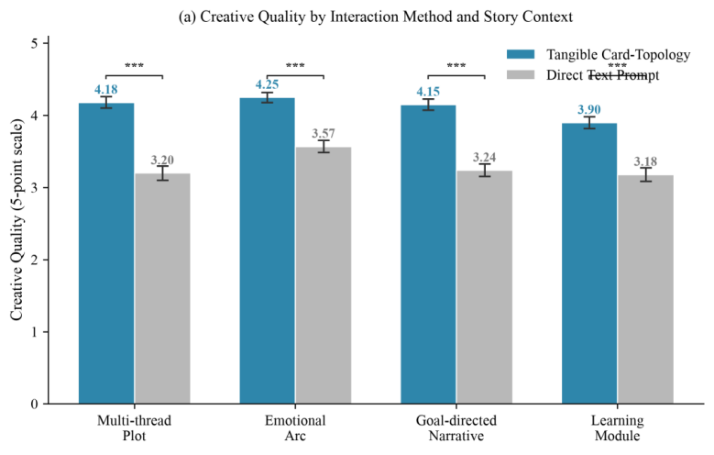
Creative Quality A significant main effect of method emerged (F(1, 47) = 38.72, p < 0.001, ηp² = 0.45): tangible interaction (M = 4.12, SD = 0.51) yielded higher creative quality than text prompting (M = 3.34, SD = 0.62). The main effect of context (F(3, 141) = 4.87, p = 0.003, ηp² = 0.09) and the method × context interaction (F(3, 141) = 4.21, p = 0.007, ηp² = 0.08) were also significant.
Simple-effects tests confirmed the tangible method outperformed text prompting in all four contexts (all p < 0.01), with the largest effects for multi- thread plot (d = 1.42) and goal-directed narrative (d = 1.31), and smaller effects for emotional arc (d = 0.98) and learning module (d = 1.05; Table 1, Figure 4).
Table 1: Creative quality by interaction method and story context (M/SD, 5-point scale).
Table available in the original PDF paper.
Story Context Tangible Card-Topology Direct Text Prompt Difference Cohen’s d Multi-thread plot 4.18 (0.55) 3.20 (0.68) 0.98 1.42
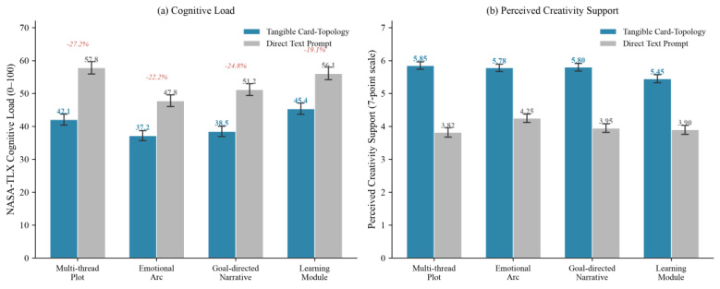
Across all contexts, the tangible method reduced cognitive load by 19–27% (Table 2, Figure 5).
NASA-TLX subscale decomposition showed the largest differences in mental demand (d = 1.18) and effort (d = 1.05), with smaller differences in frustration (d = 0.72) and temporal demand (d = 0.48).
Figure 5: Cognitive load (left, NASA-TLX 0–100) and perceived creativity support (right, 7-point scale) by interaction method and story context. Error bars = SE.Table 3: Perceived creativity support by interaction method and story context (M/7).
Table available in the original PDF paper.
Story Context Tangible Card-Topology Direct Text Prompt Cohen’s d Multi-thread plot 5.85 (0.78) 3.82 (0.98) 1.62
Perceived creativity support showed a large main effect of method (F(1, 47) = 56.33, p < 0.001, ηp² = 0.55): tangible interaction (M = 5.72, SD = 0.81) was perceived as more supportive than text prompting (M = 3.98, SD = 0.94).
The method × context interaction was significant (F(3, 141) = 3.89, p = 0.010, ηp² = 0.08), with the largest differences for multi-thread plot (d = 1.62) and goal-directed narrative (d = 1.51; Table 3).
Item-level analysis showed the largest difference in perceived structural control (tangible M = 6.05 vs. text M = 4.20, d = 1.85).
Creation time also showed a significant main effect of method (F(1, 47) = 12.44, p = 0.001, ηp² = 0.21): the tangible method was 15–22% faster across contexts, suggesting visible structure reduces time spent on prompt reformulation.
Expertise as a Moderator An exploratory mixed ANOVA with expertise as a between-subjects factor found a significant method × expertise interaction for creative quality (F(2, 45) = 4.68, p = 0.014, ηp² = 0.17).
The tangible advantage was largest for novices (Mdiff = 1.07, d = 1.68), moderate for intermediates (Mdiff = 0.76, d = 1.12), and smallest but significant for advanced creators (Mdiff = 0.50, d = 0.78; all p < 0.05).
1404 Yu Cognitive load showed a parallel pattern: the method × expertise interaction was significant (F(2, 45) = 3.92, p = 0.027, ηp² = 0.15), with novices showing the largest reduction (31.5%) and advanced creators the smallest (14.2%).
DISCUSSION
The results validate the framework’s core proposition: making narrative structure visible, embodied, and editable produces substantially better creative outcomes than text prompting, even with the AI model held constant. The large main effect on creative quality (ηp² = 0.45) demonstrates that interaction modality is a creativity-relevant design variable, operating through three interrelated mechanisms.
First, structural visibility: externalizing the narrative structure reduces the extraneous cognitive load of maintaining it in working memory (Sweller, 1988); the 19–27% reduction in NASA-TLX scores directly supports this mechanism. Second, embodied cognition: physical spatial arrangement engages sensorimotor systems that support structural reasoning (Lakoff & Johnson, 1980; Johnson, 1987), letting users work through narrative relationships by manipulating spatial analogs. Third, clear division of creative labor: the photograph-and-generate cycle creates a perceptual boundary between the user’s structural design work and the AI’s content generation, clarifying agency division and reducing the ‘control gap’ (Yang et al., 2022; the largest between- group difference was observed in structural control, d = 1.85).
The method × context interaction is informative: the tangible advantage was largest for multi-thread plots (d = 1.42) and goal-directed narratives (d = 1.31), and smaller for emotional arcs (d = 0.98) and learning modules (d = 1.05). Tangible interaction thus primarily benefits structurally complex tasks.
This extends creativity support theory (Shneiderman, 2007; Lubart, 2005): external representations’ effectiveness depends on users’ internal expertise—an aptitude-treatment interaction (Cronbach & Snow, 1977). Novices depend most on external scaffolding and gain the greatest benefits (d = 1.68; 31.5% load reduction), while advanced creators gain a smaller yet significant advantage (d = 0.78; 14.2%).
The findings include: (1) Tangible interaction should be the default for novice creators and structurally complex tasks; which shows that tangible scaffolding supports novice learners. (2) For advanced creators and simple linear tasks, keep tangible options accessible. (3) hybrid interfaces switching between tangible structural design and textual refinement retain both modalities’ advantages. (4) This study could be applicable to learning and cultural heritage contexts, where AI-assisted narratives are effective (Yu, 2025d; Yu, 2025e).
Limitations include short 200–300 word outlines, four contexts, a single prototype, and potential carryover effects; consistency across contexts and expertise mitigates these concerns. Future work should test longer narratives, dynamic tangible–text transitions, hybrid contexts, cross-cultural validation, and adaptive AI that detects structural intent from card arrangements.
REFERENCES
Antony, V. N., & Huang, C. (2023). ID.8: Co-creating visual stories with generative AI. arXiv preprint arXiv:2309.14228. https://arxiv.org/abs/2309.14228 Biskjaer, M. M., Nickelsen, C., & Petersen, M. G. (2019). Co-creative writing with
large language models. Proc. IUI, 347–358. Chung, J. J. Y., He, S., & Adar, E. (2021). The intersection of users, roles, interactions, and technologies in creativity support tools. In Proceedings of the 2021 ACM Designing Interactive Systems Conference (pp. 1817–1833). ACM. https://doi. org/10.1145/3461778.3462050 Cronbach, L. J., & Snow, R. E. (1977). Aptitudes and instructional methods: A
handbook for research on interactions. Irvington. Faul, F., Erdfelder, E., Lang, A. G., & Buchner, A. (2007). G*Power 3. Behavior Research Methods, 39(2), 175–191. Frich, J., MacDonald Vermeulen, L., Remy, C., Biskjaer, M. M., & Dalsgaard, P.
(2019). Mapping the landscape of creativity support tools in HCI. In Proceedings of the 2019 CHI Conference on Human Factors in Computing Systems (Paper No. 389, pp. 1–18). ACM. https://doi.org/10.1145/3290605.3300619 Goldfarb-Tarrant, S., Feng, H., & Peng, N. (2019). Plan, write, and revise: An interactive system for open-domain story generation. In Proceedings of the 2019 Conference of the North American Chapter of the Association for Computational Linguistics: Demonstrations (pp. 89–97). ACL. https://doi.org/10.18653/v1/N19- 4016 Hornecker, E., & Buur, J. (2006). Getting a grip on tangible interaction: A framework
on physical space and social interaction. In Proceedings of the SIGCHI Conference on Human Factors in Computing Systems (pp. 437–446). ACM. Hsieh, Y. C., Lee, S. Y., & Chen, M. P. (2023). Design cards in creative practice.
Design Studies, 85, 101123. Ishii, H., & Ullmer, B. (1997). Tangible bits: Towards seamless interfaces between people, bits and atoms. In Proceedings of the ACM SIGCHI Conference on Human Factors in Computing Systems (pp. 234–241). ACM. Jenkins, H. (2003). Game Design as Narrative Architecture. Johnson, M. (1987). The body in the mind: The bodily basis of meaning, imagination,
and reason. University of Chicago Press. Kreminski, M., Dickinson, M., Mateas, M., & Wardrip-Fruin, N. (2020). Why are we like this?: The AI architecture of a co-creative storytelling game. In Proceedings of the 15th International Conference on the Foundations of Digital Games (Article 11, pp. 1–4). ACM. https://doi.org/10.1145/3402942.3402953 Lakoff, G., & Johnson, M. (1980). Metaphors we live by. University of Chicago
Press. Lomas, J. D., Karac, M., & Gielen, M. (2021). Design space cards: Using a card deck to navigate the design space of interactive play. Proceedings of the ACM on Human-Computer Interaction, 5(CHI PLAY), Article 227, 1–23. https://doi. org/10.1145/3474654 Lubart, T. I. (2005). Creativity across development and cultures. In R. J. Sternberg
& J. C. Kaufman (Eds.), The Cambridge handbook of creativity (pp. 280–297). Cambridge University Press. Murray, J. H. (1997). Hamlet on the holodeck. Free Press. Remy, C., MacDonald Vermeulen, L., Frich, J., Biskjaer, M. M., & Dalsgaard, P.
(2020). Evaluating creativity support tools in HCI research. In Proceedings of the 2020 ACM Designing Interactive Systems Conference (pp. 457–476). ACM. https://doi.org/10.1145/3357236.3395474
character. JAIR, 39, 217–268. Roy, R., & Warren, J. P. (2019). Card-based design tools: A review and analysis of 155 card decks for designers and designing. Design Studies, 63, 125–154. https:// doi.org/10.1016/j.destud.2019.04.002 Shneiderman, B. (2007). Creativity support tools: Accelerating discovery and
innovation. Communications of the ACM, 50(12), 20–32. Sweller, J. (1988). Cognitive load during problem solving. Cognitive Science, 12(2), 257–285. Sylla, C., Gil, M., & Pereira, Í. S. P. (2022). Narrating by doing: A bridging concept
for understanding and informing the design of tangible interfaces for storytelling. Interacting with Computers, 33(6), 627–640. https://doi.org/10.1093/iwc/ iwac016 Tredinnick, L., & Laybats, C. (2023). Co-creative writing with large language models. Proc. CHI, 1–17. Wilson, M. (2002). Six views of embodied cognition. Psychonomic Bulletin &
Review, 9(4), 625–636. Yang, D., Zhou, Y., Zhang, Z., Li, T. J.-J., & LC, R. (2022). AI as an active writer: Interaction strategies with generated text in human-AI collaborative fiction writing. In A. Smith-Renner & O. Amir (Eds.), Joint Proceedings of the ACM IUI 2022 Workshops (CEUR Workshop Proceedings, Vol. 3124, pp. 56–65). CEUR-WS. Yu, Y., et al. (2024). IMARISS: Story creation tools – Inspiration mobile augmented
reality interactive story system. In Proc. HCII 2024 (pp. 105–118). Springer. https://doi.org/10.1007/978-3-031-61359-3_8 Yu, Y. (2025a). Dynamic narrative frameworks: Merging creativity and logic through systematic card-based interactivity. In Proc. AHFE 2025. https://doi. org/10.54941/ahfe1006333 Yu, Y. (2025b). Story Forge: A card-based framework for AI-assisted interactive story
telling. Electronics, 14(15), 2955. https://doi.org/10.3390/electronics14152955 Yu, Y. (2025c). “It felt like solving a multi-thread plot together”: Exploring virtual reality card-based interaction and story co-creation collaborative system design. Applied Sciences, 15(14), 8046. https://doi.org/10.3390/app15148046 Yu, Y. (2025d). Three-dimensional modeling and AI-assisted contextual narratives in
digital heritage education: Course for enhancing design skill, cultural awareness, and user experience. Heritage, 8(7), 280. https://doi.org/10.3390/heritage8070280 Yu, Y. (2025e). AI-enabled contextual narrative interaction for cultural heritage education: The synthesis of AI-assisted interactive narratives and 3D modeling framework for cultural heritage education (CH-SAIN) informed by immersive/ embodied learning and digital heritage theories. ACM Journal on Computing and Cultural Heritage. https://doi.org/10.1145/3828733 Yu, Y. (2026a). Digital or tangible? Card-based story writing interaction designs
with AI: A comparative study of GUI and TUI. International Journal of Human- Computer Interaction. https://doi.org/10.1080/10447318.2026.2658245 Yu, Y. (2026b). Card-based AI-assisted interactive storytelling: A design framework and prototyping approach [Doctoral dissertation, Univ. of Plymouth]. Zarei, N., Chu, S. L., Quek, F., Rao, N. J., & Brown, S. A. (2020). Self-avatars and
children’s creative storytelling. Proc. CHI, 1–11.
SEARCH THE AHFE DIGITAL BOOKSTORE BY ISBN
Explore the complete digital volume
Human Factors in Design, Engineering, and Computing
Read this individual research paper free through the original publisher, or explore the full digital proceedings book.