Xue Xia, Bote Qi, Shuting Jin (2026). GenAI and Search Tools in Design Education: Comparative Analysis of Student Creativity, Outcomes, and Experiences. In: Training, Education, and Learning Sciences. AHFE Open Access, vol. 231, pp. 141–149. https://doi.org/10.54941/ahfe1008005
This study investigated how different creativity-support tools shape the ideation processes and outcomes of industrial design students. Undergraduate participants (N=45) were divided into three conditions: (1) no tool, (2) image search using Pinterest, and (3) generative AI image generation using Midjourney. Their design outputs were subsequently evaluated by expert reviewers (N=10) across four dimensions: effectiveness, originality, usability, and feasibility. Findings indicate that search tools facilitated connections to real-world cases, enhancing the rationality and feasibility of concepts, yet also introduced risks of homogenization and imitation. Generative AI tools, by contrast, expanded divergent thinking and metaphorical expression, fostering originality but revealing limitations in controllability and practical applicability. Overall, this research contributes empirical evidence on the differentiated roles of search-based and generative tools in design ideation, and highlights the pedagogical value of integrating these tools complementarily in design education to balance novelty with practical feasibility.
The emergence of Generative Artificial Intelligence (GenAI) has reshaped how creativity is supported in design. Text-to-image models such as Midjourney and DALL·E, alongside visual search platforms like Pinterest and Behance, are now widely used to stimulate inspiration and accelerate early-stage ideation (Wadinambiarachchi et al., 2024; Schön, 1983). Yet these tools differ fundamentally: search platforms focus on retrieving and recombining existing references, whereas generative systems create new visual content from textual prompts (Ge & Hou, 2025). Such differences may influence how designers gather inspiration, develop concepts, and shape design outcomes (Cross, 2004; Boden, 2004).
In design education, students frequently struggle with limited inspiration and convergent thinking during early ideation. Although prior work has explored Received November 5, 2025; Revised April 5, 2026; Accepted April 23, 2026; Available online July 20, 2026
GenAI or image-search tools separately, few studies directly compare their effects or examine students’ subjective experiences (Tufte, 1990; Sawyer & Henriksen, 2023).
To address this issue, we conducted a mixed-methods study with 45 undergraduate industrial design students randomly assigned to three conditions: (1) no tool, (2) image search (Pinterest), and (3) generative AI (Midjourney). Participants completed design tasks and post-study interviews, while ten expert evaluators assessed their outputs across four dimensions: effectiveness, originality, usability, and feasibility.
The study explores three questions: RQ1: How do design outcomes differ across tool conditions? RQ2: How do search and generative tools influence students’ ideation
processes? RQ3: What perceptions and concerns do students hold when using these tools?
This research offers three contributions: (1) empirical evidence on the comparative roles of search and generative tools as cognitive scaffolds in design education; (2) integration of objective and subjective evaluations to reveal how tools shape creativity and learning; and (3) pedagogical implications— such as “tool-chaining,” prompt-engineering literacy, and cross-disciplinary teaching strategies—to inform AI-driven curriculum reform.
RELATED WORK
Image-search platforms such as Pinterest and Behance act as large visual databases that help designers gather references, reframe problems, and draw analogical inspiration (Hey et al., 2008; Herring et al., 2009). Search interactions are iterative, involving continual reformulation and evaluation of queries (Hearst, 2009). Prior work shows that such tools support divergent thinking by providing external stimuli, enabling cross-domain analogy, and strengthening contextual understanding for unfamiliar design tasks (Ferraro et al., 2021; Fu et al., 2013; Ghafurian & Reitter, 2016). However, they also introduce risks of design fixation, information overload, and superficial feature copying (Jansson & Smith, 1991; Chan et al., 2011; Viswanathan et al., 2016). Attempts to address these issues—such as interactive annotation or recombination interfaces—aim to promote more exploratory use of reference images (Häring et al., 2023).
Generative AI, particularly text-to-image diffusion models, has recently reshaped ideation by enabling the rapid creation of novel visuals from textual prompts (Ramesh et al., 2022). These tools support designers in externalizing abstract ideas and exploring stylistic and semantic variations (Wen et al., 2024; Davis et al., 2019; Cha et al., 2023). Yet, they also raise concerns regarding controllability, skill degradation, and creativity loss (Nourian et al., 2023; Amershi et al., 2019). In educational settings, students often describe generative systems as powerful inspiration catalysts while simultaneously expressing caution about prompt engineering difficulty,
GenAI and Search Tools in Design Education: Comparative Analysis 143 premature convergence, and ethical risks around originality and plagiarism (Jo et al., 2023; Yan et al., 2024; Cho et al., 2023; Chan, 2025; Chan & Hu, 2023). Social desirability bias may further distort students’ evaluation of AI (Ling & Imas, 2025).
Comparatively, search tools offer contextual grounding and help novices understand design constraints, whereas generative tools provide rapid divergence beyond prior knowledge (Simon, 1996; Palani et al., 2021; Smout et al., 2023; Yildirim et al., 2023). Recent work suggests integrating both in cyclical workflows—using search to frame problems, generation to expand ideas, and renewed search to validate concepts—to balance novelty with feasibility (Cheon et al., 2023; Siu et al., 2025). Despite increasing interest, systematic comparisons between search-based and generative tools in design education remain limited, particularly regarding their differential effects on students’ ideation strategies, subjective experience, and final output quality. This gap motivates the present study.
METHODS
This study recruited 45 undergraduate students majoring in industrial design from a university (N = 45; 14 females, 31 males). Participants were randomly assigned to one of three experimental conditions, with 15 students in each group. Group 1 (G1) served as the control group, where students were not permitted to use any external tools for searching or generating visual materials during the design task. Group 2 (G2) was restricted to using Pinterest as an image search tool, while Group 3 (G3) was restricted to using Midjourney as a generative AI tool for image creation. All groups were provided with identical task instructions, time limits, and submission requirements to ensure comparability.
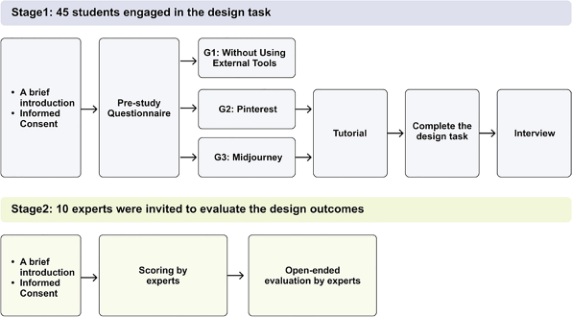
After being briefed on the study, all participants provided informed consent and reported demographic information, design experience, prior exposure to generative AI, and attitudes toward its role in design. To ensure consistent tool use, Groups 2 (Pinterest) and 3 (Midjourney) received a short standardized training on basic functions and permitted operations. Both groups were required to keep process logs—G2 recorded search keywords and reference images, while G3 documented prompts and generated outputs. Researchers monitored compliance on site (Figure 1).
Participants were tasked with designing a cognitive training wooden toy for older adults within 160 minutes. Each student produced an A3 marker sketch with annotations describing the concept, interaction logic, and usage scenario. After the task, 4–5 students per group took part in 30–45 minute semi-structured interviews about their design processes and tool-use experiences.
10 expert evaluators with industrial design experience independently assessed the sketches—blind to group assignment—on Effectiveness, Originality, Usability, and Feasibility. After scoring, group identities were revealed, and experts provided comparative reflections on how search versus generative tools influenced students’ ideation.
Figure 1: The overall experiment flow. Stage 1: 45 students engaged in the design task, stage 2: 10 experts were invited to evaluate the design process.
PROCEDURE This study adopted a mixed-methods analysis integrating visual, textual, and evaluative data to examine how different tools shaped students’ design processes and outcomes. Four data sources were used: (1) design sketches and process records, (2) student interviews, (3) expert ratings, and (4) expert interviews. Each was analyzed with appropriate methods and then integrated to address the research questions.
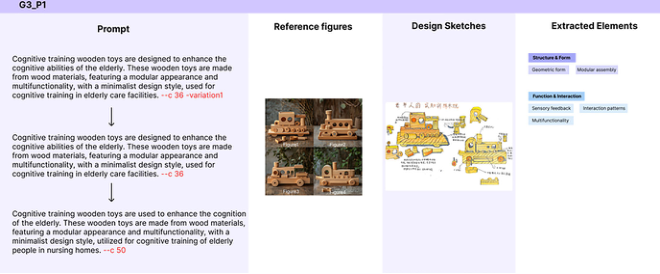
To compare concept development across conditions, each student’s sketch and process record were treated as a single analysis unit. For G1, only sketches were collected as a baseline. G2 provided search keywords and selected Pinterest images, while G3 submitted Midjourney prompts and generated outputs. All sketches were digitized into visual process boards (Figure 2), summarizing inputs, image references or AI outputs, and extracted design cues. Student interviews were then thematically analyzed (Braun & Clarke, 2006) to contextualize these process boards and reveal perceived benefits and challenges of each tool.
Figure 2: Visual process board of G3P1, illustrating reference elements identified through the analysis of prompts and their frequency, reference images, and corresponding sketches.
GenAI and Search Tools in Design Education: Comparative Analysis 145 To assess design outcomes, ten experts independently evaluated all sketches—blind to group assignment—on four five-point dimensions: effectiveness, originality, usability, and feasibility. Descriptive statistics and Friedman tests (SPSS 30) were conducted to identify group-level differences.
Following scoring, experts provided open-ended reflections on how search and generative tools influenced students’ ideation and on their broader pedagogical implications. These qualitative insights were thematically coded and triangulated with the quantitative results, generating a holistic understanding of how different tools shaped both design processes and outcomes.
RESULTS
Across conditions, students’ sketches showed clear differences in complexity, originality, and practicality. Without tools (G1), concepts were generally simple and familiar, relying on basic geometric forms and single functions. Most resembled common commercial toys and lacked annotations, interaction logic, or consideration of older adults’ cognitive or motor characteristics. Overall, outputs remained minimal and planar, with limited structural innovation.
With Pinterest (G2), sketches showed more structured forms, modular assemblies, and richer functional mechanisms. Many students borrowed visual or mechanical cues from reference images, though originality varied: some concepts approached imitation while others abstracted deeper logics such as knot-tying or puzzle structures. Iterative keyword refinement was common, and color palettes were often adopted from retrieved images. A minority achieved symbolic reinterpretations that moved beyond direct copying.
With Midjourney (G3), students produced more novel and unconventional structures, often reinterpreting AI-generated cues into new mechanisms such as maze-based play or dynamic modularity. Borrowing was less literal than in G2, though prompt iteration was limited and feasibility issues remained visible. Some color cues were incorporated, but less frequently than in the search condition.
Interview data showed consistent patterns: external tools helped students overcome “blank-page” uncertainty and accelerate early ideation. Students described both search and generative tools as providing useful starting points but requiring iterative refinement to avoid superficial copying. Tools were widely viewed as “double-edged”: they expanded possibilities yet sometimes narrowed thinking, introduced stylistic or functional mismatches, or created dependence. Concerns about originality, feasibility, and over-reliance were common. Students described AI as a collaborator rather than a replacement, emphasizing the need for strong AI literacy while maintaining human strengths such as intuition, empathy, and judgment.
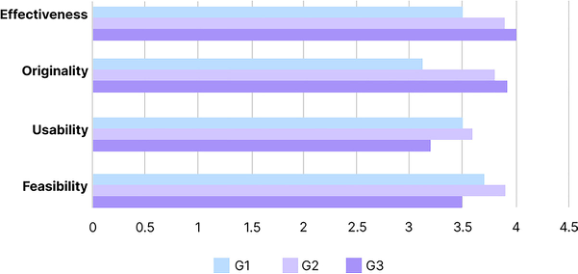
Expert ratings indicated that tool-assisted groups outperformed the control group in effectiveness and originality (Figure 3). G2 and G3 both scored higher than G1, with G3 achieving the highest originality but the lowest usability and feasibility, reflecting conceptual novelty but limited practicality. G2 achieved the highest usability and feasibility, showing stronger grounding in real-world constraints. Expert comments echoed these trends: G1 concepts were feasible but ordinary, G2 concepts were more complete and emotionally
expressive, and G3 concepts were imaginative but often misaligned with older adult needs or difficult to realize. Overall, experts described Pinterest as supporting “developable” ideas, while Midjourney encouraged “high creativity but weaker feasibility.”
Figure 3: Expert evaluation scores of student design concepts across four dimensions: effectiveness, originality, usability, and feasibility.
DISCUSSION
Across all analyses, search-based tools and generative AI influenced students’ ideation in distinct but complementary ways. Without external tools, students relied almost entirely on prior experience, resulting in simple forms and incremental concepts, reflecting the constraining effect of limited internal knowledge. Pinterest enabled rapid contextual understanding and broad exploration through iterative keyword refinement, with students often integrating structural, functional, and color cues from reference images. Midjourney provided a different form of support: its high-fidelity images helped students quickly visualize vague ideas and enter the design state, sometimes introducing unexpected directions. However, these polished outputs also encouraged early convergence, anchoring students to specific visual cues rather than fostering divergent exploration.
Process evidence showed that Pinterest supported broader analogy-based exploration, while Midjourney responses were more convergent, with fewer prompt iterations and heavier reliance on single outputs. These patterns align with prior work showing that search tools stimulate cross-domain analogy, while premature visualization from generative systems can accelerate decision- making but reduce exploration. Students’ experiences reflected this duality. Tools were valued for efficiency, accessible inspiration, and rapid visualization, yet students frequently noted limitations: Pinterest often produced visually similar clusters that reinforced fixation, and AI-generated images were sometimes overly specific, mismatched to user needs, or technically flawed. Concerns about originality, feasibility, and over-reliance were widespread, and many emphasized that effective use requires both search literacy and prompt literacy. Students consistently portrayed AI as a collaborator rather than a replacement, stressing the need to preserve uniquely human capacities such as empathy, judgment, and interpretive creativity.
GenAI and Search Tools in Design Education: Comparative Analysis 147 Expert evaluations corroborated these findings. Both tool-assisted groups outperformed the control group in effectiveness and originality, demonstrating the positive role of external representations in reducing cognitive load during early ideation. Pinterest-supported concepts were the most feasible and usable, as students could anchor ideas to real cases and established design patterns. Midjourney encouraged stronger novelty and expressive form, but experts noted frequent misalignment with elderly users and practical constraints, reflecting the risk that high-fidelity imagery can entice novices toward visually striking but unrealistic solutions. Experts emphasized the pedagogical need for balanced tool use: search tools to establish grounding and constraints, generative tools to push form and metaphor, and structured critique to maintain feasibility and user alignment.
The findings also suggest theoretical implications for design pedagogy. Tool use should be integrated into a cyclic model of “divergence → search → generation → validation,” where external representations provide cognitive scaffolds without dictating outcomes. Search and prompt literacy should be taught as core components of design reasoning, enabling students to critically interpret tool outputs. Effective learning requires attention to the interplay between external tools and internal cognition, ensuring students use tools reflectively rather than passively.
Practically, the results support adopting “tool-chaining” strategies in courses, embedding prompt engineering, and designing tasks that balance inspiration with cognitive load. Partnerships with industry could help test how these tools transfer to real contexts and encourage students to develop AI literacy alongside human-centered expertise.
This study has limitations. The sample consisted of novice designers whose limited knowledge made them prone to imitation or over-reliance, and prompt iteration among G3 students was modest, likely underestimating generative tools’ potential. The task—designing cognitive training wooden toys—restricted exploration to familiar functional categories, limiting broader divergence. Expert ratings provided group-level insights but could not fully capture individual differences in tool use strategies. Future research should expand to more diverse participants, incorporate open-ended briefs, and use longitudinal or within-subject designs to better capture process-level dynamics.
CONCLUSION
This study compared the effects of no tool, image search (Pinterest), and generative AI (Midjourney) on the creative outputs of industrial design students. Results highlight the differentiated contributions of these tools: search tools grounded ideas in real-world references, enhancing feasibility and structural completeness but introducing risks of convergence and imitation; generative AI expanded divergent thinking and metaphorical expression, bolstering originality but often lacking controllability and practical alignment. Students’ reflections revealed that both tools supported inspiration and efficiency yet also carried limitations in reliability, feasibility, and originality.
By integrating expert evaluations with qualitative insights, this work contributes empirical evidence on how creativity-support tools shape design ideation in educational settings. It underscores the need for pedagogical strategies that position search and generative tools as complementary supports within an iterative cycle of “divergence–search–generation–validation.” Such integration can help balance novelty with practicality, equipping future designers to leverage external tools while maintaining critical, human- centered judgment.
REFERENCES
Amershi, S., Weld, D., Vorvoreanu, M., Fourney, A., Nushi, B., Collisson, P., Suh, J., Iqbal, S., Bennett, P. N., Inkpen, K., Teevan, J., Kikin-Gil, R., & Horvitz, E. (2019). “Guidelines for human-AI interaction.” in: CHI ’19, Paper 3, 1–13. Boden, M. A. (2004). The creative mind: Myths and mechanisms (2nd ed.). Routledge,
London. Braun, V., & Clarke, V. (2006). “Using thematic analysis.” Qualitative Research in Psychology, 3(2), 77–101. Chan, C. K. Y. (2025). “Students’ perceptions of AI-giarism.” Education and
Information Technologies, 30(6), 8087–8108. Chan, C. K. Y., & Hu, W. (2023). “Students’ voices on generative AI.” International Journal of Educational Technology in Higher Education, 20(1), 43. Cha, Y. J., Wou, A., Saxena, A., Lee, J., Newman, M. W., & Park, S. Y. (2023).
“Metaphorical synthesis using generative AI.” in: CHI ’23, 1–15. Cheon, E., Huh, J. H., & Oakley, I. (2023). “Designing with generative AI: Metaphorical expression.” in: CHI ’23, Article 69, 1–19. Cho, H., Lee, J., Ku, B., Jeong, Y., Yadgarova, S., & Nam, T.-J. (2023). “Generative
AI and premature convergence.” in: DIS ’23, pp. 31–44. Cross, N. (2004). “Expertise in design.” Design Studies, 25(5), 427–441. Davis, N., Hsiao, C.-P., Magerko, B., & Freeman, J. (2019). “Creative sense-making with generative systems.” in: C&C ’19, pp. 83–94. Ferraro, A., Serra, X., & Bauer, C. (2021). “Exploratory search as problem discovery.”
in: CHIIR ’21, pp. 223–232. Fu, K., Chan, J., Cagan, J., Kotovsky, K., Schunn, C., & Wood, K. (2013). “Near and far analogies in design.” Journal of Mechanical Design, 135(2), 021007. Ge, W., & Hou, G. (2025). “Effects of AI model type on design creativity.” AI EDAM,
39, e17. Ghafurian, M., & Reitter, D. (2016). “Pinterest for teaching design.” in: DIS ’16, pp. 433–444. Häring, M., Gerlitz, E., Smith, M., & Tiefenau, C. (2023). “SearchIdea: Divergent
design exploration.” in: CHI ’23, Article 113, 1–15. Hearst, M. A. (2009). Search user interfaces. Cambridge University Press, New York. Hey, J., Linsey, J., Agogino, A. M., & Wood, K. L. (2008). “Analogies and metaphors in creative design.” International Journal of Engineering Education, 24(2), 283–294. Herring, S. R., Chang, C.-C., Krantzler, J., & Bailey, B. P. (2009). “Getting inspired:
Example use in creative design.” in: CHI ’09, pp. 87–96. Jansson, D. G., & Smith, S. M. (1991). “Design fixation.” Design Studies, 12(1),
3–11.
GenAI and Search Tools in Design Education: Comparative Analysis 149 Jo, E., Epstein, D. A., Jung, H., & Kim, Y.-H. (2023). “Generative AI in early design
education.” in: CHI ’23, Article 18, 1–16. Ling, Y., & Imas, A. (2025). “Underreporting AI use: Social desirability bias.” in: CHI ’25, Article 423, 1–10. Nourian, L., Shinohara, K., & Tigwell, G. W. (2023). “UX designers’ perceptions of
generative AI.” in: CHI ’23, Article 221, 1–14. Palani, S., MacNeil, S. T., & Rachatasumrit, N. (2021). “Exploratory search and problem discovery.” in: CHIIR ’21, pp. 223–232. Ramesh, A., Dhariwal, P., Nichol, A., Chu, C., & Chen, M. (2022). “Hierarchical text-
conditional image generation.” arXiv preprint. https://arxiv.org/abs/2204.06125 Sawyer, R. K., & Henriksen, D. (2023). Explaining creativity: The science of human innovation (3rd ed.). Oxford University Press, New York. Schön, D. A. (1983). The reflective practitioner. Routledge, London. Simon, H. A. (1996). The sciences of the artificial (3rd ed.). MIT Press, Cambridge. Siu, K. W. M., Zou, J., Jiang, Y., Yang, Z., Zhang, K., & Zhao, T. (2025). “Dynamic
scaffolding: AI in urban design education.” Frontiers of Urban and Rural Planning, 3(1), 1–8. Smout, A., Chandrasekara, D. T., Wu, L., Melvin, G., Seguin, J. P., Olivier, P., Mcnaney, R., & Yap, M. B. H. (2023). “Double-edged role of AI image generators.” in: CHI ’23, 1–13. Viswanathan, V., Tomko, M., & Linsey, J. (2016). “Example familiarity and fixation.”
AI EDAM, 30(5), 648–660. Wadinambiarachchi, S., Kelly, R. M., Pareek, S., Zhou, Q., & Velloso, E. (2024).
“Effects of generative AI on fixation and divergent thinking.” in: CHI ’24, Article 1, 1–18. Wen, S., Ping, S., Wang, J., Liang, H.-N., Xu, X., & Yan, Y. (2024). “Generative AI in participatory design decision-making.” in: CHI ’24, Article 253, 1–18. Yan, Z., Li, J., Zhang, Z., & Peng, H. (2024). “Students’ perceptions of generative AI
in education.” in: CHI ’24, Article 345, 1–17. Yildirim, N., Oh, C., Sayar, D., Brand, K., Challa, S., Turri, V., Walton, N., Wong, A., Forlizzi, J., McCann, J., & Zimmerman, J. (2023). “Design resources for ideating AI concepts.” in: DIS ’23, pp. 2326–2346.
LISTED IN THE AHFE DIGITAL BOOKSTORE CATALOGUE
Explore the complete digital volume
Training, Education, and Learning Sciences
Read this individual research paper free through the original publisher, or explore the full digital proceedings book.
ISBN 979-8-950676-07-9
Explore this ISBN in the AHFE Bookstore ↗Listed in the July 2026 bookstore catalogue; search by ISBN to confirm current availability · Digital book purchase optional