Nichole Breeland, Stephen Walenchok, Rachel Kelly (2026). Development, Comprehension Testing, and Preliminary Evaluation of Child- Adapted Measures of Visually Induced Motion Sickness for Virtual Reality. In: Human Factors in Design, Engineering, and Computing. AHFE Open Access, vol. 238, pp. 1543–1551. https://doi.org/10.54941/ahfe1008382
Visually induced motion sickness (VIMS) presents a salient challenge to the use of virtual reality (VR) technologies in children, and its assessment poses unique challenges for researchers. While previous work has created and employed assessment tools designed to target specific VIMS symptomology in adults, (1) the language contained in these tools may not be appropriate for comprehension across all ages, and (2) previous attempts to adapt these assessments for use in children have also fundamentally modified the original tools. In the present work, we propose updated versions of two established tools for VIMS assessment that preserve the original assessments’ questions and rating scales: the MISC-C, adapted from Bos et al.’s (2005) Misery Scale, and the SSQ-C, adapted from Kennedy et al.’s (1993) Simulator Sickness Questionnaire. In Phase 1, we modified the original language of these assessments to be appropriate for children aged 7–12 through consensus within a panel of experts in developmental and cognitive psychology. In Phase 2, we explored children’s comprehension of the initial MISC-C and SSQ-C versions within this age range and applied corresponding updates informed by these insights. In Phase 3, we conducted a preliminary evaluation of the resulting MISC-C and SSQ-C in a VR gaming use case to explore their initial application in this context, rather than to establish their broader validity or performance. We discuss initial observations regarding the use of the MISC-C and SSQ-C in children aged 7–12 and establish a foundation for future validation of developmentally appropriate VIMS assessment tools for child VR research and practice.
Virtual reality (VR) has risen in popularity among children, with applications in leisure and gaming (Meta, 2024), learning (e.g., Villena-Taranilla et al., 2022), and clinical settings (e.g., Sharbanian et al., 2012; Lambert et al., 2020). Although VR affords potentially positive applications, concerns remain regarding visually induced motion sickness (VIMS), particularly because VR may induce greater VIMS in children and adolescents than technologies such as 2D displays (Kaimara et al., 2022).
VIMS occurs when sensory conflict emerges among inputs received through the visual, vestibular, and non-vestibular proprioceptive systems, resulting in symptoms such as nausea, headache, stomach awareness, sweating, disorientation, and postural instability (Cobb, 1999). VR can create such conflict when users remain relatively stationary while visually moving through virtual environments. Moreover, children aged 7 to 12 years may be particularly susceptible to adverse effects of visual-vestibular conflict (CDC, 2025).
Common instruments for measuring VIMS include the Simulator Sickness Questionnaire (SSQ; Kennedy et al., 1993) and Misery Scale (MISC; Bos et al., 2005). The SSQ assesses oculomotor, nausea, and disorientation symptoms, whereas the MISC uses an 11-point scale (0 = No problems; 10 = Vomiting) to assess the progression and severity of motion sickness symptoms. Both were developed for adults, raising questions about their developmental appropriateness for children.
Relatively few studies have used the SSQ or MISC with children, and approaches have varied. Tychsen and Foeller (2019) developed an adapted SSQ for 4- to 10-year-olds that differed from the original SSQ in both the number of items and response scale. Other studies have used the original SSQ and/or MISC with 10- to 12-year-olds and generally reported relatively low VIMS during VR use (Rauschenberger & Barakat, 2020; Silva et al., 2025).
Although these studies demonstrate the use of VIMS measures with children, there remains a need for standardized, age-appropriate versions that maintain correspondence with the original instruments. Existing adaptations may enhance developmental appropriateness but limit direct comparison with the original measures (Kennedy et al., 1993; Tychsen & Foeller, 2019; see also Hoeft et al., 2003). Further, the MISC and SSQ have Flesch Reading Ease Scores (Flesch, 1948; Kincaid et al., 1975) below 50 (MISC = 36; SSQ = 2), suggesting their language may not be appropriate for independent use by children in the absence of a researcher who could, if needed, readily explain the scale or meaning of words beyond the participant’s comprehension or reading level.
The present study adapted the MISC and SSQ for use with children aged 7 to 12 years while maintaining correspondence with the original instruments. We used a three-phase approach to develop and preliminarily evaluate the child SSQ (SSQ-C) and MISC (MISC-C): Phase 1 consisted of an expert review of the revised scales, Phase 2 comprised an evaluation of children’s comprehension to inform further revisions, and Phase 3 consisted of a preliminary evaluation during VR gameplay. In Phase 3, children experienced a comparatively low-motion VR game (Vacation Simulator, Owlchemy Labs, 2019) and a higher-motion VR game (Epic Roller Coasters, B4T Games, 2017). We hypothesized that SSQ-C scores would increase following Epic Roller Coasters and that this increase would be greater than any corresponding change following Vacation Simulator. We similarly expected the MISC-C to detect increases in VIMS symptoms over time, particularly during Epic Roller Coasters. Together, these phases provide a foundation for future validation of developmentally appropriate VIMS assessment tools for pediatric VR research and practice.
METHOD
The initial MISC-C and SSQ-C were adapted based on Tychsen and Foeller (2019) and reviewed by experts in child development and VR-induced VIMS in Phase 1. Experts evaluated both scales for developmental appropriateness, wording, and content, with revisions made through consensus. The resulting scales were evaluated with children in Phase 2.
Five children participated in the Phase 2 cognitive walkthrough, and 20 participated in the Phase 3 user study. Participants were 7 to 12 years old and recruited from the greater Phoenix, Arizona, U.S. metropolitan area by an external market research firm. Phase 2 participants were not eligible for Phase 3. Participant demographics are presented in the Online Supplemental Materials (OSM) Table 1.1
Table 1: MISC-C used for evaluation in Phase 3.
Table available in the original PDF paper.
I feel… Fine, normal, good
Slightly funny or weird
A tiny bit like I’m dizzy, warm, my head hurts, my tummy feels bad or weird, or I’m sweaty A little like I’m dizzy, warm, have a sore head, my tummy feels bad or weird, or am sweaty
A lot like I’m dizzy, warm, have a sore head, my tummy feels bad or weird, or am sweaty A whole lot like I’m dizzy, warm, have a sore head, my tummy feels bad or weird, or am sweaty
Phase 2 evaluated children’s comprehension of the MISC-C and SSQ-C at the Exponent human factors usability lab in Phoenix, Arizona. Participants ranked randomized ordinal response terms from least to most, described MISC-C symptom constructs in their own words, and explained the meaning of SSQ-C items. The researcher read scale content aloud and probed for words or concepts participants or their peers might find confusing. Findings informed revisions to the measures used in Phase 3. The discussion guide and Phase 2 measures are provided in the (OSM Tables 2-4).
Phase 3 preliminarily evaluated the revised MISC-C and SSQ-C using a within-subjects repeated-measures design. Participants completed two 15-minute VR experiences using a Meta Quest Pro: Vacation Simulator, a comparatively low-motion experience, followed by Epic Roller Coasters, which provided greater opportunity for visual-vestibular conflict. The MISC-C was administered before, midway through (7.5 minutes), and after each game; the SSQ-C was administered before and after each game. A five- minute break separated the two games. MISC-C ratings and SSQ-C Nausea (SSQ-C-N), Oculomotor (SSQ-C-O), Disorientation (SSQ-C-D), and Total (SSQ-C-Total) scores derived from the original SSQ (Kennedy et al., 1993) served as dependent measures. Following VR use, participants were also asked whether they or their peers might find anything about the measures confusing. The final MISC-C and SSQ-C are provided in Tables 1 and 2.
Table 2: SSQ-C used for evaluation in Phase 3.
Table available in the original PDF paper.
How much?
Not at all A little A lot A whole lot
Symptoms Does your body/head feel bad or uncomfortable?
Do you feel tired or sleepy?
Does your head feel sore or hurt?
Do your eyes feel sore or tired?
Is it hard to see things clearly up close or far away?
Do you have more spit in your mouth than you normally do?
Do you feel hot or sweaty?
Is your tummy feeling sick like you might throw up?
Are you having trouble thinking or paying attention?
Does it feel like something is squeezing your head?
Do things look fuzzy or blurry?
Do you feel like you’re dizzy with your eyes open?
When you close your eyes, do you feel dizzy?
Do you feel like the room is spinning or like you’re going to fall down?
Does your tummy feel bad or weird?
Do you feel like you need to burp or that you have been burping in the past couple of minutes?
RESULTS
In the Phase 2 cognitive walkthrough, participants demonstrated good comprehension of the revised MISC-C and SSQ-C. Early testing identified difficulty distinguishing some ordinal response terms; however, all participants correctly ordered the final response set (“A tiny bit,” “A little,” “A lot,” and “A whole lot”). Most symptom descriptions were also understood. The primary comprehension issue across both measures involved “floating or spinning,” whereas participants more readily understood “dizzy.” Accordingly, “dizzy” was used in the final scales. Phase 2 also identified several SSQ-C items that benefited from clarification or shortening. For example, “Is it hard to see things up close or far away?” was revised to specify seeing things “clearly,” and longer descriptions of difficulty thinking and head pressure were simplified. Detailed cognitive walkthrough results and resulting revisions are provided in OSM Table 5.
To analyze the Phase 3 user study data, we conducted repeated-measures ANOVAs to examine the effects of Content (Vacation Simulator, Epic Roller Coasters) and Timepoint on MISC-C and SSQ-C scores. One post-Epic Roller Coasters MISC-C response and one post-Vacation Simulator SSQ-C response were missing; handling of missing data is described in the OSM.
Equation reproduced from the original PDF.
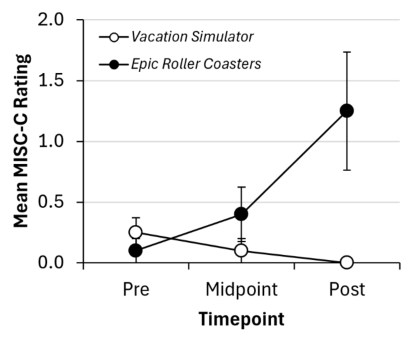
p = .26. Follow-up analyses showed a significant effect of Timepoint for Epic Roller Coasters, F(1.3, 25.6) = 4.38, p = .036, including a significant linear increase, t(19) = 2.26, p = .036. The corresponding effect for Vacation Simulator was not significant, F(2, 38) = 2.98, p = .063. Thus, MISC-C scores increased over time during the higher-motion Epic Roller Coasters experience but not during the comparatively lower-motion Vacation Simulator experience (Figure 1). Descriptive statistics can be found in OSM Table 6. This pattern is consistent with greater opportunity for illusory motion during Epic Roller Coasters, a known mechanism associated with VIMS (Cobb, 1999), and provides preliminary evidence that the MISC-C can capture differences in symptoms across VR experiences.
Figure 1: MISC-C score (0 = Fine, normal, good; 10 = I am throwing up) as a function of content and timepoint. Error bars represent SEM.
We tested the internal consistency of the SSQ-C subscales using traditional Cronbach’s alpha coefficients and Mean Inter-Item Correlations (MIIC). At post-Epic Roller Coasters, the SSQ-C-N subscale demonstrated strong internal consistency (α = .81; MIIC = .29), whereas reliability was lower for the SSQ- C-O (α = .21; MIIC = .05) and SSQ-C-D (α = .49; MIIC = .14) subscales. The lower values were associated with limited response variability on several items. Reliability estimates were also low or variable during conditions with minimal symptom endorsement, consistent with substantial floor effects in this sample. All 16 items were retained to preserve correspondence with the original SSQ (Kennedy et al., 1993). Repeated-measures ANOVAs revealed significant Content × Timepoint interactions for SSQ-C-O, F(1, 19) = 5.34, p = .032, η2
Equation reproduced from the original PDF.
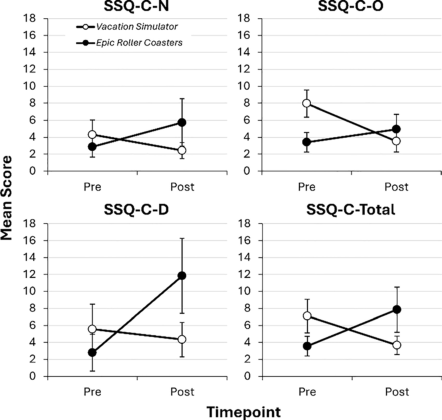
p = .25. However, these interactions were partly driven by higher pre-Vacation Simulator scores, and neither game demonstrated a significant Pre-to-Post change in isolation. No significant effects were observed for SSQ-C-N or SSQ-C-D. Descriptive statistics can be found in the OSM Table 7, and experimental results are depicted in Figure 2 below.
Figure 2: SSQ-C-N, SSQ-C-O, SSQ-C-D, and SSQ-C-Total subscale scores as a function of Content and Timepoint. We followed the identical methodology from Kennedy et al. (1993) to calculate the SSQ-C subscales and total. Like the adult SSQ, SSQ-C scores can range from 0 to 200.34, 0 to 159.18, and 0 to 292.32 in the SSC-C-N, SSQ-C-O, and SSQ-C-D subscales, respectively, with each raw numerically-converted score (ranging from 0 to 3) weighted by a factor of 9.54 (SSQ-C-N), 7.58 (SSQ-C-O), and 13.92 (SSQ- C-D). Kennedy et al. (1993) advised specifically that “[t]here is no particular interpretive meaning to the values in the conversion formulas;” rather, the scales enable the reader to more readily compare between measurements. Error bars represent SEM.
Across SSQ-C subscales, the descriptive pattern generally reflected decreasing symptoms during Vacation Simulator and increasing symptoms during Epic Roller Coasters (Figure 2). However, the absence of significant
Development, Comprehension Testing, and Preliminary Evaluation 1549 within-game changes and the low overall symptom levels warrant caution. These findings provide preliminary evidence regarding the behavior of the SSQ-C and highlight the need for further evaluation under conditions producing greater variability in VIMS symptoms.
DISCUSSION
This study developed child-adapted versions of the MISC and SSQ while maintaining correspondence with the original instruments. Expert review and cognitive walkthroughs informed developmentally appropriate language, and preliminary evaluation during VR gameplay examined how the resulting MISC-C and SSQ-C performed across experiences differing in their potential to elicit VIMS.
The clearest Phase 3 finding was the MISC-C Content × Timepoint interaction: symptoms increased significantly over time during Epic Roller Coasters but not Vacation Simulator. This pattern was consistent with the greater opportunity for illusory motion during Epic Roller Coasters and provides preliminary support for the MISC-C’s ability to capture changes in VIMS during VR exposure.
Findings for the SSQ-C were mixed. Significant Content × Timepoint interactions emerged for SSQ-C-O and SSQ-C-Total scores, and descriptive patterns generally reflected decreasing symptoms during Vacation Simulator and increasing symptoms during Epic Roller Coasters. However, these effects were influenced by elevated Vacation Simulator baseline symptoms, and significant Pre-to-Post changes were not observed within either game. Low symptom endorsement also resulted in limited response variability and floor effects, complicating interpretation of reliability and sensitivity. These findings are consistent with previous research reporting relatively low VIMS among children during experimental VR exposure (Rauschenberger & Barakat, 2020; Silva et al., 2025; Tychsen & Foeller, 2019).
Notably, this finding is not necessarily inconsistent with the MISC-C detecting changes over time. The SSQ-C distributes VIMS symptoms across multiple symptom-specific items and subscales; thus, when symptoms are infrequent or mild, many individual items may remain at zero, limiting variability and the ability to detect change. In contrast, the MISC-C provides a single response reflecting the overall progression and severity of motion sickness symptoms and may therefore capture relatively small changes even when children do not endorse a broad range of specific symptoms. The differing patterns observed across measures highlight the need for additional research to characterize their relative sensitivity under conditions producing different levels of VIMS.
The present findings should be interpreted as preliminary rather than as validation of the MISC-C or SSQ-C. Phase 3 included a small sample of typically developing children and used a fixed progression from lower- to higher-motion VR content. This sequence standardized exposure and limited potential carryover from the more provocative experience but prevents separation of content and order effects.
Future research should evaluate the measures with larger and more diverse samples, additional VR experiences and exposure sequences, and populations expected to demonstrate greater variability in VIMS. Evaluation with pediatric clinical populations and older children and adolescents would also help establish the measures’ broader applicability. Reading ability was not assessed and could be considered in future work, particularly for younger users.
CONCLUSION
The present study introduces the MISC-C and SSQ-C as developmentally adapted versions of established VIMS measures for children aged 7 to 12 years. Expert review and direct assessment with children supported revisions intended to improve comprehension while maintaining correspondence with the original MISC (Bos et al., 2005) and SSQ (Kennedy et al., 1993). Preliminary VR testing produced promising, though mixed, findings, particularly for the MISC-C. The present work provides a foundation for future validation of developmentally appropriate VIMS assessment tools for pediatric VR research and practice.
ACKNOWLEDGMENT
We sincerely thank the families who generously participated in this study; their time, insights, and experiences were invaluable to our research. We are also grateful to the expert reviewers, Karol Silva, Jessica Nave-Blodgett, and Nadia Tavassolie, who contributed to Phase 1 and whose thoughtful feedback helped to refine and strengthen the SSQ-C and MISC-C. We also would like to thank Michael Drzal for his contributions in graphic design.
REFERENCES
B4T Games (2017). Epic Roller Coasters [Video game]. B4T Games Bos, J. E., MacKinnon, S. N., & Patterson, A. (2005). Motion sickness symptoms in a ship motion simulator: Effects of inside, outside, and no view. Aviation, Space, and Environmental Medicine, 76(12), 1111–1118. Centers for Disease Control and Prevention. (2025). Motion sickness. In CDC
Yellow Book: Health information for international travel. Retrieved July 2, 2025, from https://www.cdc.gov/yellow-book/hcp/travel-air-sea/motion-sickness.html Cobb, S. V. G., Nichols, S., Ramsey, A., & Wilson, J. R. (1999). Virtual reality-induced symptoms and effects (VRISE). Presence, 8(2), 169–186. Flesch, R. (1948). A new readability yardstick. Journal of Applied Psychology, 32(3),
221–233. Hoeft, R. M., Vogel, J., & Bowers, C. A. (2003). Kids get sick too: A proposed Child Simulator Sickness Questionnaire. Proceedings of the Human Factors and Ergonomics Society 47th Annual Meeting, 2137–2141. Kaimara, P., Oikonomou, A., & Deliyannis, I. (2022). Could virtual reality
applications pose real risks to children and adolescents? A systematic review of ethical issues and concerns. Virtual Reality, 26, 697–735. Kennedy, R. S., Lane, N. E., Berbaum, K. S., & Lilienthal, M. G. (1993). Simulator sickness questionnaire: An enhanced method for quantifying simulator sickness. The International Journal of Aviation Psychology, 3, 203–220.
Development, Comprehension Testing, and Preliminary Evaluation 1551 Kincaid, J. P., Fishburne, R. P., Rogers, R. L., & Chissom, B. S. (1975). Derivation
of new readability formulas (automated readability index, fog count, and Flesch reading ease formula) for Navy enlisted personnel. Naval Air Station Memphis: Chief of Naval Technical Training. Research Branch Report, 8–75. Lambert, V., Boylan, P., Boran, L., Hicks, P., Kirubakaran, R., Devane, D., & Matthews, A. (2020). Virtual reality distraction for acute pain in children. Cochrane Database of Systematic Reviews, 10, 1–99. Meta (2024). Preteens in Horizon Worlds: Family-friendly VR & MR. Meta. https://
www.meta.com/blog/preteens-horizon-worlds-family-friendly-vr-mr Owlchemy Labs (2019). Vacation Simulator [Video game]. Owlchemy Labs. Rauschenberger, R. & Barakat, B. (2020). Health and safety of VR use by children in an educational use case. 2020 IEEE Conference on Virtual Reality and 3D User Interfaces (VR), 1–7. Sharbanian, S., Ma, X, Aghaei, N., Korner-Bitensky, N., Moshiri, K., & Simmonds,
M. J. (2012). Use of virtual reality (immersive vs. non-immersive) for pain management in children and adults: A systematic review of evidence from randomized controlled trials. European Journal of Experimental Biology, 2(5), 1408–1422. Silva, K., Breeland, N., Clark, A. M., Öztekin, I., & Kelly, R. L. (2025). Effects of virtual reality use in children aged 10 to 12 years. Frontiers in Virtual Reality, 6, 1–15. Tychsen, L. & Foeller, P. (2019). Effects of immersive virtual reality headset viewing
on young children: Visuomotor function, postural stability, and motion sickness. American Journal of Ophthalmology, 209, 151–159. Villena-Taranilla, R., Tirado-Olivares, S., Cózar-Gutiérrez, R., & González-Calero, J. A. (2022). Effects of virtual reality on learning outcomes in K-6 education: A meta-analysis. Educational Research Review, 35, 1–13.
SEARCH THE AHFE DIGITAL BOOKSTORE BY ISBN
Explore the complete digital volume
Human Factors in Design, Engineering, and Computing
Read this individual research paper free through the original publisher, or explore the full digital proceedings book.