Caroline Schon, Vanessa Fehlig, Rong Huang, Tim Wachsmuth (2026). Acceptance of Virtual Reality Among Older Adults: An Exploratory Study of a Culturally Embedded VR Application. In: Human Factors in Design, Engineering, and Computing. AHFE Open Access, vol. 238, pp. 1501–1510. https://doi.org/10.54941/ahfe1008378
The use of virtual reality (VR) applications among older adults has received limited attention in prior research and has been investigated mainly within clinical contexts. The aim of the present study was therefore to investigate the acceptance of a VR application and potential influencing factors within a sample of older participants.The sample comprised N = 119 participants aged between 55 and 89 years. In addition to demographic variables (age, gender), perceived presence, physical well-being, technology affinity, and personal relevance were assessed. The VR application immersively recreated a historically significant hotel from the region, selected for its potential to establish regional and biographical relevance.Descriptive results indicated a consistently high level of acceptance and positive user experience. Qualitative feedback from participants emphasized the realistic representation, visual clarity, interactive elements, and exploratory nature of the application. Inferential statistical analyses (ANOVAs, Mann-Whitney-U-Test and correlations) revealed no significant differences between age groups or genders and no significant correlations with the psychological variables assessed. No significant differences or correlations were detected; given the exploratory design and uneven subgroup sizes, these findings should be interpreted cautiously. Drawing on theories of cultural memory and embodied experience, the results suggest that VR enables users to engage with historical environments as shared experiential spaces. Overall, the study contributes to the emerging body of research on VR and older adults by highlighting the potential of immersive technologies to facilitate access to cultural memory and enable meaningful engagement with historical contexts that have not been personally experienced.
Virtual Reality (VR) has evolved in recent years from a specialized technology into an increasingly relevant medium across various fields of application. In addition to entertainment and gaming, VR is now used in industry, education, and healthcare (Cipresso et al., 2018; Sherman & Craig, 2018). By enabling users to experience computer-generated environments in an immersive and interactive way, the technology opens new forms of knowledge transfer and experience-based interaction with digital content. Against the backdrop
of demographic change, the question of how digital technologies can be designed to provide older adults with low-barrier and beneficial access is gaining importance.
Previous research shows that VR can be successfully used with older adults in various contexts, such as for cognitive stimulation, in rehabilitation, or to promote well-being (Skurla et al., 2022; Dermody et al., 2020). However, the focus of previous studies has been predominantly on clinical and therapeutic applications. In contrast, relatively limited information is available regarding how older adults perceive and accept VR applications outside of medical contexts. This research gap seems particularly relevant, as older adults often differ from younger user groups in terms of their affinity for technology, their prior experience with digital technologies, and their physical capabilities (Moore et al., 2023). While extensive findings on the acceptance of VR are already available for younger and tech-savvy target groups, comparable empirical findings for older adults are largely lacking.
In addition to clinical and educational applications, VR also offers potential for conveying cultural content. In particular, virtual reconstructions of historical sites make it possible not only to view past environments but also to experience them spatially and immersively. This allows historical spaces to be made accessible in a way that complements and expands traditional forms of cultural mediation. From the perspective of cultural memory, VR opens the possibility of making culturally significant places and events tangible, stimulating individual memory processes, and thereby creating an emotionally meaningful user experience. Particularly among older adults, such a form of mediation could develop high personal relevance through biographical connections and regional ties.
Against this backdrop, the present study examines the acceptance of a VR application among older adults aged 55 to 89. The application reconstructs a historic hotel of great regional significance and enables participants to explore this location virtually. The aim of the study is to analyse the extent to which such an application is accepted by older adults, and which factors influence this acceptance. The study takes into account demographic characteristics (age and gender), physical well-being during use, the perceived sense of presence, and the personal relevance of the depicted historical site.
Furthermore, the study examines to what extent VR, beyond mere acceptance, is suitable as a medium for conveying cultural memory. The focus is on the question of whether the immersive reconstruction of historical spaces enables an experience-based access to culturally significant content and can thus contribute to the preservation and transmission of regional history.
This gives rise to the following research questions (RQ): RQ1: To what extent is a virtual reality application with a regional historical focus accepted by older adults, and what influence do demographic variables (age and gender) as well as psychological factors such as physical well-being, sense of presence, and personal relevance have on this acceptance?
RQ2: To what extent is virtual reality suitable as a medium for conveying cultural memory by making historically significant spaces accessible as immersive and experiential environments?
Acceptance of Virtual Reality Among Older Adults: An Exploratory Study 1503 The study thus contributes to research at the intersection of immersive technologies, older adults, and cultural memory. It expands the existing body of research on VR acceptance among older adults by incorporating a cultural application context that has received little attention to date, while also providing initial insights into the potential of immersive technologies for conveying regional historical content.
THEORETICAL BACKGROUND Virtual reality (VR) enables users to experience computer-generated environments from a first-person perspective, providing immersive and interactive experiences that are difficult to achieve through traditional media. In cultural mediation applications, VR allows users to explore historical places that no longer exist or are otherwise inaccessible. With the increasing use of VR, understanding the factors that influence its acceptance has become an important area of research.
Research on technology acceptance has consistently shown that perceived usefulness and perceived ease of use influence individuals’ willingness to adopt new technologies (Davis, 1989). A further concept central to the effectiveness of VR is presence, commonly defined as the subjective feeling of “being there” in a virtual environment (Slater & Wilbur, 1997). Presence is closely related to immersion, which refers to the objective technological capability of a VR system to create an inclusive virtual environment, whereas presence describes the subjective psychological experience that results from it. Higher levels of presence are often associated with greater engagement, emotional involvement, and perceived realism (Witmer & Singer, 1998). In cultural mediation and educational applications, presence can support deeper connections with historical places, allowing users to experience reconstructed environments as meaningful spaces rather than as representations to be observed.
Although acceptance frameworks have been widely applied across digital technologies, older adults often face additional barriers, including technology- related anxiety, limited prior experience, and concerns about usability, which have been rarely examined (Charness & Boot, 2009). Studies focusing on older adults further suggest that technology acceptance is influenced by factors such as prior experience with digital technologies, self-efficacy, physical limitations, and the perceived relevance of technology to everyday life (Czaja et al., 2006). At the same time, the common assumption that older adults are generally unwilling to adopt new technologies has received limited empirical support. Previous research indicates that acceptance depends largely on perceived value and ease of use rather than age itself (Czaja et al., 2006; Heart & Kalderon, 2013). When technologies are accessible, meaningful, and easy to use, older adults often demonstrate positive attitudes and a high willingness to engage.
Although research on VR for older adults remains limited, the few existing studies consistently report positive experiences. Research in healthcare contexts has shown that VR can support emotional engagement, wellbeing, and meaningful experiences among older adults, including individuals living
with mild cognitive impairment or mild dementia (Matsangidou et al., 2023). In the field of cultural heritage, older visitors who experienced VR installations expressed positive attitudes toward the technology and strong intentions to revisit after the experience (tom Dieck et al., 2019). Similarly, recent research on virtual cultural experiences suggests that VR can stimulate emotional, cognitive, and social engagement among older adults while facilitating access to cultural content (Tsolakidis et al., 2025). The Pop-up VR Museum in Helsinki, for example, reported that older visitors perceived VR-based cultural experiences as particularly meaningful when they were able to connect them with their existing cultural knowledge and personal memories (Vishwanath, 2023), suggesting that prior cultural familiarity may facilitate engagement with immersive heritage applications.
According to cultural memory theory, societies preserve and transmit knowledge about the past through shared symbols, narratives, and cultural artefacts (Assmann, 1995). Historical buildings and places serve as important carriers of collective memory, even for individuals who have never directly experienced them. Digital reconstruction technologies can therefore function as new forms of memory media, enabling people to explore historical spaces that may have disappeared, become inaccessible, or otherwise remain beyond direct experience. VR is particularly suited to this purpose because it combines visual representation with embodied experience: users do not merely receive information about the past but can move through reconstructed environments and directly experience spatial relationships. In the context of regional cultural heritage, such immersive reconstructions allow users to engage with historical environments in ways that conventional formats such as text or images cannot easily provide (Champion, 2015).
The VR reconstruction of the Hotel Astoria, which serves as the application context of the present study, represents an example of a culturally meaningful heritage application (Kulturmaschine, n.d.). Hotel Astoria is a locally recognised building that, for many older residents, may serve as a point of reference for the region’s history, social life, and collective memory. This case therefore provides an opportunity not only to examine the acceptance of VR among older adults but also to explore the role of regional and personal relevance in shaping immersive cultural experiences.
METHOD
A total of 119 individuals aged 55 to 89 participated in the study. Participants were recruited through a public call for participants. The sample was heterogeneous in terms of age and gender, providing a broad basis for the analysis of individual influencing factors.
This study employed a mixed-methods design that combined quantitative survey data with qualitative observations and open-ended responses. Data were collected during one event through a standardized introduction, supervised VR use, and a post-experience questionnaire. The aim was to measure the acceptance and user experience of a historical VR application among older adults using quantitative instruments, while also gaining deeper insights through qualitative analysis.
Acceptance of Virtual Reality Among Older Adults: An Exploratory Study 1505 The data collection took place as part of an event at the university. At the beginning, all participants received a roughly 15-minute introduction from the staff member in charge, who provided background information on the Hotel Astoria, the development of the VR application, and the method used for interviewing eyewitnesses. The participants were then divided into two groups: one group first watched a roughly 20-minute documentary about the Hotel Astoria, while the other group participated in the VR experience in small groups under supervision. Each small group received a brief introduction to using the VR headset. After the VR experience, all participants filled out the questionnaire.
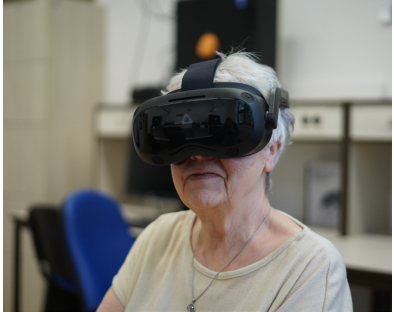
The VR application reconstructed the region’s historically significant Hotel Astoria. Interviews with eyewitnesses informed the historical reconstruction. An HTC Vive Focus 3 was used as the headset. The VR experience lasted between 6 and 20 minutes, depending on individual usage patterns.
Figure 1: Participant testing the VR application (left). Screenshot of the application (right).
To assess the sense of presence, adapted items from the ITC Sense of Presence Inventory was used (Lessiter & Freeman, 2001). Physical well-being was assessed using symptom items based on the corresponding section of the Cognitive Affective Model of Immersive Learning (Makransky & Petersen, 2021). Acceptance in the context of the virtual tour experienced by the participants was assessed using four items addressing perceived usefulness, willingness to revisit, openness to other VR topics, and recommendation. In addition, open-ended questions were used to gather qualitative assessments of the experience. Informal conversations following the event and observations during VR use were also utilized as qualitative data sources. Given the exploratory design, quantitative analyses focused on group differences and associations, while qualitative data were used descriptively to contextualize participants’ experiences.
RESULTS
To answer the first research question and investigate possible differences between various age groups, a one-way analysis of variance (ANOVA) was conducted. The groups were formed using the Sturges post-hoc rule, resulting in eight age groups. Most participants fell within the middle age ranges between 67 and 79 years, while the outer age groups were comparatively small. Before conducting the ANOVA, the underlying assumptions were tested. The normal distribution of the dependent variable presence within the age groups was examined using the Shapiro-Wilk test. Due to the sometimes very small sample sizes in individual age groups, meaningful test results could not be calculated for all groups.
In addition, one age group showed a significant deviation from the normal distribution (71–75-year-old group: p = .022). Since analysis of variance is considered robust against moderate violations of the normality assumption, the analysis was conducted nonetheless. The homogeneity of variances was tested using the Levene test and was found to be met (F(7, 101) = 2.03, p = .059). The subsequent one-way ANOVA revealed no significant effect of age group on perceived presence (F(7, 101) = 0.76, p = .626). To investigate possible differences in acceptance between age groups, a one-way analysis of variance was also conducted. Testing the assumption of normal distribution using the Shapiro-Wilk test revealed significant deviations from normal distribution in several age groups (63–67-year-old group: p < .001; 67–71-year-old group: p < .001; 71–75-year-old group: p < .001; 83–90-year-old group: p = .019). Given the relatively small group sizes in some cases and the robustness of ANOVA to moderate violations of this assumption, the analysis was nevertheless conducted. The Levene test for homogeneity of variances yielded a significant result (F(7, 99) = 3.15, p = .005), meaning that the assumption of homogeneous variances was not formally met. The results of the analysis of variance should therefore be interpreted with appropriate caution. The ANOVA showed no significant influence of age group on acceptance (F(7, 99) = 1.45, p = .195).
A Shapiro-Wilk test to assess normality revealed significant deviations from a normal distribution for both genders (male: W = .843, p = .001; female: W = .705, p < .001). Therefore, Mann-Whitney-U-Test was conducted. This test showed no significant difference in acceptance between the genders (p = .730).
In addition, correlations between various variables were examined using correlation analyses. No significant correlation was found between acceptance and technical affinity (p = .327). Similarly, no significant correlation was found between acceptance and personal relevance (p = .411). Furthermore, the analysis revealed no significant association between physical well-being and acceptance (p = .271). No significant association was found between presence and personal connection either (p = .536).
To answer the second research question, open-ended responses and informal observations were analysed descriptively in addition to the quantitative results, and these showed predominantly positive reactions. During use, enthusiasm was frequently observed. In open-ended response
Acceptance of Virtual Reality Among Older Adults: An Exploratory Study 1507 formats, several participants reported that the experience felt “just like back then” or that they had the feeling of sitting in the bar, suggesting emotional engagement and a strong connection to personal memories. It also became clear that certain details within the application specifically triggered memories. In particular, drinks, cigarettes, music, furnishings, and historical documents was mentioned by several participants and linked to personal memories.
In the subsequent discussions as well, the application was generally viewed very positively. Participants described the experience overwhelmingly as pleasant, interesting, emotionally engaging, and very realistic. In particular, the authentic depiction of the environment and individual elements helped to trigger memories and establish personal connections. These qualitative impressions align with the results of the questionnaire, in which the perceived presence was rated very positively.
DISCUSSION
The study aims to examine whether a historical VR environment is accessible to older adults as a shared space of experience and whether this experience can be interpreted in terms of cultural memory.
Research Question 1 examined whether the acceptance of a historically embedded VR application among older adults is influenced by demographic variables (age, gender) and psychological factors (physical well-being, sense of presence, personal relevance). The results show consistently high acceptance and positive user ratings regardless of age or gender. The correlations with physical well-being, personal relevance, and sense of presence also proved to be insignificant. Within this sample, the historical VR environment was positively evaluated across the examined demographic groups. Whether it provides a low-threshold gateway for broader populations requires further research.
The absence of significant differences and correlations should not be interpreted solely as an indication of a lack of effects. Rather, the consistently positive evaluations suggest that the VR application was widely accepted regardless of demographic or individual characteristics. In this context, the non-significant results can be understood as an indication of low-threshold accessibility as well as a comparatively homogeneous positive user experience within the heterogeneous sample of older adults.
Research Question 2 explored whether a culturally embedded VR may support access to cultural memory. Prior work describes historical VR applications in the field of cultural heritage confirm that older adults experience immersive environments as a kind of “journey through time,” drawing comparisons between the past and the present without the need for a personal biographical connection (Muslu et al., 2025). In this study, the qualitative feedback underscores that comments about realism, remembered objects, and feeling present in the reconstructed bar created a sense of being physically present in a bygone era. These comments suggest potential for cultural mediation. Overall, both the qualitative and quantitative results point to a high level of acceptance and an immersive experience of the application within this sample.
Several limitations must be taken into account when interpreting the results. First, there was no objective verification that the participants actually completed the entire VR application. It cannot be ruled out that socially desirable response behavior may have skewed the results. Second, the cross- sectional design does not allow for conclusions about long-term effects; it remains unclear whether and how acceptance and experience change over multiple VR sessions. Third, the sample is subject to selection bias: The call for participants specifically targeted individuals who already had an interest in VR and the historic Hotel Astoria. Some participants entered with the specific expectation of “seeing the hotel again”, which may have influenced the positive evaluation. Furthermore, the test power was limited in certain age groups due to small cell sizes, and the Levene test indicated a violation of the assumption of homogeneity of variances. Although analysis of variance is considered robust against moderate violations of this assumption, the non-significant results should be interpreted with appropriate caution given the reduced statistical power. Future studies with larger and balanced samples are necessary to conclusively clarify the presence of subtle age effects.
This study raises several areas for further research. To assess the generalizability of the findings, a replication study using a stratified sample would be desirable, as the current survey exhibits selection bias. A direct comparison with younger cohorts could also examine whether younger users experience similar forms of historical immersion or whether generation- specific approaches emerge. A longitudinal study could investigate whether acceptance and the sense of presence change with repeated use. A comparative study contrasting a VR-based presentation with a video-based presentation of the same historical content would be particularly insightful, as it would help isolate the specific added value of immersion. Finally, design options for age-appropriate VR applications can be derived from the feedback. Several participants noted that the presentation was “too real”—an indication that the degree of realism must be carefully adjusted for older users to avoid overwhelming them while still enabling immersion in the historical space.
In this sample, the culturally embedded VR application received positive evaluations across the examined age and gender groups. The findings provide preliminary evidence of its potential in cultural heritage contexts but cannot establish generalizability. The results suggest that immersive historical reconstructions can serve as a low-threshold gateway to cultural memory. In this way, the study contributes to research at the intersection of immersive technologies, aging, and cultural memory.
ACKNOWLEDGMENT
We would like to express our sincere gratitude to Alina Cyranek for creating the Hotel Astoria VR application and for making it available for this study. Further information about the application can be found at: https://blendfx. com/project/hotel-astoria-vr/
REFERENCES
Assmann, Jan. (1995). Collective Memory and Cultural Identity. New German Critique, No. 65, pp. 125–133. Champion, Erik. (2015). Critical Gaming: Interactive History and Virtual Heritage.
Farnham, UK: Ashgate Publishing. Charness, Neil and Boot, Walter R. (2009). Aging and Information Technology Use: Potential and Barriers. Current Directions in Psychological Science, Vol. 18, No. 5, pp. 253–258. Cipresso, Pietro, Giglioli, Irene A. C., Raya, Mariano A., & Riva, Giuseppe (2018).
The Past, Present, and Future of Virtual and Augmented Reality Research: A Network and Cluster Analysis of the Literature. Frontiers in Psychology, 9, 2086. Czaja, Sara J., Charness, Neil, Fisk, Arthur D., Hertzog, Christopher, Nair, Sankaran N., Rogers, Wendy A. and Sharit, Joseph. (2006). Factors Predicting the Use of Technology: Findings from the Center for Research and Education on Aging and Technology Enhancement (CREATE). Psychology and Aging, Vol. 21, No. 2, pp. 333–352. Davis, Fred D. (1989). Perceived Usefulness, Perceived Ease of Use, and User
Acceptance of Information Technology. MIS Quarterly, Vol. 13, No. 3, pp. 319–340. Dermody, Gordana, et al. “The role of virtual reality in improving health outcomes for community-dwelling older adults: systematic review.” Journal of medical internet research 22.6 (2020): e17331. Kulturmaschine. (13.07.2026). Hotel Astoria VR. https://kulturmaschine.de/project/
hotel-astoria-vr/ Heart, Tsvi and Kalderon, Efrat. (2013). Older Adults: Are They Ready to Adopt Health-Related ICT? International Journal of Medical Informatics, Vol. 82, No. 11, pp. e209–e231. Lessiter Jane, Freeman Jonathan, Keogh Edmund, Davidoff Jules (2001). A Cross-
Media Presence Questionnaire: The ITC-Sense of Presence Inventory. Presence, Vol. 10, No. 3, pp. 282–297. Makransky Guido, Petersen B. Gustav (2021). The cognitive affective model of immersive learning (CAMIL): a theoretical research-based model of learning. Immersive virtual reality. Educational Psychology Review, No. 33, pp. 937–958. Matsangidou, Maria. Solomou, Theodora. Frangoudes, Foteini. Ioannou,
Konstantina. Theofanous, Panayiota. Papayianni, Eleni and Pattichis, Constantinos S. (2023). Affective Out-World Experience via Virtual Reality for Older Adults Living with Mild Cognitive Impairments or Mild Dementia. International Journal of Environmental Research and Public Health, Vol. 20, No. 4, Article 2919. Moore, Ryan C., Jeffrey T. Hancock, and Jeremy N. Bailenson. (2023) “From 65 to 103, older adults experience virtual reality differently depending on their age: Evidence from a large-scale field study in nursing homes and assisted living facilities.” Cyberpsychology, Behavior, and Social Networking 26.12: 886–895. Muslu, L., Karakuş, Z., Asï, E., Bayindir, R. & Özer, Z. (2025). Time travel of older
people through virtual reality: a qualitative study. BMC Geriatrics, 25(1), 42. https://doi.org/10.1186/s12877-025-05699-x Sherman, William R., and Alan B. Craig (2018) Understanding virtual reality: Interface, application, and design. Morgan Kaufmann, 2018. Skurla, Miranda D., et al. (2022) “Virtual reality and mental health in older adults:
a systematic review.” International Psychogeriatrics 34.2: 143–155.
Slater, Mel and Wilbur, Sylvia. (1997). A Framework for Immersive Virtual Environments (FIVE): Speculations on the Role of Presence in Virtual Environments. Presence: Teleoperators and Virtual Environments, Vol. 6, No. 6, pp. 603–616. tom Dieck, M. Claudia, Jung, Timothy and Michopoulou, Eirini. (2019).
Experiencing Virtual Reality in Heritage Attractions: Perceptions of Elderly Users. In: Augmented Reality and Virtual Reality. Progress in IS. Springer, Cham, pp. 89–98. Tsolakidis, Andreas et al. (2025). Virtual Cultural Experiences for the Elderly: Formative Studies and First Findings Regarding Cultural Content. Applied Sciences, Vol. 15, No. 4, Article 1820. Vishwanath, G. (2023). “Enhancing Engagement through Digital Cultural Heritage:
A Case Study about Senior Citizens Using a Virtual Reality Museum”. In “Proceedings of the 2023 ACM International Conference on Interactive Media Experiences (IMX ‘23)” (pp. 150–156). Association for Computing Machinery. https://doi.org/10.1145/3573381.3596154 Witmer, Bob G. and Singer, Michael J. (1998). Measuring Presence in Virtual Environments: A Presence Questionnaire. Presence: Teleoperators and Virtual Environments, Vol. 7, No. 3, pp. 225–240.
SEARCH THE AHFE DIGITAL BOOKSTORE BY ISBN
Explore the complete digital volume
Human Factors in Design, Engineering, and Computing
Read this individual research paper free through the original publisher, or explore the full digital proceedings book.