Lanmin Liu, Robert Kluger (2026). Visual Attention, Recognition, and Driver Response During Emergency-Vehicle Encounters in a VR Driving Simulator. In: Human Factors in Design, Engineering, and Computing. AHFE Open Access, vol. 238, pp. 1998–2008. https://doi.org/10.54941/ahfe1008427
Emergency-vehicle (EV) encounters are rare but safety-critical events, making naturalistic observation of driver attention difficult. This study examined visual-search behavior and response initiation during controlled EV encounters using a virtual-reality driving simulator with eye tracking and SUMO-based traffic simulation. Thirty-five participants completed five of eight possible combinations of traffic condition, siren availability, and in-vehicle warning (IVW), yielding 339 same- and opposite-direction EV encounters. Visual attention was quantified using area-of-interest (AOI)-based dwell allocation and normalized gaze entropy. AOIs included the EV, IVW, mirrors, surrounding traffic, front scene, speedometer, and other regions. Stable pre-encounter segments served as non-EV reference periods. First EV-related visual engagement was defined as the earliest sustained gaze to the EV, IVW, or mirrors, while first action was the earliest validated braking, steering, or turn-signal response. Non-EV and EV gaze measures were compared using within-run regression models, while experimental-factor effects were evaluated using generalized estimating equations (GEE). The findings demonstrate that EV warning conditions influence visual-search redistribution and response timing, particularly during same-direction encounters. During EV1 encounters, gaze entropy increased from 0.346 to 0.485, mirror dwell increased from 7.2% to 26.8%, and forward-roadway dwell decreased from 75.7% to 58.1%. EV2 encounters showed less overall visual redistribution but a marked increase in direct EV gaze. IVW availability was associated with larger increases in entropy and mirror dwell and with earlier EV-related visual engagement. Both IVW and siren availability were associated with earlier first-action timing during EV1 encounters.
Emergency vehicle (EV) encounters are relatively rare but safety-critical traffic events that require surrounding drivers to rapidly detect an approaching EV, understand the situation, and select an appropriate response. In this study, EVs refer specifically to ambulances; more broadly, the term may also encompass fire trucks operating under emergency-response conditions. EV encounters can impose elevated demands on surrounding drivers because emergency vehicles may travel at higher speeds and operate differently from ordinary
Visual Attention, Recognition, and Driver Response 1999 traffic, creating situations that depart from drivers’ typical expectations. EV-related crashes can result in injuries or fatalities to emergency responders and other road users, while delayed or ineffective yielding may also impede emergency response. Human-factors research has therefore emphasized the importance of understanding how civilian drivers detect and respond to approaching EVs under different roadway and warning conditions (Hsiao et al., 2018; Lenné et al., 2008; Lidestam et al., 2020). Accordingly, the present study addresses two research questions: (1) how visual-search behavior changes from ordinary driving to an EV encounter, and (2) how in-vehicle warning (IVW) availability, siren availability, and traffic context influence visual attention and the timing of EV-related visual engagement and behavioral response.
Driving simulators provide a useful approach for examining these interactions because rare or potentially hazardous events can be reproduced under controlled conditions without exposing participants to real-world risk. They also allow traffic conditions, warning systems, and EV behavior to be systematically manipulated while driver behavior is continuously recorded. More recently, virtual-reality (VR) simulation has been combined with eye tracking to examine visual attention in addition to vehicle-control responses. Visual-attention measures such as area-of-interest (AOI) dwell time, gaze frequency, and gaze entropy can provide complementary information about where drivers look and how broadly visual attention is distributed across the driving environment (Chung et al., 2022; Shiferaw et al., 2019; Zhang et al., 2025).
Previous studies have shown that advance warnings can influence driver responses to approaching EVs. Lenné et al. (2008) found that advance in-vehicle warnings affected speed and lane-changing behavior during simulated EV encounters, while Lidestam et al. (2020) reported that EV-approaching warnings increased drivers’ propensity to give way and promoted earlier yielding. Field and simulator studies have further reported changes in driver responses associated with roadside warnings, warning modality, and navigation-based head-up displays (Savolainen et al., 2010; Weibull et al., 2026; David et al., 2025). Together, these findings indicate that warning design may affect whether drivers respond and, if so, when and how they respond.
Compared with vehicle-control responses, however, less is known about how visual attention changes throughout an EV encounter. Weibull et al. (2025) found that drivers receiving an EV-approaching warning began scanning mirrors earlier, demonstrating that warning information can alter visual-search behavior before the EV passes. Their analysis focused primarily on broad gaze regions, including the forward roadway, mirrors, and dashboard, leaving opportunities to examine visual-search redistribution using a broader set of AOIs and complementary measures of visual scanning. In addition, limited work has examined how warning availability, siren availability, traffic context, and EV approach direction jointly influence attention and response behavior.
The present study addresses this gap using an immersive VR driving simulator integrated with eye tracking and SUMO-based microscopic traffic
2000 Liu and Kluger simulation. Drivers experienced both same-direction and opposite-direction EV encounters under combinations of traffic presence, siren availability, and IVW availability. Visual attention was characterized using AOI dwell allocation and normalized gaze entropy, with stable pre-encounter driving periods serving as a non-EV reference. Response timing was characterized using the timing of first EV-related visual engagement and the first validated behavioral response.
EXPERIMENTAL DESIGN VR Driving Simulator
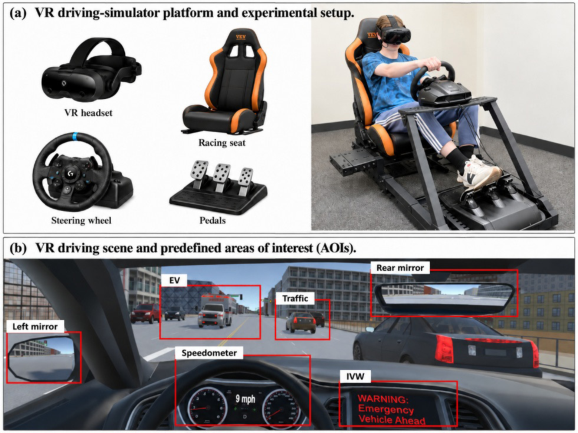
The experiment was conducted using a fixed-base VR driving simulator consisting of a VIVE Focus 3 headset with integrated eye tracking, a Logitech G923 steering wheel and pedal set, a high-performance PC, a local server, and an adjustable seated platform (Figure 1a). Unity provided the roadway environment, vehicle dynamics, and visual rendering, while Simulation of Urban MObility (SUMO) operated in parallel to generate surrounding- traffic behavior and EV movement. Steering-wheel angle, accelerator input, and brake input were recorded through the Logitech SDK, while eye-tracking data were collected through the VR headset. A synchronized data pipeline aligned timestamps across Unity, SUMO, and the eye-tracking system, enabling continuous recording of vehicle trajectories, driver-control inputs, gaze behavior, EV-relative distance, and surrounding-traffic information. The integrated platform therefore enabled controlled EV encounters while simultaneously capturing visual-attention and behavioral-response measures.
Experimental Setup The VR driving environment reproduced an approximately 1.5-mile urban roadway segment modelled after a street in Buffalo, New York. The roadway consisted of two-way traffic with three lanes in each direction, with the rightmost lane in each direction designated for on-street parking. Signalized intersections were distributed along the route to reproduce typical urban driving conditions. Participants were instructed to drive straight along the roadway under normal driving conditions. During each experimental run, two EV encounters occurred: a same-direction encounter (EV1), in which the EV approached from behind, and an opposite-direction encounter (EV2), in which the EV approached from the front. The order of the two encounters was randomized within each run.
Participants were recruited from the university and surrounding community. Eligible participants were required to be between 18 and 65 years of age and to possess a valid U.S. driver’s license. The study protocol was approved by the University of Louisville Institutional Review Board, and written informed consent was obtained from all participants before participation.
The experimental design manipulated three factors: traffic condition, siren availability, and in-vehicle warning (IVW) availability, resulting in eight possible scenario combinations. Traffic was either absent or light, the EV siren was either off or on, and the IVW was either absent or present.
Visual Attention, Recognition, and Driver Response 2001 Each participant was assigned five of the eight possible scenario combinations, resulting in an incomplete repeated-measures design.
Before data collection, participants completed a brief familiarization period with the VR simulator and vehicle controls. The integrated eye tracker was calibrated before each experimental session using the manufacturer’s standard calibration procedure. During the experimental runs, participants were instructed to drive normally and respond to surrounding traffic and EVs as they considered appropriate. No specific yielding maneuver was prescribed. Each experimental session lasted approximately 1 hour, including the survey, simulator familiarization and training, and driving sessions.
Visual attention and behavioral responses were quantified using synchronized eye-tracking, driver-control, and vehicle-trajectory data. Visual-attention measures included gaze allocation across predefined areas of interest (AOIs) and normalized gaze entropy. Behavioral measures included steering, braking, accelerator input, and the timing of the first validated driver response. The predefined AOIs used for gaze analysis are illustrated in Figure 1b.
Figure 1: VR driving-simulator platform: (a) fixed-base VR driving simulator and experimental setup; (b) VR driving scene and the areas of interest (AOIs).
METHODS
Encounter records affected by confirmed data loss, invalid timestamp sequences, or the absence of a valid EV encounter were excluded from analysis. For each run, a single 10-s stable pre-encounter driving segment was selected as the non-EV reference and was shared by the EV1 and EV2 analyses within that run. Candidate segments were required to occur before the first EV exposure, with no EV within 150 m, continuous timestamp coverage, forward vehicle motion, stable speed and steering, no lane change,
2002 Liu and Kluger and minimal braking. Segments not meeting these criteria were not used as non-EV references.
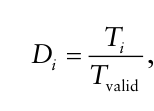
EV1 and EV2 encounters were analyzed separately because of their different visual and behavioral demands. For each analysis interval, AOI dwell proportion was calculated as
Equation reproduced from the original PDF.
valid ,
where Ti represents the valid gaze duration assigned to AOI i, and Tvalid represents the total valid gaze duration within the analysis interval. Normalized gaze entropy was calculated as
Equation available in the original PDF paper.
1 norm ln( ), ln( )
i i i p p H K
where pi is the proportion of valid gaze allocated to AOI i, and K is the number of AOIs included in the entropy calculation. Values closer to 0 indicate more concentrated gaze allocation, whereas values closer to 1 indicate more broadly distributed visual attention. Encounter-related changes in gaze outcomes were expressed as
EV non EV Y Y Y − ∆ = − .
Changes in visual search from non-EV driving to EV encounters were evaluated using within-run fixed-effects regression models with participant- clustered robust standard errors. Outcomes included normalized gaze entropy and dwell proportions for the mirrors, front scene, EV, and surrounding traffic.
To examine whether siren availability, in-vehicle warning (IVW) availability, and traffic condition modified encounter-related changes in visual attention, Gaussian generalized estimating equations (GEE) were fitted with phase (non-EV vs. EV), siren, IVW, traffic, and their interactions. Participants were treated as clusters using an exchangeable working correlation structure, and experimental factors were effect-coded as −0.5 and +0.5.
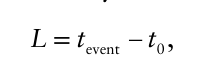
Response-timing analyses considered two outcomes: first EV-related visual-engagement latency and first-action latency. First EV-related visual engagement was defined as the earliest sustained gaze of at least 0.20 s toward the EV, IVW, or a mirror, whereas first action was defined as the earliest validated braking, steering, or turn-signal response. For both outcomes, latency was defined as the elapsed time, in seconds, from the moment the EV first came within 150 m of the participant vehicle to the corresponding first qualifying event. The 150-m threshold represented the onset of the EV encounter and the maximum distance at which the siren and IVW cues became available to the driver. Latency was calculated as
Equation reproduced from the original PDF.
where t0 represents the time at which the EV first came within 150 m of the participant vehicle, and tevent represents the timestamp of the first qual ifying visual-engagement or behavioral-response event. Because latency
Visual Attention, Recognition, and Driver Response 2003 distributions were positively skewed, log 1 L was modeled using Gaussian GEE with siren, IVW, traffic, and their interactions. Participants were treated as clusters using an exchangeable working correlation structure. Timing anal yses included only encounters in which the corresponding event was observed; encounters without an observed event were not assigned an artificial latency. To account for multiple hypothesis testing, p-values within related families of tests were adjusted using the Benjamini–Hochberg false-discovery-rate pro cedure, which controls the expected proportion of false discoveries among rejected hypotheses. Adjusted p-values are reported as q values.
RESULTS
Thirty-five licensed drivers participated in the experiment, each completing five of the eight possible experimental conditions. Participants had a mean age of 27.5 ± 4.7 years, with 14 (40.0%) female and 21 (60.0%) male participants. Following data-quality screening, 339 usable EV encounters were retained for analysis, including 169 same-direction (EV1) and 170 opposite-direction (EV2) encounters. Matched non-EV reference periods were available for 161 EV1 and 162 EV2 encounters. A first EV-related visual engagement event was observed in 163 EV1 encounters (96.4%) and 116 EV2 encounters (68.2%), with median latencies of 2.03 s [IQR: 1.33–3.08] and 2.12 s [1.21–3.19], respectively. A validated first action was observed in 152 EV1 encounters (89.9%) and 73 EV2 encounters (42.9%). Median first-action latency was 4.99 s [3.05–7.88] for EV1 and 1.97 s [1.18–2.95] for EV2.
Table 1: Changes in visual-attention measures from non-EV driving to EV encounters.
Table available in the original PDF paper.
Outcome n Non−EV Mean EV Mean Difference (95% CI) q EV1: Same-direction encounters Entropy 161 0.346 0.485 +0.139 [+0.087, +0.191] < .001
Note. Estimates represent within-run EV minus non-EV differences. q values are Benjamini–Hochberg FDR-adjusted p-values; pp = percentage points.
Clear changes in visual-search behavior were observed during same-direction EV1 encounters. Normalized gaze entropy increased from 0.346 during matched non-EV driving to 0.485 during the EV encounter, corresponding to an estimated increase of 0.139 (95% CI: 0.087–0.191, q < .001). Mirror dwell increased from 7.2% to 26.8%, an increase of 19.6 percentage points (pp) (95% CI: 15.1–24.1 pp, q < .001). In contrast, front-scene dwell decreased from 75.7% to 58.1%, a reduction of 17.6 pp (95% CI: −23.8 to −11.4 pp, q < .001). Traffic-directed dwell also increased by 0.6 pp (q = .040), whereas EV-directed dwell did not change significantly.
EV2 encounters exhibited a different visual-attention pattern. Overall gaze entropy, mirror dwell, and front-scene dwell did not differ significantly from matched non-EV driving. However, direct gaze toward the EV increased from approximately 0.1% during the non-EV reference period to 6.9% during EV2 encounters, an increase of 6.9 pp (95% CI: 3.5–10.3 pp, q = .001). Thus, EV1 was characterized by broader redistribution of visual attention, particularly toward mirrors, whereas EV2 was characterized primarily by increased direct visual attention to the approaching EV.
Effects of Warning and Traffic Context on Visual Search and Response Timing For EV1 encounters, IVW availability was associated with a larger increase in normalized gaze entropy (β = 0.128, 95% CI: 0.075–0.181, q < .001) and mirror dwell (+10.5 pp, 95% CI: 5.5–15.6 pp, q < .001), together with a greater reduction in front-scene dwell (−15.6 pp, q < .001). A Siren × IVW interaction was observed for mirror dwell (−13.4 pp, 95% CI: −21.8 to −5.0 pp, q = .013), and a Siren × IVW × Traffic interaction was observed for gaze entropy (β = −0.403, 95% CI: −0.620 to −0.186, q = .002). A statistically significant but small IVW × Traffic interaction was also detected for EV dwell (+0.1 pp, q = .049). Traffic conditions in this study alone did not produce significant main effects on the principal gaze outcomes.
Warning availability also influenced response timing during EV1 encounters. Siren (β = −0.369, 95% CI: −0.582 to −0.157, q = .002) and IVW (β = −0.421, 95% CI: −0.618 to −0.223, q < .001) were associated with shorter first EV-related visual-engagement latency, with a significant Siren × IVW interaction (β = 0.672, q < .001). Similarly, siren (β = −0.728, q < .001) and IVW (β = −0.838, q < .001) were associated with shorter first-action latency. Siren × IVW (β = 1.223, q < .001) and IVW × Traffic (β = 0.556, q = .011) interactions indicated that warning-related changes in action timing varied across experimental conditions.
In contrast, no significant main effects were observed for the primary EV2 gaze outcomes or first EV-related visual-engagement latency after FDR adjustment. For EV2 first-action latency, an IVW × Traffic interaction was observed (β = −0.578, 95% CI: −0.893 to −0.263, q = .004); however, this result was based on the 73 EV2 encounters in which a validated action was observed and should therefore be interpreted cautiously.
Table 2: GEE estimates for warning and traffic effects on gaze change and response timing.
Note. For gaze outcomes, coefficients represent Phase × factor effects on the non-EV-to-EV change; dwell estimates are reported in percentage points (pp). For latency outcomes, coefficients are on the log (1 + latency) scale. The table reports the prespecified effects of siren availability, IVW availability, and traffic condition for each outcome. Significant higher-order interactions are reported in the text. Confidence intervals are unadjusted 95% CIs, whereas q values are Benjamini–Hochberg FDR-adjusted p-values.
DISCUSSION
The results demonstrate that EV encounters produced distinct changes in drivers’ visual-search behavior, with substantially different patterns for same- direction and opposite-direction encounters. During EV1 encounters, drivers shifted attention away from the forward roadway and toward the mirrors, accompanied by a marked increase in normalized gaze entropy. This pattern suggests that a rear-approaching EV requires drivers to distribute attention more broadly across the driving environment rather than maintaining the strongly forward-focused visual strategy observed during ordinary driving. In contrast, EV2 encounters produced relatively little change in overall gaze distribution but substantially increased direct gaze toward the EV. This difference is consistent with the visual geometry of the two encounter types: a same-direction EV approaching from behind must often be detected through mirrors or indirect visual cues, whereas an opposite-direction EV is more likely to appear within the forward field of view.
Warning availability also influenced both visual attention and response timing during EV1 encounters. IVW availability was associated with larger increases in gaze entropy and mirror dwell and with a greater reduction in forward-roadway dwell, indicating that the warning altered how drivers distributed visual attention after the EV encounter began. Both IVW and siren availability were also associated with earlier EV-related visual engagement and earlier behavioral response. These results are consistent with previous studies showing that advance EV warnings can promote earlier yielding and changes in driver response behavior (Lenné et al., 2008; Lidestam et al., 2020). They also extend recent eye-tracking findings showing earlier mirror scanning in the presence of EV warnings (Weibull et al., 2025) by demonstrating broader changes in gaze allocation and visual-search distribution.
The effects of the experimental factors were not uniformly additive. Significant interactions between siren and IVW were observed for several EV1 outcomes, and traffic context moderated selected effects, particularly action timing and gaze entropy. However, traffic presence alone produced limited main effects. This suggests that light traffic may function more as
Visual Attention, Recognition, and Driver Response 2007 a contextual modifier of warning-related behavior than as an independent driver of visual attention. The relatively weak factor effects observed for EV2 further indicate that warning effectiveness may depend strongly on encounter geometry and on where EV-related information is naturally available within the driver’s visual field.
Several limitations should be considered. First, findings from the VR simulator may not fully generalize to real-world EV encounters. Second, the study used an incomplete repeated-measures design, with each participant completing five of eight conditions. Third, repeated EV exposure may have created expectancy effects, potentially influencing visual search and response timing in later runs. Future work will incorporate video-based behavioral coding and more detailed traffic-context measures to examine response appropriateness, yielding-space availability, and gaze–behavior relationships.
CONCLUSION
This study used an integrated VR driving simulator, eye tracking, and microscopic traffic simulation to examine visual attention and driver response during EV encounters. Same-direction encounters produced broader redistribution of attention, including increased mirror dwell and gaze entropy and reduced forward-roadway dwell, whereas opposite-direction encounters primarily increased direct EV gaze. IVW and siren availability were associated with earlier visual engagement and behavioral response during same-direction encounters, while IVW also altered gaze allocation. Overall, the findings indicate that EV warning effects vary by encounter direction and, for selected outcomes, traffic context.
ACKNOWLEDGMENT
This work was supported by the National Science Foundation under Award No. 2332183, EAGER: “Characterizing Driver Interactions with Emergency Vehicles.”
REFERENCES
Chung, J., Lee, H., Moon, H. and Lee, E. (2022) ‘The static and dynamic analyses of drivers’ gaze movement using VR driving simulator’, Applied Sciences, 12(5), 2362. https://doi.org/10.3390/app12052362 David, M., Kemper, D., Baumann, M. and Garcia-Hernandez, A. (2025) ‘Assessing
driver reactions to emergency navigation prompts in head-up displays’, Accident Analysis & Prevention, 221, 108199. https://doi.org/10.1016/j.aap.2025.108199 Hsiao, H., Chang, J. and Simeonov, P. (2018) ‘Preventing emergency vehicle crashes: Status and challenges of human factors issues’, Human Factors, 60(7), pp. 1048–1072. https://doi.org/10.1177/0018720818786132 Lenné, M.G., Triggs, T.J., Mulvihill, C.M., Regan, M.A. and Corben, B.F. (2008)
‘Detection of emergency vehicles: Driver responses to advance warning in a driving simulator’, Human Factors, 50(1), pp. 135–144. https://doi. org/10.1518/001872008X250557
2008 Liu and Kluger Lidestam, B., Thorslund, B., Selander, H., Näsman, D. and Dahlman, J. (2020) ‘In-car
warnings of emergency vehicles approaching: Effects on car drivers’ propensity to give way’, Frontiers in Sustainable Cities, 2, 19. https://doi.org/10.3389/ frsc.2020.00019 Savolainen, P.T., Datta, T.K., Ghosh, I. and Gates, T.J. (2010) ‘Effects of dynamically activated emergency vehicle warning sign on driver behavior at urban intersections’, Transportation Research Record, 2149(1), pp. 77–83. https://doi. org/10.3141/2149-09 Shiferaw, B., Downey, L.A. and Crewther, D.P. (2019) ‘A review of gaze entropy as
a measure of visual scanning efficiency’, Neuroscience & Biobehavioral Reviews, 96, pp. 353–366. https://doi.org/10.1016/j.neubiorev.2018.12.007 Weibull, K., Lidestam, B. and Prytz, E. (2025) ‘Driver’s gaze behavior when approached by an emergency vehicle—The effects of in-car warnings and system introduction’, Transportation Research Part F: Traffic Psychology and Behaviour, 109, pp. 137–146. https://doi.org/10.1016/j.trf.2024.12.010 Weibull, K., Norell, M.B., Thorslund, B. and Lidestam, B. (2026) ‘Exploring
false warnings and modalities for emergency vehicle alerts and their impact on driver behavior’, Human Factors, 68(9), pp. 1230–1241. https://doi. org/10.1177/00187208261436744 Zhang, S., Zuo, F., Ergan, S. and Ozbay, K. (2025) ‘Improving work zone safety: Integrating VR-CARLA co-simulation and eye tracking for behavior analysis of drivers around work zones’, Journal of Transportation Safety & Security, 17(7), pp. 826–849. https://doi.org/10.1080/19439962.2025.2462808
SEARCH THE AHFE DIGITAL BOOKSTORE BY ISBN
Explore the complete digital volume
Human Factors in Design, Engineering, and Computing
Read this individual research paper free through the original publisher, or explore the full digital proceedings book.