Anna Shimafuji, Fuma Hayashi, Tetsusei Kurashiki (2025). Eye-tracking based mental fatigue assessment in VR environments. In: Metaverse, Virtual Environments and Game Design. AHFE Open Access, vol. 178, pp. 60–65. https://doi.org/10.54941/ahfe1006345
While "stress" measured by wearable devices typically reflects autonomic nervous system responses to external pressures, a deeper form of fatigue—mental fatigue—is becoming more prevalent in today’s information-rich society. Characterized by decreased cognitive and attentional capacity, mental fatigue is harder to detect and slower to recover from, often not resolved by sleep alone. Early detection and management are crucial to prevent its chronic progression. Mental fatigue differs from peripheral stress in that it is characterized by impaired cognitive function and attention span. Mental fatigue often goes unnoticed and is not easily relieved by sleep alone. Early assessment and intervention are essential to prevent its chronic progression. We have developed ZEN EYE Pro, a VR-based eye-tracking system that allows for rapid (approximately 1 minute) and non-invasive assessment of mental fatigue in a real-world context. The purpose of this study was twofold: first, to evaluate the feasibility of ZEN EYE Pro as an objective assessment tool for mental fatigue. The second was to test the validity of our developed assessment by examining the impact of two established stress reduction interventions - mindfulness-based stress reduction (MBSR) and inhalation aromatherapy. In an experiment with 61 Japanese adult participants, the mean mental fatigue score was 44.20% (SD = 9.93). (1) A 5-minute mindfulness session with Apple Vision Pro reduced fatigue scores by 18.85% (p < 0.001). (2) A 2-minute inhalation aromatherapy session with a blend of aromas reduced fatigue scores by 14.47% (p < 0.001). These results demonstrate the feasibility and validity of objective and time-efficient mental fatigue assessment using the ZEN EYE Pro and suggest its applicability in a variety of real-world settings.
Although stress measured by wearable devices typically reflects the autonomic nervous system’s response to external pressures, a more severe concern—mental fatigue—has become increasingly prominent in today’s information-saturated society. Mental fatigue, characterized by declines in cognitive abilities and attentional capacities, is difficult to detect, slow to recover from, and often not alleviated by sleep alone. Early assessment and intervention are essential to prevent its chronic progression. In recent years, eye-tracking technology has emerged as a promising tool for the objective assessment of mental fatigue. Specifically, indicators such as fixation duration, number of fixations, and initial saccade direction have been shown to reveal attentional biases associated with mental fatigue and emotional disorders (Duque and Vázquez, 2015; Stolicyn et al., 2022). A double attention bias toward both positive and negative emotional stimuli in individuals with clinical depression has been reported (Duque
Eye-Tracking Based Mental Fatigue Assessment in VR Environments 61
and Vázquez, 2015). Predictive models combining facial imagery and eye movement patterns have achieved individual-level depression symptom detection with high accuracy (Stolicyn et al., 2022). Furthermore, the use of eye-tracking data during naturalistic video viewing has enabled accurate assessment of mental fatigue, especially among older adults (Yamada and Kobayashi, 2017). In student populations, eye gaze parameters have also been shown to serve as effective indicators of mental fatigue levels (Jyotsna and Amudha, 2018). Based on these previous studies, we developed ZEN EYE Pro, a VR-based eye-tracking system designed to assess mental fatigue in immersive environments. In addition to detecting mental fatigue, it is also critical to understand how to alleviate it once it is present. Both mindfulness-based stress reduction (MBSR) and inhalation aromatherapy have demonstrated potential in reducing anxiety and stress, with consistent effectiveness across diverse populations and clinical settings (Hedigan et al., 2023; Hue et al., 2025). Lavender essential oil has been most frequently used and is particularly associated with consistent positive outcomes, with over 70% of studies reporting reductions in stress and anxiety (Hedigan et al., 2023). The purpose of this study is twofold: first, to evaluate the feasibility of ZEN EYE Pro, a VR-based eye-tracking system, as an objective tool for assessing mental fatigue; and second, to validate the proposed assessment method by examining the effectiveness of two well-established stress reduction interventions: mindfulness-based stress reduction (MBSR) and inhalation aromatherapy. This system has been granted a Japanese patent (Patent No. 7557225).
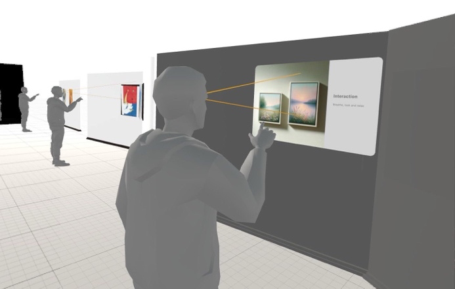
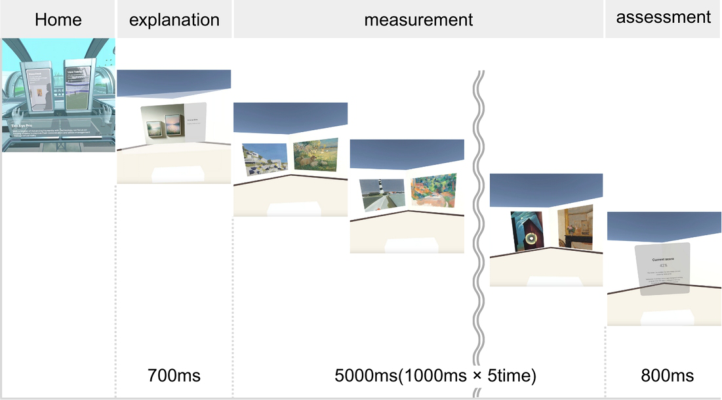
A VR-BASED EYE-TRACKING SYSTEM FOR MENTAL FATIGUE ASSESSMENT We employed a VR-based eye-tracking system, ZEN EYE Pro (https://neuralport.studio.site/casestudy-stresscheck), to non-invasively measure mental fatigue levels. The system was implemented on a PICO 4 Enterprise headset, which supports integrated eye tracking and provides a display resolution of 4320 × 2160 pixels (2160 × 2160 pixels per eye). The system was developed using the Unity SDK, which provides access to real- time eye-tracking information, including 3D gaze coordinates (x, y, z), via the XR Eye Tracking API (PICO XR Developer, 2023). The SDK supports real- time output of gaze data and pupil position at the device’s native sampling rate of 90 Hz, enabling high-resolution capture of gaze behavior. This technical configuration ensures sufficient temporal and spatial resolution to quantify subtle changes in attentional patterns. During the task, the system randomly presented five pairs of virtual spatial stimuli (10 seconds per pair): each pair consisted of one negative painting created by a depressed patient and one control painting by a typical patient. Participants were instructed to view these stimuli for a total of approximately one minute while their gaze behavior was recorded. A mental fatigue score was then calculated based on the percentage of fixation time directed toward the negative stimuli. Although negative and neutral or positive facial expressions, as used in previous studies, may be sufficient stimuli in controlled laboratory
62 Shimafuji and Hayashi
settings, they can often reveal the purpose of measurement to participants in real-world contexts. To avoid such interpretive bias and preserve ecological validity, we explored various alternatives and ultimately adopted paintings as virtual spatial stimuli after iterative refinement.
Figure 1: VR-based eye-tracking system (ZEN EYE Pro).Figure 2: Five pairs of virtual spatial stimuli.
FEASIBILITY AND BASELINE VALIDATION OF MENTAL FATIGUE SCORING To validate our approach, we conducted an experiment with 61 Japanese participants. Participants included healthy adults aged 18 to 65, with no reported history of neurological or psychiatric disorders. The mean mental fatigue score obtained using the ZEN EYE Pro was 44.20% (SD = 9.93). All measurements were conducted in a quiet, standardized environment, with each session lasting one minute per participant. These results demonstrate the feasibility of using gaze-based metrics to establish a population-level baseline for mental fatigue and to enable rapid, objective quantification
Eye-Tracking Based Mental Fatigue Assessment in VR Environments 63
in applied settings. This study was approved by the Ethics Committee of ROHTO Pharmaceutical Co., Ltd. (Approval No. ROHTO-22-020), and all participants provided written informed consent prior to participation.
EVALUATING INTERVENTIONS FOR REDUCING MENTAL FATIGUE We examined whether a VR-based eye-tracking system (ZEN EYE Pro) for mental fatigue assessment could be used to assess the effects of two stress reduction interventions that have already demonstrated efficacy. In both interventions, participants whose initial fatigue scores exceeded 60, as measured by the VR-based eye-tracking system, were classified as the high-fatigue group. All participants provided informed consent prior to participation.
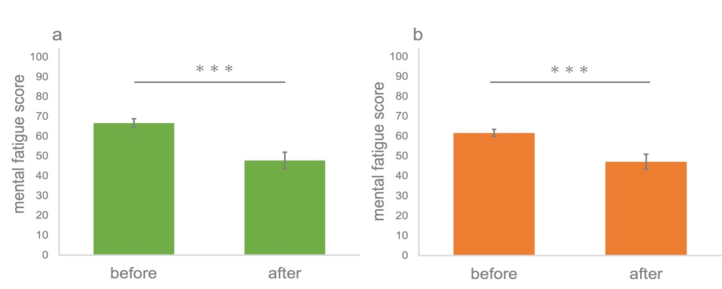
Mindfulness Session The high-fatigue group (n = 14) participated in a 5-minute mindfulness session using the Apple Vision Pro (AVP). Participants wore the AVP headset in a seated position and followed the instructions of a mindfulness application. Immediately after the session, their mental fatigue scores were reassessed using the VR-based eye-tracking system. As a result, mental fatigue scores were significantly reduced by 18.85% (t = 4.32, p <.001).
Inhalation Aromatherapy Session Similarly, the fight-fatigue group (n = 19) underwent an inhalation aromatherapy intervention. The essential oil blend was lavender-based, adjusted with orange and yuzu to align with typical Japanese olfactory preferences. One drop of the blend was applied to a custom adhesive patch (29 mm in diameter), which participants affixed to their chest approximately 15 cm below the nose. They then inhaled the scent slowly for two minutes. Immediately after the intervention, fatigue levels were reassessed using the VR-based system. This intervention significantly reduced mental fatigue by 14.47% (t = 3.01, p <.001).
Figure 3: Efficacy of two established stress reduction interventions. After the mindfulness session, mental fatigue scores were significantly reduced (a). The inhalation aromatherapy session significantly reduced mental fatigue (b).
64 Shimafuji and Hayashi
CONCLUSION
Our study demonstrates that ZEN EYE Pro, a VR-based eye-tracking system, enables rapid, non-invasive, and highly objective assessment of cognitive fatigue through gaze behavior in an immersive virtual environment. The ability to complete the assessment in approximately one minute offers a major advantage in clinical and operational contexts, particularly in settings where time and resources are constrained. Notably, this system allows for the quantification of subtle changes in attentional function that are difficult to capture using traditional questionnaires or physiological measurements, clearly distinguishing it from conventional methods.
Furthermore, the significant reductions in mental fatigue scores observed after mindfulness-based stress reduction (MBSR) and inhalation aromatherapy interventions demonstrate that the system is not only suitable for monitoring but also effective for evaluating intervention outcomes. These findings suggest that gaze-based metrics may serve as novel objective outcome indicators for stress management programs. The system holds strong potential for broader applications in early mental health screening, personalized intervention planning, and real-time monitoring of performance decline in high-stress occupations.
Future research will first explore the neural basis of mental fatigue detected by ZEN EYE Pro. For instance, if mental fatigue is found to significantly impair working memory performance, this would suggest involvement of the prefrontal cortex, particularly regions such as the dorsolateral prefrontal cortex responsible for executive control. By integrating eye-tracking data with neuroimaging techniques such as fNIRS or fMRI, we aim to clarify the correspondence between gaze behavior and neural activity patterns.
In addition, correlational studies with established brain health indices, such as the Brain Healthcare Quotient (BHQ), will be conducted to further validate the biological relevance and clinical utility of our assessment approach. BHQ reflects structural and functional brain aging and stress vulnerability, and its relationship with gaze-derived fatigue scores may position eye-tracking as a key component of comprehensive brain health monitoring.
Mental fatigue has become an increasingly critical issue in high-stakes environments such as healthcare, defense, education, and elite sports, highlighting the urgent need for scalable and non-invasive monitoring tools. ZEN EYE Pro, protected under Japanese Patent No. 7557225, provides a novel and practical contribution by bridging advanced eye-tracking technology with real-time fatigue detection.Moving forward, we will conduct long-term validation studies in high-demand environments, such as among elite athletes and Air Force personnel. These studies will aim to capture intra-individual fluctuations in mental fatigue and investigate how such variations affect information processing, attentional control, and decision- making performance under pressure. Ultimately, this line of research seeks to establish a scientific basis for the early detection of performance risks and the optimization of strategic interventions in extreme settings.
Eye-Tracking Based Mental Fatigue Assessment in VR Environments 65
ACKNOWLEDGMENT
The authors would like to sincerely acknowledge the support of ROHTO Pharmaceutical Co., Ltd. for their collaboration in experimental design and their generous financial support for the research and development activities related to this study. We are also deeply grateful to Kobe Aroma Company for providing essential oil blends for this inhalation aromatherapy intervention.
REFERENCES
Duque, A., & Vázquez, C. (2015). Double attention bias for positive and negative emotional faces in clinical depression: Evidence from an eye-tracking study. Journal of Behavior Therapy and Experimental Psychiatry, 46, 107–114. https:// doi.org/10.1016/j.jbtep.2014.09.005 Hedigan, F., Sheridan, H., & Sasse, A. (2023). Benefit of inhalation aromatherapy
as a complementary treatment for stress and anxiety in a clinical setting: A systematic review. Complementary Therapies in Clinical Practice, 52, 101750. https://doi.org/10.1016/j.ctcp.2023.101750 Hue, V. C., Siaw, Y.-L., & Mohamad Nor, A. (2025). A systematic review of mindfulness-based stress reduction in the management of anxiety disorders among adolescents and young adults aged 13–26. Asian Journal of Psychiatry, 108, 104497. https://doi.org/10.1016/j.ajp.2025.104497 Jyotsna, C., & Amudha, J. (2018). Eye Gaze as an Indicator for Stress Level
Analysis in Students. 2018 International Conference on Advances in Computing, Communications and Informatics (ICACCI), 1588–1593. https://doi.org/10.1109/ ICACCI.2018.8554715 Stolicyn, A., Steele, J. D., & Seriès, P. (2022). Prediction of depression symptoms in individual subjects with face and eye movement tracking. Psychological Medicine, 52(9), 1784–1792. https://doi.org/10.1017/S0033291720003608 Yamada, Y., & Kobayashi, M. (2017). Fatigue Detection Model for Older Adults
Using Eye-Tracking Data Gathered While Watching Video: Evaluation Against Diverse Fatiguing Tasks. 2017 IEEE International Conference on Healthcare Informatics (ICHI), 275–284. https://doi.org/10.1109/ICHI.2017.74
LISTED IN THE AHFE DIGITAL BOOKSTORE CATALOGUE
Explore the complete digital volume
Metaverse, Virtual Environments and Game Design
Read this individual research paper free through the original publisher, or explore the full digital proceedings book.
ISBN 978-1-964867-54-0
Explore this ISBN in the AHFE Bookstore ↗Listed in the July 2026 bookstore catalogue; search by ISBN to confirm current availability · Digital book purchase optional