Taiga Fukuzawa, Kazunori Kaede, Yusuke Osawa, Keiichi Watanuki (2026). Effects of Viewpoint Position and Display Device on Operators’ Driving Workload in Vehicle Teleoperation Systems. In: Human Factors in Design, Engineering, and Computing. AHFE Open Access, vol. 238, pp. 538–545. https://doi.org/10.54941/ahfe1008286
In Japan, the shortage of drivers due to the declining working-age population has become a serious problem. Vehicle teleoperation systems, in which remote operators monitor autonomous vehicles and intervene in difficult situations, offer a potential solution. Teleoperation may alleviate driver shortages and expand the operable area of autonomous vehicles by allowing operators to manage multiple vehicles and complement autonomous driving in difficult sections. In such systems, viewpoints providing wider environmental information, such as third-person and top-down views, have been investigated in addition to the conventional cockpit view. Additionally, the use of head-mounted displays (HMD) that improve situational awareness has been explored. However, the effects of the viewpoint position and display device on the operator driving workload have not been sufficiently investigated. Therefore, this study investigated these effects to identify an appropriate viewpoint presentation method for vehicle teleoperation. A driving experiment using a simulator was conducted using a monitor and HMD and three viewpoint positions (cockpit, third-person, and top-down views), resulting in six conditions. Situational awareness and vehicle operation difficulty were subjectively evaluated after each driving course. The results indicated that the characteristics and effectiveness of each viewpoint differed depending on the driving situation. In addition, the stereoscopic vision provided by the HMD potentially reduced the driving workload. These findings suggest that switching or combining viewpoints according to the driving situation may enable a more appropriate visual presentation and reduce the operators’ driving workload.
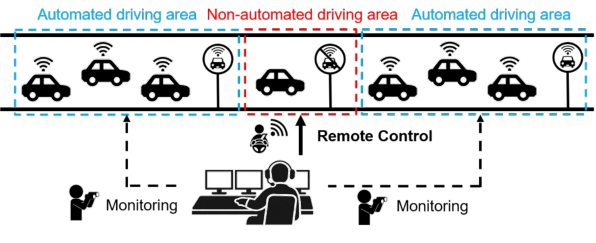
In recent years, the demand for distribution services has increased with the widespread use of mail orders and online services. Meanwhile, the shortage of drivers due to the declining working population has intensified. Therefore, research on the practical implementation of vehicle teleoperation systems has attracted increasing attention for addressing this problem. An overview of the system is shown in Figure 1. In vehicle teleoperation, a remotely located
Effects of Viewpoint Position and Display Device 539 operator monitors an autonomous vehicle and intervenes by manually operating the vehicle from a remote location when necessary (Lu et al., 2022). The operator monitors the autonomous vehicle when it meets the conditions for autonomous driving and intervenes through remote manual operation when the vehicle encounters a situation in which autonomous driving is difficult. Thus, a single operator manages multiple autonomous vehicles, thereby alleviating driver shortages and expanding the range of operating conditions.
Previous studies on viewpoint presentation methods for operators in vehicle teleoperation have suggested the effectiveness of viewpoints that provide a broad view of the area surrounding the vehicle, such as third-person and top-down views (Musicant et al., 2024), in addition to the conventional cockpit view. In addition, the use of Virtual Reality systems that employ head- mounted displays (HMD) has been investigated to improve the situational awareness of operators (Boker et al., 2023). Furthermore, the difficulty of situational awareness and vehicle control during driving affects the workload, and increased workload affects driving performance. However, the effects of differences in viewpoint position and presentation device on the workload, as well as driving scenarios in which the characteristics of each viewpoint are effective, have not been sufficiently investigated. Therefore, this study investigates an appropriate viewpoint presentation method for operators in vehicle teleoperation and experimentally clarifies the effects of the differences in viewpoint position and presentation device on operator workload.
METHOD FOR EVALUATING THE EFFECTS OF VIEWPOINT POSITION AND DISPLAY DEVICE ON OPERATOR DRIVING WORKLOAD To evaluate the effects of viewpoint presentation methods in vehicle teleoperation on the operator workload, an experiment was performed using a driving simulator, and subjective evaluations were conducted using questionnaires. The content presented in the experiment was created using the real-time development platform Unity. The experiment was conducted with six male participants (23.5 ± 1.2 years old), who received sufficient information about the experimental procedures and provided informed consent. The study was approved by the Research Ethics Committee for Human Research at Saitama University National University Corporation (R6-E-14).
Figure 1: Schematic of a vehicle teleoperation system.
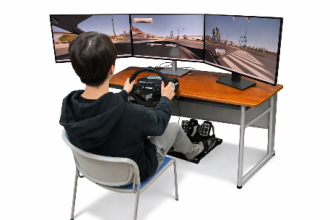
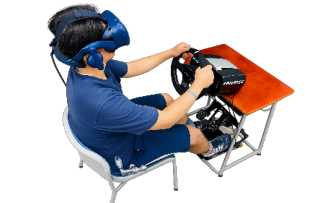
Driving Task The monitor-based driving simulator (Monitor-based DS) used in this experiment and head-mounted display-based driving simulator (HMD-based DS) DS are shown in Figure 2 and Figure 3, respectively. The participants performed driving tasks using each DS, in which they drove on roads simulating a general driving environment. The driving scenarios in the driving tasks were established with reference to the training content for obtaining a driver’s license and other relevant materials and included situations requiring driving skills. Six driving scenarios were prepared: highways, mountain roads, parking, S-curve/crank, back alleys, and sloping roads.
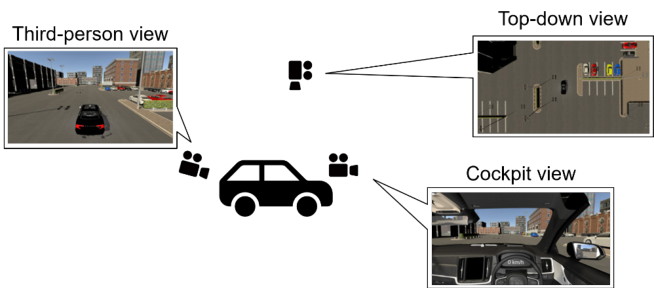
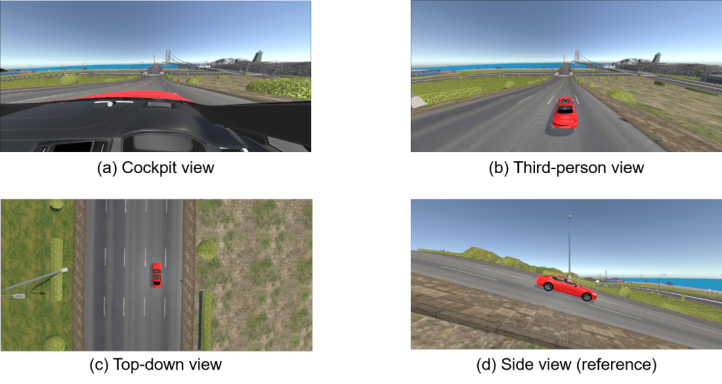
Viewpoint An overview of each viewpoint is presented in Figure 4. The cockpit view presents the field of view from the driver’s seat. The third-person view serves as a viewpoint from above and behind the vehicle, looking down at the vehicle from a higher position. The top-down view serves as a viewpoint that looks down at the vehicle directly from above. In the third-person view, rearview and side mirrors are provided to confirm the situation behind the vehicle.
In this experiment, two presentation-device conditions (Monitor-based DS and HMD-based DS) and three viewpoint positions (cockpit, third- person, and top-down views) were established, resulting in six experimental conditions. The experiments for each condition were conducted on separate days to account for participant fatigue and carryover effects between the conditions, and the order of the conditions varied among the participants.
Figure 2: Monitor-based DS.Figure 3: HMD-based DS.Figure 4: Camera positions for the cockpit, third-person, and top-down views.
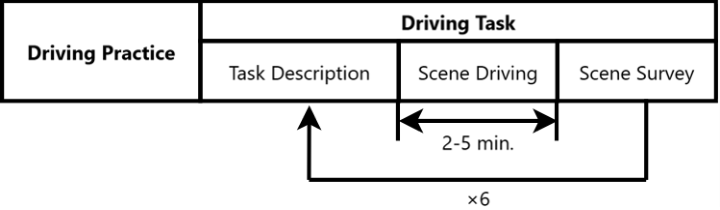
Experimental Protocol The experimental protocol is illustrated in Figure 5. After receiving sufficient driving practice, the experimental tasks and procedures were explained to the participants. In the experimental tasks, the task content was sufficiently explained to the participants before the start of each driving scenario. The driving task was then performed according to the instructions. After completing each driving scenario, the participants answered a subjective evaluation questionnaire regarding the difficulty of situational awareness and vehicle control in the driving scenario.
Evaluation Metrics The subjective evaluation questionnaires administered after each driving task consisted of the System Usability Scale (SUS) and Situation Awareness Rating Technique (SART), which evaluated system usability and situational awareness, respectively. These questionnaires were used to evaluate the usability and difficulty of situational awareness under each condition and in each driving scenario. In this study, improvements in the usability and ease of situational awareness were considered for reducing the workload of operators; therefore, these measures were used as indicators of workload.
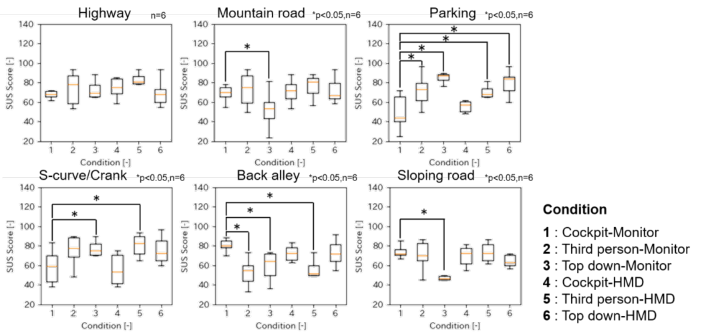
EXPERIMENTAL RESULTS The SUS scores for each driving scenario are shown in Figure 6. The SUS scores were calculated for each viewpoint condition in each driving scenario, and Dunnett’s test was conducted at a significance level of 5% using the conventional cockpit view (Monitor) as the reference. The results indicated that in the highway and mountain road scenarios, no significant differences were observed between any viewpoint condition and the cockpit view (Monitor). In contrast, in the parking and S-curve/crank scenarios, the SUS scores for the third-person and top-down views were significantly higher than that for the cockpit view (Monitor). In addition, in the scenarios involving roads with poor visibility and sloping roads, the SUS scores for the third-person and top-down views were significantly lower than that for the cockpit view (Monitor).
Figure 5: Experimental protocol.Figure 6: Conventional dunnett test with the cockpit-monitor-view as the baseline and a significance level of 5%.Figure 7: Results of t-tests (at the 5% significance level) comparing the SUS and SART scores of the monitor and HMD conditions for each viewpoint position on the sloping road.
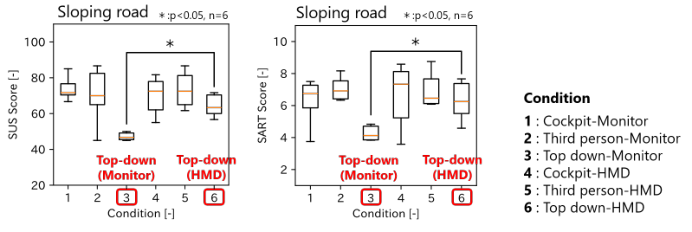
The SUS and SART scores for the sloping road are shown in Figure 7. The SUS and SART scores obtained after completing the driving task on the sloping road were calculated, and a paired t-test was conducted at a 5% significance level to compare the scores between the Monitor and HMD
Effects of Viewpoint Position and Display Device 543 conditions for each viewpoint position. No significant differences were observed between the Monitor and HMD conditions for the cockpit or third-person views. However, for the top-down view, the SUS and SART scores under the HMD condition were significantly higher than those under the Monitor condition.
DISCUSSION
The third-person and top-down views exhibited higher SUS scores than the conventional method in driving scenarios such as parking and S-curve/ crank, which required an understanding of the position and orientation of the vehicle and the surrounding conditions. This is because these viewpoints provide a wider view of the area surrounding the vehicle than the cockpit view, which makes it easier to confirm the positional relationship between the vehicle, its surroundings, and the driving route and reduces the burden during driving.
In contrast, in driving scenarios such as highways, mountain roads, and back alleys, which require continuous understanding of the situation in the direction of travel, the SUS scores for the third-person and top-down views decreased. This is because of the difficulty of sufficiently perceiving the road surface conditions ahead of the vehicle while using the third- person view. In the top-down view, directly perceiving the situation in the direction of travel is difficult, which limits the information required for driving.
In this experiment, no significant differences were observed in the SUS and SART scores between the Monitor and HMD conditions in most driving scenarios and viewpoint positions. This is because few of the driving scenarios established in this experiment require an understanding of the distance and depth through stereoscopic vision, which make the effects of stereoscopic vision provided by the HMD less likely to appear. In contrast, for the top-down view of the sloping road, the SUS and SART scores under the HMD condition were significantly higher than those under the Monitor condition. The appearance of each viewpoint on the sloping road is shown in Figure 8. In the free-response questionnaire, the participants reported difficulties in perceiving the elevation difference in the top-down (Monitor) view and in adjusting the vehicle speed according to the road slope. This is because the top–down view provides limited information on the depth direction of the road, which makes it difficult to perceive elevation differences. In contrast, in the top-down (HMD) view, participants reported that it was easy to perceive the elevation difference and adjust the vehicle speed because the HMD made it easier to perceive elevation differences on the road through stereoscopic vision, which improved usability and reduced difficulties in situational awareness. Therefore, in vehicle teleoperation, stereoscopic vision provided by an HMD may effectively improve operators’ situational awareness and reduce the workload in driving scenarios and viewpoint positions that require perception of depth and elevation differences.
Figure 8: Appearance of the view from each viewpoint on a sloping road.
CONCLUSION
In this study, the effects of the differences in viewpoint presentation methods in a vehicle teleoperation system on the operator workload were investigated by conducting a reproduction experiment of vehicle teleoperation using a Monitor and an HMD The workload was investigated for the cockpit, third-person, and top-down views. The results showed that third-person and top-down views were advantageous in scenarios that required confirmation of the state of the vehicle and surrounding conditions. However, they were unsuitable in scenarios that required confirmation of the area ahead of the vehicle or the direction of travel. In addition, stereoscopic vision was effective in scenarios that required perception of depth or elevation differences, such as a top-down view on the sloping road, thereby suggesting that presentations using an HMD could be advantageous by grasping height differences through stereoscopic vision. In future work, the effects of the workload associated with each viewpoint presentation method on driving accuracy and composite presentation methods that utilize the characteristics of each viewpoint will be investigated to develop a viewpoint presentation method that reduces operator workload.
ACKNOWLEDGMENT
We thank the members of the laboratory, who provided insightful suggestions, and everyone who assisted with the experiments.
REFERENCES
Boker, Avishag and Lanir, Joel. (2023). “Bird’s Eye View Effect on Situational Awareness in Remote Driving”, Proceedings of the 15th International Conference on Automotive User Interfaces and Interactive Vehicular Applications (AutomotiveUI 2023), Ingolstadt, Germany.
Effects of Viewpoint Position and Display Device 545 Lu, Sidi. Zhong, Ren and Shi, Weisong. (2022) “Teleoperation Technologies for
Enhancing Connected and Autonomous Vehicles”, Proceedings of the 2022 IEEE 19th International Conference on Mobile Ad Hoc and Smart Systems (MASS), Denver, CO. Musicant, Oren. Botzer, Assaf and Richmond-Hacham, Bar. (2024). “Safety, Efficiency, and Mental Workload in Simulated Teledriving of a Vehicle as Functions of Camera Viewpoint”, Sensors Vol. 24 No.18.
SEARCH THE AHFE DIGITAL BOOKSTORE BY ISBN
Explore the complete digital volume
Human Factors in Design, Engineering, and Computing
Read this individual research paper free through the original publisher, or explore the full digital proceedings book.