Maryann Godje, Javier Gonzalez-Sanchez, Elizabeth Minor (2026). Exploring User Affect in Virtual Reality Cultural Heritage Learning Using EEG. In: Human Factors in Design, Engineering, and Computing. AHFE Open Access, vol. 238, pp. 2886–2896. https://doi.org/10.54941/ahfe1008512
This study examined affective responses during guided learning and active interaction with a virtual Davula, an Assyrian goblet drum traditionally used at weddings, New Year celebrations, and festivals. We developed an immersive heritage-learning application using Three.js and deployed it on a Meta Quest 3. Eight participants completed the three-phase study, and seven provided complete synchronized datasets for the EEG-interaction analysis. The three phases are an initial baseline, guided learning about the Davula’s history and controls, and free exploration involving controller-based drum hits with audio feedback. A five-channel Emotiv Insight headset recorded six EEG-derived affective indicators: stress, engagement, focus, interest, excitement, and relaxation. We compared these measures across phases to determine whether guided learning and embodied artifact interaction produced distinguishable affective patterns. This work contributes an interactive VR platform and an exploratory methodology for integrating EEG-based affect sensing into immersive cultural-heritage experiences.
Virtual reality (VR) enables immersive interaction with cultural artifacts, offering opportunities to explore cultural heritage beyond traditional forms of presentation (Bekele et al., 2018). These environments allow users to engage through movement, sound, and direct interaction rather than passive observation (Radianti et al., 2020). Understanding affective responses during such interactions may help identify aspects of immersive experiences that could be improved. However, observable behaviors and self-reported experiences alone may not fully capture how users respond during specific interactions.
The Davula is an Assyrian goblet drum related to the Arabic doumbek, traditionally played at weddings, New Year’s celebrations, and festivals across West Asia and North Africa (Dean, 2012). In Assyrian musical traditions,
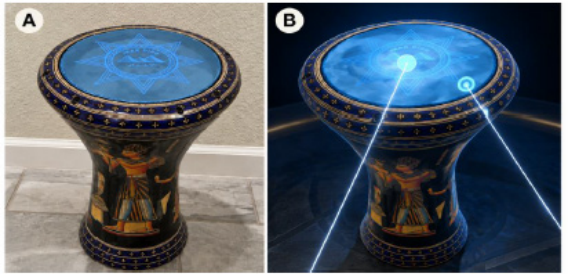
Exploring User Affect in Virtual Reality Cultural Heritage Learning Using EEG 2887 drums are commonly paired with the zurna, a high-pitched double-reed wind instrument (Younan, 2023). The Davula was selected for its cultural significance and suitability for immersive interaction (see Figure 1), allowing engagement with a virtual cultural artifact through movement and sound.
Figure 1: Assyrian goblet drum (Davula). (A) Physical instrument used as a reference for the 3D model. (B) Virtual representation in the VR application, showing controller ray casting used to identify targeted locations on the drum.
Our study examines affective responses during guided learning about the Davula’s history and cultural significance, followed by active interaction with its virtual representation. Affective computing, introduced by Picard (1997), investigates how computational systems can recognize, interpret, and respond to human affect. Contemporary approaches estimate affective states using multiple sensing modalities, including brain activity, physiological signals, facial expressions, eye movements, and behavioral data (Gonzalez-Sanchez et al., 2017). In this study, participants wore an electroencephalography (EEG) headset while interacting with the virtual environment. EEG measures electrical activity through electrodes placed on the scalp, providing signals from which affective indicators such as engagement, stress, and interest can be estimated.
By synchronizing EEG-derived indicators with recorded VR events, we investigate how affective responses vary around individual interaction events and during sustained exploration, complementing observable behavior and selfreported experiences. This approach allows us to examine the relationship between interaction and affect, potentially informing improvements to the design of immersive cultural-heritage experiences.
BACKGROUND
Immersive technologies support cultural-heritage education, exploration, reconstruction, exhibition enhancement, and virtual museums (Bekele et al., 2018). De Luca et al. (2022) explored gamification in digital cultural heritage, highlighting the role of interactive activities in engaging users with cultural content. Beyond developing immersive heritage applications, researchers have also investigated how users experience and learn from these environments. Ch’ng et al. (2020) examined user experiences through acceptance, presence, believability, and meaning-making, while Paolanti
et al. (2023) investigated knowledge-based learning outcomes. Anwar et al. (2025) considered usability, immersion, cybersickness, and emotional connection. While these approaches provide valuable information about user experiences, they offer limited insight into how affective responses fluctuate during individual interactions within virtual environments.
Physiological sensing offers an additional perspective by enabling the collection of time-varying signals during immersive experiences. Haider et al. (2025) incorporated heart rate, electrodermal activity, and photoplethysmography into an intangible-cultural-heritage XR experience, demonstrating the use of physiological measurements in this context. Iakovaki et al. (2026) proposed an affect-adaptive augmented reality museum architecture, extending this direction toward systems that could respond to users’ affective states, although the architecture was not empirically validated.
Music can elicit emotional responses associated with activity across multiple neural systems, providing a foundation for investigating affective responses during musical experiences (Koelsch, 2014). EEG has been used to investigate music- related emotional responses, including during music listening (Lin et al., 2010). EEG-based approaches have also been applied in VR environments. Hang et al. (2021) explored affect-aware social interaction, while Godje and Gonzalez- Sanchez (2026) examined affective responses during immersive experiences. These studies provide a foundation for incorporating affective sensing into VR applications. However, how EEG-derived affective indicators vary around specific interaction events in cultural-heritage VR applications remains less explored, particularly during transitions from guided instruction to active interaction.
METHODOLOGY
We conducted an exploratory within-subject study combining a VR cultural- heritage learning environment with EEG-based affective sensing. We synchronized EEG-derived indicators with VR interaction data to examine responses across experimental phases and specific interaction events. Pre- and post-experiment surveys complemented these measurements.
Research Design This exploratory study addressed the following research question: How do users’ EEG-derived affective indicators change during learning and interaction in a virtual cultural-heritage environment?
To address this question, we examined EEG-derived affective indicators across three consecutive phases: (1) baseline, (2) guided learning, and (3) artifact exploration. The outcome measures were six EEG-derived metrics generated by the Emotiv platform: stress, engagement, focus, interest, excitement, and relaxation.
VR Heritage Learning Environment The application was developed using Three.js (Three.js, 2026) and deployed on a Meta Quest 3. The library was used to construct and render the virtual environment, incorporating a scanned 3D model of the Davula. The WebXR
Exploring User Affect in Virtual Reality Cultural Heritage Learning Using EEG 2889 API supported immersive rendering and controller-based interaction. The experience included two components. During guided learning, participants read about the Davula’s history and cultural significance and received instructions for navigating and interacting with the environment. During artifact exploration, participants moved around the virtual Davula and struck it using the Meta Quest 3 controllers. Controller-based ray casting identified the targeted location on the drum (see Figure 1B), and the coordinates of each successful hit determined the corresponding audio feedback.
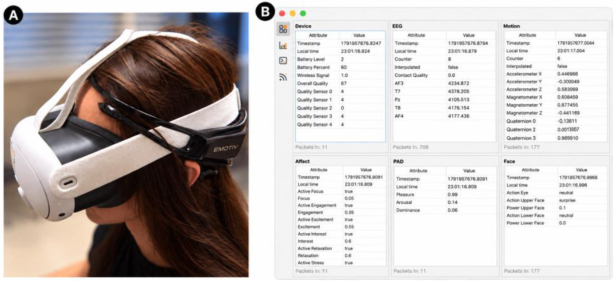
Data Collection and Synchronization EEG data were collected using the wireless five-channel Emotiv Insight headset. Before each session, the headset was fitted, and sensor-contact quality was verified using the Emotiv software. Figure 2A illustrates the experimental setup. Data were acquired using the ABE platform (Gonzalez-Sanchez, 2016), which supports the collection and visualization of EEG-derived affective indicators and associated sensor measurements (see Figure 2B). The recorded data included six proprietary EEG-derived affective indicators: stress, engagement, focus, interest, excitement, and relaxation. These indicators were treated as estimates of affective states rather than direct measurements of emotions. The six EEG-derived affective indicators were also used to calculate Pleasure-Arousal-Dominance (PAD) values following the approach described by Gonzalez-Sanchez (2016). This transformation represents the affective indicators within a three-dimensional model of affect, providing complementary measures of pleasure, arousal, and dominance. Additional measurements included head movement and automated facial-action classifications, including blinks, winks, frowning, surprise, smiling, and laughing. These classifications were treated as detected facial actions rather than direct evidence of emotional states. The VR application independently recorded interaction events, including drum hits, controller inputs, locomotion, head movement, and phase transitions. An in-headset video recording provided an additional source for verifying event timing. One participant was excluded from this analysis because a network error prevented the generation of the VR interaction log.
Figure 2: Experimental setup: (A) Participant wearing a Meta Quest 3 VR headset and an EMOTIV Insight EEG device. (B) Monitoring interface displaying real-time EEG signals, device status, motion data, facial expressions, and affective metrics.
Participants Eight participants (18-22 years old) completed the study. Six identified as female, one as male, and one as non-binary. Regarding VR experience, six had used VR once or twice, one frequently, and one had no prior experience. All participants reported some general cultural awareness, but five had no prior knowledge of the Davula, while three reported limited knowledge. Of the eight participants, seven had complete synchronized EEG and VR interaction data available for analysis.
Experimental Procedure Each session lasted approximately 15-30 minutes and included pre- and post-experiment surveys. Participants completed three consecutive phases: (1) baseline, during which they remained seated following EEG signal verification; (2) guided learning, during which they learned about the Davula and VR controls at their own pace, with each instructional screen displayed for at least five seconds; and (3) artifact exploration, during which they interacted freely with the virtual Davula using the Meta Quest 3 controllers for at least one minute.
Data Analysis Emotiv measurements and VR interaction logs were synchronized offline using Unix timestamps recorded with millisecond precision. Because both systems used synchronized clocks, the timestamps provided a common temporal reference for aligning EEG-derived affective indicators, head- movement measurements, and VR interaction events. The synchronized data were segmented by experimental phase to identify specific events, including entry into the artifact-exploration scene and successful drum strikes. Event- centered analysis examined changes in EEG- derived affective indicators around scene entry and the first successful drum strike. For each event, mean indicator values were compared between the five-second interval preceding the event and the five-second interval beginning at the event timestamp. To examine sustained interaction, the artifact-exploration period was divided into three equal-duration segments, and mean values from the first and final segments were compared. Changes were calculated for each participant and summarized using the median across participants. Movement and interaction correlations were examined using one-second time windows during artifact exploration. Quest 3 head-position changes and Emotiv Insight accelerometer- derived movement measurements were aggregated into corresponding intervals and compared using Spearman rank correlation. Drum-strike frequency was calculated for the same one-second intervals, and Spearman rank correlations were used to examine its associations with EEG-derived affective indicators. Additional analyses considered periods of relatively low head movement to assess whether movement influenced these relationships. Overall strike rates were calculated as the number of successful strikes per minute.
RESULTS
Eight participants completed the pre- and post-experiment surveys. Seven had complete synchronized Quest 3 and Emotiv Insight datasets and were included in the EEG–VR interaction analyses.
Event-Centered Affective Results
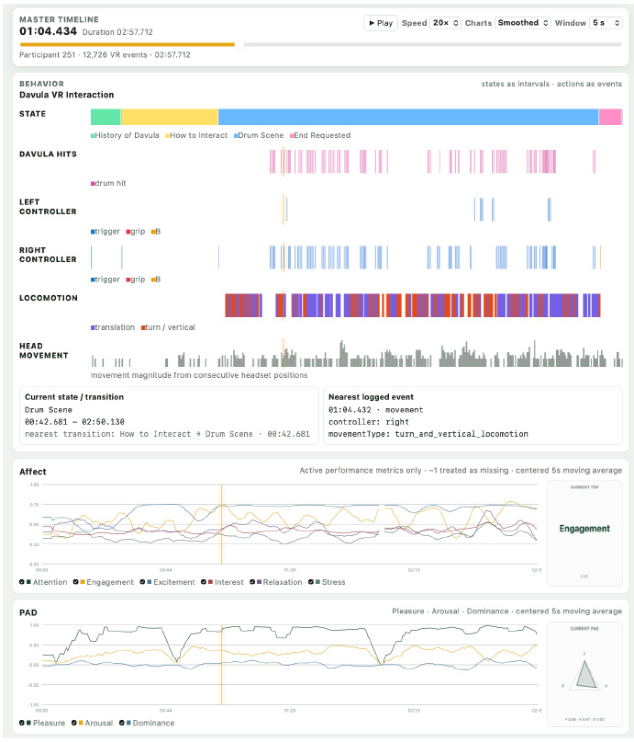
Table 1 summarizes changes surrounding the first successful drum strike, entry into the interaction scene, and sustained interaction. The table presents selected affective indicators showing notable changes across these comparisons. An interactive dashboard application was developed to visualize synchronized VR interaction events and EEG-derived measurements. The dashboard integrates experimental phases, drum strikes, controller actions, locomotion, head movement, six Emotiv affective indicators, and calculated Pleasure-Arousal-Dominance (PAD) values on a common timeline. It supports temporal exploration of participant behavior and affective responses, as illustrated in Figure 3.
Stress showed the most consistent increase, rising for five of six participants after entering the interaction scene and for six of seven following the first successful drum strike. During sustained interaction, engagement and interest increased for five participants, while excitement increased for four and stress for five. These changes were generally small and varied across participants. Participants produced approximately 16-144 successful drum strikes per minute, but strike frequency showed weak and inconsistent correlations with EEG-derived affective indicators, including during periods of relatively low head movement.
Spearman correlations between Quest 3 and Emotiv Insight head- movement measurements ranged from approximately 0.68 to 0.81 across the seven sessions, indicating similar temporal patterns of movement. Drum strikes were not consistently associated with head movement, suggesting that strike frequency and head movement captured different aspects of participant interaction.
Table 1: Summarizes selected EEG-derived affective indicators around the first successful drum strike, entry into the interaction scene, and sustained interaction. Median changes are reported on the Emotiv 0-1 scale; positive values indicate increases. One participant lacked sufficient data for the scene-entry comparison (n = 6).
Table available in the original PDF paper.
Comparison Affect Metric Participants Increasing Median Change Stress 6/7 +0.029 First successful hit: 5 s before → 5 s beginning at hit
Table 2: Distribution of participant responses to five-point Likert-scale questions (n = 8). Values represent participant counts: SA = Strongly Agree, A = Agree, N = Neutral, D = Disagree, and SD = Strongly Disagree.
Table available in the original PDF paper.
Question Strongly Agree
Agree Neutral Disagree Strongly Disagree The activity kept my attention. 5 1 1 1 0
The music influenced how I felt. 0 4 2 2 0
4 4 0 0 0
The virtual environment enhanced my emotions.
I felt connected to the instrument. 0 3 3 2 0
0 5 1 2 0
Playing the goblet drum helped me learn more about the instrument.
Figure 3: Interactive dashboard developed to visualize synchronized VR interaction events and EEG-derived measurements. The interface displays participant behavior, Emotiv affective indicators, and derived Pleasure-Arousal-Dominance (PAD) values on a common timeline.
Exploring User Affect in Virtual Reality Cultural Heritage Learning Using EEG 2893 Post-Experiment Survey Results
Based on the Self-Assessment Manikin (SAM) responses, seven participants reported positive valence, while one reported feeling very unhappy. Arousal responses ranged from very calm to very tense, and four participants reported lower dominance. As shown in Table 2, six participants agreed that the activity maintained their attention, all eight agreed that VR enhanced their emotions, and four agreed that the music influenced their feelings. Connection to the instrument was mixed, while five perceived that playing it helped them learn. Open-ended responses identified the drum sound, visual environment, movement, proximity to the artifact, and cultural information as influential aspects of the experience. Some participants also reported nervousness when approaching the drum as it appeared larger and discomfort from being observed.
DISCUSSION
Stress produced the most consistent event-centered response, potentially reflecting anticipation, novelty, cognitive effort, motor planning, or uncertainty rather than negative emotion. Stress also increased upon entering the interaction scene, before participants began playing the instrument, suggesting that anticipation or task demands may have contributed to the response. Comments describing nervousness near the drum and discomfort from being observed support this interpretation. The transition from reading instructions to active interaction may therefore have been affectively meaningful independently of the sound produced by the instrument.
During sustained interaction, stress remained higher in the final third for five participants, providing no evidence of a consistent decline as participants became familiar with the experience. The Insight stress indicator may have reflected continued cognitive or motor activation while participants coordinated the controllers and decided how to interact. Because the metric is proprietary, the present data cannot distinguish productive task engagement from discomfort or other forms of activation.
Excitement varied across participants, while engagement and interest increased slightly during sustained interaction for five participants. Similarly, six of eight participants reported that the activity maintained their attention. Although the survey responses and EEG-derived indicators represent different constructs, together they suggest sustained involvement rather than a general loss of attention as the experience continued. This finding is relevant to heritage-learning design because active exploration may help maintain involvement after guided information has been presented.
Strike rates ranged from 16 to 144 per minute but showed weak and inconsistent relationships with EEG-derived affective indicators. Participants identified sound, visual design, movement, proximity, and cultural information as influential aspects of the experience. These findings suggest that interaction quantity alone did not account for the observed affective responses. Individual differences in exploration and affective responses further support examining event-centered patterns rather than relying exclusively on group averages or total interaction counts.
Quest 3-Insight movement correlations of approximately 0.68-0.81 indicated similar temporal patterns of movement across the two devices. Movement may nevertheless have affected the head-worn EEG measurements, although weak strike–affect relationships persisted during periods of relatively low head movement. The independent Quest 3 movement measurements may therefore help identify intervals in which movement complicates the interpretation of EEG- derived indicators.
The SAM responses and calculated PAD values provide complementary perspectives on participants’ affective experiences. SAM captured retrospective self-reported valence, arousal, and dominance, whereas PAD provided continuously derived estimates calculated from Emotiv affective indicators. However, these measures were not quantitatively compared, and their correspondence cannot be established from the present analysis. Five participants also perceived that playing the drum helped them learn, but actual learning gains were not measured. Perceived educational value therefore does not establish improved knowledge or cultural awareness.
These findings complement prior heritage-XR research relying primarily on self-report or peripheral physiological signals by demonstrating an event- centered approach for relating EEG-derived indicators to specific VR actions. Nevertheless, the study remains exploratory. Limitations include the small sample size, limited prior VR experience, fixed phase order, brief reference period, variable phase durations, proprietary Emotiv metrics, possible movement artifacts, and lack of musical-experience data. Additionally, surveys included eight participants, whereas synchronized analyses included seven. Future studies should incorporate larger samples, longer baselines, movement controls, standardized durations, and objective knowledge assessments. Additional familiarization with the controllers could help distinguish responses to VR novelty from responses to the cultural artifact itself.
CONCLUSION
Active interaction with the virtual Davula was associated with participant- dependent changes in EEG-derived affective indicators. Stress increased most consistently around scene entry and the first successful drum strike, potentially reflecting anticipation, novelty, or task demands rather than negative emotion. Engagement and interest increased slightly during sustained interaction for several participants, while survey responses suggested sustained attention and perceived educational value. The weak relationships between strike frequency and affective indicators suggest that interaction quantity alone did not account for participants’ responses. By integrating synchronized EEG-derived measurements, VR interaction events, and an interactive visualization dashboard, this study demonstrates an event-centered approach for examining affective responses during immersive cultural-heritage experiences. Although exploratory, these findings provide a foundation for investigating how affective sensing can inform the design and evaluation of immersive cultural-heritage learning environments.
REFERENCES
Anwar, M. S., Yang, J., Frnda, J., Choi, A., Baghaei, N., and Ali, M. (2025). Metaverse And XR For Cultural Heritage Education: Applications, Standards, Architecture, And Technological Insights For Enhanced Immersive Experience. Virtual Reality, 29, Article 51. doi.org/10.1007/s10055-025-01126-z Bekele, M. K., Pierdicca, R., Frontoni, E., Malinverni, E. S., and Gain, J. (2018).
A Survey Of Augmented, Virtual, And Mixed Reality For Cultural Heritage. ACM Journal on Computing and Cultural Heritage, 11(2), Article 7. doi. org/10.1145/3145534 Ch’ng, E., Li, Y., Cai, S., and Leow, F.-T. (2020). The Effects Of VR Environments On The Acceptance, Experience, And Expectations Of Cultural Heritage Learning. ACM Journal on Computing and Cultural Heritage, 13(1), Article 7. doi. org/10.1145/3352933 Dean, M. (2012). The drum: A history. Scarecrow Press. De Luca D., Rimella N., Bussi E., Del Giudice M., Osello A. (2022) Evaluation Of
Gamification Approach Using Var For Digital Cultural Heritage. EDULEARN. pp. 9271–9278. doi.org/10.21125/edulearn.2022.2230 Godje, M., & Gonzalez-Sanchez, J. (2026). Exploring Real-Time EEG-Based Affective Responses In A Virtual Reality Horror Experience. In Companion proceedings of the 2026 Symposium on Interactive 3D Graphics and Games (pp. 1–2). ACM. doi.org/10.1145/3807895.3807924 Gonzalez-Sanchez, J. (2016). Affect-Driven Self-Adaptation: A Manufacturing Vision
With A Software Product Line Paradigm. Arizona State University. Gonzalez-Sanchez, J., Baydogan, M., Chavez-Echeagaray, M. E., Atkinson, R. K., and Burleson, W. (2017). Affect Measurement: A Roadmap Through Approaches, Technologies, And Data Analysis. In M. Jeon (Ed.), Emotions And Affect In Human Factors And Human-Computer Interaction (pp. 255–288). Elsevier. doi.org/10.1016/B978-0-12-801851-4.00011-2 Haider, F., de la Fuente Garcia, S., Núñez García, A., and Luz, S. (2025). Affective And
Physiological Responses To Immersive Intangible Cultural Heritage Experiences In Extended Reality. In Proceedings of the International Conference on Multimodal Interaction (pp. 791–793). ACM. doi.org/10.1145/3716553.3757094 Hang, B., Loucks, S., Patel, P., Wiseman, K., and Gonzalez-Sanchez, J. (2021).
Exploring affect recognition in a virtual reality environment. In Proceedings of the 2021 ACM International Conference on Interactive Media Experiences (pp. 326–328). ACM. doi.org/10.1145/3452918.3467671 Iakovaki, E., Konstantakis, M., Aliprantis, J., Ordoumpozanis, K., Pyroti, S., Angioplastis, A., & Tsimpiris, A. (2026). The museum that feels: AI-driven affective computing for emotion-adaptive AR experiences. In 2026 International Conference on Advances in Artificial Intelligence and Machine Learning (AAIML) (pp. 697–702). IEEE. doi.org/10.1109/AAIML67890.2026.11498226 Koelsch, S. (2014). Brain correlates of music-evoked emotions. Nature Reviews
Neuroscience, 15, 170–180. doi.org/10.1038/nrn3666 Lin, Y.-P., Wang, C.-H., Jung, T.-P., Wu, T.-L., Jeng, S.-K., Duann, J.-R., and Chen, J.-H. (2010). EEG-based emotion recognition in music listening. IEEE Transactions on Biomedical Engineering, 57(7), 1798–1806. doi.org/10.1109/ TBME.2010.2048568 Paolanti, M., Puggioni, M., Frontoni, E., Giannandrea, L., & Pierdicca, R. (2023).
Evaluating learning outcomes of virtual reality applications in education: A proposal for digital cultural heritage. ACM Journal on Computing and Cultural Heritage, 16(2), Article 36. doi.org/10.1145/3593432 Picard, R. W. (1997). Affective computing. MIT Press.
Radianti, J., Majchrzak, T. A., Fromm, J., & Wohlgenannt, I. (2020). A systematic review of immersive virtual reality applications for higher education: Design elements, lessons learned, and research agenda. Computers & Education, 147, 103778. Three.js. (2026). Three.js: JavaScript 3D library. Younan, N. (2023). Shaking the ground: Intersections of cultural trauma, collective
memory, and resilience in Assyrian popular music and dance. University of Toronto.
SEARCH THE AHFE DIGITAL BOOKSTORE BY ISBN
Explore the complete digital volume
Human Factors in Design, Engineering, and Computing
Read this individual research paper free through the original publisher, or explore the full digital proceedings book.