Sang-Jun Park, Chang-Hwoi Kim (2026). Development of an AI Agent for Failure Monitoring, Diagnosis, and Remaining Useful Life Prediction of Capacitors in Nuclear Safety System Signal Processors. In: Human Factors in Design, Engineering, and Computing. AHFE Open Access, vol. 238, pp. 1729–1738. https://doi.org/10.54941/ahfe1008401
Publisher statistics will load when you open Metrics.
AHFE OPEN ACCESS OPEN ACCESS CONFERENCE PROCEEDINGS PAPER
Development of an AI Agent for Failure Monitoring, Diagnosis, and Remaining Useful Life Prediction of Capacitors in Nuclear Safety System Signal Processors
This study proposes an AI agent that performs failure monitoring, diagnosis, and Remaining Useful Life (RUL) prediction for the electrolytic capacitors of nuclear power plants (NPPs) safety system signal processors and explains the situation and evidence to operators. An unscented Kalman filter (UKF) applied to estimate the thermal aging degradation state and detects abnormal states from the residuals of its estimates. A Large Language Model (LLM) converts each event into diagnostic information classified by severity, cause, evidence, and recommended action. For verification, the artificial dataset generated from actual measured data of accelerated thermal aging test. The artificial date set created by applying the random error to measured value and the intentional fluctuation is used for abnormal stat. The normal state produced no false alarm over eight weeks, whereas the abnormal state at week 9 was detected immediately. A two week bias signal and a step shaped degradation were discriminated as an anomalous state and a sustained state change, using only the persistence of the residual. Twenty eight of the failed specimens were detected at 9 week, and the RUL prediction error converged to 3.4 weeks. In another test cases, the AI agent alarmed 46 cycles ahead of end of life and temporarily fluctuation was not reflected the RUL as it is not affect the degression factor of an thermal aging. These results suggest that providing operators with verifiable monitoring and diagnosis explanations, together with the limits of the monitoring system, can improve the operating reliability of NPP safety systems.
The signal processor of an NPP’s safety system acquires as a safety variables and performs the function of safely shutting down the reactor. Its reliability is therefore directly rely on plant safety. However, condition monitoring, diagnosis, and prognostics have not yet been applied to many areas of the instrumentation and control (I&C) of NPPs.
1730 Park and Kim The purpose of this study is to improve the safe operation of NPPs by providing operators in advance with anomaly detection, diagnosis, and RUL information on the electrolytic capacitor, which is a component with a high failure rate in signal processors. The electrolytic capacitor is an essential component of signal processors. It ages for various reasons, such as electrolyte dry out and increasing equivalent series resistance, leading to a shortened life and sudden failures, and it is affected by surrounding environmental conditions such as temperature and humidity (IAEA, 2004; Wang and Blaabjerg, 2014). Detecting and diagnosing such thermal aging degradation at an early stage to maintain the health of the safety system’s signal processors is expected to contribute to NPP safety.
The monitoring and diagnosis model of this study applies the Kalman filter, a state estimation methodology based on a physical model, to predict the abnormal state of the capacitor (Celaya et al., 2011; Celaya et al., 2012; An et al., 2013). One reason such models have been difficult to deploy in the field is not their accuracy but their limited ability to explain the current state due to a large amount of random noise and systematic error.
Methods that present only an RUL value cannot state why an alarm occurred, whether the current model can be trusted, or what follow up action is required; for behavior the model cannot represent, such as unexpected failures or self-healing recovery (Nichicon, n.d.), the lack of explanation may lead operators to incorrect decisions.
This study resolves these problems with an AI agent using a state estimation methodology based on a physical model. The Unscented Kalman Filter (UKF) continuously monitors the current state and predicts the RUL in accordance with the UKF results.
An LLM, in the role of the AI agent, provides recommended procedures to the operator based on the monitoring, diagnosis, and RUL information. All validation in this study was performed on measured data, and artificial data generated from actual measured values were used to ensure the reliability of the simulation.
MONITORING AND PROGNOSTICS METHODOLOGY The methodology has four steps: 1) indicating the thermal aging degradation value, 2) state estimation by the UKF, 3) abnormality detection using the residual of the measurement, and 4) RUL prediction.
Step 1: Estimation of Thermal Aging Index (D) The degradation index D of thermal aging is a dimensionless value in [0, 1]. It can be defined from periodic measurements of the capacitor state. The periodic measurement variable of the capacitor state can be obtained from the charge-discharge test. D can be defined as Equation (1) below:
D(k) = 1–∆V(k)/∆V(0) (1) where ΔV(k) is the voltage excursion at cycle k, which shrinks as the capacitance falls. D = 0 is healthy and D ≥ 0.85 is end of life (EOL). According
Development of an AI Agent for Failure Monitoring, Diagnosis, and Remaining 1731 to the D value, the severity can be intentionally defined into normal, warning, and danger bands at 0.3, 0.5, and 0.7.
Step 2: UKF State Estimation Degradation is not directly observable, and the measurements include noise such as random noise and systematic error. Determining the D value is therefore formulated as state estimation. The state vector is x = [D, Ea], and the degradation rate of the Arrhenius equation is expressed in the state- transition model. The state transition and measurement models are
a E t (2)
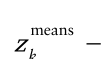
1 B exp , k k k k k k D D A t z D v k + [Equation or mathematical symbol available in the original paper PDF][Equation or mathematical symbol available in the original paper PDF] − = + ∆ = + [Equation or mathematical symbol available in the original paper PDF][Equation or mathematical symbol available in the original paper PDF][Equation or mathematical symbol available in the original paper PDF][Equation or mathematical symbol available in the original paper PDF][Equation or mathematical symbol available in the original paper PDF][Equation or mathematical symbol available in the original paper PDF] where A is the pre-exponential factor, kB is the Boltzmann constant, Tk is the measured temperature (a known input), Δt is the measurement interval, and vk is the measurement noise; zk is the measured degradation index. The model is nonlinear due to Ea, so this study uses the UKF, which propagates the covariance through the nonlinearity rather than linearizing it (Wan and van der Merwe, 2000; Julier and Uhlmann, 2004).
Since the UKF technique is a Bayesian recursive methodology that repeats prediction and update, the main variables such as the Kalman gain and the covariance matrix are updated by reconciling the covariance matrix and thereby minimizing the uncertainty of the actual measurement. That is, the true value can be estimated by the UKF technique. In this study, for constant temperature tests, the state simplifies to [D, r_eff] with r_eff ≥ 0 (irreversible wear out).
Step 3: Anomaly Detection Based on Residual An abnormal state can be distinguished by the update step’s normalized residual. The normalized residual is defined as the difference between the measurement and the prediction divided by its standard deviation.
Equation reproduced from the original PDF.
While the model is valid, the normalized residual is approximately standard normal and stays within ±3. An abnormal state is declared when |zk| > 3 for a consecutive cycles. The normalized residual is used as an early warning indicator rather than the thermal aging degradation index D, and when it is persistently out of the residual boundary, the AI agent determines that the state is abnormal because a value deviating from the boundary should no longer be considered reliable.
Step 4: Remaining Useful Life The RUL can be defined as the time until the degradation index first reaches the 0.85 value (Celaya et al., 2011). Two complementary estimators are
1732 Park and Kim calculated in parallel. The primary estimation of the RUL extrapolates the UKF state, assuming that the current effective rate is kept:
( ) RUL( ) ,D 0.85 ( ) D D k k r k − = =
[Equation or mathematical symbol available in the original paper PDF] fail fail eff
(4) With the predicted covariance, Eq. (4) provides a confidence interval rather than a point estimation. If the estimated rate is below the threshold point, the AI agent reports a ‘normal state’. To consider large fluctuations depending on the surrounding environmental conditions, a moving median value is used.
In addition, this study applied a correlation equation to mutually supplement the thermal aging degradation value D, as a peer review to improve reliability. The one point calibrated life model can be reversely calculated as L = k0/D(k0), assuming D(k) = (k/L)^p (p = 1). This method has a limitation: it is not affected by posterior noise, but it does not reflect a posterior change of state. The UKF is therefore used as the primary methodology for estimating the accurate current state, and the correlation equation was applied as a cross check to secure more reliability of the estimated state.
SIMULATION BASED ON ARTIFICIAL DATASET Simulation Design
To validate the above methodology, this study performed the simulation using artificial data. The artificial dataset was intentionally created using the data measured from the accelerated thermal aging test, in order to compare the results on the artificial data and the actual data.
In this study, the measured values were used as true values to validate and observe the degradation behavior of the capacitor. The measured values were the weekly acquired degradation information of the 40 specimens of 330 µF capacitors during weeks 1–26 (end of life at week 25). The artificial dataset was created by injecting random noise and a systematic error representing the abnormal situation.
This study considers three conditions. 1) The normal condition (N): it includes only random noise (σ = 0.005). 2) The temporary transient state (T): the measured value temporarily deviates - reading as completely failed at D = 0.95 during weeks 4–5 and then recovers to the normal condition. 3) The sustained state change (S): thermal aging continuously affects the capacitor and ends its life at week 19 (end of life is week 25 in the normal condition).
The detection rule is the persistence of the residual deviation. If the condition is recovered within a certain period after an alarm, the state is defined as a temporary transient state (sensor check recommended). If a new deviation or trend persists, it is considered a sustained state change (state reassessment and RUL re-computation). However, a sensor malfunction is not reflected in the RUL, as it is irrelevant to the capacitor life.
Development of an AI Agent for Failure Monitoring, Diagnosis, and Remaining 1733 Simulation Results
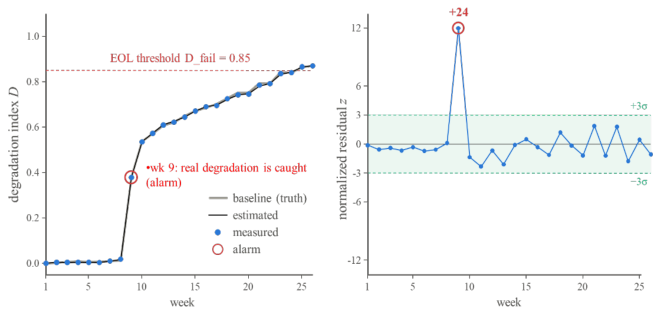
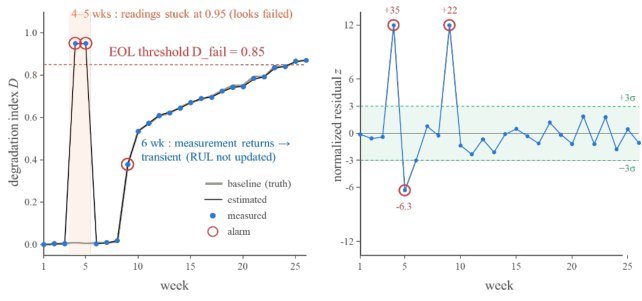
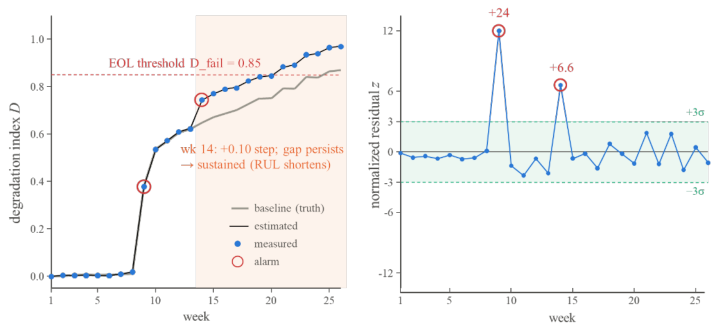
Simulation results are presented per scenario in Figures 1–3. In each figure the left panel shows the state trajectory; the horizontal axis is the test week (one measurement per week) and the vertical axis is the degradation index D (0 = new, 0.85 = end of life). The right panel shows the normalized residual z of Eq. (3), with the green band ±3 as the normal range. The judgement criterion is the behavior with respect to the nominal trajectory. That is, if some deviation occurs and then recovers to the normal trajectory, it is judged as a temporary state, as in Figure 2. If the state persistently deviates from the normal trajectory, it is judged as a persisting state change, as in Figure 3.
Figure 1: Scenario N (nominal): state trajectory (left) and normalized residual (right).
The left of Figure 1 shows that the residuals stay within ±3 over weeks 1–8 with no false alarm. In the right, the actual degradation at 9 week is caught immediately (z = +24). According to the measured values, the new thermal aging rate was estimated and the RUL converged to 10.8 weeks (the true RUL is 10 weeks) six weeks after detection. This result shows that the RUL estimated by the UKF presents more specific RUL information.
Figure 2: Scenario T (transient sensor fault): state trajectory (left) and normalized residual (right).
1734 Park and Kim The left of Figure 2 shows a temporary transient state that reads as completely failed during 4–5 weeks and judged by the measurements alone, the component appears beyond end of life (z = +35). At 6 week, however, the state recovered to the pre-alarm value (shading in Figure 2), so the state is classified as a temporary transient state (sensor check recommended). The RUL is not changed, and the normalized residual z recovers to the normal condition residual, with the 9 week degradation still caught as in Figure 1. Therefore, this result shows that if a temporary transient state occurs, it does not affect the RUL, as the normal trajectory is not changed. This result indicates that a temporarily deviating transient is considered an equipment failure (malfunction), but the RUL is not affected by it because there is no continuous state change. That is, the residual information can be used as a pre-alarm for NPP operators to observe an abnormal detection state, while the RUL information is used for maintenance.
Figure 3: Scenario S (sustained change): state trajectory (left) and normalized residual (right).
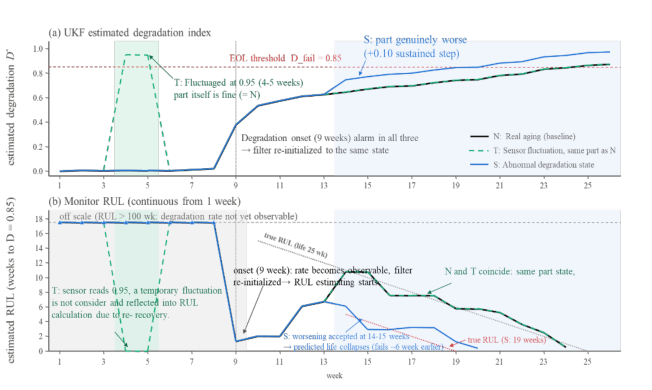
Figure 3 indicates the continuous thermal aging state. At 14 week, the trend changed, deviating from the normal condition state. The RUL is updated when the D̂ factor is changed by the continuous state change, and r_eff also increases in accordance with Equation (4) (RUL = (0.85 − D̂ )/r_eff). That is, the RUL trajectory changes through the two factors D̂ and r_eff. Before the step (week 13), D̂ = 0.63 and r̂ = 0.020 give RUL = (0.85 − 0.63)/0.020 ≈ 11 weeks; after the change (week 15), D̂ = 0.77 and r̂ = 0.027 give RUL ≈ 2.9 weeks. This means that the RUL was reduced, and the true end of life itself moved to week 19. In case T, by contrast, the z = +35 fluctuation was rejected as a transient and never contributed to the D̂ factor; therefore, neither variable of Eq. (4) changes.
This result suggests the interesting point that the RUL is not changed by a temporary fluctuation, whereas a continuous state change affects the RUL trajectory. Therefore, this study implies that the RUL and a temporary transient have to be distinguished. This information will be useful to diagnose whether the current state is a temporary state (malfunction) or a thermal aging state.
Figure 4: Degradation events (a) and the resulting RUL estimates (b), 1–26 weeks.
Figure 4 shows the comparison result of cases N, T, and S. As Figure 4 shows, the UKF estimation technique is a good methodology to estimate the RUL and to identify a temporary transient state, such as an equipment failure, by reflecting the time domain.
On the other hand, in this study, the corrected prediction technique was used to provide a thermal aging trajectory as a reference. The corrected prediction technique estimates the RUL from just a single initial point (at the 3 week point). This corrected prediction will be useful for estimating the entire RUL at the initial setting point, and many industrial fields use this type of technique to predict the end of equipment life (MIL-HDBK-217F, 1995; ISO 281, 2007; IEC/IEEE 60780-323, 2016). However, there is a limitation of this technique: it cannot reflect a changed state, such as a transient state depending on the time domain, because the corrected prediction technique uses only the initial point.
As the Figure 4 result shows, there was a huge difference between the results: the corrected prediction was overestimated compared with the UKF estimation technique. Case S estimated the current true state well (19 weeks), but the corrected prediction technique deviated from the current state because it overestimated the life at 579 weeks.
AI AGENT FOR MONITORING, DIAGNOSIS, AND RUL PREDICTION Pipeline Architecture of AI Agent Model Using LLM
As the above study results show, the aging state of the capacitor has to be estimated by a real time state estimation technique such as the UKF technique. Therefore, this study suggests the AI agent model to identify the transient state and to estimate the accurate RUL. This information will then be provided to NPP operators so that they can properly take an action depending on the current situation.
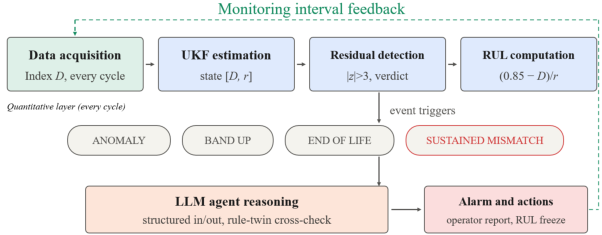
1736 Park and Kim The validated monitoring system runs as the two-layer online pipeline of Figure 5 and a quantitative layer executed every cycle (data acquisition, UKF estimation, residual detection and validation, RUL computation) and an agent layer invoked only on events (LLM reasoning, alarms, and recommended actions with interval adjustment).
Four events were embodied in the AI agent model, and the state criteria were classified into three parts: 1) a normal state satisfying the residual criterion, 2) a transient state deviating from the residual criterion, and 3) end of life (D ≥ 0.85).
The framework of the AI agent model is shown in Figure 5.
Figure 5: The AI agent pipeline: the quantitative layer (acquisition → UKF → residual validation → RUL) runs every cycle and then provides the information to NPP operators.
LLM Reasoning Layer The AI agent model was implemented by the LLM technique to carry out each role. The AI agent model is called with the measured D, the estimated state, the residual deviation, and the RUL. The estimated information is provided to NPP operators, and the information is classified depending on the state severity, such as warning, recommendation, and taking an action. The AI agent will also provide the preferred procedure to take a measure for the situation.
To clarify the role of the AI agent model, the AI agent only performs the explanation and defines the priorities to properly take an action; this system never alters any numbers. Although general LLM fault-diagnosis frameworks have been studied (Lee et al., 2025), this study is distinguished in that all outputs are estimated by the mathematical model.
CONCLUSION
This study presented an AI agent for the electrolytic capacitors of nuclear safety-system signal processors based on LLM. The degradation index D, UKF state estimation, residual based anomaly detection, and RUL prediction were integrated into a LLM methodology and validated on an artificial dataset generated from measured thermal aging data.
Development of an AI Agent for Failure Monitoring, Diagnosis, and Remaining 1737 In the simulation result, there are three observation points. First of all, there was no false alarm over eight weeks and immediately detected the real degradation at 9 weeks (z = +24). And second, The T case indicated that some transient state such as a fluctuation is not effected to RUL as this state not changed the degression factor D. But, this case led the completed failure (T, z = +35). The S case was distinguished from T case since the RUL of S case was changed. It is meaning that the degression factor D was updated due to a sustained state change (S, z = +6.6). That is, the factor D updated through the two variables of Eq. (4) then RUL changed from about 11 weeks to 2.9 weeks against a true end of life moved forward to week 19.
In contrast, the one point corrected prediction calibrated at 3 week overestimated the life at 579 weeks (23 times the truth), confirming that an initial point life estimate cannot reflect state changes over time and that recursive state estimation is required.
On top of these quantitative results, the LLM explains each event to operators by severity, cause, evidence, and recommended action without altering any numbers.
In the further study, this methodology will be validated using the actual data rather than accelerated aging data. And, the AI agent based on LMM will be verified by uncertainty analysis to improve the reliability. Also, the procedure will be embodied in AI agent to suggest the proper procedure to operators.
ACKNOWLEDGMENT
This work was supported by the National Research Foundation of Korea (NRF) grant funded by the Korea government (MSIT) (No. RS-2022- 00144521, Development of basic technology for failure diagnosis of reactor control and digital I&C system).
REFERENCES
An, D., Choi, J.-H. and Kim, N.H. (2013). Prognostics 101: A tutorial for particle filter-based prognostics algorithm using Matlab. Reliability Engineering & System Safety, Volume 115, pp. 161–169. Celaya, J.R., Kulkarni, C., Biswas, G. and Goebel, K. (2011). Towards prognostics
of electrolytic capacitors. AIAA Infotech@Aerospace Conference, St. Louis, MO, AIAA 2011-1519. Celaya, J.R., Kulkarni, C.S., Biswas, G. and Goebel, K. (2012). Towards a modelbased prognostics methodology for electrolytic capacitors: A case study based on electrical overstress accelerated aging. International Journal of Prognostics and Health Management, Volume 3 No. 2. IEC/IEEE 60780-323 (2016). Nuclear facilities - Electrical equipment important to
safety - Qualification. IEC, Geneva. International Atomic Energy Agency (2004). Management of Life Cycle and Ageing at Nuclear Power Plants: Improved I&C Maintenance. IAEA-TECDOC-1402, Vienna. ISO 281 (2007). Rolling bearings - Dynamic load ratings and rating life. International
Organization for Standardization, Geneva.
1738 Park and Kim Julier, S.J. and Uhlmann, J.K. (2004). Unscented filtering and nonlinear estimation.
Proceedings of the IEEE, Volume 92 No. 3, pp. 401–422. Lee, X.Y., Vidyaratne, L., Farahat, A. and Gupta, C. (2025). Exploring LLM-based frameworks for fault diagnosis. arXiv preprint arXiv:2509.23113. MIL-HDBK-217F (1995). Reliability Prediction of Electronic Equipment, Notice 2.
U.S. Department of Defense, Washington, DC. Nichicon Corporation (n.d.). Application Guidelines for Aluminum Electrolytic Capacitors. Technical Note CAT.8101E. Wan, E.A. and van der Merwe, R. (2000). The unscented Kalman filter for nonlinear
estimation. Proc. IEEE AS-SPCC Symposium, Lake Louise, Canada, pp. 153–158. Wang, H. and Blaabjerg, F. (2014). Reliability of capacitors for DC-link applications in power electronic converters - an overview. IEEE Transactions on Industry Applications, Volume 50 No. 5, pp. 3569–3578.
SEARCH THE AHFE DIGITAL BOOKSTORE BY ISBN
Explore the complete digital volume
Human Factors in Design, Engineering, and Computing
Read this individual research paper free through the original publisher, or explore the full digital proceedings book.