Yan Chen, Moajjem H. Chowdhury, Yunmei Liu (2026). From Driver Intent to Road-User Perception: A Narrative and Systematic Review of Perceived Aggressive Driving. In: Human Factors in Design, Engineering, and Computing. AHFE Open Access, vol. 238, pp. 2020–2029. https://doi.org/10.54941/ahfe1008429
Aggressive driving (AD) has no unified definition: some perspectives focus on the driver's intent, whereas others focus on measurable violations. Consequently, studies using divergent definitions measure fundamentally different phenomena, meaning behavior that surrounding road users perceive as aggressive is excluded if no harm was intended or no law was broken. This paper therefore proposes perceived aggressive driving (PAD), defined as any driving behavior that surrounding road users perceive as aggressive, regardless of intent, initiating agent, or legal status. A narrative review of prior definitions motivates a four-stage, process-oriented framework linking triggering factors, driver motivation, driving behaviors, and outcome impacts. A PRISMA 2020 systematic review, comprising 63 included studies, was then mapped onto this framework. Results were distributed unevenly across four stages, almost all studies documented triggering factors and observable behaviors (k = 59 each), while most reported driver motivation (k = 51) and only a minority examined outcome impacts (k = 21). The evidence supports features of the framework including broad triggering factors, dual motivational pathways, a substantial non-violative category invisible to official records, and explicit behavior-to-outcome links. Overall, these findings validate PAD framework as a workable construct while extending its application to mixed-traffic environments and informing clearer regulatory strategies for perceived aggressive behaviors.
Road traffic crashes remain one of the leading causes of death worldwide, with an estimated 1.19 million fatalities each year (World Health Organization, 2023). Aggressive driving (AD) contributes substantially to this burden: behaviors indicative of AD were involved in 56% of fatal crashes in the United States between 2003 and 2007 (AAA Foundation for Traffic Safety, 2009), and crash-involved drivers judged to have driven aggressively suffer markedly higher injury-severity risks, particularly among young drivers (Paleti et al., 2010). Despite decades of research, however, there is still no unified concept of what constitutes aggressive driving.
Existing definitions have been developed from two broad perspectives. Motivation-based perspectives characterize AD as a psychological state
From Driver Intent to Road-User Perception 2021 rooted in frustration, anger, or hostility (Berkowitz, 1989), and distinguish instrumental aggression from hostile aggression (Shinar, 1998). Alternatively, outcome- and violation-based perspectives define AD through objective outcomes: deliberate acts that increase collision risk (Tasca, 2000), selfish or unsafe vehicle operation that affects others (Neuman et al., 2003), or the commission of multiple moving violations that endanger people or property (National Highway Traffic Safety Administration, 2004).
These perspectives have developed largely in parallel, and their differences have practical consequences. Studies that adopt different definitions are difficult to compare, which slows cumulative evidence building (Dula & Geller, 2003). In addition, definitions that require intent do not cover behavior that surrounding road users experience as aggressive when no harm was intended and no law was broken, for example when an inattentive driver drifts into an adjacent lane and forces others to brake. Finally, intent-based boundaries are difficult to apply in mixed traffic, where automated vehicles can execute maneuvers that surrounding road users perceive as aggressive even though no human intention is involved (Talebpour & Mahmassani, 2016; Stange et al., 2022).
We therefore propose to define aggression in driving by the experience of surrounding road users rather than by the state of the driver. We define perceived aggressive driving (PAD) as any driving behavior that surrounding road users perceive as aggressive, regardless of whether it is intentional, human-initiated, vehicle-initiated, or legally violative. Under PAD, intent is not discarded; it is treated as an explanatory attribute that helps account for why a behavior occurred, rather than as a criterion for whether the behavior belongs to the construct.
The paper addresses two research questions:
RQ1: How has AD been defined from these different perspectives, and how can a unified, process-oriented framework integrate them under the PAD construct?
RQ2: How does the empirical AD literature distribute across the stages of this framework, and what does that distribution imply for the construct?
Correspondingly, the paper makes two contributions: (1) a four-stage PAD framework that integrates prior definitions into a single process-oriented structure; and (2) a systematic review mapping of 63 empirical studies onto the framework, whose distribution provides a descriptive evaluation of the considerations that motivate the construct.
METHODS
The study combines two complementary review methods (Grant & Booth, 2009). Part 1 is a narrative review of definitional and theoretical sources, used to examine how AD has been described and to construct the PAD framework (RQ1). Part 2 is a systematic review of empirical studies, used to map the published evidence onto the framework (RQ2).
Narrative Review The narrative review identified prior definitions, models, and theories of AD through iterative searches with backward and forward citation chasing from retrieved sources until no new conceptual accounts emerged
(Greenhalgh & Peacock, 2005). The search was conducted with keywords including “aggressive driving,” “driver aggression,” and “traffic safety framework.” Sources were included if they offered a conceptual or definitional account of AD or described causal mechanisms linking psychological, environmental, and behavioral factors. Through thematic comparison and consensus coding within the author team, recurring elements were organized into the four-stage framework presented in the following section, and each retained definition was scored against the framework’s components.
Systematic Review The systematic review followed PRISMA 2020 guidelines (Page et al., 2021); the search was conducted in February 2026. Four databases (Web of Science, TRID, PubMed, and IEEE Xplore) were searched with the keyword set: (“aggressive driving” OR “dangerous driving” OR “aggressive behavior” OR “risky driving”) AND (“driving behavior” OR “driver behavior”) AND “safety” NOT (“review” OR “systematic review” OR “meta-analysis”), supplemented by citation searching. The inclusion criteria were: (1) full-text primary empirical studies published in English; (2) explicit focus on aggressive or dangerous driving; (3) human drivers operating four-wheel motor vehicles; (4) at least one relevant domain reported (factor, motivation, behavior, impact, or effect); (5) at least one measurable outcome related to driving behavior or road safety; and (6) data provided to support the reported findings. The exclusion criteria were: (1) non-primary literature; (2) no explicit focus on aggressive or dangerous driving; (3) studies involving only non-four-wheel transportation modes; (4) absence of empirical behavior or safety outcomes, or of analyzable results; (5) purely qualitative or opinion pieces without extractable evidence for their findings; and (6) duplicate records or papers with inaccessible full text.
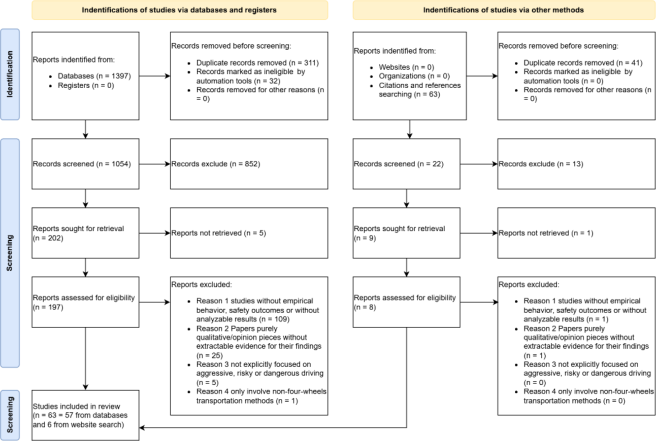
Figure 1: PRISMA 2020 flow diagram of the study selection process.
From Driver Intent to Road-User Perception 2023 The screening was performed independently by two reviewers, with disagreements resolved by consensus, the process is summarized in Figure 1. Records were deduplicated and screened in two stages; 57 studies were retained and citation searching contributed 6 more, yielding final 63 included studies.
Methodological quality was assessed with the Mixed Methods Appraisal Tool (MMAT, Hong et al., 2018), which accommodates the quantitative descriptive, quantitative non-randomized, and qualitative designs present across the included studies within a single rubric. Following the tool’s guidance against summary scores, we use the resulting categories (High, 4–5 criteria met; Moderate, 2–3; Low, 0–1) as a descriptive quality categorization.
For each retained study, study descriptors, the AD-related behaviors examined, and the outcomes reported were extracted (Popay et al., 2006). Each study was then mapped onto our proposed PAD framework. Because the included studies report incommensurable effect metrics, we report the mapping as structured counts under the Synthesis Without Meta-analysis reporting guideline (Campbell et al., 2020).
FROM AGGRESSIVE DRIVING TO PERCEIVED AGGRESSIVE DRIVING (RQ1) Prior Definitions and Models of AD
Early definitions treated road aggression as a motivational process. The frustration–aggression hypothesis holds that frustration experienced while driving, such as delays or obstruction, elicits anger that can be expressed as aggressive behavior (Berkowitz, 1989). Shinar extended this view by separating instrumental aggression, which is goal-oriented and aimed at overcoming an obstacle, from hostile aggression, which is driven by anger and the wish to harm another road user; both are deliberate, but they differ in purpose (Shinar, 1998).
Later work shifted definitional emphasis toward observable outcomes or violations. Tasca defined AD as deliberate on-road actions that increase collision risk and stem from impatience, annoyance, or hostility (Tasca, 2000). Neuman et al. described AD as operating a vehicle in a selfish, pushy, or unsafe manner that adversely affects others (Neuman et al., 2003), and enforcement-oriented definitions followed: NHTSA characterized AD as committing a combination of moving violations that endanger persons or property (National Highway Traffic Safety Administration, 2004), and the AAA Foundation emphasized unsafe acts performed with disregard for safety (AAA Foundation for Traffic Safety, 2009). A recent systematic review restricted the construct further, limiting AD to intentional acts that endanger others and excluding errors attributable to inexperience or distraction (Su et al., 2023).
These prior definitions are complementary: motivational perspectives explain why aggression arises, whereas outcome- and violation-based perspectives describe how it is expressed in traffic. Across these definitions,
the occurrence of perceived aggressive behaviors could be generalized as four stages, following the input-to-outcome logic of process models of aggression (Anderson & Bushman, 2002): the conditions that precede aggressive behavior, the driver’s motivational state, the behavior itself, and its safety consequences. We define these stages as triggering factors, driver motivation, observable driving behaviors, and outcome impacts. Table 1 summarizes which stages each prior definition covers.
Table 1: Coverage of prior AD definitions by framework stage (✓ covered; ✓* covered without differentiating subcategories; – not covered).
Remaining Gaps and Opportunities for Integration Each prior definition captures aspects of AD that the other does not address directly. Synthesizing these two perspectives reveals gaps that an integrative framework is positioned to address.
Conceptual variation. Definitions vary in their scope, purpose, inclusion criteria, and the role assigned to intent. Consequently, studies nominally addressing the same construct often measure distinct phenomena, complicating cross-study synthesis and comparison.
Narrow causal focus. Situational and systemic conditions, such as roadway design, traffic density, and enforcement context, have received less definitional attention, although observational work indicates that these conditions interact with driver states in AD behaviors (Shinar & Compton, 2004).
Connection to regulation and process. Legal status is rarely treated as a defining dimension, although violative and non-violative acts differ in how they can be measured and addressed (Neuman et al., 2003).
Finally, prior definitions address isolated components of aggressive behaviors. A framework integrating these components would offer a clearer mapping of the end-to-end process of aggressive driving, providing actionable insights for driver education, legal regulation, and autonomous
From Driver Intent to Road-User Perception 2025 driving logic (Deffenbacher et al., 2002; Neuman et al., 2003; Ma & Zhang, 2024).
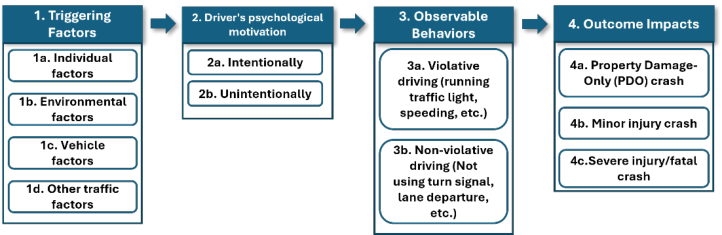
The Perceived Aggressive Driving Framework To address the gaps, we propose the PAD framework (Figure 2) as a four- stage process flow: triggering factors, driver motivation, observable driving behaviors, and outcome impacts.
Stage 1: Triggering factors. The conditions that raise the likelihood of aggressive expression, including individual factors (gender, age), environmental factors (congestion, time pressure, weather), vehicle factors, and other contextual factors such as cultural and social norms. This stage extends the causal field beyond the internal psychological states emphasized by earlier models.
Stage 2: Driver motivation. Whether the ensuing behavior is enacted intentionally (anger-driven, instrumental, competitive, or retaliatory) or arises unintentionally through errors and lapses (Reason et al., 1990), distraction, fatigue, or habituation. PAD retains both pathways.
Stage 3: Observable driving behaviors. The maneuvers other road users can see, divided into violative acts that breach traffic law (e.g., speeding, running a red light) and non-violative acts that are not codified as offenses but are nonetheless perceived as aggressive (e.g., failing to signal a lane change).
Stage 4: Outcome impacts. Safety consequences are categorized by severity (property-damage-only, minor-injury, and severe-or-fatal crashes) rather than treated as binary.
Figure 2: The four-stage PAD framework.
Relative to prior definitions, the framework has four distinguishing features: (i) it extends the causal field beyond internal states to situational and systemic factors; (ii) it accommodates both intentional and unintentional pathways; (iii) it separates violative from non-violative behaviors, aligning the construct with legal and measurement practice; and (iv) it grades outcomes by severity. The PAD definition is positioned at the behavioral level of this structure: a behavior counts as PAD through the experience of surrounding road users, while intent, agency, and legality are treated as attributes within the framework.
MAPPING EMPIRICAL LITERATURE ONTO THE PERCEIVED AGGRESSIVE DRIVING FRAMEWORK (RQ2) Characteristics of the Included Studies
Under the MMAT, 33 studies (52.4%) were rated High quality and 30 (47.6%) Moderate; none was rated Low. The included studies therefore meet a baseline of methodological rigor.
Each study was mapped onto the PAD framework stages it addresses; a study can populate several stages at once. Results are summarized in Table 2, where k denotes the number of studies: 94% of studies document triggering factors (k = 59), 81% document motivation (k = 51), 94% document behaviors (k = 59), and 33% document outcome impacts (k = 21).
Table 2: Framework coverage of the 63 included studies (k denotes the number of studies).
Both classes 32 Stage 4. Outcome impacts (k = 21) Severe or fatal crash 10
Minor injury 9 Property damage only 4
The results show three patterns. First, documentation is concentrated at the earlier stages of the framework: nearly all studies address triggering factors or driving behaviors, while outcome impacts are reported by a small minority, and quantified links from a specific behavior to a crash or injury outcome are the least common. Second, in driver motivation, intentional and unintentional pathways are both well documented (39 and 30 studies, respectively), and 18 studies record both in the same population: behavior with the outward form of aggression arises without hostile intent in nearly half of the included studies. Third, in driving behaviors, non-violative acts are documented by a majority of the studies that report behaviors, usually alongside violative acts. The first pattern identifies where safety evidence is most limited; the second and third show that a framework of PAD should cover behaviors that arise without hostile intent and behavior that violates no traffic law.
From Driver Intent to Road-User Perception 2027 Evidence for the PAD Framework’s Four Distinguishing Features
The characteristics of the included studies demonstrate the advantages of the PAD framework in four aspects.
First, the PAD framework extends its triggering stage beyond drivers’ internal states, and the systematic review results support this extension. Individual factors were the most consistently documented triggers. Specifically, among the 33 studies evaluating gender, most associated higher aggression with male drivers, while the vast majority of the 35 studies addressing age linked younger drivers to more aggressive behavior. At the same time, factors outside the individual also show some patterns: adverse traffic and environmental conditions are associated with more aggressive behavior in 14 of the 22 studies that examine them, cultural and social norms show consistent effects in 18 studies, and enforcement presence is associated with less aggressive behavior in 3 of the 4 studies that examine it. Consistent with the framework’s assumptions, the triggering factor stage incorporates individual, environmental, and normative influences alike.
Second, both intentional and unintentional behaviors are substantively populated, and each is internally diverse. Intentional pathways are documented in 39 studies and unintentional pathways in 30, and 18 studies document both in the same population. The two sides also differ in composition: intentional evidence concentrates on anger-driven (k = 28), instrumental (k = 17), retaliatory (k = 11), and competitive motives (k = 7), whereas unintentional evidence spreads across distraction (k = 20), errors and lapses (k = 17), fatigue (k = 8), and habituation (k = 4). A construct that reserves a place for both pathways, and that keeps intent as an attribute rather than a boundary, covers this diversity; definitions that make intent a necessary condition (Su et al., 2023) leave the unintentional portion of this record outside the definition.
Third, violative and non-violative behaviors are both well represented. Thirty-eight studies document non-violative behaviors, and the item-level counts show that this class contains a series of behaviors: the most frequently documented are close following that is not treated as a legal violation (k = 14) and intimidating or threatening acts (k = 13), followed by aggressive acceleration and hard braking (k = 12), horn or headlight use (k = 12), and gestures or verbal aggression (k = 11). These acts rarely appear in crashes or enforcement records (Rolison, 2020) and are measured predominantly through self-report, so a definition bounded by traffic law would leave these PAD behaviors outside the scope.
Fourth, the available outcome evidence is compatible with the PAD framework’s flow. All 21 studies reporting outcome impacts align with the PAD framework, either fully or in part: they link the outcomes to observable driving behaviors, and some additionally account for antecedent factors such as driver characteristics or traffic conditions. Their evidence is also categorized by severity, matching the fourth stage of the framework: severe or fatal crashes are the most frequently documented outcome (k = 10), followed by minor injury (k = 9) and property-damage-only crashes (k = 4). Because no intent is attributed, the same form of analysis extends to mixed traffic,
where the behavior of automated vehicles can be assessed on the same terms as human driving (Ma & Zhang, 2024).
CONCLUSION
This paper proposed the PAD framework for the perceived aggressive behaviors. A narrative review organized prior definitions into a four-stage PAD framework, and a systematic review mapped 63 studies onto it. The results showed that the framework can be populated with the published record, and that the record supports its distinguishing features: unintentional and intentional pathways are both well documented, non-violative behaviors form a substantial and varied class that official records do not capture, and the studies that link behaviors to crash outcomes all follow the behavior-to- outcome flow that the framework formalizes. PAD framework also provides a unified structure for defining, measuring, and comparing aggressive-appearing driving, and one that remains applicable as road traffic is increasingly shared with automated vehicles.
LIMITATIONS Two limitations should be noted. First, the included studies are dominated by cross-sectional and observational designs, and much of the Stage 1–3 evidence rests on self-reports susceptible to recall and social-desirability bias (Lajunen & Summala, 2003). Second, the mapping is descriptive: we report structured counts of where evidence exists rather than pooled effect sizes, and the coverage asymmetry described above should therefore not be read as evidence against intent-based accounts, only as an indication that such accounts are currently disconnected from safety data.
ACKNOWLEDGMENT
This research was supported by a Jon Rieger Seed Grant from the University of Louisville. Disclosure of interests: the authors have no competing interests to declare that are relevant to the content of this article.
REFERENCES
AAA Foundation for Traffic Safety (2009). Aggressive driving: Research update.
AAA Foundation, Washington, DC. Anderson, C.A., Bushman, B.J. (2002). Human aggression. Annu. Rev. Psychol. 53, 27–51. Berkowitz, L. (1989). Frustration-aggression hypothesis: examination and
reformulation. Psychol. Bull. 106(1), 59–73. Campbell, M., McKenzie, J.E., Sowden, A., et al. (2020). Synthesis without metaanalysis (SWiM) in systematic reviews: reporting guideline. BMJ 368, l6890. Deffenbacher, J.L., Filetti, L.B., Lynch, R.S., et al. (2002). Cognitive-behavioral
treatment of high anger drivers. Behav. Res. Ther. 40(8), 895–910. Dula, C.S., Geller, E.S. (2003). Risky, aggressive, or emotional driving: addressing the need for consistent communication in research. J. Safety Res. 34(5), 559–566.
From Driver Intent to Road-User Perception 2029 Grant, M.J., Booth, A. (2009). A typology of reviews: an analysis of 14 review types
and associated methodologies. Health Inf. Libr. J. 26(2), 91–108. Greenhalgh, T., Peacock, R. (2005). Effectiveness and efficiency of search methods in systematic reviews of complex evidence: audit of primary sources. BMJ 331(7524), 1064–1065. Hong, Q.N., Fàbregues, S., Bartlett, G., et al. (2018). The Mixed Methods Appraisal
Tool (MMAT) version 2018 for information professionals and researchers. Educ. Inf. 34(4), 285–291. Lajunen, T., Summala, H. (2003). Can we trust self-reports of driving? Effects of impression management on driver behaviour questionnaire responses. Transp. Res. Part F 6(2), 97–107. Ma, Z., Zhang, Y. (2024). Driver-automated vehicle interaction in mixed traffic:
types of interaction and drivers’ driving styles. Hum. Factors 66(2), 544–561. National Highway Traffic Safety Administration (2004). Aggressive driving enforcement: evaluations of two demonstration programs. Report No. DOT HS 809 707. U.S. Department of Transportation, Washington, DC. Neuman, T.R., Pfefer, R., Slack, K.L., et al. (2003). Guidance for Implementation of
the AASHTO Strategic Highway Safety Plan, Volume 1: A Guide for Addressing Aggressive-Driving Collisions. NCHRP Report 500. Transportation Research Board, Washington, DC. Page, M.J., McKenzie, J.E., Bossuyt, P.M., et al. (2021). The PRISMA 2020 statement: an updated guideline for reporting systematic reviews. BMJ 372, n71. Paleti, R., Eluru, N., Bhat, C.R. (2010). Examining the influence of aggressive driving
behavior on driver injury severity in traffic crashes. Accid. Anal. Prev. 42(6), 1839–1854. Popay, J., Roberts, H., Sowden, A., et al. (2006). Guidance on the conduct of narrative synthesis in systematic reviews. ESRC Methods Programme, Version 1. Reason, J., Manstead, A., Stradling, S., et al. (1990). Errors and violations on the
roads: a real distinction? Ergonomics 33(10–11), 1315–1332. Rolison, J.J. (2020). Identifying the causes of road traffic collisions: using police officers’ expertise to improve the reporting of contributory factors data. Accid. Anal. Prev. 135, 105390. Shinar, D. (1998). Aggressive driving: the contribution of the drivers and the situation.
Transp. Res. Part F 1(2), 137–160. Shinar, D., Compton, R. (2004). Aggressive driving: an observational study of driver, vehicle, and situational variables. Accid. Anal. Prev. 36(3), 429–437. Stange, V., Kühn, M., Vollrath, M. (2022). Manual drivers’ experience and driving
behavior in repeated interactions with automated Level 3 vehicles in mixed traffic on the highway. Transp. Res. Part F 87, 426–443. Su, Z., Woodman, R., Smyth, J., Elliott, M. (2023). The relationship between aggressive driving and driver performance: a systematic review with meta- analysis. Accid. Anal. Prev. 183, 106972. Talebpour, A., Mahmassani, H.S. (2016). Influence of connected and autonomous
vehicles on traffic flow stability and throughput. Transp. Res. Part C 71, 143–163. Tasca, L. (2000). A review of the literature on aggressive driving research. Ontario Advisory Group on Safe Driving, Toronto. World Health Organization (2023). Global status report on road safety 2023. WHO,
Geneva.
SEARCH THE AHFE DIGITAL BOOKSTORE BY ISBN
Explore the complete digital volume
Human Factors in Design, Engineering, and Computing
Read this individual research paper free through the original publisher, or explore the full digital proceedings book.