Runa Narita, Tomoya Hasebe, Daisuke Morioka (2026). Analysis of Mechanical Loads on the Handrail During Stair Ascent at the Initiation and Completion Phases. In: Human Factors in Design, Engineering, and Computing. AHFE Open Access, vol. 238, pp. 2181–2188. https://doi.org/10.54941/ahfe1008444
Japan has one of the most rapidly aging populations in the world, with 29.5% of its people aged 65 years or older, making it a super-aging society. Previous biomechanical studies on handrail use have focused mainly on lumbar and joint moments, electromyography, and sensory evaluation. In the present study, we focused on the mechanical loads applied to handrails by users. To our knowledge, no previous studies have investigated the mechanical loads at the initiation and completion of stair climbing. To address this gap in the literature, we measured and analyzed the mechanical loads exerted on a handrail at the initiation and completion of stair climbing. Participants were two healthy adult men (age, 29.0 ± 11.3 years; height, 174.5 ± 0.7 cm; weight, 67.4 ± 14.5 kg). Informed consent was obtained prior to the start of the experiment. The movement in this experiment was stair ascent, following the Japan’s traffic rule of keeping to the left. The starting foot was the right foot. The analysis revealed that the gripping time on the handrail was approximately 1.30 s at the initiation of stair climbing and 1.72 s at the completion of stair climbing. The average maximum grip force was approximately 40.9% of the participants’ maximum voluntary grip force at the initiation of stair climbing, and 15.7% at the completion of stair climbing. In future work, we will increase the number of participants in order to improve data accuracy; acquire data on gripping movements under steady-state conditions; and refine the experimental system.
Japan has become a super-aged society, with people aged 65 years and over accounting for 29.5% of the population. In addition, the number of people certified as requiring long-term care/support insurance has increased by approximately 1.02 million over the past decade (Long-Term Care Insurance Service Status Report, FY2014–FY2023). Fractures and falls are involved in 14.8% of individuals requiring long-term care/support and are reported to be the third leading cause of care dependency (Comprehensive Survey of Living Conditions, 2025). Consequently, age-related declines in motor function represent an important societal challenge.
The installation of handrails is considered an effective measure for preventing injuries and subsequent disabilities caused by these accidents.
In Japan, the handrails must be installed on stairways in public facilities and numerous other buildings. Gripping a handrail during stair ascent is expected to reduce the incidence of slips and falls.
Some studies on handrail use have focused on the biomechanical demands on users, including joint moments and electromyographic activity, while others have relied solely on subjective assessments obtained through questionnaire surveys (Fukuta et al., 2002; Hokazono et al., 2002; Kunii et al., 2002). In contrast, our research group has focused on the mechanical loads exerted on handrails by users, using strain measurements and analyses of externally applied loads. However, no previous study has examined the mechanical loading characteristics of handrails during the initial and terminal phases of stair ascent. Therefore, the present study experimentally measured the mechanical loads acting on a handrail during the initial and terminal phases of stair ascent, and this paper reports the measurement methodology, analytical procedures, and resulting loading trends.
EXPERIMENTAL EQUIPMENT The stair-ascent experiments were performed using an experimental device developed by the authors to measure the handrail gripping force applied to the handrail. The system has four primary components: an experimental handrail, a staircase, a pedestal, and a supporting pillar. This section describes each component in detail.
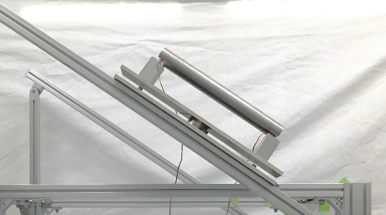
Experimental Handrail The handrail was constructed from a hollow, grade AISI 304 stainless steel pipe with an outer diameter of 34 mm, a wall thickness of 3 mm, and a length of 300 mm. One full notch and one partial notch were introduced along the longitudinal axis of the pipe for measuring the gripping force. Two foil strain gauges (KFG-1-120-C1-11L3M2R; Kyowa Electronic Instruments Co., Ltd., Tokyo, Japan) were affixed circumferentially on the inner surface at both ends of the partial notch in order to detect gripping forces. Furthermore, a six-axis force torque sensor (MINI45-E; ATI Industrial Automation, Inc., Apex, NC) was attached between the handrail and its supporting post to measure the loads exerted on the handrail during stair ascent. The sensor coordinate system is shown in Fig. 1.
Figure 1: Experimental handrail.
Analysis of Mechanical Loads on the Handrail During Stair Ascent 2183 Replica Handrail
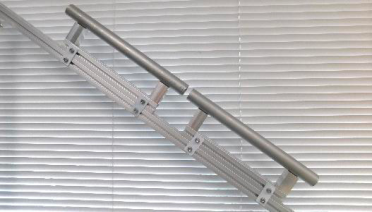
Because installing only the experimental handrail might lead to unnatural walking patterns, an additional handrail (diameter: 34 mm, length: 391 mm) made of the same materials as the experimental handrail was installed, with a clearance of 14.5 mm.
Figure 2: Replica handrail.
Stairs In accordance with the Enforcement Order of the Building Standards Act of Japan, the staircase was designed using dimensions commonly adopted in public transportation passenger facilities. The staircase had a riser height of 180 mm, a tread depth of 260 mm, and a width of 1,000 mm. The staircase consisted of six steps and was constructed using the ALFA FRAME SYSTEM (M6 series; NIC Autotec Inc., Tokyo, Japan).
Pedestal and Support Post To avoid contamination of the handrail gripping data by locomotion-induced vibration noise during stair ascent, the handrail was installed on a pedestal that was structurally independent of the staircase rather than directly attached to it. The pedestal dimensions were 1,015 mm in height, 450 mm in width, and 900 mm in depth. To prevent movement of the pedestal during the experimental trials, four 25-kg barbell weight plates (total mass: 100 kg) were placed on the pedestal as ballast. The handrail support was designed so that the vertical distance from the nosing of the second step to the upper surface of the handrail was 800 mm.
EXPERIMENTAL SETUP Participant Information
The participants were two healthy right-handed volunteers (age, 29.0 ± 11.3 years; height, 174.5 ± 0.7 cm; weight, 67.4 ± 14.5 kg). Informed consent was obtained from each participant. The number of participants in this study was determined with reference to previous studies (Miyazaki et al., 2023; Moriya et al., 1999). The study was approved by the Takushoku University Research Ethics Committee (No. 202508).
Experimental Conditions Prior to data acquisition, the maximum voluntary gripping force of each participant was measured using the experimental handrail. Both participants then performed five trials of stair ascent while gripping the handrail with their left hand. Gait started with the foot contralateral to the gripping hand, and the handrail was gripped after movement.
All sensor signals were recorded using LabVIEW 2020 (National Instruments Corp., Austin, TX). The sampling frequency was 1,000 Hz.
RESULTS
First Step Gripping time with the left hand during stair ascent under the first step condition was 1.30 s. The gripping force ratio was calculated using the participants’ maximum voluntary gripping force. The maximum gripping force ratio measured during stair ascent was 40.88% (Table 1).
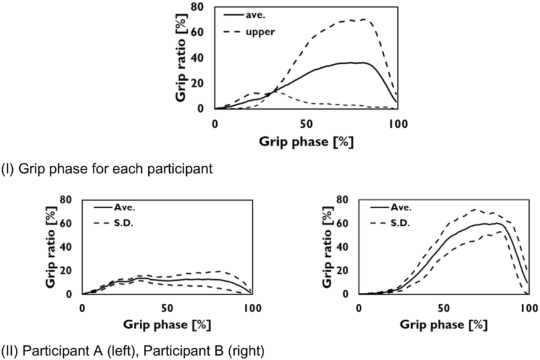
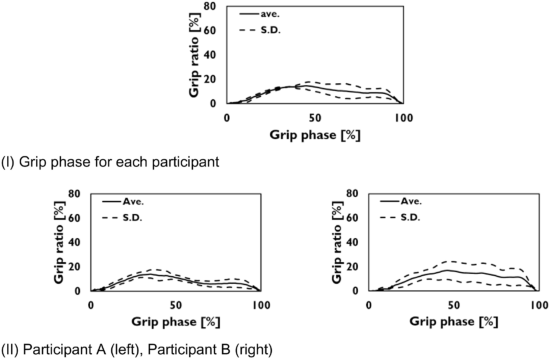
To account for variability in measurement duration between the participants, the interval between gripping onset and gripping termination was time-normalized. Figure 3(I) shows the grip phase. The vertical axis represents the gripping force ratio, and the horizontal axis represents the grip phase. The maximum gripping ratio was observed at 81% of the grip duration, and its value was 36.3%. Figure 3(II) shows the grip phase graph for each participant. For participant A, the maximum gripping force ratio occurred at 34% of the grip duration, and its value was 13.6%. The corresponding values for participant B were 81% and 60.3%.
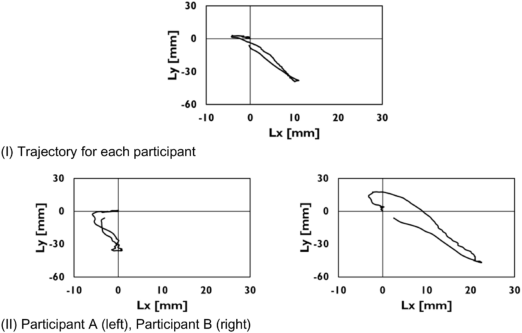
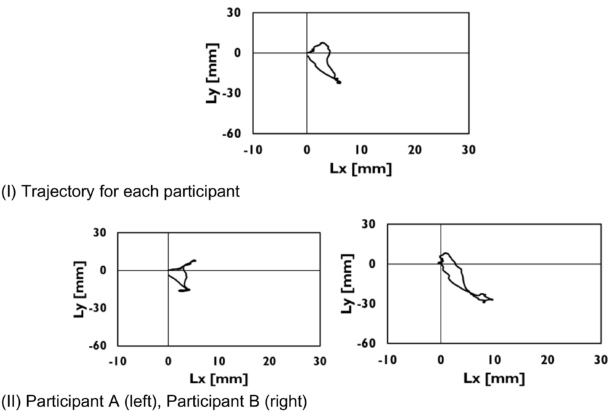
The load application point on the X–Y plane was determined using the load and torque measured by the 6-axis force/torque sensor. Subsequently, as with the graph for the grip phase, the load application points were time- normalized from gripping onset to gripping termination, and the mean value was calculated. Figure 4 shows the trajectory of the load-application points on the X–Y plane. Under the first step condition, the trajectory was located mainly in the fourth quadrant. After grip initiation, there was a shift toward the negative X-axis direction, followed by a substantial movement in the Y-axis direction. The trajectory then reversed direction before terminating. Individual trajectory analysis revealed that for Participant A, most of the trajectory was in the third quadrant, and the trajectory shifted toward the negative Y-axis along a curved path. After reversing direction, it followed a path similar to its pre-reversal trajectory before terminating. For Participant B, trajectory points were frequently observed in the fourth quadrant. After grip initiation, the trajectory followed a narrow clockwise elliptical path. Furthermore, to visualize the participants’ body balance characteristics, a rectangular area was calculated using the maximum and minimum values for each axis of the trajectory plot. The resulting area was approximately 953.83 mm2. Participant B exhibited an area approximately 6.6 times larger than that of participant A.
Table 1: Mechanical load exerted on the handrail for each participant during the first step condition.
Table available in the original PDF paper.
A B Average S.D.
Grip time [s] 1.32 1.27 1.30 0.03 Grip ratio [%] 15.81 65.96 40.88 35.46
X-Y rectangular area [mm²] 250.96 1656.71 953.83 994.01
Figure 3: Average grip phase during the first step condition.Figure 4: Average trajectory of the load-application points on the X–Y plane during the first step condition.
Sixth Step During stair ascent at the sixth step, the mean handrail gripping duration was approximately 1.72 s. The maximum gripping force ratio measured during handrail use was approximately 15.66% (Table 2).
Analysis of the gripping phase showed that the peak gripping force ratio (14.8%) occurred at approximately 45% of the grip phase. Furthermore, greater variability in the gripping force ratio was observed after approximately 30% of the gripping phase (Fig. 5). For participant A, the peak gripping force ratio was approximately 14.0% and occurred at 29% of the grip phase, whereas for participant B, the peak gripping force ratio was approximately 17.0% and occurred at 64% of the grip phase.
The calculated load-application points on the X–Y plane at the sixth step were distributed mainly in the first and fourth quadrants (Fig. 6). The calculated load-application point progressed clockwise after grip initiation. After shifting approximately 20 mm toward the negative Y-axis, it gradually moved back toward the origin. Individual trajectory analysis revealed that for Participant A, the calculated load-application point initially shifted approximately 5 mm in the positive X-axis direction following grip initiation and subsequently moved approximately 15 mm in the negative Y-axis direction before converging toward the origin. Similarly, for Participant B, the load-application point trajectory was observed in both the first and fourth quadrants, following a clockwise curved path that reached approximately 10 mm in the positive X-direction and 30 mm in the negative Y-direction before reversing direction and moving back toward the origin. The mean rectangular area calculated from the calculated load-application point trajectories was 257.73 mm2, and the difference between the participants was approximately 2.8-fold.
Table 2: Mechanical load exerted on the handrail for each participant during the sixth step condition.
Table available in the original PDF paper.
A B Average S.D.
Grip time [s] 1.48 1.96 1.72 0.34 Grip ratio [%] 15.74 15.57 15.66 0.12
X-Y rectangular area [mm²] 135.50 379.96 257.73 172.86
Figure 5: Average grip phase during the sixth step condition.Figure 6: Average trajectory of the load-application points on the X–Y plane during the sixth step condition.
DISCUSSION
Comparison of the handrail gripping duration between the first and sixth steps revealed a difference of 0.42 s, with a longer gripping duration observed at the sixth step. Analysis of the individual participant data revealed that both participants exhibited longer gripping durations at the sixth step than at the first step. In particular, Participant B showed a markedly longer gripping duration at the sixth step, with a difference of approximately 0.69 s compared with the first step. At the first step, the participants initiated stair ascent by generating upward body movement with a unilateral stepping action. In contrast, at the sixth step, they terminated the ascent task by bringing both feet together and assuming a stationary posture. Consequently, the longer grasping duration observed at the sixth step may reflect the need for additional handrail support to ensure postural stability during the transition from locomotion to standing.
Examination of the calculated load-application points on the X–Y plane revealed that at the first step, the trajectory tended to shift in the negative X-axis direction after handrail grip initiation. In contrast, for the sixth step, most of the plotted points were distributed along the X-axis. At the first step, stair ascent was initiated from a stationary posture, and the participants appeared to rely more heavily on the handrail than they did at the sixth step. Consequently, the action of pushing against the handrail during ascent initiation may have produced the observed trajectory pattern. Comparison of the trajectories between participants showed that at the sixth step, the load-application points tended to be distributed in a similar direction for both participants. In contrast, a consistent tendency was not observed at the first step. This discrepancy may reflect individual differences in stair-climbing strategy. When gripping the handrail from a stationary position, these
individual movement characteristics may have become more pronounced. The rectangular area calculated from the calculated load-application points was 3.7 times larger at the first step than at the sixth step. Body balance is likely to be unstable during movement initiation. Therefore, the larger rectangular area observed at the first step may be attributable to increased body sway resulting from reduced postural stability during movement initiation.
CONCLUSION
This study investigated the mechanical loads exerted on handrails during both initial and terminal stair ascent. Compared with the sixth step during movement termination, the first step during movement initiation exhibited a shorter gripping duration but tended to have a higher gripping force ratio and rectangular area. Nevertheless, the small sample size (n = 2) limits the generalizability of these findings. Future studies should include a larger number of participants and further improve measurement accuracy.
REFERENCES
Fukuta, Satoshi. Morikawa, Yutaka and Takasu, Yasuo. (2002). Research Study for Circlar and Elliptic Sectional Shape Handrail about Facility of Gripping. Aichi Industrial Technology Institute research report No. 1, pp. 53–54. Hokazono, Asami and Hatta, Kazutoshi. (2002). A Study on How to Fix to Position
of the Horizontal Handrail. The Japanese Journal of Ergonomics Volume 38 (Supplement), pp. 268–269. Kunii, Kiyoteru. Kamiyo, Hiroyo. Yatogo, Takeshi and Nomura, Kan. (2002). Study on Vertical Grab-Bar for the Rest Room to Support Standing Up. Journal of Architecture and Planning (Transactions of AIJ) Volume 67, No. 561, pp. 167–172. Ministry of Health, Labour and Welfare. FY2014 Long-Term Care Insurance Service
Status Report (Annual report). Website: https://www.mhlw.go.jp/topics/kaigo/ osirase/jigyo/14/dl/h26_gaiyou.pdf (Accessed: 23 July 2026). Ministry of Health, Labour and Welfare. FY2023 Long-Term Care Insurance Service Status Report (Annual report). Website: https://www.mhlw.go.jp/topics/kaigo/ osirase/jigyo/23/dl/r05_gaiyou.pdf (Accessed: 23 July 2026). Ministry of Health, Labour and Welfare. Overview of the 2025 Comprehensive
Survey of Living Conditions. Website: https://www.mhlw.go.jp/toukei/saikin/ hw/k-tyosa/k-tyosa25/dl/05.pdf (Accessed: 23 July 2026). Miyazaki, Yusuke. Shoda, Kohei. Kitamura, Koji and Nishida, Yoshifumi. (2023).
Assessing Handrail-Use Behavior during Stair Ascent or Descent Using Ambient Sensing Technology. Sensors Volume 23, No. 4 Article 2236. Moriya, Masamichi and Ogawa, Koichi. (1999). A study on the usability of handrail.
The Japanese Journal of Ergonomics Volume 35, No. 2 (Supplement). Statistics Bureau of Japan. Population Estimates, September FY2026. Website: https:// www.stat.go.jp/data/jinsui/pdf/202609.pdf (Accessed: 25 September 2026).
SEARCH THE AHFE DIGITAL BOOKSTORE BY ISBN
Explore the complete digital volume
Human Factors in Design, Engineering, and Computing
Read this individual research paper free through the original publisher, or explore the full digital proceedings book.