Yoshitaka Maeda, Kota Miyanishi, Kosuke Oiwa, Yukikazu Murakami (2026). Attention to Medications and Related Information During Pharmacist Verification: An Analysis of Experts and Novices Using AI-Based Gaze Classification. In: Human Factors in Design, Engineering, and Computing. AHFE Open Access, vol. 238, pp. 2208–2215. https://doi.org/10.54941/ahfe1008447
Pharmacists perform prescription verification to assess the appropriateness of prescriptions and medication verification to confirm that dispensed medications match those prescriptions. Understanding how pharmacists gather information during these processes is important for improving verification practices and training. Our previous eye-tracking study showed differences in gaze behavior between experienced and novice pharmacists; however, that analysis focused mainly on gaze behavior within prescriptions and did not capture gaze directed toward other information sources throughout the verification task. In the present study, we reanalyzed eye-tracking data from a simulated verification task to examine gaze toward dispensed medications and related information, including prescriptions and medication bags. Gaze targets were classified using a deep-learning-based image classifier, and relative gaze duration toward medications and related information was evaluated using a log-transformed ratio. Data from 11 pharmacists (five experts and six novices) were analyzed. No significant difference in the log-ratio was found between experts and novices, and the effect size was small. Substantial inter-individual variability was observed, particularly among experts. These findings indicate that the relative gaze time toward medications and related information varies considerably among pharmacists and cannot be explained by professional experience alone. Further investigation of the relationship between these gaze patterns and error-detection performance may help identify effective verification strategies and inform future pharmacist training.
Medication-related errors remain an important patient safety concern, and pharmacists play a critical role in preventing them. Pharmacists must detect medication-related problems while maintaining both accuracy and efficiency
Attention to Medications and Related Information 2209 in increasingly complex clinical environments. Therefore, understanding how pharmacists gather and process information during verification is important for improving the safety of medication use.
Pharmacist verification involves two distinct but related forms of checking. Accuracy checking focuses primarily on whether the dispensed medication correctly matches the prescription, whereas clinical checking evaluates whether the prescribed medication is appropriate and safe for the patient. Clinical checking is a complex process influenced by pharmacists’ experience, the available clinical information, and the surrounding work environment (Elgebli et al., 2023). To perform these checks, pharmacists must gather and integrate information from multiple sources, including prescriptions, dispensed medications, medication bags, and other relevant information. Differences in how pharmacists gather information from these sources may therefore reflect differences in verification strategies.
Eye-tracking has been used to examine pharmacists’ information-gathering processes during medication-related tasks. Previous studies have shown that pharmacists’ gaze behavior varies according to the dispensing environment and the characteristics and arrangement of medications (Tsuji et al., 2022, 2024, 2025). Eye-tracking has also been applied to simulated medication- order validation, showing changes in pharmacists’ visual behavior and error detection under interruptions (Thibault et al., 2019). These studies have primarily examined gaze behavior in relation to specific dispensing conditions, medication selection, or task-related factors.
In our previous study, experienced and novice pharmacists performed a simulated prescription and medication verification task while their eye movements were recorded (Maeda et al., 2025). The analysis focused primarily on gaze behavior within prescriptions, using fixation duration, fixation count, heatmaps, and gaze plots. Experienced pharmacists completed the verification task more quickly and showed longer average fixation durations and broader visual coverage of prescription information, whereas novices tended to repeatedly inspect more limited areas. These findings suggested that professional experience influences how pharmacists gather information during verification. However, that analysis was limited to gaze characteristics within prescriptions and did not quantify gaze directed toward dispensed medications and other information used during the verification task.
Building on these findings, the present study extended the analysis to gaze targets throughout the prescription and medication verification task. Specifically, we quantified relative gaze time toward dispensed medications compared with prescriptions and medication bags and examined whether the gaze-time ratio differed between experienced and novice pharmacists. We also examined inter- individual variability in the gaze-time ratio to determine whether gaze allocation patterns varied within each experience group.
METHODS
Participants and Experimental Task This study reanalyzed eye-tracking data obtained from a previously conducted simulated prescription and medication verification experiment. The experimental task and part of the eye-tracking data have been reported
previously (Maeda et al., 2025); however, the present study used an expanded dataset and addressed a different research question by analyzing gaze targets throughout the verification task.
Thirteen pharmacists participated in the experiment: seven novices with 1–2 years of professional experience and six experts with more than 20 years of experience. Twenty-two fictional prescriptions were prepared, each containing three medications, along with 66 corresponding medication packages. Eleven of the 22 prescriptions contained one typical error based on actual medication-related incidents at our hospital. The embedded errors included name similarity, strength mismatch, incorrect administration instructions, appearance similarity, patient mismatch, pharmacological conflict, dosage form error, therapeutic duplication, packaging error, dispensing quantity error, and patient identification error.
Participants were instructed to verify each prescription and its corresponding dispensed medications and to mark an “X” on the relevant part of the prescription when they detected an error. Participants were allowed to use a computer to access medication package inserts during the task. The order of the 22 prescriptions was counterbalanced across participants. Eye movements were recorded using Tobii Pro Glasses 2 (Tobii Technology, Stockholm, Sweden) at a sampling frequency of 100 Hz.
Gaze Target Classification To identify gaze targets throughout the verification task, the eye-tracking videos were converted into image sequences, and gaze targets were classified into five categories: medicine (dispensed medications), medicine bag, prescription, monitor (computer monitor or keyboard), and idle (e.g., taking a prescription from or returning it to the basket).
Because manual labeling of all images from long-duration recordings would have required substantial effort, a semi-automated labeling procedure was used. An initial set of images was manually labeled into the five gaze-target categories and used to construct an image classification model. The model was then applied to images from subsequent participants, and misclassified images were manually corrected. The corrected images were added to the training dataset, and this process was repeated iteratively to facilitate labeling of the recordings.
Gaze recordings from all 13 participants were used in the gaze-target classification procedure. The resulting labeled dataset was used to fine- tune a pretrained EfficientNetV2-S model (Tan and Le, 2021). Data from participants 1–10 were used for training, data from participant 11 were used for validation, and data from participants 12 and 13 were used to test the model on unseen participants. All layers of the pretrained model were fine-tuned using the Adam optimizer with cross-entropy loss, a learning rate of 0.001, a batch size of 32, and 10 epochs. The model with the highest validation accuracy was selected for subsequent gaze-target classification.
Relative Gaze-Time Analysis For the relative gaze-time analysis, participants with an eye detection rate greater than 60% throughout the verification task were included according to a predefined data-quality criterion. Two participants (one expert and one novice) were excluded on this basis, resulting in 11 participants (five experts and six novices) in the final analysis.
Attention to Medications and Related Information 2211 For each participant, the duration of gaze directed toward each classified target was calculated from the sequentially classified images. To characterize relative gaze time, gaze targets were grouped into medicine and contextual information. Medicine represented gaze directed toward the dispensed medications, whereas contextual information was defined as the combined gaze duration for the prescription and medicine-bag categories. The monitor and idle categories were not included in the calculation of the gaze-time ratio.
For each participant, relative gaze time was quantified using the following log-ratio:
medicine
T LogRatio ln T T prescription medicinebag
[Equation or mathematical symbol available in the original paper PDF][Equation or mathematical symbol available in the original paper PDF][Equation or mathematical symbol available in the original paper PDF][Equation or mathematical symbol available in the original paper PDF] = [Equation or mathematical symbol available in the original paper PDF][Equation or mathematical symbol available in the original paper PDF] + [Equation or mathematical symbol available in the original paper PDF][Equation or mathematical symbol available in the original paper PDF] where T represents the total gaze duration for each category. A higher log- ratio indicates relatively more gaze time toward the dispensed medications, whereas a lower log-ratio indicates relatively more gaze time toward contextual information.
Statistical Analysis Differences in the log-ratio between experienced and novice pharmacists were evaluated using Welch’s t-test. Because of the small sample size, the Mann–Whitney U test was also performed as a nonparametric analysis. Cohen’s d was calculated as the effect size for the between-group difference using the pooled standard deviation. In addition to the group comparison, inter-individual variability in the log-ratio was examined descriptively using the standard deviation and range within each experience group. Statistical analyses were performed using MATLAB (R2024b).
RESULTS
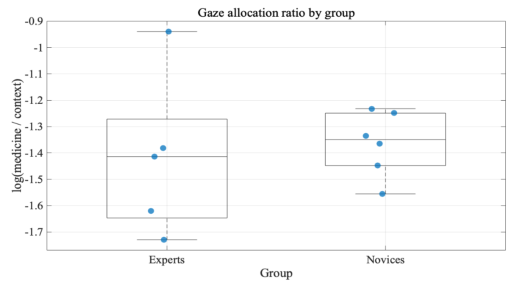
Relative Gaze Time Between Experienced and Novice Pharmacists The mean log-ratio was −1.417 ± 0.304 for experienced pharmacists and −1.364 ± 0.123 for novice pharmacists (Figure 1). Experienced pharmacists showed a slightly lower mean log-ratio, indicating relatively more gaze time toward contextual information; however, the between-group difference was small and not statistically significant (Welch’s t-test, p = 0.729; Mann–Whitney U test, p = 0.429). The effect size was also small (Cohen’s d = −0.239).
Figure 1: Comparison of relative gaze-time ratios between experienced and novice pharmacists.
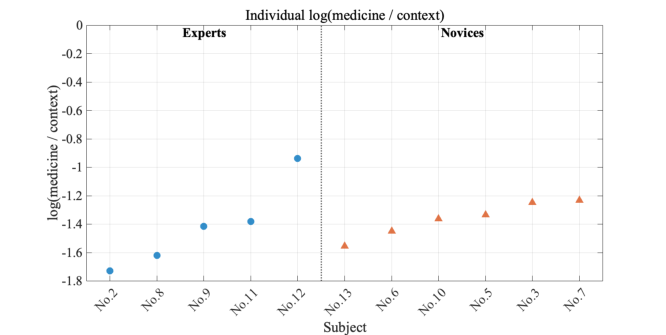
Inter-Individual Variability in Relative Gaze Time Individual log-ratios are shown in Figure 2. Substantial inter-individual variability was observed, particularly among experienced pharmacists. The standard deviation and range of the log-ratio were 0.304 and 0.790, respectively, in the experienced group, compared with 0.123 and 0.323 in the novice group. Thus, variability within the experienced group was considerably greater than the difference in mean log-ratio between the two experience groups.
Figure 2: Individual differences in relative gaze time between dispensed medications and contextual information.
Among experienced pharmacists, individual log-ratios ranged from approximately −1.73 to −0.94, indicating marked differences in relative gaze time toward medications and contextual information. In contrast, novice pharmacists showed a narrower distribution, with log-ratios ranging from approximately −1.56 to −1.23.
DISCUSSION
The present study quantified pharmacists’ relative gaze time toward dispensed medications and contextual information throughout a simulated prescription and medication verification task. No significant difference in the gaze-time ratio was observed between experienced and novice pharmacists, and the effect size was small. Instead, substantial inter-individual variability was observed, particularly among experienced pharmacists. These findings suggest that relative gaze time toward medications and contextual information cannot be explained by professional experience alone.
Our previous study using the same experimental task showed differences between experienced and novice pharmacists in verification time, fixation duration, and visual coverage within prescriptions (Maeda et al., 2025). In contrast, the present study found no clear difference between the two groups in relative gaze time toward medications and contextual information. These findings suggest that differences associated with professional experience may
Attention to Medications and Related Information 2213 be evident in some aspects of gaze behavior, but not necessarily in relative gaze time across information sources.
Previous studies of clinical checking also indicate that pharmacists do not necessarily perform verification in a uniform manner. Elgebli et al. (2023) described clinical checking as a complex, variable, and experience-driven process influenced by factors including access to information and the surrounding work environment. In a subsequent study, Elgebli et al. (2024) compared pharmacists’ actual clinical checking behavior with standard operating procedures and found variations between prescribed procedures and actual practice, as well as differences in the extent to which individual checking subtasks were performed. Professional judgment was identified as one factor contributing to differences between prescribed procedures and actual checking practices.
Variability has also been reported in pharmacists’ decision-making during clinical checking. Elgebli et al. (2025) found that pharmacists showed relative consistency in processing clinical cues and expectations during simulated clinical checking, whereas their subsequent actions showed substantial variability. These findings indicate that even when pharmacists encounter similar information, their subsequent verification decisions and actions may differ. The present findings extend these observations by showing that substantial inter-individual variability is also present in pharmacists’ relative gaze time across information sources during verification.
One possible interpretation of the observed variability is that pharmacists differ in the aspects of verification to which they give greater emphasis. Relatively more gaze time toward contextual information, such as prescriptions and medication bags, may reflect greater emphasis on integrating information relevant to the appropriateness of the prescription. In contrast, relatively more gaze time toward dispensed medications may reflect greater emphasis on accuracy checking, such as confirming the drug, strength, dosage form, and quantity against the prescribed information. Thus, the observed differences in relative gaze time may reflect individual differences in the emphasis placed on different aspects of verification.
The particularly large variability observed among experienced pharmacists is noteworthy. One possible explanation is that pharmacists develop individualized verification strategies through accumulated professional experience. Such strategies may be influenced not only by the amount of experience but also by differences in prior training and learning experiences. Anto et al. (2013) reported that strategies used for accuracy checking were acquired through previous experience and training and that the extent of accuracy-checking training received by pharmacy staff varied among individuals. In addition, preceptors have been shown to play an important role in shaping how pharmacy learners develop ways of thinking and acting as professionals (Kennie-Kaulbach et al., 2024). Thus, differences in how pharmacists learned verification practices during their professional development may be one factor contributing to the individual variability observed in the present study.
The present findings may also have implications for pharmacist training. If experienced pharmacists use multiple verification strategies, training based on a single “expert” pattern may not adequately represent the range
of effective verification behaviors. An important next step is to examine the relationship between gaze-time patterns and error-detection performance. In particular, determining whether different gaze-time patterns are associated with the detection of different types of medication errors may help identify effective information-gathering strategies for specific verification tasks. Such findings could contribute to training approaches that help pharmacists understand and select appropriate verification strategies according to the task rather than simply reproducing a single pattern of expert behavior.
Several limitations should be considered. First, the final analysis included only 11 pharmacists, limiting the generalizability of the findings. Second, the task was conducted in a simulated verification environment. Third, gaze- target classification indicates where visual attention was directed but does not directly identify the purpose or cognitive processing underlying each gaze. Contextual information was operationally defined as prescriptions and medication bags, both of which may be used for multiple purposes during verification. Finally, the present analysis did not examine the relationship between gaze-time patterns and detection of specific error types. Future studies combining gaze-time measures, error-detection performance, and qualitative data on verification strategies will be needed to clarify the functional significance of the observed individual differences.
CONCLUSION
This study examined pharmacists’ relative gaze time toward dispensed medications and contextual information during prescription and medication verification. No significant difference in the gaze-time ratio was found between experienced and novice pharmacists, whereas substantial inter-individual variability was observed, particularly among experienced pharmacists. These findings indicate that relative gaze time toward medications and contextual information varies considerably among pharmacists and cannot be explained by professional experience alone. Further investigation of the relationship between gaze-time patterns and error-detection performance may help identify effective verification strategies and inform future pharmacist training.
ACKNOWLEDGMENT
This study was supported by the JSPS KAKENHI (Grant Number JP23K04309).
REFERENCES
Anto, B., James, K.L., Barlow, D., Brinklow, N., Oborne, C.A. and Whittlesea, C.
(2013). “Exploratory study to identify the process used by pharmacy staff to verify the accuracy of dispensed medicines”, International Journal of Pharmacy Practice, Vol. 21, No. 4, pp. 233–242. doi: 10.1111/j.2042-7174.2012.00255.x. Elgebli, A., Hall, J. and Phipps, D.L. (2023). “Clinical checking in practice: qualitative perspectives from community pharmacists”, International Journal of Pharmacy Practice, Vol. 31, No. 5, pp. 504–511. doi: 10.1093/ijpp/riad056.
Attention to Medications and Related Information 2215 Elgebli, A., Hall, J. and Phipps, D.L. (2024). “Protocols versus practice: unravelling
clinical checking variations in community pharmacies in England—a multi-method study”, International Journal of Clinical Pharmacy, Vol. 46, pp. 1114–1123. doi: 10.1007/s11096-024-01743-9. Elgebli, A., Hall, J. and Phipps, D.L. (2025). “Community pharmacists’ decisionmaking patterns in clinical prescription checking: A simulation-based study”, Exploratory Research in Clinical and Social Pharmacy, Vol. 17, 100569. doi: 10.1016/j.rcsop.2025.100569. Kennie-Kaulbach, N., Cooley, J., Williams, C., Riley, B., Anksorus, H. and
O’Sullivan, T.A. (2024). “How Preceptors Support Pharmacy Learner Professional Identity Formation”, American Journal of Pharmaceutical Education, Vol. 88, No. 9, 100740. doi: 10.1016/j.ajpe.2024.100740. Maeda, Y., Oiwa, K., Katano, M. and Tsurumi, M. (2025). “The Impact of Pharmacist Expertise on Information Gathering During Prescription and Medication Verification: Eye-Tracking in a Simulated Experiment”, Human Factors in Design, Engineering, and Computing, Vol. 199, pp. 1494–1503. doi: 10.54941/ ahfe1006961. Tan, M. and Le, Q.V. (2021). “EfficientNetV2: Smaller Models and Faster Training”,
Proceedings of the 38th International Conference on Machine Learning, Vol. 139, pp. 10096–10106. Thibault, M., Porteils, C., Goulois, S., Lévy, A., Lebel, D. and Bussières, J.-F. (2019).
“The Impact of Phone Interruptions on the Quality of Simulated Medication Order Validation Using Eye Tracking: A Pilot Study”, Simulation in Healthcare, Vol. 14, No. 2, pp. 90–95. doi: 10.1097/SIH.0000000000000350. Tsuji, T., Nagata, K., Sasaki, K., Matsukane, R., Ishida, S., Kawashiri, T., Suetsugu, K., Watanabe, H., Hirota, T. and Ieiri, I. (2022). “Analysis of the thinking process of pharmacists in response to changes in the dispensing environment using the eye- tracking method”, Journal of Pharmaceutical Health Care and Sciences, Vol. 8, 23. doi: 10.1186/s40780-022-00254-x. Tsuji, T., Nagata, K., Tanaka, M., et al. (2024). “Eye-tracking-based analysis of
pharmacists’ thought processes in the dispensing work: Research related to the efficiency in dispensing based on right-brain thinking”, Journal of Pharmaceutical Health Care and Sciences, Vol. 10, 21. doi: 10.1186/s40780-024-00341-1. Tsuji, T., Nagata, K., Tanaka, M., et al. (2025). “Right-brain utilization in pharmacists’ dispensing processes: An eye-tracking analysis of efficiency and safety using error- induction models”, Journal of Pharmaceutical Health Care and Sciences, Vol. 11, 37. doi: 10.1186/s40780-025-00443-4.
SEARCH THE AHFE DIGITAL BOOKSTORE BY ISBN
Explore the complete digital volume
Human Factors in Design, Engineering, and Computing
Read this individual research paper free through the original publisher, or explore the full digital proceedings book.