Jun Ito, Shin Usuki (2026). Interactive Mattress Balancing Body Pressure Distribution and Maintaining Sleeping Posture: Optimized Control of Variable Spring Constant. In: Human Factors in Design, Engineering, and Computing. AHFE Open Access, vol. 238, pp. 2313–2324. https://doi.org/10.54941/ahfe1008457
This study addresses the support of the recumbent human body by simultaneously considering posture maintenance and the redistribution of interface pressure, with prolonged recumbency and pressure ulcer prevention as the target application. Prior work has focused on reducing contact pressure without incorporating body alignment into the optimization. The body is modeled as a discrete set of support points, each carried by an independent spring and each associated with a contact area, and the problem is posed as a multi-objective optimization combining shape preservation and pressure redistribution. A closed-form optimum is obtained in which the stiffness at each point is proportional to its contact area and inversely proportional to its required displacement; equalizing reaction forces, the form usually assumed, is recovered only when the contact areas are equal. The two objectives are therefore not inherently conflicting. Introducing the stiffness range attainable with conventional pocket springs, however, shows that the cervical and popliteal regions fall short of the required stiffness by factors of 1.1 and 1.4, so that the exact optimum is not realizable in a passive structure and a genuine trade-off reappears. Variable stiffness, and hence active support integrating sensing and actuation, is required to track the optimum. This work is a feasibility study establishing the analytical framework rather than a validated physiological model.
The support of the recumbent human body is generally evaluated from two primary perspectives: pressure redistribution and posture maintenance. The present study is directed at prolonged recumbency, where pressure ulcer prevention rather than short-term comfort is the governing requirement. These arise from a complex mechanical interaction among body geometry, material properties and load distribution, and mattress design must satisfy two conflicting requirements at once: maintaining the natural alignment of the body and avoiding localized pressure concentration.
2314 Ito and Usuki Pressure redistribution has been extensively studied, particularly in the medical field, where prevention of pressure ulcers has been a central concern. Numerous studies have emphasized the importance of reducing contact pressure and achieving a uniform pressure distribution (Peng et al., 2024; Fadil et al., 2022; Ito and Usuki, 2024). In engineering research, biomechanical modelling and finite element analysis have been used to study the interaction between the body and support surfaces and the resulting pressure distributions (Linder-Ganz et al., 2007; Gefen, 2007). Clinical studies and reviews have examined pressure relief and the effectiveness of support surfaces directly (Makhsous et al., 2007; Brienza et al., 2010; Sprigle and Sonenblum, 2011; McInnes et al., 2015), and the dependence of risk on both the magnitude and the duration of loading has been set out in the same literature (Gefen, 2009).
In practical mattress design, zoned stiffness configurations are commonly adopted: softer regions under protruding parts such as the shoulders and hips, stiffer regions under concave areas such as the lumbar region. These designs are largely based on empirical knowledge, and the underlying mechanical principles have not been fully clarified.
Research on active support systems has advanced in parallel: air- spring mattresses with variable stiffness (Chao and Shen, 2022), stiffening mechanisms in soft robotics (Manti et al., 2016), and cushions with integrated soft-rigid actuators (Peng et al., 2024). Pressure-sensing bed surfaces have developed alongside them, so far for posture estimation rather than for closing a control loop (Liu et al., 2014). This work is directed at implementation, and the theoretical definition of the optimal support condition is usually left implicit.
In this context, the present study reformulates the human body support problem as an integrated mechanical problem that simultaneously considers geometric shape preservation and force redistribution. Pressure redistribution alone does not guarantee posture preservation, as the body may deform to conform to the support surface. The human body is therefore discretized into a finite number of representative points, each modeled as a spring element, so that the problem can be expressed as a multi-objective optimization problem in which posture maintenance is explicitly incorporated as a constraint.
The aim is a design principle for interactive mattresses in which stiffness is not only spatially distributed but dynamically controlled, so that sensing and actuation can track the theoretical optimum. The study is a feasibility investigation of that framework rather than a complete physiological or engineering model.
MODEL Discretized Human Body Support Model
Human body support is inherently a continuous contact problem involving complex anatomical geometry, heterogeneous tissue properties, and nonlinear material behavior, and the contact between the body and the support surface is distributed and varies with posture and material response. Directly handling
Interactive Mattress Balancing Body Pressure Distribution 2315 such a system makes analytical treatment extremely difficult. Therefore, a conceptual simplification is introduced to extract the essential mechanical structure: the posterior contour of the human body is discretized into a finite number of representative regions, each treated as an independent support point, so that the continuous contact problem becomes a discrete mechanical system.
Seven representative support points are selected: the occiput (i = 1), the cervical region (i = 2, taken as the coordinate origin), the thoracic/scapular region (i = 3), the lumbar region (i = 4), the sacrum/buttocks (i = 5), the popliteal region (i = 6) and the heel (i = 7). Points 1, 3, 5 and 7 are protrusions that carry load; points 2, 4 and 6 are concavities where support is otherwise deficient and where gaps cause airway obstruction and lower back pain.
The model therefore represents the dual requirements of body support at once: load-bearing and geometric gap compensation.
Each support point is assumed to be supported by a linear spring, and the relationship between force and displacement is given by Pi = ki xi (1)
where Pi is the reaction force, ki is the local stiffness, and xi is the displacement. Each point is further associated with a contact area Ai, so that the interface pressure is pi = Pi/Ai. Contact areas differ by nearly an order of magnitude between the heel and the buttocks, and this asymmetry is what distinguishes force from pressure. This spring-based formulation allows stiffness to be treated as a spatially varying design variable and corresponds to the concept of zoned stiffness in practical mattress design.
The main result does not depend on the number of support points N. For a general N-point system the optimal stiffness is ki* = W Ai / (xi* Σj Aj) (2)
derived in the Results section: stiffness is proportional to contact area and inversely proportional to displacement, and this structure is invariant with respect to N.
Geometric Definition and Target Displacement The geometry of the human body is defined as relative quantities with respect to a reference point. In this study, the cervical region is taken as the reference, and its displacement is set to zero. The relative protrusions of each body region are obtained from a lateral image of a standing adult male using pixel- based scaling, and are given as
s = [5.4, 0, 6.1, 2.5, 5.0, −0.2, 5.2] cm (3) These values represent the geometric profile of the posterior body surface, as illustrated in Figure 1, where the discrete support points correspond to si.
Figure 1: Posterior body surface profile and its discretization into support points si.
This measurement is a pilot observation based on a single subject and does not claim statistical representativeness. Since the objective of this study is not to reproduce a specific body shape but to derive a general relationship between geometry and stiffness, this limitation is not essential.
Posture maintenance is formulated as the preservation of relative geometry, and the target displacement is defined as
Equations and mathematical formulas are available in the original paper PDF.
xi where c is an offset representing the overall sinking depth. This formulation allows the body to sink as a whole while preserving its geometric configuration.
Model Assumptions and Scope Three simplifications are adopted: the support points behave independently, the material is linear elastic, and the geometric profile is taken from a standing posture without allowing for soft-tissue deformation in the supine position. The objective is not a high-fidelity body representation but the relationship between geometry and stiffness distribution, for which these assumptions preserve analytical tractability.
OPTIMIZATION FORMULATION AND ANALYTICAL SOLUTION Formulation of the Optimization Problem
In this study, the stiffness at each support point, ki (i = 1, …, 7), is treated as a design variable, and the problem is formulated as an optimization problem that simultaneously satisfies posture maintenance and pressure redistribution.
Posture maintenance is defined as the deviation from the target displacement: *)2 (5)
7 (xi − xi
7 pi (7)
7 (pi − pˉ)2, pi = Pi/Ai (6) pˉ = (1/7) Σi=1 Formulating the objective in pressure rather than in force is essential: because the contact areas differ, equalizing the reaction forces does not equalize pressure and in fact concentrates pressure on the smaller-area
Interactive Mattress Balancing Body Pressure Distribution 2317 regions. Here, Vp is minimized when all interface pressures are equal. In addition, the static equilibrium condition is imposed:
where λ ≥ 0 is a weighting parameter that adjusts the relative importance of posture maintenance and pressure redistribution.
Limiting Behavior and Problem Structure To understand the characteristics of the problem, the limiting cases of the weighting parameter λ are considered. In the posture-dominant case (λ → 0), J ≈ Ex and the optimal solution is xi = xi
* = c + si; that is, the displacement at each support point matches the target displacement. In the pressure-dominant case (λ → ∞), J ≈ λVp and the optimal solution is pi = pˉ for all i. The latter corresponds to a perfectly uniform interface pressure; however, the displacements may deviate from the target values, potentially causing postural distortion.
These objectives are usually taken to be in conflict; here, because ki is freely adjustable, a solution satisfying both exists.
Analytical Optimal Solution and Design Comparison Using the spring relation (1), a solution can be derived that simultaneously satisfies the posture condition xi = xi
* and the uniform-pressure condition pi = pˉ. Equilibrium (8) fixes the common pressure at pˉ = W/ΣAj, so that Pi = W Ai/ΣAj and the optimal stiffness distribution is ki
* Σj Aj) (10) Stiffness is proportional to contact area and inversely proportional to required displacement. When all contact areas are equal this reduces to ki
*), the force-equalizing form assumed in earlier work, which is therefore a special case of (10).
Therefore, this solution is the global optimum for every λ ≥ 0. This result indicates that posture maintenance and pressure redistribution are not inherently conflicting in this problem, but can be achieved simultaneously by designing an appropriate stiffness distribution.
The comparison results are shown in Table 1. For a uniform stiffness k¯ , the body is assumed to sink as a rigid body by an additional offset δ determined from the equilibrium condition (8), so that xi = xi
2318 Ito and Usuki Vp are evaluated from these displacements and forces. From these results, it is confirmed that only the analytical optimal solution satisfies both posture maintenance and pressure redistribution simultaneously.
Table 1: Comparison of stiffness design scenarios.
Table available in the original PDF paper.
Scenario k¯ [N/cm] Ex [cm²] Vp [kPa²] Soft foam 5.0 1600.3 10.62 Medium foam 10.0 197.4 13.30
Hard foam 20.0 1.1 21.75 Analytical optimum (variable) 0.000 0.00
Posture error Ex and interface-pressure variance Vp for three uniform stiffness scenarios (soft: k¯ = 5.0 N/cm, medium: k¯ = 10.0 N/cm, hard: k¯ = 20.0 N/cm) and the analytical optimal solution (W = 686.7 N, x¯* = 4.5 cm). Only the analytical solution achieves simultaneous minimization of both objectives.
Finally, the role of the weighting parameter λ is considered. Since the analytical optimal solution exists, λ does not affect the optimal solution itself. However, in practical design where constraints on stiffness distribution exist, λ functions as a measure to evaluate deviations from the optimal solution.
RESULTS
Structure of the Analytical Solution Substituting the posture constraint xi = xi
* = pˉAi (13) and eliminating pˉ with the equilibrium condition (8), together with the target displacement definition (4), yields the explicit form
ki = W Ai / [(c + si) Σj Aj] (14) Two factors govern the optimum: protruding regions need low stiffness so that they can deform without generating excessive reaction forces, while large-area regions carry a proportionally larger share of the load and need higher stiffness. At the occiput and the heel both effects act in the same direction, giving the lowest stiffnesses of the set.
Numerical Example and Optimal Stiffness Distribution The formulation is evaluated using the subject model defined above, with a total body weight of W = 686.7 N (70 kg). The offset c, representing the overall sink-in depth, follows from the mean geometric profile s¯ = 3.429 cm and the prescribed mean displacement x¯* = 4.5 cm:
c = 4.5 − 3.429 = 1.071 cm (15) Interface pressures require the contact areas. The areas in Table 2 are representative values for an adult lying supine, summing to 2200 cm2;
Interactive Mattress Balancing Body Pressure Distribution 2319 they are assumed for illustration rather than measured here, and the pressures below are conditional on them. The resulting target displacements and optimal stiffness values are summarized in Table 2 and plotted in Figure 2.
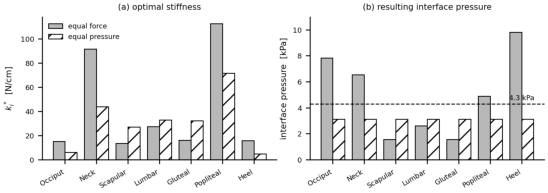
Equilibrium fixes the common interface pressure at pˉ = W/ΣAj = 686.7/2200 = 0.312 N/cm² = 3.12 kPa, below the value of approximately 4.3 kPa (32 mmHg) conventionally taken as the capillary occlusion pressure associated with ischaemic risk. This level is set entirely by body weight and total contact area and cannot be altered by any choice of stiffness; the stiffness distribution governs only how uniformly that level is approached.
The contrast with force equalization is shown in Figure 2(b). Assigning the same reaction force W/7 = 98.1 N to every point produces pressures from 1.6 kPa at the scapular and gluteal regions to 9.8 kPa at the heel, four of the seven above the ischaemic threshold, because the load is carried by areas that differ by more than a factor of six; the area-weighted optimum (10) places every point at 3.12 kPa. The stiffness distribution changes accordingly, the large-area regions taking a larger share of the load, and its range narrows from 13.7–112.6 N/cm to 5.0–71.6 N/cm.
Table 2: Target displacements and optimal stiffness distribution for each support point.
Heel 100 6.271 5.0 25.7 Contact areas are representative values assumed for illustration. ki
* is the area-weighted optimum (10); kmax is the largest stiffness obtainable at that point with conventional pocket springs. † exceeds kmax.
Figure 2: Force equalization compared with pressure equalization. (a) Optimal stiffness ki*; (b) the resulting interface pressure. Grey bars assign the same reaction force W/7 to every point; hatched bars are the area-weighted optimum (10). The dashed line in (b) is the 4.3 kPa capillary occlusion pressure.
Whether the optimum of (10) can be built passively is decided by the stiffness obtainable from a helical spring, k = Gd4/(8D3n), with G = 79.3 GPa for spring steel, wire diameter d, coil diameter D and n active turns. For a representative unit (d = 2.0 mm, D = 70 mm, n = 6) this gives 0.77 N/ cm; across the range of dimensions assumed here as typical of manufactured pocket springs (d = 1.4-2.4 mm, D = 40-80 mm, n = 4-8) a single coil spans 0.09-12.8 N/cm.
The stiffness available at a support point is that of a single coil multiplied by the number of coils the region can accommodate. At an assumed pocket pitch of 7 cm one coil occupies about 49 cm², so the attainable stiffness scales with contact area, and the resulting bound kmax is listed in Table 2. The consequence is unfavourable precisely where it matters, since the concave regions require the highest stiffness and have the smallest area and hence the fewest coils: the cervical region requires 43.7 N/cm against a bound of 38.5 N/cm, and the popliteal region 71.6 N/cm against 51.4 N/cm.
The shortfall is modest, a factor of 1.1 and 1.4, and it is a statement about a particular passive construction rather than a divergence. The required stiffness remains finite for every prescribed sinking depth x¯* greater than s¯ − min si = 3.63 cm, and it grows without bound only as that limit is approached. What the bound establishes is that the exact optimum is unattainable in this construction, so the two objectives can no longer be met simultaneously and a genuine trade-off reappears. The resulting problem is non-convex in k, so a weighted sum does not recover the whole Pareto set; an ε-constraint form, minimizing Vp subject to Ex ≤ ε, is the appropriate way to trace it.
DISCUSSION
What the Stiffness Distribution Can and Cannot Do The analytical results separate the design problem into two parts that behave quite differently.
The first part is the uniformity of the interface pressure, and this the stiffness distribution controls completely. Equation (10) drives both the posture error and the pressure variance to zero at once, so posture preservation and pressure redistribution are not intrinsically opposed. Earlier treatments that equalize reaction forces reach this conclusion only under the tacit assumption of equal contact areas; once the areas are admitted, force equalization is seen to concentrate pressure on the occiput and the heel rather than relieve it.
The second part is the level at which the pressure is equalized, pˉ = W/ΣAj, and this lies entirely outside the stiffness design space. No redistribution of ki changes it. Reducing it requires enlarging the total contact area, through deeper immersion, thicker comfort layers or local conforming supports, which is an independent design variable. For the present subject the level is 3.12 kPa, below the ischaemic threshold, so uniformity is the binding requirement here; for a heavier subject or a smaller contact area the ordering would reverse.
Interactive Mattress Balancing Body Pressure Distribution 2321 Studies of pressure ulcer mechanisms point the same way, localized internal stress and deep tissue deformation being decisive (Linder-Ganz et al., 2007; Gefen, 2010; Linder-Ganz and Gefen, 2004): support is a matter of mechanical compatibility rather than of surface pressure alone.
Necessity of Active Control and Role of the Parameter λ The weighting parameter λ plays a role here that differs from its usual one. Multi-objective problems of this kind are ordinarily solved numerically, by evolutionary or related methods (Deb et al., 2002), and varying λ in a weighted sum then traces different Pareto-optimal solutions; in the unconstrained problem treated here the distribution (10) satisfies Ex = 0 and Vp = 0 simultaneously, so J = 0 for every λ ≥ 0 and the weighting is immaterial.
Under the manufacturing bounds of the preceding section the situation changes, because the exact realization of ki
* is prevented at the cervical and popliteal regions and the implemented distribution deviates from the optimum, leading to Ex > 0, Vp > 0 (16)
In this context, λ expresses the relative penalty between posture error and pressure non-uniformity—a weighting for approximate design rather than a complete parameterization of the Pareto set, which for this non-convex problem requires the ε-constraint form noted above.
In an active system the picture changes. Variable-stiffness elements and integrated actuators allow the support condition to be adjusted in real time (Chao and Shen, 2022; Manti et al., 2016; Peng et al., 2024), so that stiffness becomes controllable in time as well as in space and the design question turns from choosing a fixed distribution into tracking ki
*. A static optimum, taken by itself, would justify no more than a one-time setting: once ki
* has been realized there is nothing further to adjust, and an adjustable mattress would do in place of an interactive one. The case for interactive support rests instead on the optimum being non-stationary, and the closed form makes that dependence explicit, since ki
* is set by si and Ai, both of which change in use: a turn from supine to lateral alters profile and contact areas together, and soft-tissue creep enlarges the contact area over a night, lowering pˉ while redistributing it. Because pressure ulcer risk is governed by the product of pressure and its duration (Gefen, 2009), holding one distribution fixed—even the optimal one—need not be the best policy, and deliberately cycling the load share within a neighbourhood of ki
* may be preferable to tracking it exactly. So read, the closed form does not prescribe a control trajectory but fixes the reference distribution about which one should be centred. The argument is inferential: the time dependence of si, Ai and hence of ki
* is not measured here, and quantifying it is a prerequisite for any closed-loop design.
LIMITATIONS AND FUTURE WORK The present model is a first-order approximation representing human body support as a discrete system of linear springs; interactions between regions, nonlinear material properties, viscoelasticity and detailed anatomical geometry are not considered. The contact areas are treated as fixed parameters, whereas in a real mattress they change with immersion and are themselves a design variable.
Two further qualifications concern the objective itself. First, because the body is treated as holding its relative geometry, the posture term does not resolve local deformation such as isolated lumbar sag; connecting the support points by an elastic beam would make it sensitive to this. Second, driving the pressure variance to zero is an idealization adopted for the pressure ulcer setting treated here; whether perfect uniformity is also what comfort requires is a separate question, and prescribing an admissible band rather than a point target is the natural extension.
Nonlinear tissue behaviour and time-dependent responses affect the pressure distribution appreciably (Oomens et al., 2013), and continuous and FEM-based models are the established tools for them (Viceconti et al., 2005). Future work extends the model accordingly, validated against coupled FEM analysis.
CONCLUSION
This study formulated the support of the recumbent body as a multi- objective optimization combining posture preservation and interface- pressure redistribution, and obtained a closed-form optimum in which the stiffness at each support point is proportional to its contact area and inversely proportional to its required displacement. The force-equalizing solution assumed in earlier work is the special case of equal contact areas; where the areas differ, as they do by more than a factor of six along the body, equalizing forces concentrates pressure on the occiput and the heel instead of relieving it.
The two objectives are therefore not intrinsically in conflict, and in the unconstrained problem they are met together. What the stiffness distribution cannot influence is the level at which the pressure is equalized, fixed by body weight and total contact area; lowering it belongs to a separate design variable, the contact area itself.
The stiffness range attainable with conventional pocket springs shows where the passive limit lies. Attainable stiffness scales with the area available for coils, so the concave regions, which require the most stiffness, have the fewest coils: the cervical and popliteal regions fall short by factors of 1.1 and 1.4. The exact optimum is therefore unrealizable in this construction, a trade- off reappears, and variable stiffness with sensing and actuation becomes the natural route.
Interactive Mattress Balancing Body Pressure Distribution 2323 The work is a feasibility study establishing the analytical framework rather than a validated physiological model, the contact areas and body profile being representative rather than measured. Future work should admit an elastic continuum and nonlinear material behaviour, and validate the predicted pressures with a sensor-equipped prototype.
REFERENCES
Brienza, D., Kelsey, S., Karg, P., Allegretti, A., Olson, M., Schmeler, M., Zanca, J., Geyer, M. J., Kusturiss, M., Holm, M. (2010) “A randomized clinical trial on preventing pressure ulcers with wheelchair seat cushions”, Journal of the American Geriatrics Society, Vol. 58, No. 12, pp. 2308–2314.
Chao, Y., Shen, L. M. (2022) “Nonlinear stiffness characteristics and model of air spring for mattress based on finite element and numerical analysis”, Advanced Theory and Simulations, Vol. 5, No. 11, 2200393.
Deb, K., Pratap, A., Agarwal, S., Meyarivan, T. (2002) “A fast and elitist multiobjective genetic algorithm: NSGA-II”, IEEE Transactions on Evolutionary Computation, Vol. 6, No. 2, pp. 182–197.
Fadil, R., Hoffmann, B., Lovelace, S., Farahani, B., Arzanpour, S., Loscheider, J., Aboonabi, A., Tavakolian, K. (2022) “Design and evaluation of a dynamic air cushion for pressure ulcers prevention”, Journal of Tissue Viability, Vol. 31, No. 3, pp. 491–500.
Gefen, A. (2007) “The biomechanics of sitting-acquired pressure ulcers in patients with spinal cord injury or lesions”, International Wound Journal, Vol. 4, No. 3, pp. 222–231.
Gefen, A. (2009) “Reswick and Rogers pressure–time curve for pressure ulcer risk. Part 1”, Nursing Standard, Vol. 23, No. 45, pp. 64–68.
Gefen, A. (2010) “The biomechanics of heel ulcers”, Journal of Tissue Viability, Vol. 19, No. 4, pp. 124–131.
Ito, J., Usuki, S. (2024) “Measurement and control of body pressure towards smart bed system”, International Journal of Automation Technology, Vol. 18, No. 1, pp. 104–111.
Linder-Ganz, E., Gefen, A. (2004) “Mechanical compression-induced pressure sores in rat hindlimb: muscle stiffness, histology, and computational models”, Journal of Applied Physiology, Vol. 96, No. 6, pp. 2034–2049.
Linder-Ganz, E., Shabshin, N., Itzchak, Y., Gefen, A. (2007) “Assessment of mechanical conditions in sub-dermal tissues during sitting: A combined experimental– MRI and finite element approach”, Journal of Biomechanics, Vol. 40, No. 7, pp. 1443–1454.
Liu, J. J., Xu, W., Huang, M.-C., Alshurafa, N., Sarrafzadeh, M., Raut, N., Yadegar, B. (2014) “Sleep posture analysis using a dense pressure sensitive bedsheet”, Pervasive and Mobile Computing, Vol. 10, pp. 34–50.
Makhsous, M., Rowles, D. M., Rymer, W. Z., Bankard, J., Nam, E. K., Chen, D., Lin, F. (2007) “Periodically relieving ischial sitting load to decrease the risk of pressure ulcers”, Archives of Physical Medicine and Rehabilitation, Vol. 88, No. 7, pp. 862–870. 2324 Ito and Usuki Manti, M., Cacucciolo, V., Cianchetti, M. (2016) “Stiffening in soft robotics: A review of the state of the art”, IEEE Robotics and Automation Magazine, Vol. 23, No. 3, pp. 93–106.
McInnes, E., Jammali-Blasi, A., Bell-Syer, S. E. M., Dumville, J. C., Middleton, V., Cullum, N. (2015) “Support surfaces for pressure ulcer prevention”, Cochrane Database of Systematic Reviews, No. 9, CD001735.
Oomens, C. W. J., Zenhorst, W., Broek, M., Hemmes, B., Poeze, M., Brink, P. R. G., Bader, D. L. (2013) “A numerical study to analyse the risk for pressure ulcer development on a spine board”, Clinical Biomechanics, Vol. 28, No. 7, pp. 736–742.
Sprigle, S., Sonenblum, S. (2011) “Assessing evidence supporting redistribution of pressure for pressure ulcer prevention: A review”, Journal of Rehabilitation Research and Development, Vol. 48, No. 3, pp. 203–213.
Viceconti, M., Olsen, S., Nolte, L. P., Burton, K. (2005) “Extracting clinically relevant data from finite element simulations”, Clinical Biomechanics, Vol. 20, No. 5, pp. 451–454.
SEARCH THE AHFE DIGITAL BOOKSTORE BY ISBN
Explore the complete digital volume
Human Factors in Design, Engineering, and Computing
Read this individual research paper free through the original publisher, or explore the full digital proceedings book.