Michael J. Jorgensen, Daniel Chikwendu, Nils A. Hakansson, Juan Hernandez, Hai Nguyen (2026). Comparison of Horizontal Moment-Arm Measurements for the Revised NIOSH Lifting Equation and the Lifting Fatigue Failure Tool. In: Human Factors in Design, Engineering, and Computing. AHFE Open Access, vol. 238, pp. 2460–2470. https://doi.org/10.54941/ahfe1008471
The Revised NIOSH Lifting Equation (RNLE) and Lifting Fatigue Failure Tool (LiFFT) manual handling risk assessment methods require measuring horizontal load moment-arms, but from different body landmarks. Since it is unclear if these different measurement methods are interchangeable the research objectives were to determine if differences exist between RNLE and LiFFT moment-arms and determine the impact of moment-arm differences on assessment method risk interpretations. Twenty subjects lifted loads from ten vertical (floor-to-mid shin, mid shin-to-knuckle, knuckle-to-shoulder, shoulder-and-above) and horizontal (close: 30cm; intermediate: 55cm; far: 75cm) zone combination locations. Moment-arms were quantified by a motion capture system by determining the horizontal distance between reflective markers placed on the third knuckle and markers placed on the hips (LiFFT method) and ankles (RNLE method). ANOVA techniques assessed moment-arm differences within each vertical zone, and risk interpretations (low-, moderate-, high-risk) were assessed using both RNLE and LiFFT moment-arms in each assessment method. RNLE moment-arms were larger than LiFFT moment-arms in the shoulder-and-above and knuckle-to-shoulder vertical zones. LiFFT moment-arms were larger than RNLE moment arms in the mid shin-to-knuckle and floor-to-mid shin vertical zones. When LiFFT moment-arms were input into RNLE and LiFFT assessment methods there was no difference in resulting risk categories. When RNLE moment-arms were input into RNLE and LiFFT methods there was no difference in resulting risk categories. For sagittally-symmetric lifting it appears RNLE and LiFFT moment-arm measurements may be used interchangeably reducing multiple measurements.
Low back pain (LBP) ranks high in terms of prevalence and healthcare costs. Estimates for the cost of LBP (direct and indirect costs) in the United States
Comparison of Horizontal Moment-Arm Measurements 2461 range from $19.8 to $118.8 billion (Dagenais et al., 2008), whereas the 12-month prevalence of LBP lasting 7 days, seeking medical care, and lost time due to LBP were 25%, 14% and 10%, respectively (Ferguson et al., 2019). To reduce the risk of LBP it is imperative to understand the biomechanical contributors, of which one of the most predictive contributors is the external load moment (Marras et al., 2000; Norman et al., 1998), i.e., the load weight multiplied by the horizontal distance the load is from the body.
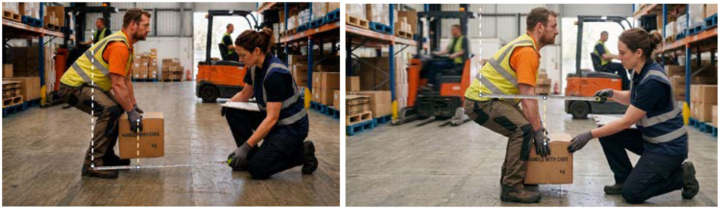
Validated manual material handling (MMH) risk assessments methods, such as the Revised NIOSH Lifting Equation (RNLE; Waters et al., 1993; Lu et al., 2014) and the Lifting Fatigue Failure Tool (LiFFT; Gallagher et al., 2017) utilize aspects of the external load moment, which typically requires manually measuring the horizontal moment-arm, but from different body landmarks. The RNLE requires measuring from the midpoint between the 3rd metacarpal-phalangeal joint (3rd knuckle) to the midpoint between the ankles (Figure 1), whereas LiFFT requires measuring from the 3rd knuckle to the approximate L5/S1 intervertebral disc, utilizing the iliac crest (hip) as the measurement landmark (Figure 1).
Figure 1: Manual measurement method for the Revised NIOSH Lifting Equation (left pane: horizontal distance between the 3rd knuckle to the midpoint between the ankles) and the Lifting Fatigue Failure Tool (right pane: horizontal distance between the 3rd knuckle and the approximate L5/S1 disc).
In practice, multiple assessment methods are sometimes used to increase confidence in risk assessment outcomes when evaluating jobs involving lifting or lowering tasks. To save time on exposure measurements collecting one horizontal moment-arm and applying it to both LiFFT and the RNLE would be ideal. Recent research (Jorgensen et al., 2024) found that when utilizing the LiFFT-method measurement moment-arm for both the RNLE and LiFFT assessment methods to assess LBP risk in the same industrial multi-task manual material handling jobs, the RNLE and LiFFT showed a strong correlation in terms of increasing risk factor exposure resulting in increasing method outputs for both methods (i.e., Lifting Index for the RNLE, probability of high-risk for LiFFT). This study also found that the resulting RNLE and LiFFT risk category classifications (i.e., low, moderate, high) exhibited moderate agreement when assessing the same jobs utilizing the LiFFT-method moment-arm for both the RNLE and LiFFT.
Given these findings, it may be tempting to suggest that utilizing one horizontal moment-arm measurement (e.g., LiFFT-method horizontal moment-arm) for both RNLE and LiFFT assessments would be acceptable
with little loss of outcome accuracy. However, Jorgensen et al. (2024) also indicated the industrial manual material handling jobs assessed did not include tasks with extreme torso flexion, nor did they measure the RNLE method moment-arm. Thus, it is unknown how the RNLE and LiFFT methods would compare for tasks with different magnitudes of torso flexion, nor if measurement body landmark differences lead to differences in horizontal moment-arm measurements and differences in resulting risk category classifications. As such, there were two main research objectives of this study: 1) determine if differences exist between the RNLE and LiFFT moment-arm measurements when lifting loads from the same locations, and 2) determine the impact of any moment-arm differences on RNLE and LiFFT risk category classifications when lifting loads from the same locations.
METHODS
Participants for this study were of a sample of convenience from a university population, consisting of twenty participants (12 males, 8 females). The mean (SD) age, height and weight was 25.3 yrs (6.0), 173.4 cm (10.1), and 82.9 kg (13.3), respectively, for male participants, and 25.3 yrs (4.2), 162.3 cm (7.1), and 63.3 kg (10.2), respectively, for female participants. Most participants were inexperienced with manual material handling, and participants could not participate if they had a prior history of or were currently experiencing low back pain.
Upon arrival at the laboratory participants were briefed on the study objectives and procedures, whereupon participants signed an informed consent form approved by the Wichita State University Institutional Review Board for Human Subjects (IRB #5911), providing written consent to participate in this study.
After providing written consent to participate, demographics (sex, age, manual material handling experience) and anthropometric measurements (stature, body mass, knee height, knuckle height, elbow height, shoulder height) were collected. This was followed by application of reflective markers to various body landmarks that would be utilized with an infrared motion capture system during the experimental lifting tasks. Reflective markers were placed on the knuckles (3rd metacarpal-phalangeal joint), ankles (lateral malleolus), and iliac crest of each participant, and a reflective marker was placed on the box to quantify box movement and displacement. To quantify the horizontal moment-arms using the LiFFT and RNLE measurement approaches a 12-camera infrared motion capture system (Motion Analysis, Rohnert Park, CA, USA) was utilized to record the three-dimensional time-dependent positions of the various markers throughout the various experimental tasks at 120 Hz.
The experimental tasks consisted of lifting a box (18cm × 29cm × 23cm) with handles from 10 different horizontal-vertical zone combination locations, defined by the ACGIH TLV for Lifting (ACGIH, 2024), to an upright standing stance with the box ending at the elbow level of the participant. The three ACGIH TLV defined horizontal zones (distances measured horizontally from the ankles of an upright participant to handles of the box) were defined as
Comparison of Horizontal Moment-Arm Measurements 2463 ‘Close’ (0-30cm), ‘Intermediate’ (30-60cm), and ‘Far’ (60-80cm). The specific box handle locations to represent each horizontal zone were 30cm, 55cm and 75cm for the Close, Intermediate and Far zones, respectively. The four ACGIH TLV defined vertical zones were ‘Floor to Mid-Shin’, ‘Mid-Shin to Knuckle’, ‘Knuckle to Shoulder’, and ‘Shoulder and Above’. The specific vertical box handle location for the Floor to Mid-Shin zone was 15cm (for all participants) and 50cm for the Mid-Shin to Knuckle zone (for all participants). The Knuckle to Shoulder zone box handle height was based on elbow height anthropometry and was 110cm for males (approximately 75th percentile) and 103cm for females (approximately 75th percentile). Similarly, the box handle height in the Shoulder and Above zone was based on shoulder height anthropometry and was 160cm for males (approximately 99th percentile male) and 145cm for females (approximately 99th percentile female). The lifting trials were infeasible in the Shoulder and Above and Knuckle to Shoulder vertical zones in the Close horizontal zone due to interference of the surface the box sat on, thus, lifting from these two zone combinations was not performed. The box weights varied as a function of vertical and horizontal zones, ranging from 1.7kg to 9 kg, and were selected to represent low-risk box weights based in part on frequent lifting (30 to 360 lifts per hour, >2 hours per day) established by the ACGIH TLV for Lifting (ACGIH, 2024). The various box weights and locations of the box as a function of vertical and horizontal zones are shown in Table 1.
Table 1: Experimental lifting task conditions (i.e., box weight, box handle vertical and horizontal distances) as a function of vertical and horizontal zone.
Table available in the original PDF paper.
Vertical Zone Horizontal Zone Close (30cm) Intermediate (55cm) Far (75cm)
Shoulder and Above
Not feasible Weight: 3.2kg Height (males): 160cm Height (females): 145cm
Weight: 1.7kg Height: 15cm Each of the vertical-horizontal zone combinations was presented to the participants in a random order, where participants performed three lifting repetitions from each of the 10 vertical-horizontal zone combinations, at a rate of three lifts per minute. Participants would reach to the box (origin) and lift/transfer the box to an ending location in front of their body at elbow level (destination). Upon completion of each lifting trial a researcher would then return the box to the origin to be ready for the next lifting trial. Participants performed sagittal-symmetric experimental lifting tasks without moving their feet, using a self-determined lifting technique.
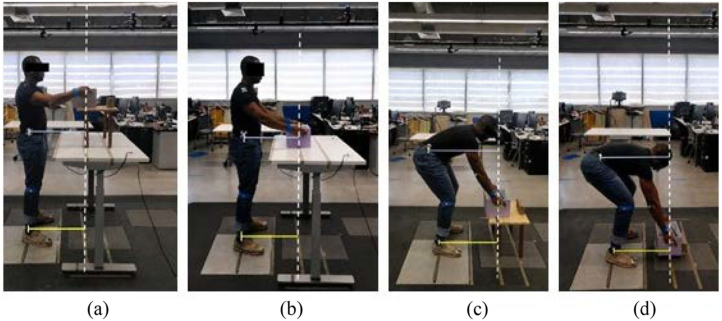
The three-dimensional kinematic data from the reflective markers were processed using Cortex software (Motion Analysis, version 8.1.0, Rohnert Park, CA, USA) to determine the time-dependent x-, y- and z-axis positions relative to a fixed coordinate system. From this processed data the horizontal moment-arms for the LiFFT and RNLE assessment method approaches were determined at the origin of the lift, which was defined as the point in time when the participant began to move the box. The RNLE method horizontal moment-arm (Figure 2) was the horizontal distance between the midpoint between the knuckles (3rd metacarpal-phalangeal joint) and the midpoint between the ankles (lateral malleolus). The LiFFT method horizontal moment-arm (Figure 2) was defined as the distance between the midpoint between the knuckles (3rd metacarpal-phalangeal joint) and the midpoint between the hips (iliac crest).
Figure 2: Experimental lifting tasks and moment-arm measurements from the motion capture system, lifting from the intermediate horizontal zone for the following vertical zones (a) Shoulder and Above, (b) Knuckle to Shoulder, (c) Mid-Shin to Knuckle, (d) Floor to Mid-Shin. The yellow horizontal line represents the mid-point of the knuckles to the ankles (RNLE approach) and the white horizontal line represents the mid-point of the knuckles to iliac crest (LiFFT approach).
To determine if the RNLE and LiFFT method moment-arms could be used interchangeably the impact of using the different moment-arms was explored for each horizontal-vertical zone combination. To determine the impact on the RNLE method, both LiFFT and RNLE method moment-arms were input into the RNLE to determine the resulting RNLE Lifting Index. Inputs included the moment-arms to determine the horizontal multiplier, the origin and destination vertical heights to determine the vertical multiplier, coupling was defined as ‘Good’, asymmetry was set at 0 degrees, and the lifting frequency and duration were set at 3 lifts per minute and 8 hours, respectively. The Lifting Index (LI) was determined using the LiFFT moment- arm and RNLE moment-arm and then classified as low- (LI ≤ 1.0), moderate- (1.0 < LI < 3.0), or high-risk (LI ≥ 3.0). To determine the impact on the LiFFT method, both the LiFFT and RNLE method moment-arms were input into the
Comparison of Horizontal Moment-Arm Measurements 2465 LiFFT assessment method to determine the resulting probability of high-risk. Inputs included the horizontal moment-arms, the weight of the box, and the number of repetitions equivalent to an 8-hour work shift (i.e., 1440 repetitions). The probability of high-risk was determined using the LiFFT moment-arm and RNLE moment arm and then classified as low- (≤ 25%), moderate- (25% – 50%), or high-risk (>50%).
Moment-arm measurements were statistically assessed utilizing a two- way repeated measures Analysis of Variance (ANOVA) at each vertical zone, where independent variables included assessment method measurement approach (RNLE, LiFFT) and horizontal zone (close, intermediate, far). Significant main effects were explored utilizing a Tukey HSD post-hoc test, and significant two-way interactions were explored utilizing a Fishers LSD post-hoc test utilizing a Bonferroni adjustment for the number of comparisons, using α = 0.05.
RESULTS
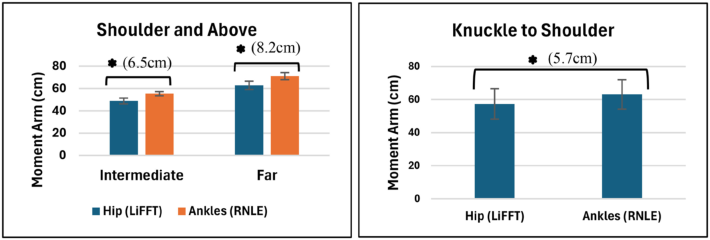
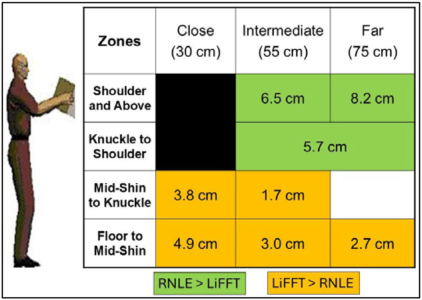
In the Shoulder and Above zone there was a significant method by horizontal zone interaction (p < 0.0001), where the RNLE moment-arm was significantly larger than the LiFFT moment-arm (by 6.5cm and 8.2cm at the intermediate and far zones, respectively; Figure 3). In the Knuckle to Shoulder zone a significant method main effect was present (p < 0.0001) where the RNLE moment-arm was significantly greater (by 5.7cm) than the LiFFT moment- arm (Figure 3).
Figure 3: Mean moment-arms in the shoulder and above zone as a function of horizontal zone and assessment method (left pane) and in the knuckle to shoulder zone as a function of assessment method (right pane) -*indicates significant difference in moment-arms.
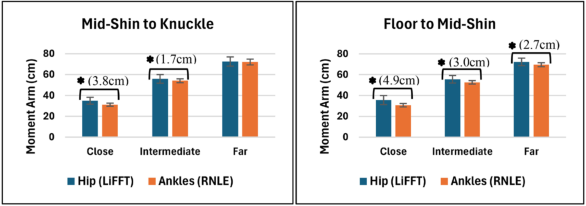
In the Mid-Shin to Knuckle zone (Figure 4) there was a significant method by horizontal zone interaction (p < 0.0001), where LiFFT moment-arms were significantly larger than RNLE moment-arms (by 3.8cm and 1.7cm at the close and intermediate zones, respectively). In the Floor to Mid-Shin zone (Figure 4) there was a significant method by horizontal zone interaction (p = 0.0004), where the LiFFT moment-arm was significantly larger than the RNLE moment-arm (by 4.9cm, 3.0cm and 2.7cm at the close, intermediate and far zones, respectively).
Figure 4: Mean moment-arms as a function of horizontal zone and assessment method in the mid-shin to knuckle zone (left pane) and the floor to mid-shin zone (right pane) - *indicates significant difference in moment-arms.
Viewing these results from a collective perspective (Figure 5), when lifting from the Shoulder and Above and the Knuckle to Shoulder vertical zones the RNLE moment-arm measurement was always significantly greater than the LiFFT moment-arm measurement. When lifting from the Mid-Shin to Knuckle and the Floor to Mid-Shin vertical zones the LiFFT moment-arm measurement was always significantly greater than the RNLE moment-arm measurement.
Figure 5: Magnitude of the significant difference in moment-arms between LiFFT and RNLE assessment methods as a function of horizontal and vertical zones.
The impact of the differences in LiFFT and RNLE moment-arms was assessed by inputting the LiFFT and RNLE moment-arms into the RNLE and determining the differences in the resulting RNLE Lifting Index and then inputting the LiFFT and RNLE moment-arms into the LiFFT assessment method and determining the resulting differences in the LiFFT probability of high-risk.
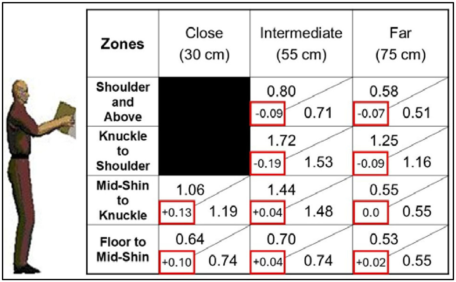
When the RNLE moment-arms were input into the RNLE assessment method (Figure 6) the resulting mean Lifting Indexes were in the low-risk classification (0.0 < LI ≤ 1.0) in six of the zone combinations (ranging from 0.53 to 0.80) and in the moderate-risk classification (1.0 < LI < 3.0) in four of the zone combinations (ranging from 1.06 to 1.72). When inputting the LiFFT moment-arms instead of the RNLE moment-arms into the RNLE
Comparison of Horizontal Moment-Arm Measurements 2467 assessment method, there were slight increases (ranging from 0.02 to 0.13) in the LI in the Mid-Shin to Knuckle and Floor to Mid-Shin zones and slight decreases in the LI (ranging from 0.07 to 0.19) in the Knuckle to Shoulder and Shoulder and Above zones. These small changes in the LI did not result in any RNLE risk category changes when using the LiFFT moment-arms instead of the RNLE moment-arms.
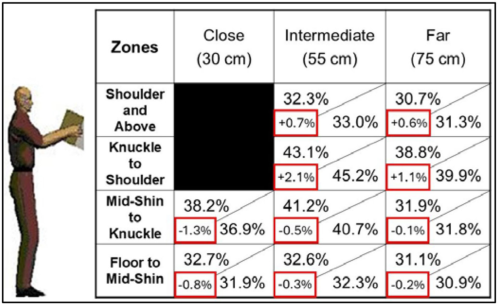
Figure 6: Mean RNLE Lifting Index values as a function of zone and assessment method. For each cell, the upper-left diagonal value is the Lifting Index using the RNLE moment-arms, the lower-right diagonal value is the Lifting Index using the LiFFT moment-arms, and the value in the red box is Lifting Index difference when using LiFFT moment-arms in the RNLE.Figure 7: Mean LiFFT probability of high-risk values as a function of zone and assessment method. For each cell, the upper-left diagonal value is the LiFFT probability of high-risk using the LiFFT moment-arms, the lower-right diagonal value is the LiFFT probability of high-risk using the RNLE moment-arms, and the value in the red box is probability value difference when using RNLE moment-arms in the LiFFT method.
When the LiFFT moment-arms were input into the LiFFT assessment method (Figure 7) the resulting mean probability of high-risk was in the moderate-risk classification (25% to 50%) in all 10 zone combinations (ranging from 31.1% to 43.1%). When inputting the RNLE moment-arms
instead of the LiFFT moment-arms into the LiFFT assessment method, there were slight decreases (ranging from 0.1% to 1.3%) in the Mid-Shin to Knuckle and Floor to Mid-Shin zones and slight increases (ranging from 0.6% to 2.1%) in the Knuckle to Shoulder and Shoulder and Above zones. These small changes in probability of high-risk did not result in any LiFFT risk category changes when using the RNLE moment-arms instead of the LiFFT moment-arms.
DISCUSSION
Assessing low back injury risk from manual handling activities typically requires quantitative exposure measurements, where two such assessment methods are the long-standing and widely used RNLE and the more recent LiFFT assessment methods. One common input into each of these methods includes the horizontal moment-arms but the two methods use different body landmarks for measurement purposes. It was of interest to determine if there are differences between the RNLE- and LiFFT-method moment-arm measurements for the same lifting tasks, and if any differences observed would have an impact on the resulting risk category classifications. The two main findings from this study were 1) the RNLE- and LiFFT-method moment-arms were significantly different from each other at most horizontal- vertical zones investigated, and 2) although there were differences between the method-specific moment-arm measurements, using these moment-arm measurements interchangeably in LiFFT and the RNLE did not alter the risk category interpretations.
Except for one zone (far horizontal distance in the Mid-Shin to Knuckle vertical zone; Figure 4) the RNLE and LiFFT moment-arm measurements were significantly different from each other. However, the direction of the difference was dependent upon the vertical height, where lifting from the two upper zones resulted in greater RNLE moment-arms and lifting from the two lower zones resulted in greater LiFFT moment-arms. These moment- arm differences as a function of vertical zone likely resulted from varying degrees of knee flexion and location of hips when lifting from different vertical heights. Lifting from the Knuckle to Shoulder and Shoulder and Above zones can be performed in mostly upright posture, where the iliac crest is somewhat anterior to the location of the ankles (Figure 2). Reaching to further horizontal distances within these vertical zones resulted in greater distance from the ankles to the hands (RNLE method) compared to the iliac crest to the hands (LiFFT method). Lifting from the lower vertical zones (Floor to Mid-Shin and Mid-Shin to Knuckle) resulted in varying degrees of torso flexion and knee flexion. Since the ankles remained stationary and the hips typically translated posteriorly with increased torso and knee flexion, the LiFFT moment-arms increased and were larger than the RNLE moment- arms when lifting from these lower vertical heights.
The magnitude of the method-specific moment-arm differences when lifting from the same vertical-horizontal zone locations varied from 1.7cm to 4.9cm when lifting from the two lower vertical zones, and from 5.7cm
Comparison of Horizontal Moment-Arm Measurements 2469 to 8.2cm when lifting from the two upper vertical zones. These moment- arm differences are well within the error reported by authors investigating manually measuring moment arms. For the RNLE, Dempsey et al. (2001) found mean manual horizontal moment-arm measurement error of 8.0cm for symmetric lifting, whereas Marras et al. (2010) found a mean absolute error of 10.9cm when manually measuring horizontal moment-arms from the hands to the approximate L5/S1, similar to the LiFFT measurement approach. As such, error magnitude may be more of an issue from manual measurements rather than which landmarks are used (hip vs. ankles) when quantifying the horizontal moment-arms.
Although the moment-arms were significantly different between RNLE and LiFFT measurement methods when lifting from most locations, it appears the RNLE and LiFFT moment-arms could be used interchangeably. When utilizing LiFFT moment-arms in the RNLE the change in the Lifting Index (compared to using the RNLE moment-arms) ranged from -0.19 to +0.13 (Figure 6), with no change in the risk category classification. Similarly, when utilizing RNLE moment-arms in the LiFFT assessment method, the change in probability of high risk (compared to using the LiFFT moment-arms) ranged from −1.9% to +2.1% (Figure 7) with no change in the risk category classification. Collectively, at least for sagitally-symmetric lifting of low- to lower-moderate risk loads, it appears that one moment-arm measurement, either the RNLE or LiFFT method, may be utilized with little to no change in risk category classification.
The results of this study should be viewed with respect to several methodological limitations. First, most participants were inexperienced with manual handling activities. Second, all lifting tasks were performed with feet stationery. Lifting in real workplaces vary in terms of foot placement, thus, differences in moment-arm measurements may exist between assessment methods. Third, the selected load weights were low to reduce risk of injury, lifting heavier loads may alter body postures. Finally, the lifting tasks were sagittally-symmetric (i.e., no torso asymmetry or twisting), it is unknown what the moment-arm differences would be at various torso asymmetry angles.
CONCLUSION
This study quantified horizontal moment-arms using the technique from the RNLE and LiFFT from various horizontal and vertical locations and evaluated the risk category classifications when utilizing the RNLE and LiFFT moment- arms in each assessment method. While there were significant differences between the LiFFT and RNLE moment-arms, ranging from 1.7cm to 8.2 cm, depending on vertical and horizontal zone, using the RNLE and LiFFT moment-arms interchangeably in each assessment method resulted in no change in risk category classification. Thus, at least for sagittally symmetric lifting of low- to lower-moderate risk loads, it appears that one moment-arm measurement, either the RNLE or LiFFT method, may be utilized with little to no change in risk category classification.
REFERENCES
ACGIH (2024). American Conference of Governmental Industrial Hygienists, TLVs and BEIs: Threshold Limit Values for Chemical Substances and Physical Agents and Biological Exposure Indices. Cincinnati, OH. (www.acgih.org). Dagenais S, Caro J, Haldeman S. (2008). A Systematic Review of Low Back Pain
Cost of Illness Studies in the United States and Internationally. The Spine Journal, Vol. 8, 8–20. Dempsey PG, Burdorf A, Fathallah FA, Sorock GS, Hashemi L. (2001). Influence of measurement accuracy on the application of the 1991 NIOSH equation. Applied Ergonomics, Vol. 32, 91–99. Ferguson SA, Merryweather A, Thiese MS, Hegmann KT, Lu M-L, Kapellusch JM,
Marras WS. (2019). Prevalence of low back pain, seeking medical care, and lost time due to low back pain among manual material handling workers in the United States. BMC Musculoskelet Disord, Vol. 20, 243. Gallagher S, Sesek RF, Schall MC, Huangfu R. (2017). Development and validation of an easy-to-use risk assessment tool for cumulative low back loading: The Lifting Fatigue Failure Tool (LiFFT). Applied Ergonomics, Vol. 63, 142–150. Jorgensen MJ, Martinez A, Hakansson NA. (2024). Comparison of multi-task
ergonomic assessment methods for risk of upper extremity and low back musculoskeletal disorders. Applied Ergonomics, Vol. 119, 104313. Lu M-L, Waters TR, Krieg E, Werren D. (2014). Efficacy of the revised NIOSH lifting equation to predict risk of low-back pain associated with manual lifting: A one- year prospective study. Human Factors, Vol. 56, 73–85. Marras WS, Allread WG, Burr D, Fathallah F. (2000). Prospective validation of a low-
back disorder risk model and assessment of ergonomic interventions associated with manual materials handling tasks. Ergonomics, Vol. 43, 1866–1886. Marras WS, Lavender SA, Ferguson SA, Splittstoesser RE, Yang G, Schabo P. (2010).
Instrumentation for measuring dynamic spinal load moment exposures in the workplace. Journal of Electromyography and Kinesiology, Vol. 20, 1–9. Norman R, Wells R, Neumann P, Frank J, Shannon H, Kerr M, Ontario Universities Back Pain Study Group. (1998). A comparison of peak vs. cumulative work exposure risk factors for the reporting of low back pain in the automotive industry. Clinical Biomechanics, Vol. 13, 561–573. Waters TR, Putz-Anderson V, Garg A, Fine LJ. (1993). Revised NIOSH equation for
the design and evaluation of manual lifting tasks. Ergonomics, Vol. 36, 749–776.
SEARCH THE AHFE DIGITAL BOOKSTORE BY ISBN
Explore the complete digital volume
Human Factors in Design, Engineering, and Computing
Read this individual research paper free through the original publisher, or explore the full digital proceedings book.