Cathy Chen (2026). Actuation Feasibility and Cost Floor for a Low-Cost Active Knee–Ankle–Foot Orthosis: A Parametric Biomechanical Analysis. In: Human Factors in Design, Engineering, and Computing. AHFE Open Access, vol. 238, pp. 2853–2863. https://doi.org/10.54941/ahfe1008509
Powered lower-limb exoskeletons cost roughly USD 80,000–110,000, motivating maker-built active knee–ankle–foot orthoses (KAFOs) whose components are often chosen on price before the demand is known. We ask what minimum actuation an active KAFO needs for sit-to-stand (STS) transfer and what it costs. An illustrative low-cost design (6061-T6 frame, cable transmission, a 55 kgf·cm hobby servo, IMU/sEMG intent detection) is audited with a reproducible parametric model built from published biomechanics, manufacturer ratings and September 2026 prices; no human participants were involved. Full-assistance STS requires about 46–99 N·m of peak knee-extension torque per knee for 60–90 kg users, against 5.39 N·m servo stall torque: a gap of 8.5–18.4× (43–92× against a 20 % continuous rating). Because gearing cannot add power, even a lossless transmission limits knee speed under this load to 0.13–0.28 rad/s, 7–25× below natural STS knee speeds. Closing the torque gap through an assumed 40 mm knee pulley puts at least 1.15–2.48 kN in the cable, 2.7–5.8× the safe working load of 1/16-in stainless cable, and no bend-radius-compliant cable at that radius is admissible above 32.7 N·m. Integrated brushless actuators, several marketed for exoskeletons, already contain the reduction, making the cable stage redundant. A bilateral minimum-viable design built this way is priced at USD 2,345–3,459 (actuators 47–63 %), 24–47× below the Medicare fee schedule for powered exoskeletons but 4.3–8.4× above a hobby-component baseline, before validation, certification and service. We contribute a reusable feasibility-gate method, an explicit torque–power–tension–cost budget and bench prerequisites for human-loaded testing.
Personal-use powered exoskeletons are priced at about USD 80,000 or more (Kandilakis and Sasso-Lance, 2021), and the U.S. Medicare fee schedule for a bilateral powered hip–knee–ankle–foot device (HCPCS K1007), effective 1 April 2024, spans USD 81,929–109,238 (CMS, 2024; Lifeward, 2024). Maker-built active knee–ankle–foot orthoses (KAFOs) promise a fraction of that, with the risk of choosing components on price and label before the task’s demand is known. A hobby servo sold as “55 kg” is typical: the figure is a stall torque in kilogram-force centimetres (5.39 N·m) at the highest supply voltage, with no continuous rating (AGFRC, 2026). An under-sized
2854 Chen actuator strapped to a person with weak or insensate legs is a hazard, not only a performance problem.
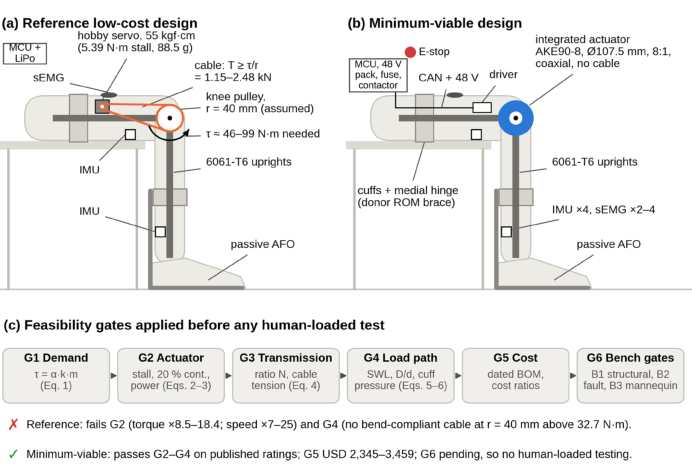
We therefore work backwards from the task. RQ1: What peak knee- extension torque must an active KAFO deliver for sit-to-stand (STS) for users of 60–90 kg, with partial or full assistance? RQ2: Can a 55 kgf·cm hobby servo with a cable transmission meet it once continuous rating, power and cable loads are counted? RQ3: What is the minimum-viable architecture, what does it cost, and what must be verified before any human-loaded test? We contribute a reusable feasibility-gate method (Fig. 1), a torque–power– tension–cost budget that locates where the common design fails, a dated cost floor, and a hazard–control–verification matrix with bench gates. The analysis is model-based: no participants were involved and no clinical benefit is claimed.
Figure 1: (a) Reference low-cost design; (b) derived minimum-viable design; (c) feasibility gates G1–G6 and outcomes. Limbs and actuator near scale; servo pulley enlarged.
RELATED WORK
Sit-to-stand as the binding knee task. Inverse-dynamics studies report per- leg knee-extension moments in STS of about 0.88, 0.77 and 0.48 N·m/kg (converted from %BW·BH) without, with normal and with strong arm support (Bahrami et al., 2000); 0.95–1.06 N·m/kg in healthy adults and 1.15 N·m/kg on the unaffected limb after stroke (Gunnell et al., 2025); and 0.51–1.97 N·m/kg across computed strategies (Yoshioka et al., 2007). STS is regarded as more strength-demanding than walking (Gunnell et al., 2025), and STS knee exoskeletons are sized on it, e.g. 80 N·m at 3 rad/s (Shepherd and Rouse, 2017).
Actuation Feasibility and Cost Floor for a Low-Cost Active Knee–Ankle–Foot Orthosis: 2855 Human factors and risk. Skin and soft-tissue injury is the most frequent adverse event of medical exoskeletons, and devices differ in behaviour on power loss (He et al., 2017); maximum averaged thigh-strap pressures of 28–38 kPa, far above perfusion-based guidance, were recorded on one exoskeleton user (Tamez-Duque et al., 2015). Missing is a reverse-specification audit linking STS biomechanics to hobby actuator claims, transmission and interface loads, and a dated bill of materials (BOM).
METHODS
Reference system. The audited design is an illustrative composite of components common in maker builds (Fig. 1a): bilateral active knees with passive ankle–foot orthoses (AFOs); 6061-T6 aluminium uprights and cuffs; one hobby servo per knee (55 kgf·cm at 8.4 V) driving a cable loop to a knee pulley of 40 mm radius (assumed); and intent detection from inertial measurement units (IMUs) and surface electromyography (sEMG). Its purpose is STS assistance for users with knee-extensor weakness or paralysis; hip actuation, balance, walking and clinical outcomes are out of scope. The analysis is a sequence of gates (Fig. 1c), reproduced by a supplementary script. Demand (G1). The required peak knee-extension torque per knee is τreq = αkm (1)
where m is body mass (60–90 kg), k the per-leg peak knee moment per kilogram and α the share the device supplies. Three scenarios bracket practice: partial assistance (PA), αk = 0.50 N·m/kg (Gunnell et al., 2025); full assistance with arm support (FA-A), 0.765 N·m/kg (4.41 %BW·BH at 1.77 m; Bahrami et al., 2000); and full assistance without arm support (FA), 1.10 N·m/kg, near the upper end of the 0.88–1.15 N·m/kg reported for unassisted rising (Bahrami et al., 2000; Gunnell et al., 2025). Fast or unusual strategies approach 2 N·m/kg (Yoshioka et al., 2007) and are reported as a sensitivity. Actuator and power (G2). The rating gives τstall = 55 × 9.807 × 0.01 = 5.39 N·m. As hobby datasheets give no continuous torque, we adopt a servo maker’s rule of 20% of stall (ROBOTIS, 2020). Eq. (2) gives the ratio needed for motor torque τm at transmission efficiency η. Gearing trades torque for speed but cannot add power: with the linear characteristic τs = τstall(1 − ωs/ω0), the highest knee speed at which τreq can be delivered over all ratios, reached at Nopt, follows Eq. (3): req m stall stall m , { ,0.2 } τ = τ ∈τ τ ητ N (2)
τ τ ω η = ω = = τ µτ P P N (3)
2 , 4
req 0 stall max max max opt req stall Here ω0 = 9.52 rad/s (0.110 s/60° at 8.4 V; AGFRC, 2026), so Pmax = 12.8 W. We compare ωmax with loaded knee-extension speeds of 2.0–3.2 rad/s in
2856 Chen natural STS (Schenkman et al., 1996), using η = 0.90 for an open cable (assumed) and 0.55–0.75 for a Bowden sheath (Asbeck et al., 2015). Transmission, load path and interface (G3–G4). The tension at a knee pulley of centreline radius r is at least T = τ/r, whatever the upstream reduction (pretension adds to it), and a single cable stage needs a servo pulley of radius rs (Eq. 4). A cable of diameter d is admissible if T ≤ Sd/SF, with SF = 5 (the floor for running wire rope; OSHA, 2026) as a screening allowance rather than a medical-device factor, and if the pulley root diameter is at least 25d for 7 × 19 cable (Sava, 2026), i.e. r ≥ 13d (SF absorbs the ≈8% bending loss). Sd is the minimum breaking strength of 302/304 stainless 7 × 19 cable (DoD, 2005) or, with swaged-ball ends, 68–80% of it (Lexco Cable, 2026). Eq. (5) gives the smallest admissible pulley; Eq. (6) the force and projected bearing area of a thigh cuff at distance L from the knee for a mean pressure plim:
τ = =
req , s r T r r N
(4)
req min SF min max 13 , d d r d S
Equation available in the original paper PDF.
req req req lim C F A L Lp
(6) with L = 0.20 m (0.15–0.25 m, assumed) and plim = 16 kPa, the onset of discomfort in circumferential limb compression (Kermavnar et al., 2018). Actuator survey (G2) and cost (G5). Integrated brushless actuators with published ratings and price, including quasi-direct-drive (QDD) units with one low-ratio stage, were screened on peak torque, as the STS torque peak is brief; speed at peak torque is unpublished and was checked through rated power, and thermal duty is left to bench gate B1. Prices (USD) and online sources are dated 26 September 2026; the BOM has a low (lowest verified listing) and a typical (mainstream listing) variant. Cost ratios pair like-for-like variants; the K1007 comparison overstates the saving because K1007 devices also power the hips. G6 comprises the bench gates B1–B3 (Discussion).
RESULTS
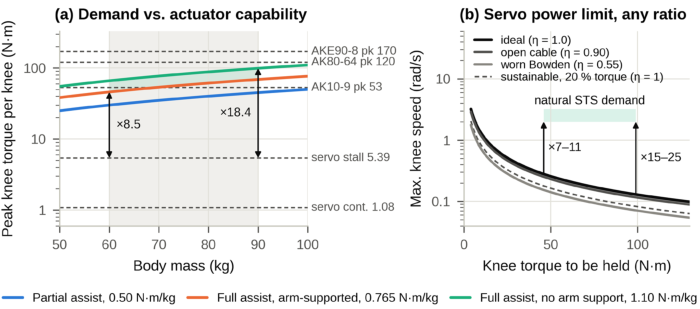
Torque and power gap (G1–G2). Full-assistance STS needs 46–99 N·m of peak knee torque per knee, and partial assistance 30–45 N·m (Table 1, Fig. 2a). Against 5.39 N·m stall torque this is a shortfall of 8.5–18.4× (FA- A, FA) and 5.6–8.3× (PA), or 43–9× against the continuous rating, requiring reductions of 9.5–20.4 at stall or 47–102 in continuous duty (η = 0.90). The power limit holds for any ratio: through a lossless reduction, one servo
Actuation Feasibility and Cost Floor for a Low-Cost Active Knee–Ankle–Foot Orthosis: 2857 can deliver 46 N·m only at up to 0.28 rad/s and 99 N·m only at up to 0.13 rad/s, 7–25× below natural STS (Fig. 2b), and a worn Bowden sheath roughly halves these values. Peak torque and peak speed do not coincide in STS, but even at a quarter of natural peak speed the gap would be 1.8–6.2×. At 2 N·m/kg, demand rises to 120–180 N·m, 22–33× the stall torque.
Table 1: Results per knee by scenario (η = 0.90 unless stated; r = 40 mm; L = 0.20 m).
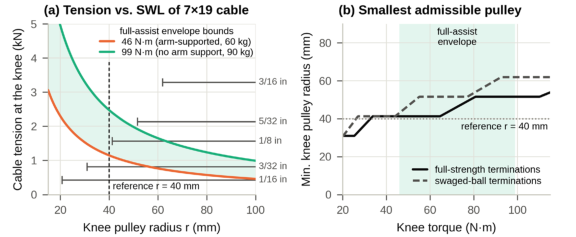
Cable tension and geometry (G3–G4). At the reference 40 mm pulley the envelope loads the cable to at least 1.15–2.48 kN (Fig. 3a), 2.7–5.8 × the 427 N safe working load of 1/16-in stainless cable, whose breaking strength is itself exceeded above 85 N·m. The largest 7 × 19 cable that meets the bend rule at 40 mm is 3/32 in, admissible only up to 32.7 N·m (26.2 N·m with swaged-ball ends), below the whole full-assistance envelope. Covering the envelope needs a knee pulley of 41–52 mm radius (43–62 mm with swaged balls; Fig. 3b), up to 124 mm in diameter and larger than the Ø107.5 mm AKE90-8 actuator (CubeMars, 2026). A single cable stage would also need a 2.0–4.2 mm servo pulley, far below the 21–41 mm minimum radius for 1/16–1/8-in cable, so a gear stage is needed anyway.
Figure 2: (a) Peak STS knee torque per knee versus body mass; dashed lines: actuator ratings in N·m (RMD-X8-P20-120 also peaks at 120); arrows: stall-torque gap. (b) Knee speed limit of one 55 kgf·cm servo through any ratio (Eq. 3), versus natural STS.Figure 3: (a) Cable tension versus knee pulley radius for the full-assistance bounds; grey segments are the safe working load (SF = 5) of 7 × 19 stainless cable, starting at each size’s minimum pulley radius (13d). (b) Smallest admissible knee pulley radius (Eq. 5).
Integrated actuators and interface loads (G2–G4). Of the four integrated actuators (Table 2), the 9:1 AK10-9 V3 (53 N·m peak) covers partial assistance, and arm-supported full assistance only up to 69 kg. The 8:1 AKE90-8, the 19.6:1 RMD-X8-P20-120 and the 64:1 AK80-64 cover the whole envelope on peak torque; at the 2 N·m/kg sensitivity they cover users up to 85 kg (AKE90-8) and 60 kg (120 N·m units). Speed at peak torque is unpublished: the AKE90-8 and RMD-X8-P20-120 are rated at 572–691 W, above the ≤317 W implied by coincident peak torque and speed, whereas the AK80-64 (241 W rated) may be speed-limited. With reduction and output bearing enclosed and rated, pulley, cable and anchors become redundant and the actuator can mount coaxially on the knee (Fig. 1b); an off-the-shelf 9:1 unit already powers a partial-assist knee exoskeleton (Divekar et al., 2024). The credible architecture is simpler than the one it replaces, at the cost of mass (0.85–1.4 kg per knee against 0.09 kg) and, for the 64:1 unit, a 4.7 N·m backdrive torque. At the thigh the torque becomes a cuff force of 230–495 N (L = 0.20 m), needing 144–309 cm² of projected bearing area per cuff to stay below 16 kPa (Table 1), or 413 cm² at L = 0.15 m, more than one cuff can provide.
Table 2: Actuator screening on peak torque (USD per knee, 26 September 2026).
Table available in the original PDF paper.
Mass (kg)
USD per Knee
Covers PA / FA-A / FA
Actuator Ratio Rated / Peak (N·m)
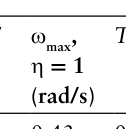
Rated Speed (rad/s) / Power (W) 9.5† / – 0.089 35–95 No / No / No
CubeMars AK80-64§ n/p, not published. *20% of stall. †No-load. ‡Actuator mass; price includes driver. §No-load 7.9 rad/s at 48 V. Servo prices: 60 kg-class DS5160 to A86BHM. Sources: AGFRC (2026); CubeMars (2026); AIFITLAB (2026).
Actuation Feasibility and Cost Floor for a Low-Cost Active Knee–Ankle–Foot Orthosis: 2859 Cost floor (G5). The minimum-viable bilateral design is priced at USD 2,345– 2,767 with AKE90-8 actuators and USD 2,837–3,459 with AK80-64 units (Table 3). Knee actuation dominates: 47–55% of the total with AKE90-8 units and 57–63% with AK80-64 units (USD 644–990 per joint). The hobby- component baseline costs USD 337–644, so, like-for-like, the credible design costs 4.3–8.4× more than the hobby framing suggests, yet 24–47× less than the K1007 fee schedule. Several actuators and the AKE driver were out of stock when priced.
Power: 48 V 10 Ah Li-ion pack with BMS and charger; DC–DC 260 272 Safety chain: E-stop, 48 V-coil DC contactor, 58 V fuse 210 210
Structure: 6061-T6 bar and plate, bearings, fasteners 75 147
275 425
Orthotic interface: 2 × hinged knee brace (cuffs, medial hinge), 2 × AFO Total, minimum-viable (AKE90-8) 2,345 2,767 Total with 2 × CubeMars AK80-64 (integrated driver) 2,837 3,459
Hobby baseline: 2 × servo, Arduino, IMUs, sEMG, cable, LiPo, straps 337 644 Totals from unrounded prices. Excludes labour, wiring, connectors, enclosures, shipping, taxes and tariffs, the safe-state brake, certification, clinical validation and service. Item listings and URLs: supplementary files.
HUMAN FACTORS AND PRE-HUMAN-TEST SAFETY REQUIREMENTS Low cost is pursued for broader clinical and community adoption, but affordability cannot come from removing risk controls. Hazard identification informed by ISO 14971 paired each hazard with a control and a verification that exposes no person to an unvalidated device (ISO, 2019); risk estimation and residual-risk evaluation remain future work. Misalignment stresses skin and joints (Näf et al., 2018), unenclosed cables pinch and whip on failure, and software-only protection without physical limits can deliver uncontrolled torque during power transients, faults or sensor drift. Cutting such features moves the cost onto the user’s body, whereas the costed safety chain (E-stop, contactor, fuse; USD 210) is only 8–9% of the BOM, with the safe-state brake still to be priced. Savings must come from rated standard parts, not from omitting safety engineering.
Six-phase task analysis. P1 Donning and fitting: alignment to anatomical landmarks and cuff fastening without restricting blood flow; risk: anatomical– mechanical knee-axis mismatch. P2 Calibration: self-checks and sensor zeroing while supported; risks: sensor drift, communication errors. P3 Sit-to- stand: both knees powered evenly as the centre of mass moves over the feet; risk: mistimed or asymmetric torque causing a fall. P4 Assisted standing and stepping: assistance follows intent; risks: lag, overheating near the torque limit. P5 Abnormal-event recovery: a stumble, sudden stop or battery loss
2860 Chen must lead to a defined, graded safe state, not a free-swinging or abruptly locking knee. P6 Standard and emergency doffing: single-pull quick releases and a manual brake release that work by hand, without tools or power.
Hazard–control–verification matrix. Table 4 lists eleven hazards across these phases. Three controls depart from intuitive low-cost choices. The safe state on power loss is a damped, then locked knee, never a free one: commercial devices lock the knees (Indego, Ekso) or collapse slowly (ReWalk; He et al., 2017), whereas releasing a loaded knee mid-rise causes buckling. Thermal limits apply to skin-contact surfaces (43 °C for contact of 10 min or more; IEC, 2020) separately from the actuator’s winding limit, with extra margin for impaired sensation. Removing the cable stage eliminates cable whip and derailment, but the 1.4 kg lateral actuator adds bulk that can pinch or snag on armrests.
Table 4: Hazard–control–verification matrix (phases P1–P6 as in the task analysis).
Table available in the original PDF paper.
Hazard (Phase) → Effect Control Pre-Human Verification
Uprights and cuffs adjustable to the knee axis; medial hinge
DISCUSSION AND LIMITATIONS A bilateral active-knee design for STS is plausible in the low thousands of USD. What fails is the premise that directly driven hobby actuation can supply it: gearing cannot add power, and cable tension is fixed by joint torque and pulley radius. A quasi-passive variant, a servo slowly charging a spring that a clutch releases, escapes the power bound but not the tension or cuff-load limits. Partial assistance (30–45 N·m; cuff forces 150–225 N) benefits the wearer more than the budget, since the full-assist AKE90-8 currently costs less than the partial-assist AK10-9, and it has improved STS after stroke (Gunnell et al., 2025). Full assistance for complete paralysis needs 46–99 N·m and, commercially, powered hips and structured training; knee-only powering did not lower walking energy cost relative to passive KAFOs (Rodríguez-Fernández et al., 2022). A low-cost active KAFO is best positioned for transfers and supported standing.
Three habits follow for accessibility engineering and human factors practice: specify before shopping, reporting stall and continuous ratings separately; follow the load path to the body, where every newton-metre at the knee reappears as cable tension, bearing load and cuff pressure; and state what a cost claim excludes: the 24–47 × ratio sets prototype parts against a cleared, supported device that also powers the hips.
Limitations. The model screens quasi-static peaks from small cohorts and assumes symmetric loading; misalignment, cuff compliance and frame deflection can raise the torque needed. Manufacturer ratings were not independently verified, and the 8.4 V servo rating is generous (at 7.4 V, Pmax falls to 10.1 W). Frame fatigue, balance and hip mechanics were not analysed; interface loads use mean pressure; the BOM omits wiring, shipping and the safe-state brake. Mannequins cannot reproduce tissue compression, and bench tests cannot capture reflexes or stumbles.
Bench-validation plan. G6 comprises three bench gates before any human- loaded test. B1, structural and thermal: proof loading at 1.5 × the maximum expected working load (an uncertainty allowance, not a regulatory factor) and cycling on an STS torque profile; pass: no measurable permanent deformation or cable fraying, and winding and contact temperatures within limits. B2, fault response: power, encoders, IMUs and bus communication are interrupted or corrupted; pass: torque disabled within a 10 ms target and the knee reaching its damped-then-locked state under static load. B3, instrumented mannequin: pass: mean cuff pressures below the transient limit and the 40 mmHg (5.3 kPa) sustained limit summarised by Tamez-Duque et al. (2015), and hard stops that prevent hyperextension. Passing the gates does not authorise human testing, which also requires ethics review, a clinical investigation plan (ISO, 2026), assessment against IEC 80601-2-78 (IEC, 2019) and regulatory advice.
CONCLUSION
An active KAFO that assists sit-to-stand must deliver about 46–99 N·m of peak knee torque per knee for full assistance of 60–90 kg users, or 30–45 N·m for partial assistance. A 55 kgf·cm hobby servo with a cable transmission cannot: it is 8.5–18.4 × short in torque at stall, its power limits
2862 Chen knee speed under load to 0.13–0.28 rad/s, and its cable would carry at least 1.15–2.48 kN at a 40 mm pulley. Integrated actuators meet the envelope on published peak ratings with a simpler coaxial architecture, and a bilateral design built this way costs USD 2,345–3,459 in parts: 24–47× below the fee schedule for commercial devices and 4.3–8.4× above hobby budgets. The answer to the title is a few thousand dollars, not a few hundred; whether the device is safe to wear is for the bench gates to establish.
ACKNOWLEDGMENT
The authors acknowledge the use of Grammarly for assistance with translation from Chinese to English during the preparation of this manuscript. The authors have reviewed and edited the final text and assume full responsibility for its content and accuracy. The authors checked all sources, numbers and text and are responsible for the content.
REFERENCES
AGFRC (2026) A86BHM brushless digital servo: Specifications. Available at: https:// www.agfrc.com/index.php?id=2472. AIFITLAB (2026) MyActuator RMD-X8-P20-120 motor. Available at: https://
aifitlab.com/products/myactuator-rmd-x8-120-motor. Asbeck, A.T., De Rossi, S.M.M., Holt, K.G. and Walsh, C.J. (2015) ‘A biologically inspired soft exosuit for walking assistance’, The International Journal of Robotics Research, 34(6), pp. 744–762. Bahrami, F., Riener, R., Jabedar-Maralani, P. and Schmidt, G. (2000) ‘Biomechanical
analysis of sit-to-stand transfer in healthy and paraplegic subjects’, Clinical Biomechanics, 15(2), pp. 123–133. CMS, Centers for Medicare & Medicaid Services (2024) DMEPOS fee schedule: July 2024 quarterly update, MLN Matters MM13658. Baltimore, MD: CMS. CubeMars (2026) AKE90-8 KV35, AK80-64 KV80 and AK10-9 V3.0 KV60 robotic
actuators; driver board for AKE series. Available at: https://www.cubemars.com and https://store.cubemars.com. Divekar, N.V., Thomas, G.C., Yerva, A.R., Frame, H.B. and Gregg, R.D. (2024) ‘A versatile knee exoskeleton mitigates quadriceps fatigue in lifting, lowering, and carrying tasks’, Science Robotics, 9(94), eadr8282. DoD, U.S. Department of Defense (2005) MIL-DTL-83420M: Wire rope, flexible,
for aircraft control, general specification for. 1 April. Gunnell, A.J., Sarkisian, S.V., Hayes, H.A., Foreman, K.B., Gabert, L. and Lenzi, T.
(2025) ‘Powered knee exoskeleton improves sit-to-stand transitions in stroke patients using electromyographic control’, Communications Engineering, 4, 104. He, Y., Eguren, D., Luu, T.P. and Contreras-Vidal, J.L. (2017) ‘Risk management and regulations for lower limb medical exoskeletons: A review’, Medical Devices: Evidence and Research, 10, pp. 89–107. IEC, International Electrotechnical Commission (2019) IEC 80601-2-78:2019
Medical electrical equipment – Part 2-78: Particular requirements for basic safety and essential performance of medical robots for rehabilitation, assessment, compensation or alleviation. Geneva: IEC. IEC, International Electrotechnical Commission (2020) IEC 60601-1:2005+AMD1: 2012+AMD2:2020 Medical electrical equipment – Part 1: General requirements for basic safety and essential performance. Geneva: IEC.
Actuation Feasibility and Cost Floor for a Low-Cost Active Knee–Ankle–Foot Orthosis: 2863 ISO, International Organization for Standardization (2019) ISO 14971:2019 Medical
devices – Application of risk management to medical devices. Geneva: ISO. ISO, International Organization for Standardization (2026) ISO 14155:2026 Clinical investigation of medical devices for human subjects – Good clinical practice. Geneva: ISO. Kandilakis, C. and Sasso-Lance, E. (2021) ‘Exoskeletons for personal use after spinal
cord injury’, Archives of Physical Medicine and Rehabilitation, 102(2), pp. 331–337. Kermavnar, T., Power, V., de Eyto, A. and O’Sullivan, L.W. (2018) ‘Computerized cuff pressure algometry as guidance for circumferential tissue compression for wearable soft robotic applications: A systematic review’, Soft Robotics, 5(1), pp. 1–16. Lexco Cable (2026) Plain balls (swaged), stainless steel: Minimum breaking strength.
Available at: https://catalog.lexcocable.com. Lifeward (2024) Medicare revises 2024 fee schedule to include payment rate for the ReWalk Personal Exoskeleton [Press release], 12 April. Näf, M.B., Junius, K., Rossini, M., Rodriguez-Guerrero, C., Vanderborght, B. and
Lefeber, D. (2018) ‘Misalignment compensation for full human-exoskeleton kinematic compatibility: State of the art and evaluation’, Applied Mechanics Reviews, 70(5), 050802. OSHA, Occupational Safety and Health Administration (2026) 29 CFR 1917.42 Miscellaneous auxiliary gear, paragraph (b)(1). Available at: https://www.osha. gov/laws-regs/regulations/standardnumber/1917/1917.42. ROBOTIS (2020) Torque ratings. Available at: https://www.robotis.us/robotis-blog/
torque-ratings/. Rodríguez-Fernández, A., Lobo-Prat, J., Tarragó, R., Chaverri, D., Iglesias, X., Guirao-Cano, L. et al. (2022) ‘Comparing walking with knee-ankle-foot orthoses and a knee-powered exoskeleton after spinal cord injury: A randomized, crossover clinical trial’, Scientific Reports, 12, 19150. Sava, Carl Stahl Sava Industries (2026) Pulley design information. Available at:
https://www.savacable.com/sava-expertise/pulleys-design-information. Schenkman, M., Riley, P.O. and Pieper, C. (1996) ‘Sit to stand from progressively lower seat heights: Alterations in angular velocity’, Clinical Biomechanics, 11(3), pp. 153–158. Shepherd, M.K. and Rouse, E.J. (2017) ‘Design and validation of a torque-controllable
knee exoskeleton for sit-to-stand assistance’, IEEE/ASME Transactions on Mechatronics, 22(4), pp. 1695–1704. Tamez-Duque, J., Cobian-Ugalde, R., Kilicarslan, A., Venkatakrishnan, A., Soto, R.
and Contreras-Vidal, J.L. (2015) ‘Real-time strap pressure sensor system for powered exoskeletons’, Sensors, 15(2), pp. 4550–4563. Yoshioka, S., Nagano, A., Himeno, R. and Fukashiro, S. (2007) ‘Computation of the kinematics and the minimum peak joint moments of sit-to-stand movements’, BioMedical Engineering OnLine, 6, 26.
SEARCH THE AHFE DIGITAL BOOKSTORE BY ISBN
Explore the complete digital volume
Human Factors in Design, Engineering, and Computing
Read this individual research paper free through the original publisher, or explore the full digital proceedings book.