Marco Santórum, David Morales-Martínez, Mayra Carrión-Toro, Daniel Carvajal, Juan Benavides (2026). Sustainability-Driven Assistive Technology: A LEGO Prototype for Enhancing Safe Navigation. In: Human Factors in Design, Engineering, and Computing. AHFE Open Access, vol. 238, pp. 402–412. https://doi.org/10.54941/ahfe1008273
Ensuring safe and independent mobility remains a significant challenge for people with visual impairments, particularly in contexts where specialized assistive technologies are costly or difficult to access. This paper presents the design and evaluation of an Assistive Navigation Prototype (ANP) based on LEGO Mindstorms to support obstacle detection and non-visual feedback during mobility. The prototype was developed through a participatory, user-centered process based on the iPlus methodology and integrates proximity sensors, haptic feedback, and a modular robotic structure. The system was designed to identify obstacles and provide immediate feedback to support navigation in indoor and controlled urban environments. Evaluation in simulated and semi-real conditions examined obstacle detection, system response, and perceived usability. The results showed reliable obstacle detection, consistent system response, and positive usability perceptions, supporting the feasibility of LEGO-based prototyping for exploratory assistive navigation applications. The study contributes a low-cost and adaptable approach to the development of mobility-oriented assistive technologies, particularly for contexts where access to specialized solutions is limited.
Independent and safe mobility remains a major challenge for people with visual impairments, as obstacles and changes in the surrounding environment can interfere with orientation and movement. Although assistive technologies have introduced different approaches to support mobility, access to specialized solutions may be constrained by their cost, availability, and adaptation to specific environments, particularly in developing regions such as Latin America (Nierling and Maia, 2020; Ok et al., 2024). These limitations create a need for exploratory mobility solutions that can be adapted to different contexts without requiring highly specialized or costly infrastructure.
Assistive navigation systems can address part of this challenge by detecting obstacles and translating environmental information into feedback that does not depend exclusively on vision. In this context, proximity sensing combined with haptic or auditory feedback can provide users with information
Sustainability-Driven Assistive Technology 403 about nearby obstacles while maintaining attention on the surrounding environment. However, developing and testing such systems requires flexible prototyping platforms that allow sensing, interaction, and mechanical configurations to be modified during early design stages. Participatory and user-centered approaches are particularly relevant because they allow mobility requirements, feedback preferences, and contextual constraints to be incorporated into the design process (Quintero, 2022).
Based on these considerations, this study presents an Assistive Navigation Prototype (ANP) developed with LEGO Mindstorms. The prototype combines proximity sensors, haptic feedback, and a modular robotic structure to detect obstacles and communicate their presence during navigation. LEGO Mindstorms was selected as a prototyping platform because its programmable and reconfigurable components facilitate the construction and modification of robotic systems during iterative development (Lindsay and Hounsell, 2017; Nanou and Karampatzakis, 2023). Rather than proposing a replacement for established mobility aids, the ANP is intended as an exploratory platform for investigating the feasibility of low-cost sensing and non-visual feedback mechanisms for assistive navigation.
The development process followed the iPlus methodology, incorporating user-oriented requirements during the identification, definition, and refinement of the prototype. In this study, the methodology was specifically applied to mobility-related requirements, including obstacle detection, feedback, and adaptation to the intended operating environments. The resulting prototype was evaluated through controlled tests in simulated and semi-real conditions to examine its functional behavior and perceived usability.
Consequently, the main contributions of this study are threefold: (i) the design and implementation of a modular assistive navigation prototype integrating proximity sensing and non-visual feedback; (ii) the evaluation of obstacle detection, system response, and perceived usability under controlled and semi-real conditions; and (iii) an analysis of the feasibility of LEGO-based educational robotics as an accessible prototyping platform for mobility-oriented assistive technology. The present article is organized as follows: Section 2 introduces the theoretical foundations; Section 3 describes the design framework and methodology; Section 4 presents the evaluation process; Section 5 discusses the main results and their implications; and Section 6 concludes the study with recommendations for future developments.
THEORETICAL FOUNDATIONS Assistive Technologies and Visual Impairment
Assistive technologies (AT) are designed to compensate for functional limitations and support autonomy and participation among people with disabilities (World Health Organization, 2022). For people with visual impairments, mobility represents a particularly relevant application domain because the absence or reduction of visual information can hinder the identification of obstacles, changes in the environment, and other cues required for safe movement. Although conventional mobility aids remain essential, technological developments have introduced complementary
systems capable of detecting environmental conditions and communicating relevant information through non-visual modalities.
Assistive navigation technologies commonly employ sensors to identify obstacles or environmental features and convert the detected information into auditory, tactile, or haptic feedback. These approaches seek to provide users with additional spatial information without relying on visual perception. Recent developments in sensing and human–computer interaction have expanded the possibilities for designing navigation aids that respond to environmental conditions and provide more immediate feedback (Messaoudi et al., 2022; Dandona and Dandona, 2006). However, the effectiveness of these systems depends not only on detection capabilities but also on the timeliness, clarity, and accessibility of the feedback provided to the user.
Despite technological progress, the adoption of advanced assistive navigation systems may be limited by acquisition costs, dependence on proprietary components, maintenance requirements, and adaptation to specific operating environments. These challenges have driven growing interest in low-cost, modular, and open-source alternatives, including DIY and educational robotics-based assistive solutions, which foster local innovation and reduce dependence on imported systems (Messaoudi et al., 2022). Consequently, the effectiveness of assistive technologies depends not only on technical performance but also on affordability, adaptability, and sustainability, reinforcing the need for interdisciplinary approaches that integrate engineering, inclusive design, and social responsibility.
Educational Robotics as an Accessible Prototyping Platform Educational robotics has become an effective means for fostering creativity, problem-solving, and inclusion in technology-driven environments. Among available platforms, LEGO Mindstorms stands out for combining modular hardware components, sensors, actuators, and a visual programming environment that enables the development of functional robotic systems with limited prior technical expertise (Cuéllar and Pegalajar, 2014). Successive generations, including RCX, NXT, and EV3, have progressively enhanced connectivity, computational capabilities, and compatibility with widely used programming languages, reinforcing its suitability for rapid prototyping and experimentation (Afari and Khine, 2017).
Beyond its educational role, LEGO Mindstorms embodies constructivist learning principles and open-ended experimentation, allowing users to explore mechanical and computational concepts while developing functional prototypes. Its modularity, global availability, and lower cost compared to industrial robotics platforms make it particularly suitable for developing affordable, customizable, and sustainable assistive technologies, especially in resource-constrained contexts where accessibility gaps persist (Moreno and Pastor-Mendoza, 2018). Prior studies have demonstrated its effectiveness in inclusive and assistive scenarios, including cognitive stimulation for students with cerebral palsy, social interaction support for children with autism, and enhanced STEM engagement for learners with
Sustainability-Driven Assistive Technology 405 diverse disabilities (Hinchliffe et al., 2016; Lindsay and Hounsell, 2017; Pivetti et al., 2020).
Moreover, the platform’s flexibility supports participatory and user- centered prototyping processes, enabling collaborative exploration of configurations that integrate tactile feedback, auditory cues, and sensor- based interaction, key elements for assistive technologies aimed at users with visual impairments. In this sense, LEGO Mindstorms functions not only as a technical tool but also as a catalyst for democratizing assistive technology development, facilitating knowledge transfer, local adaptation, and scalable innovation aligned with principles of accessibility, sustainability, and social inclusion.
User-Centered and Accessible Prototyping for Assistive Technologies The design of assistive navigation technologies requires consideration of both technical performance and the way information is perceived and interpreted during mobility. User-Centered Design (UCD) provides a framework for incorporating users’ needs, abilities, and contextual conditions into system requirements and iterative development (Abras et al., 2004; Walden et al., 2020). In the context of visual impairment, this approach is particularly relevant because design decisions concerning sensor placement, feedback modality, timing, and interaction can directly influence how environmental information is perceived during navigation.
Within this framework, participatory design (PD) strengthens UCD by promoting co-creation and user empowerment, positioning individuals with disabilities as active contributors rather than passive recipients of technology (Quintero, 2022). Empirical evidence shows that continuous user involvement in the design of tactile, auditory, and multimodal assistive systems improves usability, reduces cognitive load, and increases acceptance and long-term sustainability (Nair et al., 2022; Theodorou et al., 2022). These principles are closely aligned with Universal Design (UD), which advocates for flexibility, perceptible information, tolerance for error, and equitable use, ensuring that technologies are inclusive by design rather than through post-hoc adaptation (Ntoa et al., 2022; Kulkarni, 2019).
Beyond technical considerations, accessibility-oriented innovation has a strong ethical and social dimension. International frameworks recognize accessibility as a fundamental human right and a key driver of social participation and autonomy (Ntoa et al., 2022). Moreover, inclusive assistive technologies contribute directly to the United Nations Sustainable Development Goals by reducing inequalities and supporting sustainable communities. Addressing challenges such as diverse user needs and limited access to proprietary systems requires multimodal interaction strategies that integrate auditory and tactile feedback in a coherent manner.
Within this framework, the iPlus methodology is used to structure the identification and refinement of requirements for the Assistive Navigation Prototype. Its application in this study focuses on mobility-related needs, including obstacle detection, feedback mechanisms, environmental conditions, and interaction requirements. These inputs guide the iterative definition and refinement of the prototype, allowing technical configurations to be adjusted as navigation requirements are clarified.
METHODOLOGICAL APPROACH AND IMPLEMENTATION Methodological Approach
This study followed an iterative technological development process focused on the design and evaluation of an assistive navigation system. Scrum practices were used to organize development activities into short cycles of implementation, testing, and refinement, while the iPlus methodology provided a structured process for identifying and formalizing mobility-related requirements (Carrión-Toro et al., 2020). User participation was integrated throughout all phases through co-design activities, interviews, and prototype testing, ensuring that both functional and experiential aspects were informed by real user needs.
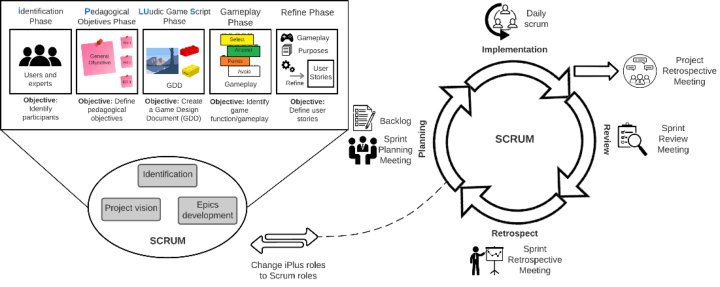
iPlus Methodology The iPlus methodology is a structured, user-centered framework originally developed for educational serious games and later extended to interactive and assistive systems. Its main contribution is the systematic incorporation of user, domain, and technical perspectives during early design and refinement activities (Carrión Toro, 2022). As illustrated in Fig. 1, iPlus can be combined with Scrum to organize iterative software–hardware development. In this study, the methodology was adapted to the requirements of assistive navigation, with emphasis on mobility conditions, obstacle detection, feedback, and interaction.
Figure 1: iPlus methodology-SCRUM integration.
Identification Phase: This phase focused on identifying mobility-related challenges for people with visual impairments in indoor and controlled urban environments. Discussions with accessibility specialists, potential users, and the product owner were used to identify limitations associated with existing solutions, including cost, adaptability, feedback mechanisms, and environmental constraints. These inputs led to the definition of a modular navigation prototype based on LEGO Mindstorms, with emphasis on obstacle detection and non-visual feedback.
Pedagogical Objectives Phase: In this study, the objective-definition phase was adapted from its original pedagogical orientation to formalize the functional objectives of the navigation system. Through participatory
Sustainability-Driven Assistive Technology 407 discussions involving users, accessibility experts, and the product owner, mobility requirements were translated into actionable system objectives. These included multi-height obstacle detection, timely non-visual feedback, and user-initiated interaction to support safer navigation.
Refinement Phase: In this phase, ideas were prioritized and formalized through participatory reviews and validation matrices. Viable requirements were structured into epics and user stories for Scrum-based development, resulting in a traceable, human-centered backlog that guided the transition from conceptual design to iterative prototyping.
Implementation The Assistive Navigation Prototype (ANP) was developed using an agile, user-centered approach that combined Scrum practices with iterative prototyping, enabling continuous refinement based on user feedback and contextual requirements. This process ensured alignment with principles of inclusive design, sustainability, and responsible technological innovation.
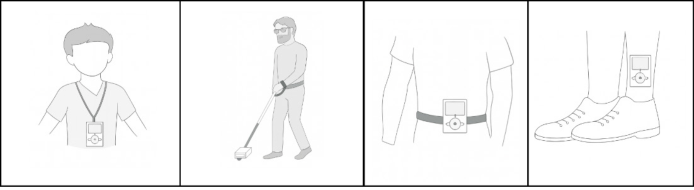
During development, multiple physical configurations were explored, including arm, belt, and leg-mounted designs, with the goal of maximizing comfort and stability. Due to ergonomic constraints related to the size and weight of LEGO Mindstorms components, these alternatives proved suboptimal. Following comparative evaluations with visually impaired participants and experts, the prototype was ultimately integrated into a mobility cane, offering improved stability, natural movement alignment, and optimal sensor positioning (see Fig. 2).
Figure 2: Comparative sketches of early mounting alternatives.
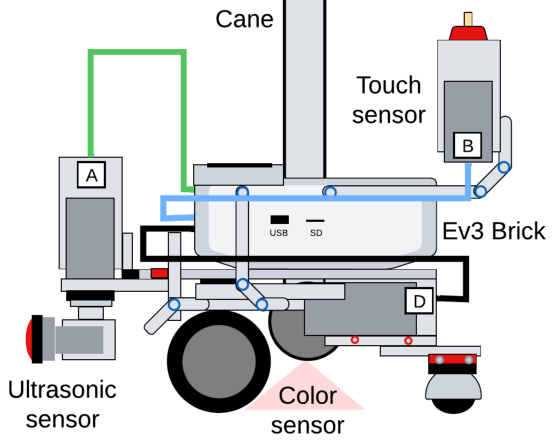
Once the structural configuration was defined, a modular assembly strategy was adopted to facilitate rapid testing and reconfiguration. The prototype incorporated two main parts: a base unit composed of the EV3 processing brick with dual servomotors supporting movement, and sensors (ultrasonic, color, tactile).
Programming was implemented using the LEGO Mindstorms block- based environment, enabling rapid iteration and clear representation of the navigation logic. The system follows an autonomous scanning routine for obstacle detection, supported by simple decision rules and real-time voice guidance (e.g., “Left”, “Right”, “Go”, “Stop”) to reduce cognitive load and enhance orientation.
Environmental awareness was expanded through the integration of a color sensor to identify surface changes such as stairs or risk zones, triggering differentiated audio alerts. In addition, a tactile sensor was incorporated as a non-visual activation mechanism, allowing intuitive system control through physical contact, see Fig. 3.
In general, the ANP implementation resulted in a modular and accessible assistive system that combines real-time sensing, multimodal feedback, and ergonomic integration with a mobility cane. Iterative prototyping enabled continuous refinement, ensuring reliable obstacle detection, clear user feedback, and user comfort. The use of educational robotics facilitated rapid prototyping and exploration of low-cost alternatives, supporting sustainability and potential deployment in resource-constrained contexts.
Figure 3: Assistive navigation prototype.
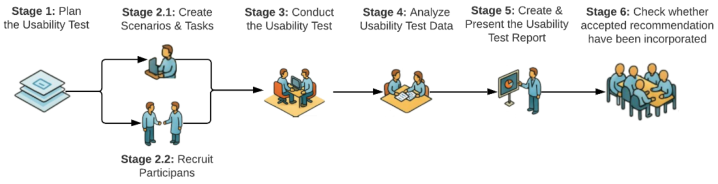
EVALUATION The evaluation of the Assistive Navigation Prototype (ANP) followed a structured, human-centered protocol inspired by Rautela (Rautela, 2018). The process began with a brief training session to familiarize participants with the system’s purpose, components, and sensor behavior (see Fig. 4). The study involved 25 participants, including students trained in usability and accessibility and experts in assistive technologies and visual impairment, providing complementary technical and experiential perspectives on the prototype. All participants provided informed consent, and the evaluation adhered to institutional ethical guidelines. After the orientation, participants observed demonstrations of the system and performed predefined navigation- related tasks in a controlled environment.
Figure 4: Evaluation protocol.
To approximate real mobility conditions, the ANP was evaluated in indoor and semi-urban university environments, including hallways, doorways, stairs, and open spaces. The evaluation comprised three complementary sessions: (i) technical validation of sensor performance, assessing accuracy, response time, and stability under varying lighting and surface conditions; (ii) simulated low- vision navigation, in which blindfolded participants without visual impairments assessed alert clarity, ease of activation, interaction with the modified cane, and perceived safety; and (iii) testing with individuals with visual impairments, who completed the route with minimal assistance and provided feedback focused on ergonomics, trust, and the relevance of multisensory feedback.
To complement functional testing, an adapted System Usability Scale (SUS) was applied, preserving the ten-item structure while contextualizing items around tactile activation, auditory cue interpretation, multimodal feedback, and perceived safety. Participants completed the questionnaire individually after interacting with the prototype, producing usability scores from 0 to 100.
Throughout the evaluation, both quantitative and qualitative data were collected, including alert response times, navigation behavior, system stability, and user feedback. The prototype demonstrated reliable obstacle detection with sub-second response times and acceptable accuracy, while participants highlighted the clarity of auditory cues and suggested adding haptic feedback and personalization options.
RESULTS AND DISCUSSION
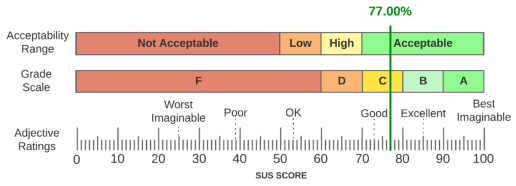
The evaluation results provided initial evidence of functional feasibility and positive perceived usability of the ANP. With an average SUS score of 77% across 25 participants, the prototype falls within the “reliable usability” range of the Bangor scale (Fig. 5), indicating that users perceived it as intuitive, coherent, and easy to operate for educational and community contexts. This result supports the effectiveness of the user-centered design approach adopted during the development process.
Figure 5: SUS score in the Bangor scale.
Qualitative feedback indicated that participants were generally able to interpret the auditory navigation cues and operate the tactile activation mechanism without visual interaction. These findings suggest that the selected feedback mechanisms were appropriate for communicating basic navigation instructions.
From a technical standpoint, the ANP achieved sub-second obstacle detection and stable performance in most indoor and semi-urban settings. However, performance decreased under highly illuminated or reflective conditions, highlighting limitations associated with the sensing capabilities of the LEGO Mindstorms components. These observations indicate the need for more robust or complementary sensing technologies in future iterations.
Participants identified key improvements related to long-term adaptability, notably the inclusion of haptic feedback for noisy environments and the personalization of auditory alerts (tone, intensity, and language). These suggestions align with goals of social responsibility and equitable access, particularly in low- resource contexts. Feedback on comfort and stability further highlighted the benefits of modular educational robotics for low- cost prototyping, despite the system not being suitable for large-scale deployment at this stage.
The results should be considered alongside the study’s limitations. The ANP is an early-stage exploratory prototype aimed at understanding mobility challenges rather than a mass-producible solution. Additionally, evaluations involved students and domain experts trained in usability rather than end users with visual impairments, which is appropriate for initial validation but calls for future testing in authentic contexts with representative users.
Overall, the quantitative and qualitative results provide initial evidence that the proposed system constitutes a viable and promising low-cost assistive navigation concept. The evaluation not only confirms its functional feasibility but also identifies specific design improvements related to environmental robustness, multisensory feedback, and personalization, which will guide future development toward more inclusive and sustainable assistive technologies.
CONCLUSIONS AND FUTURE WORK This study presented the design and evaluation of a user-centered Assistive Navigation Prototype (ANP) developed with LEGO Mindstorms to support safe and independent mobility for people with visual impairments. An applied inclusive design approach combined the iPlus methodology with iterative prototyping to ensure technical feasibility, usability, and social relevance.
The evaluation provided initial evidence of positive perceived usability, with an average SUS score of 77% across 25 participants. Participants with training in usability and accessibility and experts in assistive technologies and visual impairment highlighted the clarity of the auditory cues, the stability of the navigation behavior, and the ease of tactile activation. These findings support the feasibility of the proposed interaction approach for early-stage assistive navigation prototyping, while not replacing validation with representative end users.
From a technical perspective, the prototype achieved sub-second obstacle detection and stable operation in most of the evaluated indoor and semi- urban conditions. However, performance decreased under highly illuminated
Sustainability-Driven Assistive Technology 411 or reflective conditions, revealing limitations associated with the sensing capabilities of the LEGO Mindstorms hardware. These findings emphasize the importance of environmental robustness when designing low-cost navigation technologies and provide specific directions for further refinement.
Future work will focus on improving sensing robustness, incorporating complementary haptic feedback, optimizing the physical structure, and exploring migration to open microcontroller platforms. Further evaluations with representative end users with visual impairments in authentic mobility contexts will also be necessary to assess long-term usability, comfort, trust, and adaptability. These developments will help determine the extent to which the proposed modular approach can evolve from an exploratory prototype toward a more practical and sustainable assistive navigation solution.
ACKNOWLEDGMENT
The authors wish to acknowledge the contribution of the “Laboratorio de Investigación de Sistemas de Información e Inclusión Digital” - LudoLab https://ludolab.epn.edu.ec/ (accessed on 6 September 2026) for its support in the research and publication of this article.
REFERENCES
Abras, C., Maloney-Krichmar, D., Preece, J. et al. (2004), ‘User-centered design’, Bainbridge, W. Encyclopedia of Human-Computer Interaction. Thousand Oaks: Sage Publications 37(4), 445–456. Afari, E. and Khine, M. S. (2017), ‘Robotics as an educational tool: Impact of lego
mindstorms’, International Journal of Information and Education Technology 7(6), 437–442. Carrión Toro, M. d. C. (2022), iPlus una metodología centrada en el usuario para el diseño de juegos serios., PhD thesis, Escuela Politécnica Nacional. Carrión-Toro, M., Santorum, M., Acosta-Vargas, P., Aguilar, J. and Pérez, M. (2020),
‘iplus a user-centered methodology for serious games design’, Applied Sciences 10(24), 9007. Cuéllar, M. P. and Pegalajar, M. (2014), ‘Design and implementation of intelligent systems with lego mindstorms for undergraduate computer engineers’, Computer Applications in Engineering Education 22(1), 153–166. Dandona, L. and Dandona, R. (2006), ‘Revision of visual impairment definitions in
the international statistical classification of diseases’, BMC medicine 4(1), 7. Hinchliffe, K., Saggers, B., Chalmers, C. and Hobbs, J. (2016), Utilising robotics social clubs to support the needs of students on the autism spectrum within inclusive school settings, Autism CRC - Cooperative Research Centre for Living with Autism, Australia. Online; accessed 20 January 2025. URL: https://eprints. qut.edu.au/102667/ Kulkarni, M. (2019), ‘Digital accessibility: Challenges and opportunities’, IIMB
Management Review 31(1), 91–98. Lindsay, S. and Hounsell, K. G. (2017), ‘Adapting a robotics program to enhance participation and interest in stem among children with disabilities: a pilot study’, Disability and Rehabilitation: Assistive Technology 12(7), 694–704. Messaoudi, M. D., Menelas, B.-A. J. and Mcheick, H. (2022), ‘Review of navigation
assistive tools and technologies for the visually impaired’, Sensors 22(20), 7888.
Moreno, E. F. and Pastor-Mendoza, J. (2018), Synergy lego mindstorms–arduino: Taking advantage of both platforms, in ‘2018 XIII Technologies Applied to Electronics Teaching Conference (TAEE)’, IEEE, pp. 1–6. Nair, V., Olmschenk, G., Seiple, W. H. and Zhu, Z. (2022), ‘Assist: Evaluating the
usability and performance of an indoor navigation assistant for blind and visually impaired people’, Assistive Technology 34(3), 289–299. Nanou, A. and Karampatzakis, D. (2023), ‘The participation of students with autism in educational robotics: A scoping review’, Social Sciences 12(12), 675. Nierling, L. and Maia, M. (2020), ‘Assistive technologies: social barriers and socio-
technical pathways’, Societies 10(2), 41. Ntoa, S., Margetis, G., Antona, M. and Stephanidis, C. (2022), Digital accessibility in intelligent environments, in ‘Human-automation interaction: Manufacturing, services and user experience’, Springer, pp. 453–475. Ok, E., Donald, J. and Enderson, J. (2024), ‘Global accessibility and inclusivity’,
https://www.researchgate.net/publication/386243939 Global Accessibility and Inclusivity. Online; accessed 20 January 2025. Pivetti, M., Di Battista, S., Agatolio, F., Simaku, B., Moro, M. and Menegatti, E. (2020), ‘Educational robotics for children with neurodevelopmental disorders: A systematic review’, Heliyon 6(10). Quintero, C. (2022), ‘A review: accessible technology through participatory design’,
Disability and Rehabilitation: Assistive Technology 17(4), 369–375. Rautela, A. (2018), ‘Cone trees - the usability testing process’, https://medium.
com/conetrees/the-usability-testing-process-diagram-cone-trees-c77941edfeeb. Online; accessed 20 January 2025. Theodorou, P., Tsiligkos, K., Meliones, A. and Filios, C. (2022), ‘An extended usability and UX evaluation of a mobile application for the navigation of individuals with blindness and visual impairments outdoors—an evaluation framework based on training’, Sensors 22(12), 4538. Walden, A., Garvin, L., Smerek, M. and Johnson, C. (2020), ‘User-centered design
principles in the development of clinical research tools’, Clinical trials 17(6), 703– 711. World Health Organization (2022), ‘Global report on assistive technology’, https:// www.who.int/publications/i/item/9789240049451. Online; accessed 20 January 2025.
SEARCH THE AHFE DIGITAL BOOKSTORE BY ISBN
Explore the complete digital volume
Human Factors in Design, Engineering, and Computing
Read this individual research paper free through the original publisher, or explore the full digital proceedings book.