Wenhui Sun, Wei Huang, Lan Chen, Hua Yang (2024). Advancing Inclusive Gaming: A Framework for the Visually Impaired. In: Design for Inclusion. AHFE Open Access, vol. 128, pp. 151–160. https://doi.org/10.54941/ahfe1004800
Our study proposes the Visual Impairment-Design, Dynamics, Experience (VI-DDE) framework, a new take on the existing Design, Dynamics, Experience (DDE) model ( Walk, Görlich, and Barrett, 2017). The VI-DDE framework focuses on making video games easier to access and enjoy for those with visual impairments. We put the VI-DDE framework to the test by designing a unique Action Role-Playing Game (ARPG) specifically for visually impaired players. Our experiments, comparing this game to traditional games, confirm that our VI-DDE framework successfully improves game accessibility and fun for visually impaired gamers.
Our study focuses on improving video games for people with visual impair- ments, a group often missed in the daily gaming world. Even though new technologies have made games more exciting with better graphics and inter- active play, these advances usually concentrate on the visual parts, which doesn’t help those who are visually impaired. There are not many game choices for them, making them feel left out of the regular gaming community.
Considering that around 2.2 billion people globally (World Health Orga- nization, 2020), including 12.63 million in China, have some kind of vision problem, it’s really important to create games that suit visually impaired play- ers. We’re working on making games that are not just playable but also really enjoyable for people with visual impairments, moving away from the usual focus on games that only rely on visuals.
LITERATURE REVIEW
Game Design Frameworks: Selecting DDE as the Base In game design, several frameworks help guide how games are made and stud- ied. The Mechanics-Dynamics-Aesthetics (MDA) framework by Hunicke, LeBlanc, and Zubeck is well-known (Hunicke, Leblanc, and Zubek, 2004). It breaks down games into mechanics, dynamics, and aesthetics. Jesse Schell’s Elemental Tetrad is another one, combining mechanics, aesthetics, story, and technology (Schell, 2008).
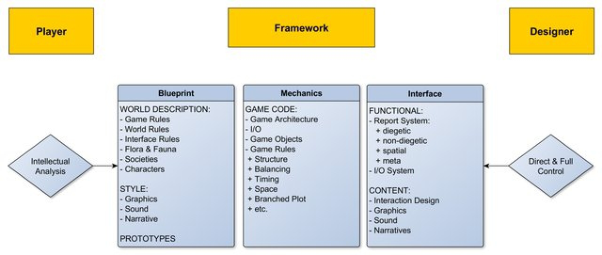
But these frameworks don’t always consider every player’s needs, especially those with disabilities. Our study uses the Design, Dynamics, Experience (DDE) model (see Figure 1) as the base. This model is more inclusive, combin- ing regular game design with the specific needs of visually impaired players. It’s a solid base for making games that more people can enjoy.
Figure 1: The design part of the DDE framework (Walk, Görlich, and Barrett, 2017).
Inclusive Design in Gaming Inclusive design in gaming has grown from just focusing on how users inter- act with products to include ideas from different fields. This way of designing games means finding a balance: changing the rules enough to make games more accessible, but not so much that the game loses its essence. Westin sug- gests that game design needs practical, inclusive methods (Westin, Engström, and Brusk, 2019).
Game accessibility, part of inclusive design, is about more than just making small changes. It’s about ensuring all players, no matter their abilities, have a fair chance to enjoy the game. While there is not much research in this area, the Web Content Accessibility Guidelines (WCAG), an accessibility guide for web design and development geared toward visually impaired players, is a good point of reference to build on. But as Park and Kim point out, games are special and need their own kind of accessibility rules (Park and Kim, 2013). This is especially true for games made for people with different needs, like those who are visually impaired.
DEVELOPMENT OF THE VI-DDE FRAMEWORK Gathering User Insights for the VI-DDE Framework
We started creating the VI-DDE framework by asking 80 people with visual impairments about their gaming habits. Their answers showed that they’re really into gaming and have different things they like in games. They mostly wanted better sound effects, easier controls, and games that use more than just sight.
The results indicate a significant opportunity to improve existing games, particularly in making them more immersive and intuitive for visually
Advancing Inclusive Gaming: A Framework for the Visually Impaired 153
impaired players. This active gaming community’s involvement signals a clear need for games designed with greater inclusivity in mind.
We looked at “The Vale: Shadow of the Crown” as an example. This game uses 3D audio well, just like what our survey found. These ideas are super important for the VI-DDE framework. They guide us to make games that are easier for visually impaired players to enjoy.
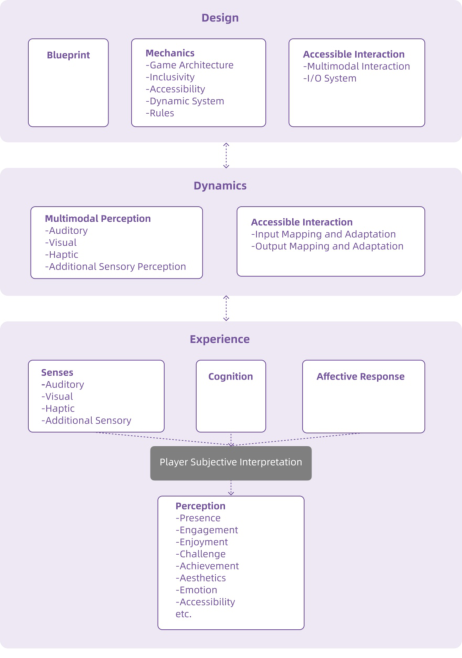
Bridging Theory and Practical Needs The Visual Impairment - Design, Dynamics, Experience (VI-DDE) framework is a structured approach to game design that introduces inclusivity into the game design methodology. It is a macro way of thinking about game design, but it can also be used to develop detailed game design guidelines. For exam- ple, it shows how the visual part of a game can be translated into different types of sounds for visually impaired players.
Figure 2: The complete VI-DDE framework.
Design Dimension: VI-DDE recommends considering inclusivity from the very beginning of game development. This refers to adding features to the rules and techniques of the game to ensure that everyone can play. For exam- ple, spatial audio can be used to help players understand where they are in
the game and interact using haptic feedback. It is important to ensure that information is easily accessible, for example by using voice to describe what is on the screen.
Dynamics Dimension: This dimension of VI-DDE focuses on the methods of interaction in the game. It incorporates the physical and psychological characteristics of the visually impaired player. This simply means that the game should react and change in a sensible way in response to the player’s actions. For example, you can use sound and haptic cues to guide the player.
Experience Dimension: The game experience dimension of VI-DDE is slightly different from other game experience dimensions. We propose the perspective of accessibility. In the development of games for the visually impaired community, we need to focus on accessibility issues, especially for visually impaired players. We know that the quality of the accessibility experi- ence for visually impaired players can greatly affect other aspects of the game. For example, if a game is not accessible enough, it may not be as immersive or challenging for visually impaired players.
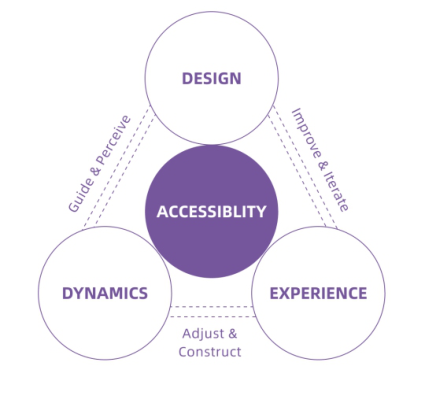
These three parts of the VI-DDE framework work together, and they also influence each other (see Figure 3). The design dimension makes the game accessible, the dynamics makes the interactions feel real, and the experience dimension focuses on the visually impaired players themselves.
Figure 3: Three dimensions of the VI-DDE framework.
By centering on inclusion, VI-DDE aims to create games that visually impaired players can play and have fun at the same time. This approach not only ensures that the game is playable, but also provides a rich and satisfying experience for a diverse players. The main goal of the VI-DDE framework is to create a comprehensive and inclusive game design strategy. Game designers need to upgrade themselves with knowledge of psychology and how players experience games. Continuously improving the game based on feedback from visually impaired players is the key to making a great accessible game.
Advancing Inclusive Gaming: A Framework for the Visually Impaired 155
APPLICATION OF THE VI-DDE FRAMEWORK IN AN ARPG GAME To validate the VI-DDE framework, we developed an ARPG game based on it. Our game utilizes auditory and haptic feedback with the aim of providing an accessible and engaging experience for visually impaired players.
Core Experience: Audio-Based Gameplay We designed an action role-playing game (ARPG) with the help of the Visual Impairment-Design, Dynamics, Experience (VI-DDE) framework. This game features many elements like exploring worlds, fighting in real-time, and strat- egy. which aligning seamlessly with VI-DDE’s aspects. ARPGs are also the kind of game that visually impaired players have shown great interest in from our earlier survey, making it a suitable choice. Our game focuses on saudi- tory and haptic feedback to make it accessible and fun for visually impaired players.
Following the VI-DDE’s inclusive idea and design tips, our game is mainly about audio, using haptic feedback to help out. We concentrated on designing the audio, how players interact, haptic feedback and assistive systems in the game. All these parts integrate in the ARPG gameplay.
The game features three main types of levels: Free Exploration Levels: Players can explore a world full of sounds, using hearing and touch to move around and interact.
Combat Levels: These levels bring the excitement of battle, using sound and touch for players to understand what’s happening. We’ve thought care- fully about how to design these levels for combat. Typically, there are three phases to an action in combat, the forward swing, the attack frame or action frame, and the backward swing. And while you can usually see these stages, visually impaired players cannot. Our focus was to make each stage have a different sound. Additionally, we complete the battle determination based on the timing of these sound effects and the timing of the player’s inputs.
Plot Levels: Players get into the story, connecting with the characters and the plot through sound-based conversations. The game is set in a critical time in the late Ming Dynasty - the night Li Zicheng invaded Beijing. Players act as the Brocade Guards, protecting the city. We uses soundscapes and narratives to make players feel like they’re in that time.
For the game’s interaction method, we chose the controller’s interaction method. This is because the controller provides visually impaired players with a unique vibration feedback experience that is difficult to provide with a keyboard and mouse. We chose the Xbox controller for our design because of its representativeness, but it can also be adapted to other game controllers.
This way of designing the game makes sure it’s not just playable but also really enjoyable for visually impaired players, offering them a rich gaming experience.
Technical Implementation: Spatial Audio Strategy in Unreal Engine Our game was developed with the UE engine. In addition to spatial audio, managing different types of audio information is also a focus in game devel- opment. For example, we designed a unique audio system specifically for the enemy AI.
The audio design of this game prioritizes spatial audio, which was also concluded in the VI-DDE framework. After research and testing, we found two advanced spatial audio solutions - Project Acoustics and Dolby Atmos.
Project Acoustics is an advanced wave-based acoustic simulation that reproduces the propagation of sound in 3D environments, especially diffrac- tion, occlusion and reflection. Its main advantage is the ability to create physically realistic sound effects in games without having to manually set up sound paths or rely on high CPU-loaded ray tracing (Microsoft, n.d.).
Dolby Atmos, on the other hand, uses object-based audio mixing. It creates an immersive listening experience by precisely placing sound in three- dimensional space (Dolby Games, n.d.). Dolby Atmos utilizes specific HRTF (Head Related Transfer Function) data to ensure that the sound changes direction and space correctly before it reaches the user’s ears.
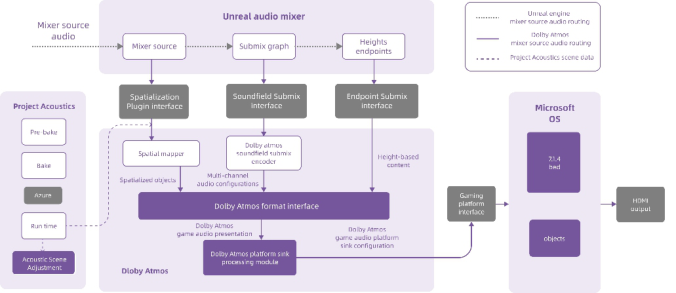
In developing the game, we integrated Project Acoustics and Dolby Atmos so that we could capitalize on the strengths of both (see Figure 4). During the acoustic simulation phase, we used Project Acoustics to perform prefab- ricated acoustic simulations of key scenes to predict sound behavior. We used Project Acoustics to predict the sound behavior of the key scenes, selectively applying it to a few key scenes, such as the nighttime outdoor part of the palace at the beginning of the exploration level. In the sound object placement phase, we used Dolby Atmos technology to assign positions to each sound object in 3D space. Finally, we integrated both technologies using relevant plug-ins in the Unreal Engine. The improved spatial audio system achieved good results.
Figure 4: Strategies for developing spatial audio in VI-DDE gaming.
EVALUATION This study utilized a mixed-method approach, combining data science and social science techniques to test the research hypotheses. The evaluation combined scales, semi-structured interviews, and game system backend data designed to qualitatively and quantitatively analyze the gaming experiences of visually impaired players. This approach allows for an effective assessment of the effectiveness of the VI-DDE framework in improving multiple aspects of game accessibility and engagement.
Advancing Inclusive Gaming: A Framework for the Visually Impaired 157
Experiment Based on the perceptual dimensions identified in the VI-DDE framework, a specialized Likert scale questionnaire was designed to measure differ- ent aspects of immersion, engagement, challenge, achievement, aesthetics, and accessibility. The scale is based on the Game Experience Question- naire (GEQ) (IJsselsteijn, de Kort, and Poels, 2013) and the MEC Spatial Presence Questionnaire (MEC-SP) (Vorderer et al., 2004), as well as on rel- evant physiological-cognitive properties of the visually impaired community. And the questionnaire is divided into three sections: immersion, subjective experience and accessibility.
Ten VI players were invited to participate in the controlled study, experi- encing three different games in varying sequences. These include the exper- imental ARPG game developed using the VI-DDE framework, and two control games for comparison: Control Game 1: “Wo Long: Fallen Dynasty” a well-regarded ARPG with no specific design or assistance systems for visually impaired players.
Control Game 2: “Tingyoujianghu (Audio Game)” a RPG popular among visually impaired players, featuring specific designs in accessibility.
Figure 5: Visually impaired players experience experimental games and control group games.
Data Analysis We conducted an analysis of the questionnaire data, comparing the results between our developed ARPG game and two control games. The results are presented in Tables 1 and 2.
Table 1. Comparison of game experience between experimental game and control game 1 (Wo Long: fallen dynasty).
Through the results we can find: Immersion: Immersion is an important indicator of the gaming experience. Our game (EG) scored higher than the other two games in terms of immer- sion (CG1: 2.80, CG2: 2.95). This illustrates the strength of the VI-DDE framework in crafting immersion.
In terms of game experience elements like Enjoyment, Engagement, Chal- lenge, and Achievement, EG outperformed the other two games, indicating the VI-DDE framework’s comprehensive attention to and coverage of game experience elements.
The aesthetics score of EG (4.00) did not significantly differ from CG1 (3.33), with a p-value of 0.057. This may be because “Wo Long” has pro- fessional audio that appeals to everyone, including non-visually impaired individuals, which suggests more attention to the audio design.
EG’s accessibility was significantly higher than CG1 (12.5) but not as high as the specially designed game for visually impaired players, “Tingy- oujianghu” (CG2: 35.8). This could be due to EG’s lack of refinement and coverage in accessibility details compared to CG2. “Tingyoujianghu”, as a specialized game for the visually impaired that has been popular in the market for many years, offers many aspects worth learning in terms of accessibility.
These findings suggest that the VI-DDE framework is well suited for mak- ing fun, engaging, immersive and accessible games. While it excels in many ways, there is still room for improvement, especially in making games easily accessible.
Semi-Structured Interview Insights In the interviews, a significant number of players, 9 out of 10, consider our experimental ARPG game to be the most fun. They gave various rea- sons, showing the effectiveness of the VI-DDE framework.This diversity in player feedback supports the framework’s inclusivity principle, highlighting its capability to cater to different sensory experiences and play styles, which is essential in a medium as subjective and varied as video gaming.
Feedback on the game controller’s haptic experience was particularly pos- itive. Players enjoyed how it added to their gaming experience, providing a sense of realism and immersion. This haptic feedback in game is crucial,
Advancing Inclusive Gaming: A Framework for the Visually Impaired 159
especially for visually impaired players, as it enhances their engagement and enjoyment of the game.
Furthermore, the importance of audio design in gaming was highlighted by players. Players praised the spatial audio, appreciating how it made the game world feel more real and helped with navigation. This shows that high-quality audio is key in creating an accessible and immersive experience, particularly for games designed for visually impaired users.
CONCLUSION AND FUTURE WORK Our research findings clearly demonstrate the impact of the VI-DDE frame- work we proposed on enhancing the gaming experience, for players with visually impairments. In comparison to games VI players have shown a pref- erence for the experimental game that was developed using this inclusive framework. This indicates that the framework has been successful in creating game content that’s more engaging and accessible.
Notably features such as controller haptic feedback and spatial audio have played a role in immersing players into the game world. The focus on acces- sibility within the VI-DDE framework has been validated, although further refinement and verification are still necessary.
Building upon these research findings future studies should aim to delve into understanding how gaming experiences differ among players with vary- ing degrees of impairment including those with low vision or complete blindness. It would also be valuable to explore how levels of impairment inter- sect, with game preferences and overall gaming experiences. Furthermore our future game development efforts will focus on expanding and refining hap- tic feedback. Game audio will also be further improved based on VI player feedback.
ACKNOWLEDGMENT
This work is funded by Accessibility Research Association, Shenzhen, China.
to Game Design and Game Research. In: AAAI Workshop - Technical Report, vol. 1. IJsselsteijn, W. A., de Kort, Y. A. W., Poels, K. (2013). The Game Experience Questionnaire. Eindhoven: Technische Universiteit Eindhoven. In: Proceedings of the first ACM SIGCHI annual symposium on Computer-human interaction in play. pp. 161–169. Microsoft. What is Acoustics?. Retrieved from: https://learn.microsoft.com/zh-cn/ga
ming/acoustics/what-is-acoustics. Park, H. J., Kim, S. B. (2013). Guidelines of serious game accessibility for the disabled. In: 2013 International Conference on Information Science and Applications (ICISA). IEEE. pp. 1–3.
Schell, Jesse. (2008). The Art of Game Design: A Book of Lenses. ISBN: 9780080919171. Vorderer, P., Wirth, W., Gouveia, F. R., et al. (2004). Mec spatial presence questionnaire. Journal. Retrieved Sept 18, 2015. Walk, W., Görlich, D., Barrett, M. (2017). Design, dynamics, experience (DDE):
An advancement of the MDA framework for game design. In: Game Dynamics. Springer, Cham. pp. 27–45. Westin, T., Engström, H., Brusk, J. (2019). Towards sustainable inclusive game design processes. In: Interactivity, Game Creation, Design, Learning, and Innovation. Springer, Cham. pp. 390–396. World Health Organization. (2020). World report on vision. Journal.
LISTED IN THE AHFE DIGITAL BOOKSTORE CATALOGUE
Explore the complete digital volume
Design for Inclusion
Read this individual research paper free through the original publisher, or explore the full digital proceedings book.
ISBN 978-1-964867-04-5
Explore this ISBN in the AHFE Bookstore ↗Listed in the July 2026 bookstore catalogue; search by ISBN to confirm current availability · Digital book purchase optional