Yoshiaki Goto, Ryou Ozaki, Hiroki Imoto (2024). Experiments on the manipulation of doors by the elderly with dementia. In: Design for Inclusion. AHFE Open Access, vol. 128, pp. 93–108. https://doi.org/10.54941/ahfe1004795
It is common for elderly people with dementia to be confused about opening and closing doors. In the door opening and closing operation, various factors such as the way of door opening and closing , the shape of the handle, and the material of the door seem to affect the judgment and understanding of the opening and closing operation method. Therefore, in this study, we investigated the characteristics of door opening and closing operations of elderly people with dementia, and examine how to control the behavior of elderly people with dementia by door design and control problem behaviors in daily life.First of all, we examined the incidence of BPSD and other diseases and the measures being implemented through questionnaire surveys and on-site surveys.Next, we conducted an experiment to confirm the judgment, comprehension, and memory of elderly people with dementia, who are thought to be the cause of these occurrences, regarding the peculiar storage behaviors found in the on-site survey. The experiment was conducted on 10 elderly people with dementia at a special nursing home in Okayama Prefecture. We asked them to store daily life tools in multiple storage devices with different ways of opening and closing, and examined their opening and closing movements and memories of stored objects. It was found that the opening and closing of storage furniture doors in elderly people with dementia was influenced by long-term memory.In addition, we conducted an open/close operation experiment to investigate the current status of the opening and closing operation of the doors of elderly people with dementia. Using a miniature door samples of various ways of opening and closing, with various life-size handle We observed the opening and closing operation of the door of an elderly person with dementia, and confirmed how the judgment and understanding of the operation method change depending on the shape of the door handle and the opening and closing method. The experiment was conducted on 14 elderly people with dementia at a special nursing home in Okayama Prefecture. It was difficult to open and close a door that required unfamiliar operation such as a push plate with a single-hinged door that opened by pushing. It seems to be influenced by past experience with opening and closing.We hope that the results of these experimental studies will lead to measures to prevent problematic behaviors (troubled storage and wandering) seen in the daily lives of elderly people with dementia.
The purpose of this study is to explore the peculiarities of doorway joinery operation of elderly people with dementia, and to obtain basic data for exam- ining architectural measures in houses. To this end, we grasped the living conditions of elderly people with dementia at home, investigated the occur- rence and causes of BPSD, etc., and conducted daily movement experiments of elderly people with dementia to explore the characteristics of doorway opening and closing behavior.
OUTLINE OF STUDY After on-site survey about symptoms of BPSD in daily life, we conducted following one survey and two experiments.
a. Experiment of storage door opening and closing. b. Survey for awareness of the ways of opening and closing doors. c. Experiment of entrance and exit door opening and closing.
EXPERIMENT OF STORAGE DOOR Purpose of the Experiment
We conducted an experiment to confirm the judgment, comprehension, and memory of elderly people with dementia, who are thought to be the cause of these occurrences, regarding the peculiar storage behavior (troubled storage) found in the on-site survey. We investigated the effects of the opening and closing method of storage furniture doors and the shape of the operation unit on the elderly with dementia.
Outline of the Experiment Procedure of the Experiment Subjects received one item at a time (purse, passbook, keys) and put them freely in the furniture. After chatting with the lab assistant for one minute, the subject was asked if he or she remembers the object he or she just stored, and then the subject took the stored object out of the storage furniture. Evaluation was performed using video data taken by the camera. The experiment was conducted on December 7 and 12, 2018 at a special nursing home facility in Takahashi City, Okayama Prefecture, Japan.
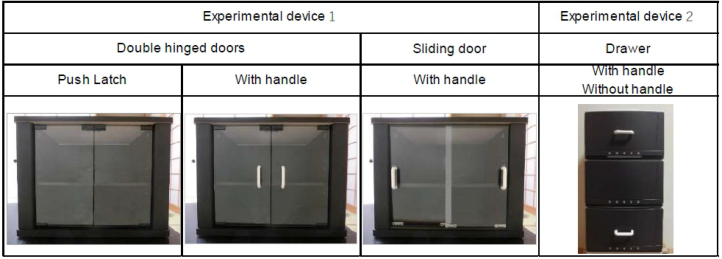
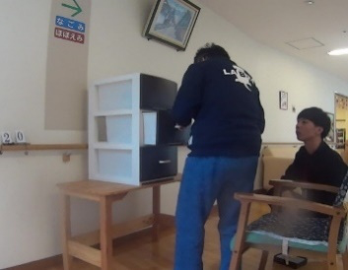
Equipment The device 1 was a push-latch type TV stand with double glass doors. We prepared the state as it is, the state with the handle attached, and the state with the opening and closing method changed to a different state. The device 2 was a three- drawers pull-out room case made of resin, which was pulled out by putting a hand on the lower drawer, and handles were attached to the upper and lower drawers (Fig. 1). In advance, the device 1 was filled with pen stands and books, and the device 2 was filled with clothing and other items in different quantities for each drawer.
Figure 1: Experimental devices.
Subjects Since verbal instructions were given, 10 residents who were able to communi- cate were selected by the facility staff (Table 1). In addition, there were some subjects who could not perform the experiment due to lack of response to
Experiments on the Manipulation of Doors by the Elderly With Dementia 95
instructions. No. 5 and 8 are excluded from the subsequent results because there was no response.
Table 1. Subjects profile.
Table available in the original PDF paper.
Walking morphology
No. Age Gender Degree of care required
Types of dementia
Degree of dementia 1 78 female 3 DAT IIIa Self-reliance 2 93 female 3 DAT IIIa wheelchair 3 87 female 3 DAT IIIb walker 4 92 female 3 DAT IIIa Self-reliance 5 89 female 3 DAT IIIa wheelchair 6 86 female 4 other IIIa wheelchair 7 91 male 3 DAT IIIb Self-reliance 8 95 female 4 unknown IIIa walker 9 92 female 3 DAT IIIa walker 10 93 female 4 other IIIa wheelchair
DAT: Alzheimer’s dementia, Degree of care required, see note *1, Degree of dementia, see note *2.
Result
Result of Experiment of Opening/Closing the Storage Door Based on the video taken, the state of opening and closing the storage door of the subject was evaluated on a four-point scale, focusing on the smoothness of the opening and closing.
There were those that could not operate because the operation method was not known and those that could not operate because the force required for opening and closing was insufficient. Subjects No. 6 and 7 did not respond to some of the experiments. Many subjects opened and closed both devices 1 and 2 smoothly with the opening and closing method with a handle (Table 2).
Table 2. Result of opening and closing the storage.
1 Smoothly without hesitation 2 Smoothly despite hesitation during the opening and closing operation 3 Managed to open and close it despite hesitation 4 Couldn’t open and close it - no response.
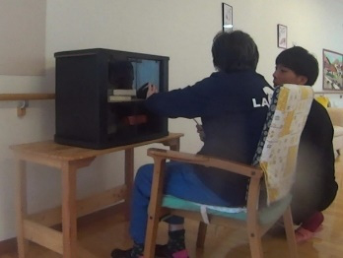
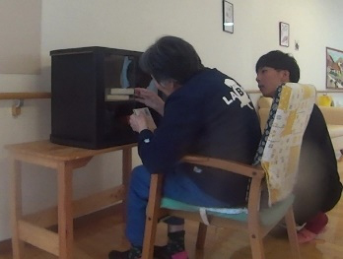
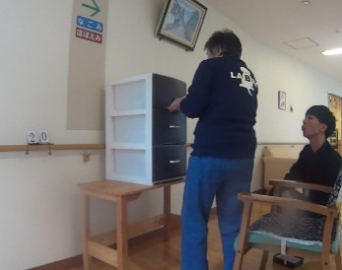
Example of Operation That Could Not Be Opened and Closed Smoothly Fig. 2, 3, 4, and 5 show examples of not being able to open and close smoothly with device 1. Subject No. 4 received the passbook with both hands, switched to her left hand, and tried to insert her fingers into the lower part of the push with her right hand. The passbook was changed to the right hand, and the left hand was placed on the centre of the door surface to check the storage location (Fig. 2). She switched the passbook to her left hand and tried to slip the fingers of his right hand into the gap between the doors (Fig. 3). Finally, She placed the passbook on the device and tried to insert her fingers from both sides of the push with the fingers of both hands. In device 2, the same subject first stood up from the chair, pulled out with her left hand, placed her hand on the upper left corner, and tried to put her hand on the lower part of the drawer while holding the passbook in her right hand (Fig. 4). Next, she touched the left and right corners of the upper drawer with both hands, and lifted it upward with her right hand while placing her right hand on the recess at the bottom of the drawer. After that, while putting right hand on the handle in the middle drawer, she lifted it up once, and then pulled it toward to open and close it (Fig. 5).
Figure 2: Confirmation of the opening and closing method.Figure 3: Putting hand in the gap of the door.
Experiments on the Manipulation of Doors by the Elderly With Dementia 97
Figure 4: Putting hand in the lower part of the drawer.Figure 5: Operation using the handle.
SURVEY FOR AWARENCES OF THE WAYS OF OPENING AND CLOSING DOOR Purpose of the Survey
In the opening and closing operation of the door, various factors such as the opening and closing method of the door, the shape of the handle, and the material of the door seem to affect the judgment and understanding of the opening and closing operation method. Therefore, the purpose of this study is to confirm the overall daily life of elderly people with dementia and to understand their behavior toward entrance and exit doors.
Summary of Survey We investigated the characteristics of the opening and closing of entrance doors of elderly people with dementia through questionnaire surveys and experiments to determine the judgment of how to open and close doors. And we investigated methods to control the mobility-related behavior of elderly people with dementia by designing doors and to control the range of movement in their daily lives.
Research Summary We surveyed a detailed understanding of the problematic behaviors that occur when elderly people with dementia at home use storage furniture and door- ways, and how to deal with them. The survey items were the attributes of the subject, the content of the problematic behavior, countermeasures, whether or not the door installed in the home can be opened and closed, and the state of the problem. The questionnaire was distributed to members of the Okayama Branch of the Association of People with Dementia and their families, and responses were received between December 2019 ∼January 2020.
Table 3. Subjects profile.
Table available in the original PDF paper.
Gender Age Time of onset Types of dementia Degree of care required*1 1 female 91 16 years ago VaD 3 or over 2 female 85 - 3 or 5 years ago another 2 3 male -64 6 years or older ago DAT unknown 4 female 65–74 3 or 5 years ago DAT 2 5 male 65–75 unknown DAT 2 6 female 65–76 6 years or older ago DAT 3 or over 7 male -64 6 years or older ago FTD unknown 8 female 65–74 6 years or older ago DAT 3 or over
DAT: Alzheimer’s dementia, FTD: Frontotemporal dementia, *1 See note *1.
The respondents were family members of the subjects. The attributes of the subjects are shown in Table 3. There was a total of eight people, three men and five women.
Experiment Summary Among the factors that prevent the door from being opened and closed, “not recognize the door” and “not know how to open the door” are confirmed by simple experiments. Using photographs of entrance doors with different com- binations of opening and closing methods and handle shapes, we examined whether elderly people with dementia can judge and understand the types of doors and how to open and close them. The event was conducted on October 29, 2020 at a special nursing home facility. The experimental procedure was carried out according to the following procedure.
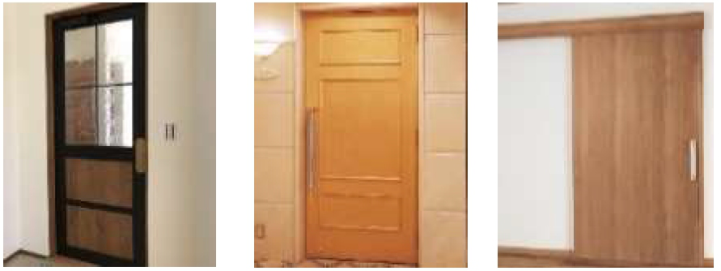
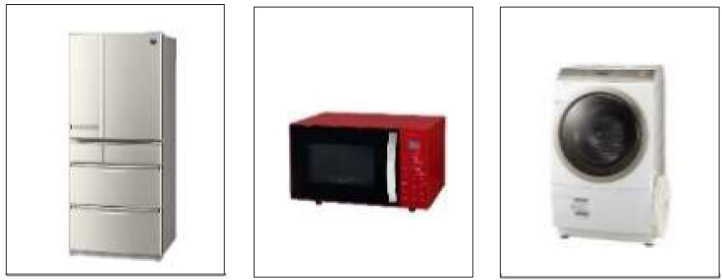
Fourteen sample photographs (11 types of entrance doors and 3 types of home appliances with doors) extracted from catalogues, etc., were presented to each subject.
Each time a sample photo was presented, a total of three items are asked: the type of door, the opening and closing operation of the door, and the operation part.
Experiments on the Manipulation of Doors by the Elderly With Dementia 99
Table 4. Samples.
Table available in the original PDF paper.
No. Sample Photos 1 Entrance and exit doors Push to open Swing doors Lever Handle 2 Knob Handle 3 Bar Handle 4 Push Plate 5 Pull open Swing doors Lever Handle 6 Knob Handle 7 Bar Handle 8 Hand Hold 9 Sliding door Bar Handle 10 Carved Puller 11 folding door Bar Handle 12 household appliance refrigerator 13 microwave oven 14 Washing machine (drum type)
Survey Result When we asked about problematic behaviors in the daily lives of elderly peo- ple with dementia related to storage and entrances, five respondents said they had problematic behaviors.
Table 5 shows the most responses to the contents of problematic behav- iors in daily life related to storage and entrances and exits, as well as the contents of countermeasures for problematic behaviors. In terms of prob- lematic behavior in daily life of storage and doorways, the most common answer was that they did not know how to open and close both of them.
Table 5. Problematic behaviors.
Table available in the original PDF paper.
Questions Response Number of answer
3
Storage Problems in everyday life
Don’t know how to open and close storage furniture
5
Forget what you stored yourself 3 Ingenuity to the problem
Label furniture to be able to choose your own clothes, etc.
5
Don’t change the arrangement of stored items
2
Entrances and exits
Problems in everyday life
Don’t know how to open and close storage door
2
Don’t know if the door is locked. 2 Ingenuity to the problem
Get creative with locks on your front door and doorway
As a result of the questionnaire, it was possible to confirm the state of the usual opening and closing operation other than the answer items.
Experiment Result Responses to each item were evaluated on a four-point scale. In this paper, we show only the result of determining the type of door and the opening and closing operation.
Determination of the Type of Door Many subjects were unable to distinguish between microwave oven and washing machine (drum type) from the entrance and exit doors (Table 6). Some participants referred to microwave oven and washing machine (drum- type) as other home appliances such as televisions.
Determination of Opening and Closing Operation When the shape of the handle was a lever handle with a swing door that could be opened by pulling the opening and closing method, and when the shape of the handle was a hand hold with a swing door that could be opened by pulling the opening and closing method, seven subjects were able to “immediately understand”. They understood that it was a swing door that could be pushed open, but They were confused about whether to open it by pushing it or
Experiments on the Manipulation of Doors by the Elderly With Dementia 101
pulling it open. Seven subjects were unable to distinguish the opening and closing operation of the washing machine (drum type) (Table 7).
Table 6. Determination of the type of door.
Table available in the original PDF paper.
Table 7. Determination of opening and closing.
Table available in the original PDF paper.
OPENING AND CLOSING OPERATION EXPERIMENT Purpose of the Experiment
We investigated the current status of opening and closing operations of elderly people with dementia in detail, using miniature door samples.
Samples were able to be changed the way to open/close, and door handles. We identified how the shape of the door handle and the opening and closing method change the judgment and understanding of the operation method.
The experiment was conducted on November 16 and November 17, 2020 at a special nursing home facility in Takahashi City, Okayama Prefecture.
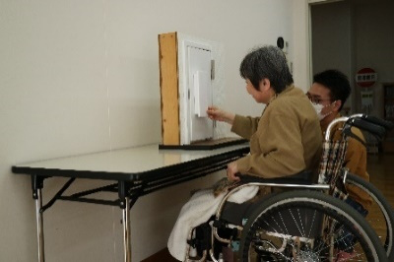
Contents of the Experiment Experimental Procedure Before the start of the experiment, the subject was told that “this is a minia- ture door, it can be opened and closed. Questions asked were “How do you open it?” and “How do you close it?” If they could not open it, we told them how to open it, and asked them the same questions, and asked them to operate it.
The operation was recorded with a video camera and evaluated based on the video data.
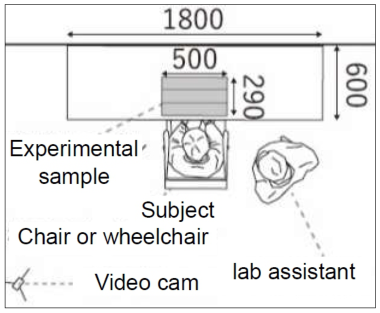
Figure 8: Equipment.
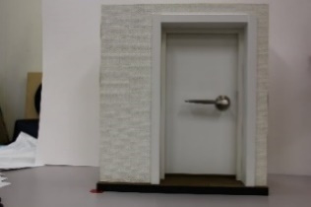
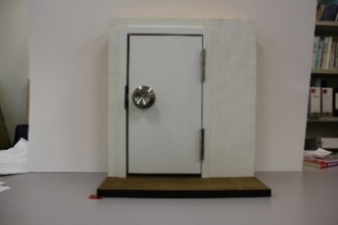
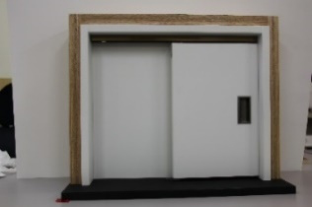
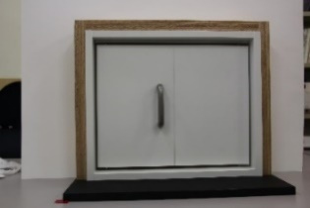
Experimental Samples There were three types of door opening and closing methods: a single swing door, a sliding door, and a folding door. For swing doors, we conducted exper- iments with two patterns: a door that can be opened by pushing and a door that can be opened by pulling. Fig. 10, 11, 12 and 13 show experimental samples of each opening and closing method. There were six types of door handle: lever handle, bar handle, knob handle, carved puller, hand hold, and push plate. A total of 13 patterns were used to perform experiments (Table 8).
Experiments on the Manipulation of Doors by the Elderly With Dementia 103
Figure 9: Experimental scene.
Experimental Subjects The subjects were 14 residents of the facility (Table 9). There were some subjects that were impossible due to the lack of response to instructions.
Table 8. Samples.
Table available in the original PDF paper.
Handle shape Name of product
No. Opening and closing method
1 Push to open Swinging door
Lever Handle MIWA LOCK WLO56ST color:S51DT3342 2 Knob Handle MIWA LOCK OMDST color:BS51DT3342 3 Bar Handle UNION CORPORATION G2605-01-090-L150 4 Push Plate UNION CORPORATION SP3-01-023 5 Pull to open Swinging door
Lever Handle MIWA LOCK WLO56ST color:BS51DT3342 6 Knob Handle MIWA LOCK OMDST color: BS51DT3342 7 Bar Handle UNION CORPORATION G2605-01-090-L150 8 Hand Hold UNION CORPORATION T110-53-076 9 Sliding door Bar Handle UNION CORPORATION G2605-01-090-L150 10 Hand Hold KOHNAN SHOJI No.406 AL30×30 11 Carved Puller UNION CORPORATION T208-01-023 12 folding door Bar Handle UNION CORPORATION G2605-01-090-L150 13 Hand Hold UNION CORPORATION T110-53-076
Experimental Result Availability of Opening and Closing Almost all subjects were able to open and close when the opening and closing method was a sliding door and the shape of the handle was a carved puller,
and when the opening and closing method was a folding door and the shape of the handle was a bar handle. Only one subject was able to open and close when the shape of the handle was a push plate with a swinging door that could be opened by pushing (Table 10).
Experiments on the Manipulation of Doors by the Elderly With Dementia 105
Figure 12: Experimental sample no. 11.Figure 13: Experimental sample no. 12.Table 10. Availability of opening and closing.
Table available in the original PDF paper.
Smoothness of Opening and Closing Focusing on the smoothness of the subjects’ opening and closing operations, the evaluation was performed on a four-point scale. In all experimental sam- ples, none of the subjects were evaluated as “opening and closing smoothly without hesitation”. The subject who could open and close when the handle was a push plate with a swinging door that could be opened by pushing, was also evaluated as “Managed to open and close it despite hesitation” (Table 11).
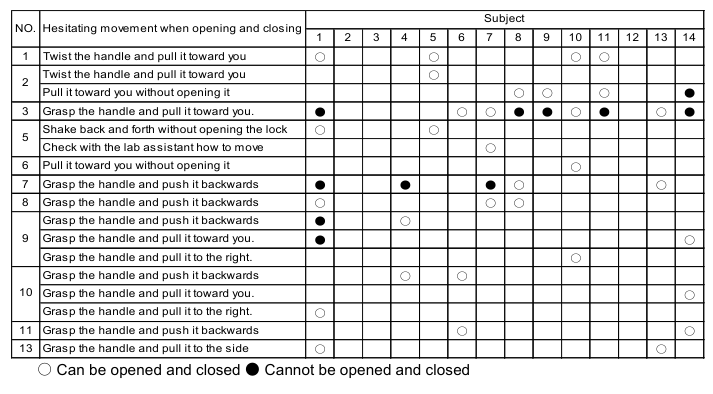
Hesitating Movement in Open/Close Even if it was possible to open and close, it was confirmed that a stray move- ment occurred. Therefore, focusing on the hesitant movement during opening
and closing, we could classify into three categories: “Not know the direction of opening and closing the door”, “Not Know how to operate the handle”, and “Not know the existence of the handle”. In this report, only “Not know the direction of opening and closing the door” and “Not know how to oper- ate the handle” are shown (Tables 12 and 13). In the opening and closing method, a single-swing door opened by pushing was most confusing, and following in the order, a single-swing door opened by pulling, a sliding door, and a folding door. In terms of the shape of the handles, a bar handle was most confusing, and following in the order, a hand hold, a knob handle, a push plate, a lever handle, and a carved puller.
Table 11. Smoothness of opening and closing.Table 12. Not know the direction of opening and closing the door open/close.
Table available in the original PDF paper.
Table 13. Not know how to operate the handle.
CONCLUSION
As a result of conducting a simple storage behavior experiment, we were able to learn some of the judgment, comprehension, and memory of elderly people with dementia. One of the causes of troublesome storage is the effect of long- term memory for the opening and closing operation of storage furniture. They were not familiar with the new opening and closing method and did not know how to open and close it. In the experiment, elderly people with dementia had difficulty handling furniture that required unfamiliar operations, such as push-latch double doors and drawers without handles. It can be expected that there is a possibility of suppressing or promoting storage by the difference in the opening and closing method. For items that are not wanted to be stored by elderly people with dementia, it seems that storage can be suppressed by using an unfamiliar opening and closing method for some storage furniture doors.
Next, we sorted out the factors that prevent the opening and closing of doors related to entrance doors, and conducted experiments to learn about the behavior of elderly people with dementia toward opening and closing entrance doors.
Based on the results, in the experiment on opening and closing a miniature door, some subjects had difficulty opening and closing a door that requires unfamiliar operation such as a push plate with a swing door that is opened by pushing. It is considered that it is necessary to investigate past experiences related to opening and closing.
We would like to express our gratitude to the residents and staff of the Green Hill Junsei Special Nursing Home for the Elderly who cooperated with the experiment.
NOTES *1 Degree of care required: Japanese Scale, 1 to 5 (serious), 3 means general care. *2 Degree of dementia: Japanese Scale, I to IV (serious) and M, III means that it’s difficult to communicate in daily life.
REFERENCES
Akagi, T., Adachi, K., Funahashi, K. (2000) Research Trends and Issues on the Living Environment of Elderly People with Dementia in Japan. Japanese Journal of Gerontology Gerontology, 22(3), pp. 411–424 (in Japanese). Hanawa, Y., Onoda Y., Tsukuda, H. (2017) Study for the behavioral characteristics
of the elderly with dementia referring living experience. Summaries of Technical Papers of Annual Meeting of AIJ 2017 -Architectural Design- pp. 1245–1246 (in Japanese). Hashimoto, M., Suzuki, M. (2018) A study on difficulties in the living environment of elderly people with dementia: 1. Summaries of Technical Papers of Annual Meeting of AIJ 2018-Architectural Design- pp. 1283–1284 (in Japanese). Imoto, H., Ozaki, R., Goto Y. (2019) Study on the way of house improvement for
abnormal storing: Part1. The study on the behavior of dementia in daily life by the interview survey. Summaries of Technical Papers of Annual Meeting of AIJ 2019 -Architectural Design- pp. 851–852 (in Japanese). Imoto, H., Shintani, M., Goto Y. (2018) Study on the house improvement for mitigating BPSD of dementia elderly: Part1. The survey on dementia elderly the life condition. Summaries of Technical Papers of Annual Meeting of AIJ 2018-Architectural Design- pp. 1287–1288 (in Japanese). Oshima, C., Kodama, K. (July 2011) Effectiveness of Home Environment Modifi-
cations for Elderly with Dementia Corresponding to Eldery People’s Conditions Based on Survey with Care Managers. J. Archit. Plann Vol. 76, No. 655, pp. 1205–1212 (in Japanese). Ozaki R., Yukitake R., Goto Y. (2021) Study on the manipulation of doors by the elderly with dementia: Part2. Experiment on the manipulation of doors using miniature doors. Summaries of Technical Papers of Annual Meeting of AIJ 2021-Architectural Design- pp. 207–208 (in Japanese). Takahashi, S., Akagi, T. (2005) Research Trends and Issues on the Residential Envi-
ronment of Elderly People with Dementia in Japan: The Third Report. Focusing on the Last Five Years (2004–08), Japanese Journal Gerontology, Vol. 27, No. 2, p. 176 (in Japanese). Yukitake, R., Ozaki, R., Goto, Y. (2021) Study on the manipulation of doors by the elderly with dementia: Part1. State of doors manipulation by the elderly with dementia. Summaries of Technical Papers of Annual Meeting of AIJ 2021 -Architectural Design- pp. 205–206 (in Japanese).
LISTED IN THE AHFE DIGITAL BOOKSTORE CATALOGUE
Explore the complete digital volume
Design for Inclusion
Read this individual research paper free through the original publisher, or explore the full digital proceedings book.
ISBN 978-1-964867-04-5
Explore this ISBN in the AHFE Bookstore ↗Listed in the July 2026 bookstore catalogue; search by ISBN to confirm current availability · Digital book purchase optional