Clinton Aigbavboa, Pelumi Adetoro, Douglas Aghimien, Opeoluwa Akinradewo, Ayodeji Emmanuel Oke, Simon Ofori Ametepey, Matthew Ikuabe, John Aliu, Andrew Ebekozien (2026). Making a Case for Construction Genome: Defining the Fundamental Genetic Code of Construction Processes. In: Human Factors in Design, Engineering, and Computing. AHFE Open Access, vol. 238, pp. 2948–2960. https://doi.org/10.54941/ahfe1008518
Persistent fragmentation in construction has continued to limit how interactions among project components shape performance and adaptation. Hence, this study introduces Construction Genome as an analytical metaphor for examining the organisation of construction processes. Following PRISMA guidelines, a systematic literature review of 27 English-language articles published between 2015 and 2026 was conducted, with articles sourced from Scopus and Google Scholar databases. A qualitative meta-synthesis was used to explore approaches to integrating the construction process and genome applications across seven non-biological fields, drawing on General Systems Theory, Socio-Technical Systems Theory, and Complex Adaptive Systems Theory. The results reveal that while existing approaches address specific integration problems, genome applications provide complementary insights into performance, delivery, annotation, integration, configuration, context and adaptation. Construction Genome was conceptualised as the configuration of process, human, technological, informational, organisational and resource elements, together with the rules, relationships and dependencies governing their interactions. An integrated conceptual framework was proposed to connect this theoretical foundation with the literature findings. This study establishes a conceptual foundation for investigating how recurring process arrangements function and adapt under different project conditions. Practically, the study facilitates potential applications in identifying performance issues, coordinating interventions, and preserving transferable knowledge across construction projects. However, empirical validation is required to confirm the framework’s completeness, explanatory value and applicability.
The construction industry remains a significant contributor to global economic development, accounting for about 13% of global Gross Domestic Product (Annor et al., 2025; Deloitte, 2021). However, construction labour productivity has consistently lagged behind other sectors, with global productivity growth averaging about 1% per year over two decades (McKinsey Global Institute, 2017). This has been attributed to fragmentation, in which actors, data systems, processes and decisions are poorly integrated, limiting knowledge transfer, interoperability and cross-project learning (Riazi et al., 2020; Kulakov, 2025).
Existing research has addressed this fragmentation through digital and knowledge-based approaches, including Building Information Modelling (BIM) for design coordination and lifecycle data management (Tran et al., 2024), Digital Twins that link physical assets with dynamic digital representations (Radzi et al., 2024), and the integration of BIM with the Internet of Things, analytics, automation and artificial intelligence (Begić & Galić, 2021; El Jazzar et al., 2021). However, these approaches address specific aspects of construction and do not explain how its fundamental components collectively shape project performance, adaptation and optimisation.
The concept of genome offers one possible foundation for such a system-level explanation. In biology, the genome is the complete set of genetic information that governs the structure, function, interaction and evolution of an organism (Shapiro, 2017; Formenti et al., 2022), and genome-oriented thinking has since been extended to materials science, urban systems and software engineering (Dima et al., 2016; de Pablo et al., 2019; Wu et al., 2024; Luna-Rivera et al., 2025). This study therefore introduces and defines Construction Genome through a systematic review, identifying the fundamental elements, relationships and recurring patterns of construction processes.
Theoretical Background The study is grounded primarily in General Systems Theory (von Bertalanffy, 1968), which treats complex phenomena as systems of interdependent components governed by common principles of interaction, organisation, feedback and adaptation. Construction projects are organised systems of materials, technologies, actors, processes, information flows and rules, better understood through the relationships among their components than through isolated parts (Ghamarimajd et al., 2025; Naveed & Khan, 2022).
Socio-Technical Systems (STS) theory holds that performance depends on the joint interaction of social and technical subsystems rather than on technological efficiency alone (Triantis, 2021). Construction has been characterised as a complex socio-technical system (Bayramova et al., 2023; Gumede & Tladi, 2023), in which digital technologies cannot be separated from the people, processes, objectives and culture into which they are introduced (Abdelmegid et al., 2024). A construction process thus includes people, competencies, decision-making authority and communication as well as materials and activities.
Complex Adaptive Systems (CAS) theory adds that interacting agents change through experience, allowing system-level patterns to emerge that no single component determines (Holland, 2014). Construction multi-project environments and megaprojects display such self-organisation, co-evolution and recombination (Aritua et al., 2009; Daniel & Daniel, 2019), so that a change in one part of the system can produce unintended consequences elsewhere. CAS thus explains why identifying individual attributes is insufficient: how those attributes interact, adapt and combine also matters.
Building on these foundations, genome-oriented abstraction is used as an analytical metaphor rather than a literal biological equivalence. Genomics itself cautions against treating the genome as a deterministic instruction set (Goldman & Landweber, 2016), and genome ideas have long served as informational and organisational metaphors, as in the “genetic programme” (Peluffo, 2015). The metaphor helps identify the fundamental units of a construction process, their relationships and dependencies, and whether recurring configurations explain how characteristics are expressed under different project conditions.
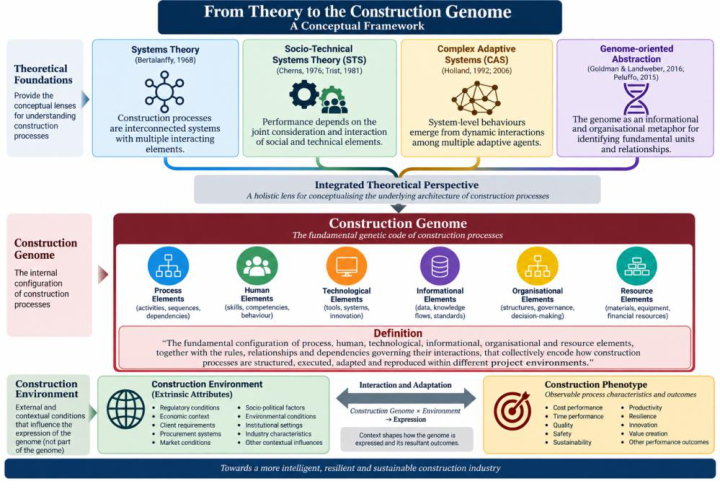
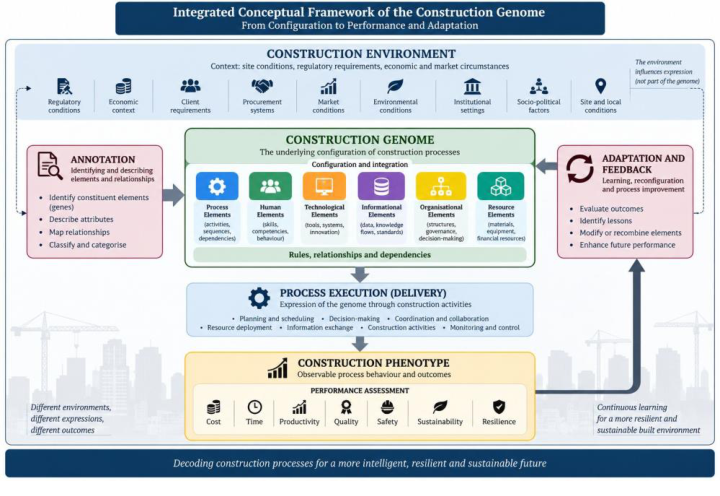
On this basis, the Construction Genome is conceptualised as the fundamental configuration of process, human, technological, informational, organisational and resource elements, together with the rules, relationships and dependencies governing their interactions, that collectively encode how construction processes are structured, executed, adapted and reproduced within different project environments. Regulatory, economic, procurement and market conditions form the environment in which the genome is expressed, and their interaction gives rise to observable outcomes, the construction phenotype, such as productivity, cost, time, quality, safety and sustainability (Figure 1).
Figure 1: Theoretical and conceptual foundations for defining the Construction Genome. (Source: Cherns (1976), Trist (1981), Holland (1992, 2006), Aritua et al. (2009), Peluffo (2015), Goldman and Landweber (2016), Daniel and Daniel (2019), Bayramova et al. (2023), and Abdelmegid et al. (2024))
MATERIALS AND METHODS
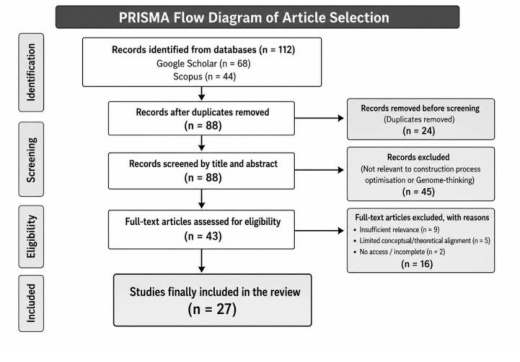
Research Approach This study adopted an interpretivist philosophy, which treats knowledge as socially constructed and supports the synthesis of existing concepts to explain complex phenomena (William, 2024; Pervin & Mokhtar, 2022). A systematic literature review provided a transparent process for identifying, evaluating and selecting studies, while meta-synthesis supported the interpretive integration of concepts, relationships and system-level patterns across them (Sim & Mengshoel, 2023). The review followed the Preferred Reporting Items for Systematic Reviews and Meta- Analyses (PRISMA) framework (Figure 2).
Search Strategy and Selection Scopus and Google Scholar were searched for peer-reviewed English-language articles published between 2015 and 2026, using terms such as “construction process modelling”, “construction process knowledge”, “digital construction optimisation” and “genome-system” combined with AND and OR, supplemented by backward snowballing. The initial search yielded 112 records (68 from Google Scholar and 44 from Scopus). After 24 duplicates were removed, 88 records were screened by title and abstract, and 45 were excluded as not relevant to construction process optimisation or genome-oriented thinking. Of the 43 full-text articles assessed for eligibility, 16 were excluded for insufficient relevance (n = 9), limited conceptual or theoretical alignment (n = 5), or lack of access or incomplete text (n = 2). The final body of evidence comprised 27 peer-reviewed articles.
Figure 2: PRISMA flow diagram of article selection
Meta-Synthesis Procedure
Iterative coding and thematic interpretation were applied to two literature streams. Construction studies were examined for the focus, contributions and limitations of integration approaches, and genome-oriented studies for the construct each field offers to construction. The two streams were then integrated through interpretive abstraction informed by the three theories above, which produced the proposed definition and conceptual framework.
RESULTS AND DISCUSSION
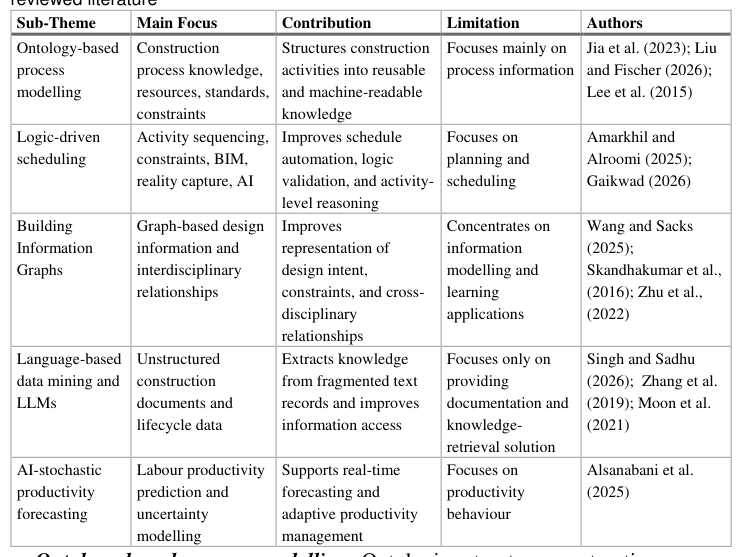
Themes on Fragmentation Improvement Efforts in Construction The synthesis revealed two patterns: efforts to reduce fragmentation in construction, and applications of genome-oriented thinking beyond biology. Table 1 categorises the first. Collectively, these efforts show a transition towards structuring construction knowledge so that it is more reusable, machine-readable, interoperable and supportive of decision-making, although each addresses only part of the problem.
Table 1. Approaches to improving construction process fragmentation identified in the reviewed literature
Ontology-based process modelling. Ontologies structure construction process knowledge by linking activities, resources, regulations and constraints through semantic rules (Jia et al., 2023), or by capturing the geometry, functionality and physical characteristics of prefabrication and assembly processes (Lee et al., 2015). They make process knowledge explicit and reusable, but remain focused on process information.
Logic-driven scheduling. Integrating BIM, planning documents and reality capture supports automated activity sequencing and logic checking (Amarkhil & Alroomi, 2025; Essam et al., 2023; Nusen et al., 2021), and satisfiability modulo theories can compute optimal schedules under resource limits (Gaikwad, 2026). These remain planning solutions with limited capacity to explain wider process interactions.
Building Information Graphs. Building Information Graphs link discipline- specific subgraphs of objects and relationships through a meta-graph (Wang & Sacks, 2025), and graph structures have supported access control and BIM/GIS integration (Skandhakumar et al., 2016; Zhu et al., 2022). They improve cross- disciplinary representation but focus on data interoperability.
Language-based data mining. Natural language processing, text mining and large language models extract knowledge locked in contracts, specifications and site records (Zhang et al., 2019; Moon et al., 2021; Singh & Sadhu, 2026) and support lifecycle data management (Chaplygin & Losev, 2025), but remain documentation and knowledge-retrieval solutions.
AI-stochastic productivity forecasting. Hybrid Long Short-Term Memory and Markov chain models (Alsanabani et al., 2025) and machine learning models (Florez-Perez et al., 2022; Jacobsen et al., 2024) forecast labour productivity from workforce, site and external variables, addressing fragmentation only at the productivity-management level.
Themes on Application of Genome-Thinking
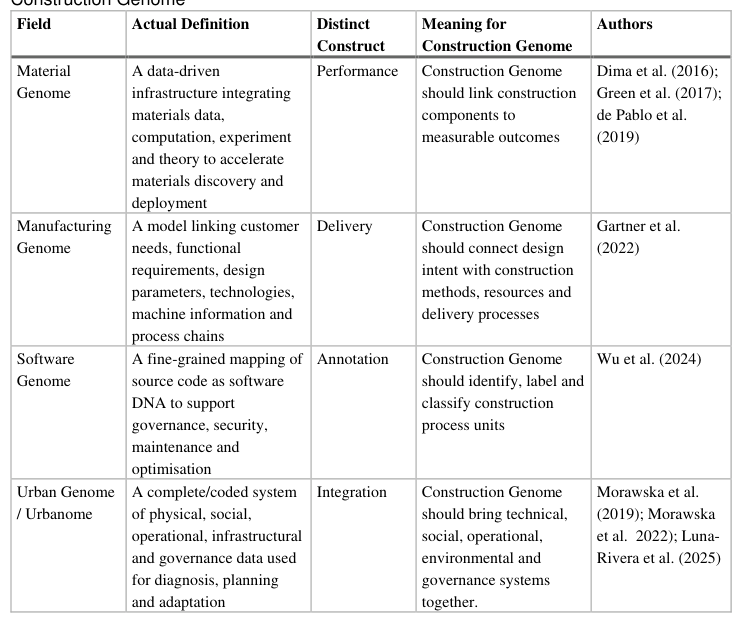
Table 2 summarises how genome-oriented thinking has been applied beyond biology and the distinct construct each field offers to Construction Genome.
Table 2. Applications of genome-oriented thinking beyond biology and their meaning for Construction Genome
Materials Genome. The Materials Genome Initiative connects computation, experiment, collaborative networks and data to reduce the time and cost of materials discovery (Dima et al., 2016; de Pablo et al., 2019). Its transferable construct is performance: Construction Genome should explain how the structure of construction components and processes influences their outcomes.
Manufacturing Genome. The Manufacturing Genome integrates customer needs, functional requirements, design parameters, technologies and machines to model interdependencies between product design and production planning (Gartner et al., 2022). For construction, this points towards delivery, linking client needs and design decisions with methods, resources and delivery chains.
Software Genome. The Software Genome Project maps source code as “software DNA” at a fine-grained level to support governance, security and maintenance (Wu et al., 2024). Construction processes similarly contain coded elements such as activity sequences, specifications, method statements and safety controls, pointing towards annotation of the smallest meaningful process units.
Urban Genome. The Urbanome places data on the physical, social, operational and structural characteristics of a city on a common platform for diagnosis and scenario testing (Morawska et al., 2019), extended to service protocols, infrastructural designs and governance rules (Luna-Rivera et al., 2025). This points towards integration of technical, social, operational, environmental and governance systems.
Architectural Genome. In evolutionary design, genes define design variables and fitness values measure performance, revealing relationships between parameters and outputs (Makki et al., 2022). Construction methods, materials, sequencing and site constraints can likewise be treated as parameters whose combinations produce different outcomes, the construct of configuration.
Landscape and heritage gene-thinking. Landscape and house gene mapping show how built forms express environmental adaptation, cultural continuity and local construction wisdom (Li et al., 2025; Chen et al., 2026). Construction processes are similarly shaped by local materials, climate, skills, regulations and culture, pointing towards context.
Organisational DNA. Organisational DNA links structure, decision rights, motivators, information and renewal to organisational survival and adaptation (Madi, 2025). Construction performance is likewise shaped by leadership, authority, communication, skills and culture, pointing towards adaptation: the capacity to learn, renew and respond to change.
Integrated Conceptual Framework for Construction Genome
Figure 3 presents the integrated conceptual framework. The Construction Genome sits at its centre and is examined through annotation, which identifies constituent elements and their relationships; configuration, which concerns how they are arranged; and integration, which concerns how they function together. This reflects the interdependence emphasised by General Systems and Socio-Technical Systems theories (von Bertalanffy, 1968; Clegg, 2000).
Figure 3: Integrated conceptual framework for Construction Genome
Delivery, context and performance explain how the genome is expressed and assessed. Delivery enacts the configuration through decisions, coordination and resource use, producing observable outcomes, the construction phenotype; context captures the site, regulatory and market conditions on which the effectiveness of socio-technical configurations depends (Clegg, 2000); and performance provides criteria such as productivity, quality, safety and sustainability, much as materials genome research connects modelling to evaluation (de Pablo et al., 2019). Adaptation connects the phenotype back to the genome through learning and reconfiguration, reflecting how feedback and recombination change project organisation and outcomes (Daniel & Daniel, 2019).
Implications of the Study Theoretically, the study defines Construction Genome as a construct for understanding the configuration of construction elements and the relationships governing them, distinct from the operating environment and observable outcomes. This offers a basis for investigating why similar practices perform differently across projects, and an agenda for identifying recurring process relationships and the conditions that influence their effectiveness.
Practically, the concept could help managers diagnose problems through dependencies across project delivery: repeated installation delays, for instance, may involve interactions among design approvals, material availability, workforce readiness and inspections. Project management offices could document process configurations with their context and outcomes to guide future teams and strengthen benchmarking.
CONCLUSION
This study examined how genome-oriented thinking could provide a conceptual foundation for understanding the organisation of construction processes. Construction Genome brings the configuration of these processes, their contextual operation and their capacity for adaptation into one analytical perspective. It suggests that interventions should be judged by the wider arrangements they affect, and that the conditions and dependencies behind an outcome should be retained when transferring practice between projects.
The study is limited by its English-language scope and by the interpretive judgement involved in transferring genome concepts across disciplines. Operational definitions and comparative empirical studies are required to test whether the proposed elements and relationships explain how construction processes function and adapt.
REFERENCES
Abdelmegid, M. et al. (2024) ‘Conceptualizing digital twins in construction projects as socio-technical systems’, in Proceedings of the 41st International Symposium on Automation and Robotics in Construction (ISARC). Lille: IAARC, pp. 577–584. https://doi.org/10.22260/ISARC2024/0075
Alsanabani, N. et al. (2025) ‘A hybrid AI-stochastic framework for predicting dynamic labor productivity in sustainable repetitive construction activities’, Sustainability, 17(24), article 11097. https://doi.org/10.3390/su172411097
Amarkhil, Q. and Alroomi, A. (2025) ‘Logic-driven construction scheduling using AI and semantic data’, Proceedings of International Structural Engineering and Construction, 12(1), article CON-38. https://doi.org/10.14455/ISEC.2025.12(1).CON-38
Annor, J. et al. (2025) ‘Economic contributions of the construction sector: A comparative analysis of workforce and financing factors across regions’, in Collins, W., Perrenoud, A.J. and Posillico, J. (eds.) Proceedings of Associated Schools of Construction 61st Annual International Conference. EPiC Series in Built Environment, 6. EasyChair, pp. 643–653. https://doi.org/10.29007/j1j9
Aritua, B., Smith, N.J. and Bower, D. (2009) ‘Construction client multi-projects – A complex adaptive systems perspective’, International Journal of Project Management, 27(1), pp. 72–79. https://doi.org/10.1016/j.ijproman.2008.02.005
Bayramova, A. et al. (2023) ‘Enhanced safety in complex socio-technical systems via safety-in-cohesion’, Safety Science, 164, article 106176. https://doi.org/10.1016/j.ssci.2023.106176
Begić, H. and Galić, M. (2021) ‘A systematic review of Construction 4.0 in the context of the BIM 4.0 premise’, Buildings, 11(8), article 337. https://doi.org/10.3390/buildings11080337
Chaplygin, E. and Losev, K. (2025) ‘The role of large language models within construction facilities lifecycle data management’, in Klyuev, S.V. et al. (eds.) II International Scientific Conference “Recent Advances in Architecture and Construction” 2024. Lecture Notes in Civil Engineering, 627. Cham: Springer, pp. 226–238. https://doi.org/10.1007/978-3-031-82938-3_27
Chen, Y., Mohamed Afla, M.R. and Wang, Z. (2026) ‘Identification and expression of traditional house gene mapping: A study of seaweed house in Rongcheng, China’, Journal of Asian Architecture and Building Engineering, 25(3), pp. 1647–1661. https://doi.org/10.1080/13467581.2025.2497407
Cherns, A. (1976) ‘The principles of sociotechnical design’, Human Relations, 29(8), pp. 783–792. https://doi.org/10.1177/001872677602900806
Clegg, C.W. (2000) ‘Sociotechnical principles for system design’, Applied Ergonomics, 31(5), pp. 463–477. https://doi.org/10.1016/S0003-6870(00)00009-0
Daniel, E. and Daniel, P.A. (2019) ‘Megaprojects as complex adaptive systems: The Hinkley point C case’, International Journal of Project Management, 37(8), pp. 1017–1033. https://doi.org/10.1016/j.ijproman.2019.05.001
de Pablo, J.J. et al. (2019) ‘New frontiers for the materials genome initiative’, npj Computational Materials, 5, article 41. https://doi.org/10.1038/s41524-019-0173-4
Deloitte (2021) GPoC 2020: Global powers of construction. Deloitte. Available at: https://s3.eu-central-1.amazonaws.com/cdn.a3bau.at/public/2021-07/Global%20Powers%20of%20Construction%202020.pdf (Accessed: 12 September 2026).
Dima, A. et al. (2016) ‘Informatics infrastructure for the Materials Genome Initiative’, JOM, 68(8), pp. 2053–2064. https://doi.org/10.1007/s11837-016-2000-4
El Jazzar, M. et al. (2021) ‘Integrating Construction 4.0 technologies: A four-layer implementation plan’, Frontiers in Built Environment, 7, article 671408. https://doi.org/10.3389/fbuil.2021.671408
Essam, N., Khodeir, L. and Fathy, F. (2023) ‘Approaches for BIM-based multi-objective optimization in construction scheduling’, Ain Shams Engineering Journal, 14(6), article 102114. https://doi.org/10.1016/j.asej.2023.102114
Florez-Perez, L., Song, Z. and Cortissoz, J.C. (2022) ‘Using machine learning to analyze and predict construction task productivity’, Computer-Aided Civil and Infrastructure Engineering, 37(12), pp. 1602–1616. https://doi.org/10.1111/mice.12806
Formenti, G. et al. (2022) ‘The era of reference genomes in conservation genomics’, Trends in Ecology & Evolution, 37(3), pp. 197–202. https://doi.org/10.1016/j.tree.2021.11.008
Gaikwad, A. (2026) Exact delivery under resource limits: Logic-driven project scheduling [Preprint]. Research Square. https://doi.org/10.21203/rs.3.rs-8658891/v1
Gartner, P. et al. (2022) ‘Manufacturing genome: A foundation for symbiotic, highly iterative product and production adaptations’, in Andersen, A.-L. et al. (eds.) Towards sustainable customization: Bridging smart products and manufacturing systems. Lecture Notes in Mechanical Engineering. Cham: Springer, pp. 35–46. https://doi.org/10.1007/978-3-030-90700-6_3
Ghamarimajd, Z. et al. (2025) ‘Application of systems thinking and system dynamics in managing risks and stakeholders in construction projects: A systematic literature review’, Systems Research and Behavioral Science, 42(6), pp. 1465–1479. https://doi.org/10.1002/sres.3032
Goldman, A.D. and Landweber, L.F. (2016) ‘What is a genome?’, PLOS Genetics, 12(7), article e1006181. https://doi.org/10.1371/journal.pgen.1006181
Green, M.L. et al. (2017) ‘Fulfilling the promise of the materials genome initiative with high-throughput experimental methodologies’, Applied Physics Reviews, 4(1), article 011105. https://doi.org/10.1063/1.4977487
Gumede, N.P. and Tladi, B. (2023) ‘Socio-technical systems: Using actor-network theory to make the social more tangible in a technical space’, South African Journal of Industrial Engineering, 34(3), pp. 140–155. https://doi.org/10.7166/34-3-2957
Holland, J.H. (1992) ‘Complex adaptive systems’, Daedalus, 121(1), pp. 17–30.
Holland, J.H. (2006) ‘Studying complex adaptive systems’, Journal of Systems Science and Complexity, 19(1), pp. 1–8. https://doi.org/10.1007/s11424-006-0001-z
Holland, J.H. (2014) Complexity: A very short introduction. Oxford: Oxford University Press. https://doi.org/10.1093/actrade/9780199662548.001.0001
Jacobsen, E.L. et al. (2024) ‘Probabilistic forecasting of construction labor productivity metrics’, Journal of Information Technology in Construction, 29, pp. 58–83. https://doi.org/10.36680/j.itcon.2024.004
Jia, L. et al. (2023) ‘Ontological method for the modeling and management of building component construction process information’, Buildings, 13(8), article 2065. https://doi.org/10.3390/buildings13082065
Kulakov, A. (2025) An empirical study of the UK construction industry fragmentation, productivity and performance. PhD thesis. University College London. https://doi.org/10.14324/000.th.10208357
Lee, S., Isaac, S. and Bock, T. (2015) ‘An ontology for process information modeling’, in Proceedings of the 32nd International Symposium on Automation and Robotics in Construction (ISARC). Oulu: IAARC, pp. 1–7. https://doi.org/10.22260/ISARC2015/0032
Li, X. et al. (2025) ‘Evaluating landscape gene perception in traditional villages for sustainable development: A methodological framework integrating game theory and the cloud model’, Buildings, 15(19), article 3441. https://doi.org/10.3390/buildings15193441
Liu, R. and Fischer, M. (2026) ‘Ontology-based modeling and reasoning for construction field context’, Journal of Management in Engineering, 42(1), article 04025059. https://doi.org/10.1061/JMENEA.MEENG-6778
Luna-Rivera, J.M. et al. (2025) ‘Urban genome: A new paradigm for sustainable cities’, npj Urban Sustainability, 5, article 77. https://doi.org/10.1038/s42949-025-00265-1
Madi, K. (2025) ‘Revisiting the organisational DNA metaphor: Unlocking genetic potential’, European Journal of Business and Innovation Research, 13(2), pp. 39–55. https://doi.org/10.37745/ejbir.2013/vol13n23955
Makki, M., Navarro-Mateu, D. and Showkatbakhsh, M. (2022) ‘Decoding the architectural genome: Multi-objective evolutionary algorithms in design’, Technology|Architecture + Design, 6(1), pp. 68–79. https://doi.org/10.1080/24751448.2022.2040305
McKinsey Global Institute (2017) Reinventing construction: A route to higher productivity. McKinsey & Company. Available at: https://www.mckinsey.com/capabilities/operations/our-insights/reinventing-construction-through-a-productivity-revolution (Accessed: 12 September 2026).
Moon, S., Lee, G. and Chi, S. (2021) ‘Semantic text-pairing for relevant provision identification in construction specification reviews’, Automation in Construction, 128, article 103780. https://doi.org/10.1016/j.autcon.2021.103780
Morawska, L. et al. (2019) ‘Towards Urbanome the genome of the city to enhance the form and function of future cities’, Nature Communications, 10, article 4014. https://doi.org/10.1038/s41467-019-11972-6
Morawska, L. et al. (2022) ‘How to build Urbanome, the genome of the city?’, Science of the Total Environment, 810, article 152310. https://doi.org/10.1016/j.scitotenv.2021.152310
Naveed, F. and Khan, K.I.A. (2022) ‘Investigating the influence of information complexity on construction quality: A systems thinking approach’, Engineering, Construction and Architectural Management, 29(3), pp. 1427–1448. https://doi.org/10.1108/ECAM-05-2020-0311
Nusen, P. et al. (2021) ‘Construction planning and scheduling of a renovation project using BIM-based multi-objective genetic algorithm’, Applied Sciences, 11(11), article 4716. https://doi.org/10.3390/app11114716
Peluffo, A.E. (2015) ‘The “genetic program”: Behind the genesis of an influential metaphor’, Genetics, 200(3), pp. 685–696. https://doi.org/10.1534/genetics.115.178418
Pervin, N. and Mokhtar, M. (2022) ‘The interpretivist research paradigm: A subjective notion of a social context’, International Journal of Academic Research in Progressive Education and Development, 11(2), pp. 419–428. https://doi.org/10.6007/IJARPED/v11-i2/12938
Radzi, A.R. et al. (2024) ‘Relationship between digital twin and building information modeling: A systematic review and future directions’, Construction Innovation, 24(3), pp. 811–829. https://doi.org/10.1108/CI-07-2022-0183
Riazi, S.R.M. et al. (2020) ‘A critical review of fragmentation issues in the construction industry’, Talent Development & Excellence, 12(2s), pp. 1510–1521. Available at: https://salford-repository.worktribe.com/output/1357982/a-critical-review-of-fragmentation-issues-in-the-construction-industry (Accessed: 12 September 2026).
Shapiro, J.A. (2017) ‘Biological action in Read–Write genome evolution’, Interface Focus, 7(5), article 20160115. https://doi.org/10.1098/rsfs.2016.0115
Sim, J. and Mengshoel, A.M. (2023) ‘Metasynthesis: Issues of empirical and theoretical context’, Quality & Quantity, 57(4), pp. 3339–3361. https://doi.org/10.1007/s11135-022-01502-w
Singh, P. and Sadhu, A. (2026) ‘Next-generation language-based data mining techniques for smart construction documentation: Challenges and opportunities’, Canadian Journal of Civil Engineering, 53, pp. 1–22. https://doi.org/10.1139/cjce-2025-0329
Skandhakumar, N. et al. (2016) ‘Graph theory based representation of building information models for access control applications’, Automation in Construction, 68, pp. 44–51. https://doi.org/10.1016/j.autcon.2016.04.001
Tran, T.V., Tran, H.V.V. and Nguyen, T.A. (2024) ‘A review of challenges and opportunities in BIM adoption for construction project management’, Engineering Journal, 28(8), pp. 79–98. https://doi.org/10.4186/ej.2024.28.8.79
Triantis, K. (2021) ‘Efficiency driven socio-technical system design’, in Parmeter, C.F. and Sickles, R.C. (eds.) Advances in efficiency and productivity analysis. Springer Proceedings in Business and Economics. Cham: Springer, pp. 41–67. https://doi.org/10.1007/978-3-030-47106-4_3
Trist, E.L. (1981) The evolution of socio-technical systems: A conceptual framework and an action research program. Occasional Paper 2. Toronto: Ontario Ministry of Labour, Ontario Quality of Working Life Centre.
von Bertalanffy, L. (1968) General system theory: Foundations, development, applications. New York: George Braziller.
Wang, Z. and Sacks, R. (2025) ‘Building Information Graphs (BIGs): Remodeling building information for learning and applications’, Data-Centric Engineering, 6, article e44. https://doi.org/10.1017/dce.2025.10024
William, F.K.A. (2024) ‘Interpretivism or constructivism: Navigating research paradigms in social science research’, International Journal of Research Publications, 143(1), pp. 134–138. https://doi.org/10.47119/IJRP1001431220246122
Wu, Y. et al. (2024) ‘The Software Genome Project: Unraveling software through genetic principles’, in Proceedings of the 39th ACM/IEEE International Conference on Automated Software Engineering (ASE ’24). New York: Association for Computing Machinery, pp. 2319–2323. https://doi.org/10.1145/3691620.3695307
Zhang, F. et al. (2019) ‘Construction site accident analysis using text mining and natural language processing techniques’, Automation in Construction, 99, pp. 238–248. https://doi.org/10.1016/j.autcon.2018.12.016
Zhu, J. et al. (2022) ‘The application of graph in BIM/GIS integration’, Buildings, 12(12), article 2162. https://doi.org/10.3390/buildings12122162
SEARCH THE AHFE DIGITAL BOOKSTORE BY ISBN
Explore the complete digital volume
Human Factors in Design, Engineering, and Computing
Read this individual research paper free through the original publisher, or explore the full digital proceedings book.