Haozhe Ma (2026). Wilderness Vanguard: Design and Implementation of a Quadruped- Robot-Based Proactive Terrain Verification System for Mitigating Visual-Deception Risks in Outdoor Hiking. In: Human Factors in Design, Engineering, and Computing. AHFE Open Access, vol. 238, pp. 309–318. https://doi.org/10.54941/ahfe1008264
Publisher statistics will load when you open Metrics.
AHFE OPEN ACCESS OPEN ACCESS CONFERENCE PROCEEDINGS PAPER
Wilderness Vanguard: Design and Implementation of a Quadruped- Robot-Based Proactive Terrain Verification System for Mitigating Visual-Deception Risks in Outdoor Hiking
With the growing popularity of outdoor exploration, falls and missteps caused by visually deceptive terrain have become a major safety concern for hikers. This study proposes a quadruped-robot-based proactive terrain verification system and investigates the role of multimodal feedback under high cognitive load. Based on a Risk Proxy design concept, the robot physically probes potentially hazardous terrain before the user proceeds. The prototype was developed through three iterative sensor configurations. V1.0 employed only 2D LiDAR; V2.0 added an OAK-D depth camera; and V3.0 integrated LiDAR-based topographic ranging, depth-based ground geometry detection, and RGB image recognition into a multi-sensor fusion architecture. Robot kinematics were also optimized by adjusting body inclination, friction, and centre-of-gravity parameters to improve locomotion over uneven terrain. V3.0 addressed the limitations of individual sensing modalities, in particular the inability of LiDAR-only sensing to detect cavities beneath a visually continuous surface. Detection performance has not yet been systematically quantified; a formal evaluation protocol is reported as part of the planned validation work. Based on this configuration, Wilderness Vanguard integrates a quadruped robot, a mobile application, and a smartwatch-based haptic interface to support pre-trip preparation, on-trail monitoring, and hazard warning. A planned controlled experiment will further evaluate whether multimodal, particularly high-frequency haptic, feedback improves reaction time, cognitive load, and system trust under simulated high-pressure conditions. The study aims to shift outdoor safety from reactive response to proactive prevention, while providing a new approach to wearable interaction and human–robot collaboration in high-risk environments.Keywords: proactive terrain verification; quadruped robot; risk proxy; multimodal haptic feedback; visual deception; human–robot collaborative wearable system
The global outdoor adventure market has expanded rapidly in recent years, accompanied by increasing participation in hiking and related activities. However, safety incidents remain frequent, with falls and missteps among the leading causes of injury. In natural environments such as snow-covered cliffs, leaf-covered pits, and low-contrast rocky slopes, human perception
310 Ma of depth and surface texture can become unreliable. This phenomenon is referred to in this study as visual deception. Because approximately 80–90% of environmental perception relies on visual input (Cutting and Vishton, 1995), discrepancies between the visual appearance and physical properties of terrain can expose even experienced hikers to unexpected hazards.
Global adventure tourism has grown into a market estimated at USD 464.3 billion in 2025 (Grand View Research, 2025). Hiking remains a major context for outdoor emergencies: hiking accounted for 48% of search and rescue incidents in U.S. national parks between 1992 and 2007 (Heggie, 2009), and 73% of individuals involved in outdoor exploration accidents in China in 2024 were engaged in hiking (China Adventure Association, 2025). Falls and missteps, water-related incidents, and getting lost are among the major causes (Heggie, 2009). These patterns suggest that visual deception is not limited to rare extreme situations, but represents a broader safety problem requiring systematic technological intervention.
Existing outdoor safety technologies primarily focus on macro-level GPS navigation or post-incident emergency response, such as fall detection and automatic emergency calls from wearable devices (Fankhauser et al., 2014; Wellhausen et al., 2019). Such approaches are inherently reactive and offer limited capacity to detect micro-scale terrain hazards, including cavities concealed by leaves or fractures hidden beneath snow. Moreover, current warning systems often rely on a single sensory channel. Visual alerts or conventional low-frequency vibration may be overlooked when users are physically fatigued or psychologically stressed, potentially resulting in cognitive tunnelling and missed warnings.
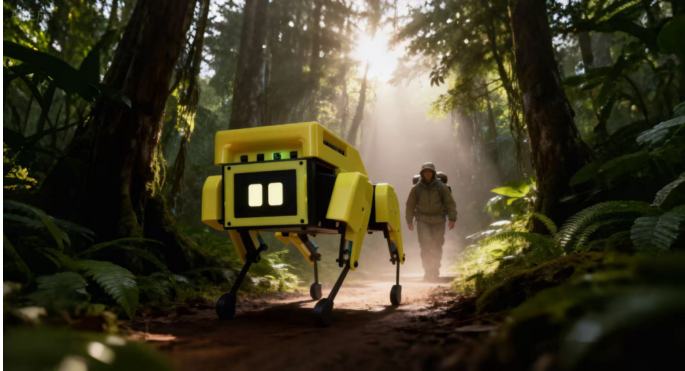
To address this gap, we developed Wilderness Vanguard, a human– robot collaborative prototype in which a multisensory quadruped robot functions as a physical Risk Proxy, probing terrain before the user proceeds (see Figure 1). Hazard information is subsequently communicated through a smartwatch-based graded warning interface. Three research questions are proposed: RQ1: Compared with visual-only or conventional vibration feedback, can multimodal feedback combining visual and high-frequency haptic cues significantly reduce users’ reaction time to potential hazards under high cognitive load?
RQ2: Can multimodal feedback reduce users’ subjective cognitive load during complex tasks?
RQ3: How do different feedback modalities influence user trust in and perception of the Risk Proxy system?
These questions address whether multimodal haptic feedback can compensate for visual limitations and improve the effectiveness of a Risk Proxy system in demanding outdoor environments. Previous studies have shown that multimodal alerts, such as combined visual and haptic feedback, can reduce reaction time and information omission in navigation and search- and-rescue tasks involving high cognitive load (Ferris and Sarter, 2008). Evaluating this mechanism in outdoor terrain-risk scenarios therefore has both engineering and interaction-design significance.
Figure 1: Wilderness Vanguard performing proactive terrain detection on a simulated woodland trail while the user follows at a safe distance.
RELATED WORK
Visual Depth Perception and Terrain Misjudgement Human perception of environmental depth and spatial layout relies on the integration of multiple cues, including binocular disparity, motion parallax, texture gradients, and occlusion (Cutting and Vishton, 1995). When texture or illumination becomes homogeneous, as on flat-lit snowfields or leaf- covered ground, these cues may become unreliable, producing systematic errors in depth perception. This provides a perceptual explanation for the visual-deception problem addressed in this study.
Research on environmental perception further suggests that the absence of effective texture gradients can substantially impair the perception of egocentric distance and terrain depth (Renner et al., 2013). Consequently, simply improving visual presentation, such as through higher-resolution cameras or clearer maps, may not fully resolve the problem. Non-visual physical sensing is therefore required as a complementary source of terrain information.
Terrain Perception and Quadruped-Robot Navigation Quadruped robots are well suited to unstructured terrain because of their discontinuous support patterns and adaptive locomotion. Fankhauser et al. (2014) demonstrated the importance of high-density elevation mapping and multisensory terrain reconstruction for stable robot locomotion. Wellhausen et al. (2019) further combined proprioceptive information, such as foot-contact forces, with visual perception to assess terrain travers ability, highlighting the limitations of vision alone on low-texture or visually deceptive surfaces.
These studies directly support the use of LiDAR, depth imaging, and RGB vision in the present system. However, most previous research has focused on autonomous robot navigation rather than on robots serving as proactive
312 Ma sensing agents for human users and translating environmental observations into understandable and trustworthy warnings.
Recent work has further demonstrated that integrating proprioception with visual and depth-based exteroception is critical for robust quadrupedal locomotion in challenging natural environments (Miki et al., 2022). Building on this principle, Wilderness Vanguard extends terrain perception into a wearable human–robot interaction loop.
Multimodal Haptic Warning and Information Presentation Haptic feedback can provide effective information redundancy when visual or auditory channels are overloaded. Röbig et al. (2019) compared visual and haptic smartwatch navigation cues and found that haptic feedback reduced dependence on visual attention during movement. Van Erp and Van Veen (2004) demonstrated the value of vibrotactile cues for directional guidance, while Sarter (2006) argued that appropriately designed multimodal redundancy can reduce information-processing demands, although poorly coordinated timing or intensity may create additional interference.
These findings support the use of high-frequency pulsed haptic feedback as a primary warning channel in Wilderness Vanguard. Research on cross- modal attention further indicates that salient tactile alerts can rapidly redirect spatial attention when vision is overloaded without imposing additional visual processing demands (Ferris and Sarter, 2008).
Human–Robot Trust and Risk Compensation When robots assume part of the responsibility for safety-related decisions, user trust becomes critical to system effectiveness. Lee and See (2004) emphasized that successful automation depends on appropriate trust calibration, rather than simply maximizing trust. Excessive reliance may reduce users’ own vigilance.
This concern is consistent with Wilde’s (1998) risk homeostasis theory, which suggests that stronger external safety protection may encourage riskier behaviour as individuals attempt to maintain a preferred subjective level of risk. Human–robot interaction studies in emergency evacuation have likewise demonstrated the possibility of overtrust, with users continuing to follow robotic guidance even after erroneous recommendations (Robinette et al., 2016).
Accordingly, Wilderness Vanguard is designed not only to communicate risk but also to support active hazard intervention. Together, research on perceptual failure, terrain sensing, multimodal feedback, and trust calibration provides the theoretical basis for the proposed system and its subsequent evaluation.
SYSTEM DESIGN The Wilderness Vanguard ecosystem integrates a physical robotic probe with a wearable digital interface. Its architecture comprises three functional layers: physical sensing, risk assessment, and user interaction.
Wilderness Vanguard: Design and Implementation 313 Hardware Architecture: The Risk Proxy
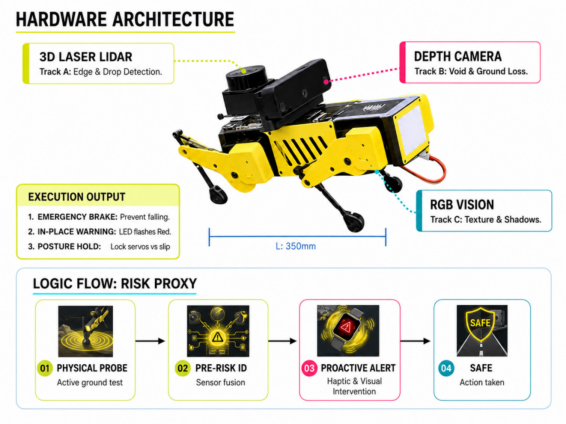
The physical sensing platform is based on the Mini Pupper quadruped robot. Because individual sensors may fail under complex outdoor conditions—for example, water reflections can interfere with depth imaging, while strong sunlight may reduce the stability of infrared-based ranging—the system adopts three parallel sensing channels rather than a single sensor.
The first channel uses 2D/3D LiDAR for edge and drop-off detection. The second uses an OAK-D depth camera to detect cavities and missing ground geometry. The third uses RGB vision to identify texture and shadow cues. Sensor data are fused onboard, and abrupt changes in ground elevation or density trigger a hazard signal that is transmitted to the wearable interface (see Figure 2).
This architecture follows recent findings that robust quadrupedal locomotion in natural environments requires the integration of proprioceptive and exteroceptive sensing (Miki et al., 2022).
Figure 2: Hardware architecture and sensor functions: LiDAR, depth imaging, and RGB vision jointly support the closed-loop process of physical probing, risk identification, and proactive warning.
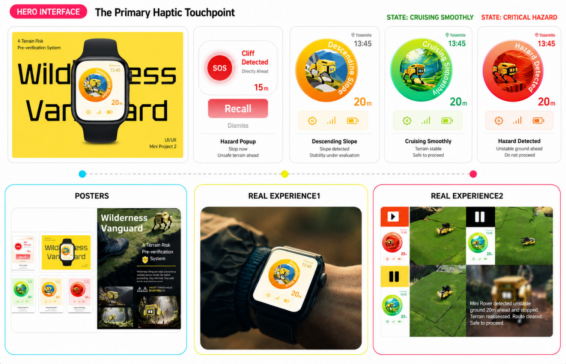
Digital Ecosystem: Haptic State Machine The smartwatch interface operates as a four-state warning system: Cruising (green, gentle low-frequency vibration), Descending Slope Evaluation (yellow), Hazard Detected (orange), and Critical Hazard (red, high-frequency pulsed haptic feedback combined with visual warning) (see Figure 3). When the robot detects a critical hazard, the interface rapidly transitions from normal cruising to the critical-hazard state. The abrupt high-frequency haptic signal is intended to interrupt cognitive tunnelling caused by fatigue or divided attention and redirect the user’s attention to the hazard.
Figure 3: Four-level smartwatch warning interface showing the transition from normal cruising to critical hazard.
PROTOTYPE AND TECHNICAL VALIDATION Physical Test Environment
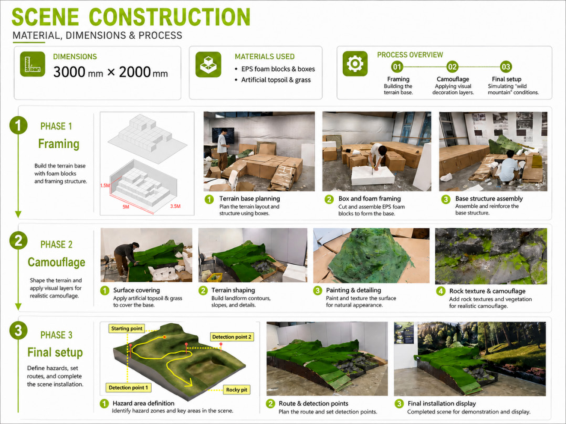
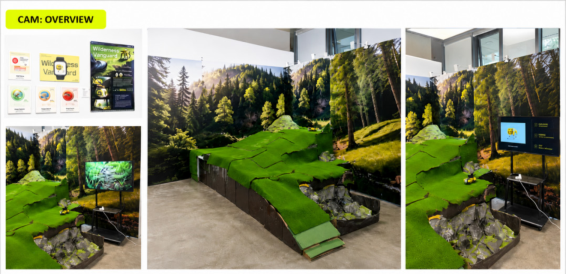
To evaluate the sensing algorithm under controlled but realistic conditions, a physical terrain prototype measuring approximately 3000 mm × 2000 mm was constructed. EPS foam blocks and cardboard boxes were used to create structural cavities, while artificial turf and simulated topsoil concealed surface irregularities. Lighting was used to reproduce outdoor illumination conditions (see Figure 4).
The resulting test environment incorporated three representative forms of visual deception: drop-offs, wet terrain, and concealed structural cavities.
Figure 4: Materials and construction process of the physical test terrain, including structural framing, surface camouflage, and lighting simulation.
Wilderness Vanguard: Design and Implementation 315 Validation of the Detection Algorithm
The multisensory architecture was validated through incremental prototype iterations.
V1.0 used only 2D LiDAR. It reliably detected steep geometric drop-offs but showed limited performance for concealed cavities where the surface contour remained visually continuous.
V2.0 incorporated an OAK-D depth camera and used ground-depth gradients to improve detection beyond geometric ranging alone.
V3.0 further introduced RGB vision and cross-validated visual texture confidence against depth geometry. When depth sensing indicated a cavity while RGB texture confidence was low, the system prioritized the depth- based assessment and activated emergency braking and posture locking.
Repeated informal trials in the physical terrain environment indicated that the V3.0 fusion configuration recovered the cavity cases missed by V1.0 and the low-contrast cases missed by V2.0. These trials were exploratory and were not conducted under a fixed protocol, so no detection-accuracy figure is claimed here. A quantitative evaluation, using a balanced set of hazard and safe-ground trials and a reported confusion matrix, is planned alongside the human-subject study described in Section 5.
Figure 5: Deployment of the physical terrain prototype, with the robot conducting terrain detection while system status is transmitted to the monitoring interface.
FUTURE WORK
Wilderness Vanguard has completed hardware–software integration and preliminary technical validation. However, the human-factors questions addressed by RQ1–RQ3—whether multimodal feedback improves reaction time, cognitive load, and system trust—remain to be examined through controlled user studies.
Experimental Design A within-subject design is planned with 20 recreational hikers who have no professional guiding or rescue experience. Participants will observe the robot conducting proactive terrain inspection in the physical environment described in Section 4.1 while simultaneously performing a secondary
316 Ma cognitive task, such as continuous auditory memory, to simulate the divided attention associated with demanding outdoor activity.
When the robot detects a concealed hazard, participants will receive one of three randomly ordered warning conditions through the smartwatch: Condition A: visual feedback only; Condition B: visual feedback + conventional low-frequency vibration; Condition C: visual feedback + high-frequency pulsed haptic feedback.
Participants will be instructed to press a response button as soon as they perceive the warning, and response latency will be recorded automatically.
Measures and Analysis For RQ1, reaction times across the three conditions will be compared using repeated-measures ANOVA.
For RQ2, subjective cognitive load will be assessed using the NASA Task Load Index (NASA-TLX) after each condition.
For RQ3, semi-structured interviews will examine how participants develop trust in the Risk Proxy system and how they perceive its use. Particular attention will be given to statements related to the trust-calibration framework proposed by Lee and See (2004).
Hypotheses The following hypotheses will be tested:
H1: Reaction time under Condition C will be significantly shorter than under Condition A.
H2: NASA-TLX scores under Condition C will be significantly lower than under Condition A.
H3: Condition C will generate higher user-trust ratings than Conditions A and B. However, participants may also express concerns regarding excessive reliance on robotic judgment, consistent with Wilde’s (1998) risk homeostasis theory and the system’s use of a physical blocking/stabilization posture rather than relying solely on soft warnings.
Ethical Considerations Delegating part of terrain-risk assessment to a robotic agent raises potential ethical concerns. Users may become less vigilant or attempt routes they would otherwise avoid because they perceive the system as providing additional protection, reflecting the risk-homeostasis effect (Wilde, 1998).
To mitigate this possibility, Wilderness Vanguard does not rely solely on informational warnings. When a critical hazard is detected, the robot adopts a physical blocking and stabilization posture, creating a physical cue and partial restriction on further movement. This approach represents a form of system- enforced hazard rejection, rather than leaving the final response entirely to the user’s subjective judgment.
CONCLUSIONS
This study proposed and implemented Wilderness Vanguard, a quadruped-robot-based proactive terrain verification system designed to mitigate visual-deception risks during outdoor hiking.
Through iterative development from V1.0 to V3.0, the system integrated LiDAR, depth imaging, and RGB vision into a multisensory fusion architecture and was shown to recover the hazard cases that the single-sensor configurations failed to detect. A four-level smartwatch-based haptic warning interface was further developed, demonstrating the engineering feasibility of combining a robotic Risk Proxy with multimodal wearable warnings.
Based on research in perceptual psychology, terrain-aware robotics, multimodal haptics, and human–automation trust, the study formulated three research questions and a corresponding controlled experimental protocol to evaluate reaction time, cognitive load, and system trust.
The principal contribution of this work is to shift outdoor safety from macro-level navigation and post-incident response toward proactive physical verification of micro-scale terrain hazards. The proposed system provides both a reusable technical architecture and an empirical framework for investigating human–robot collaborative safety in high-risk environments.
ACKNOWLEDGMENT
The authors would like to express their sincere gratitude to the Central Academy of Fine Arts (CAFA), Tongji University, and Stanford University for their invaluable academic support, research resources, and inspiring collaborative environment that made this study possible. Special thanks are also extended to SFK for their insightful guidance and mentorship throughout the design and prototyping phases of the Wilderness Vanguard project.
REFERENCES
China Adventure Association. (2025). 2024 annual report on outdoor exploration accidents in China. Beijing: China Adventure Association. Cutting, J. E., & Vishton, P. M. (1995). Perceiving layout and knowing distances:
The integration, relative potency, and contextual use of different information about depth. In W. Epstein & S. Rogers (Eds.), Perception of Space and Motion (pp. 69–117). Academic Press. https://doi.org/10.1016/B978-012240530-3/ 50005-5 Fankhauser, P., Bloesch, M., Gehring, C., Hutter, M., & Siegwart, R. (2014). Elevation mapping for locomotion and navigation using high-density terrain maps. In 2014 IEEE/RSJ International Conference on Intelligent Robots and Systems (IROS) (pp. 354–361). IEEE. https://doi.org/10.1109/IROS.2014.6942926 Ferris, T. K., & Sarter, N. (2008). Cross-modal links in attention and the
design of multimodal interfaces. Human Factors, 50(1), 17–27. https://doi. org/10.1518/001872008X312297 Grand View Research. (2025). Adventure tourism market size, share & trends analysis report. https://www.grandviewresearch.com/industry-analysis/adventure- tourism-market-report Heggie, T. W. (2009). Dead men walking: Search and rescue in US National
Parks. Wilderness & Environmental Medicine, 20(3), 244–249. https://doi. org/10.1580/08-WEME-OR-299R.1
Human Factors, 46(1), 50–80. https://doi.org/10.1518/hfes.46.1.50_30392 Miki, T., Lee, J., Hwangbo, J., Wellhausen, L., Koltun, V., & Hutter, M. (2022).
Learning robust perceptive locomotion for quadrupedal robots in the wild. Science Robotics, 7(62), eabk2822. https://doi.org/10.1126/scirobotics.abk2822 Renner, R. S., Velichkovsky, B. M., & Helmert, J. R. (2013). The perception of egocentric distances in virtual reality: A review. ACM Computing Surveys, 45(4), 1–40. https://doi.org/10.1145/2536853.2536855 Röbig, S., Schneegass, C., & Schmidt, A. (2019). Pedestrian navigation with a
smartwatch: The influence of haptic vs. visual feedback. In Proceedings of the 21st International Conference on Human-Computer Interaction with Mobile Devices and Services (MobileHCI ‘19). ACM. https://doi.org/10.1145/3338286.3340115 Robinette, P., Howard, A. M., & Wagner, A. R. (2016). Overtrust of robots in emergency evacuation scenarios. In 2016 11th ACM/IEEE International Conference on Human-Robot Interaction (HRI) (pp. 101–108). IEEE. https://doi. org/10.1109/HRI.2016.7451740 Sarter, N. B. (2006). Multimodal information presentation: Design guidance and
research challenges. International Journal of Industrial Ergonomics, 36(5), 439–445. https://doi.org/10.1016/j.ergon.2006.01.011 Van Erp, J. B. F., & Van Veen, H. A. H. C. (2004). Vibrotactile in-vehicle navigation system. Transportation Research Part F: Traffic Psychology and Behaviour, 7(4–5), 24–256. https://doi.org/10.1016/j.trf.2004.09.006 Wellhausen, L., Dos Santos, A., Fraundorfer, F., & Hutter, M. (2019). Proprioceptive
and visual terrain perception for quadruped robots. In 2019 IEEE/RSJ International Conference on Intelligent Robots and Systems (IROS) (pp. 4089–4096). IEEE. https://doi.org/10.1109/IROS40897.2019.8967702 Wilde, G. J. S. (1998). Risk homeostasis theory: Why safety interventions can fail.