Manabu Chikai, Kentaro Watanabe, Bach Quang Ho, Jooho Park, Yui Murakami, Kayo Koike, Min Ma, Masahiro Tsutsu (2026). Effects of Customer-Side Environmental Noise on Interactions in Avatar-Mediated Remote Customer Service. In: Human Factors in Design, Engineering, and Computing. AHFE Open Access, vol. 238, pp. 363–372. https://doi.org/10.54941/ahfe1008269
Our research group has been investigating factors contributing to comfortable working conditions for operators providing avatar-mediated remote customer service. However, the effects of customer-side environmental noise on these interactions remain unclear. This study was focused on speech comprehension and investigating whether customer-side environmental noise interferes with service interactions. To this end, we reproduced an airport crowd-noise environment and examined its effects on remote customer service interactions. Mock customer service interactions were conducted between customers and a remote operator. Ten participants (five men and five women) served as customers, while one operator performed all customer service tasks. All experimental trials were conducted in a soundproof room. The acoustic environment was created using a digital mixer and two loudspeakers and calibrated to provide a flat frequency response. Objective measures included recorded speech data and the operator’s gaze behavior during the interactions. In addition, subjective evaluations of customer service quality (0‒100 points) and self-reported stress (0‒100 points) were obtained after each trial. The results showed that both customers and the operator tended to experience higher subjective stress levels under noisy conditions. Furthermore, under noisy conditions, subjective stress was apparently influenced more strongly by listening effort and difficulties in verbal communication than by interpersonal distance itself. These findings suggested that customer-side environmental noise should be considered when designing avatar-mediated customer service systems. Based on these findings, guidelines for avatar robot placement and service-environment design in practical service settings should be developed in future studies.
This study was aimed identifying factors that contribute to a “good avatar- mediated interaction” during customer service, focusing on the operator’s working environment.
We considered remote customer service using avatar robots as a potential new way of working. Watanabe (2023) reported that avatar technologies used in remote customer service may complement traditional face-to-face
service by redefining the workplace, promoting employee skill development, and enhancing wellbeing. Watanabe and Ho (2023) observed that avatar- mediated customer service improved the flexibility of service delivery.
However, customer service staff (hereafter referred to as operators) may spend much of the working day using a personal computer (PC), tablet, smartphone, or other electronic device; therefore, factors contributing to operator fatigue should be investigated. During avatar-mediated remote customer service, operators must observe customers’ facial expressions and behaviors (nonverbal communication) and understand their speech (verbal communication). In our previous studies, we have subjectively evaluated satisfaction and stress during customer service interactions in terms of avatar appearance and the perceived distance between customers and the avatar robot (Chikai et al., 2025). The results indicated that customer stress levels decreased with increasing interpersonal distance between the customer and the avatar robot. In addition, customers reported higher stress levels when seated. These findings suggested that interpersonal distance and customer posture influence remote customer service interactions.
When factors influencing satisfaction and stress during customer service interactions are considered from the perspectives of nonverbal and verbal communication, verbal information is particularly important. Resolving customer issues requires operators to accurately understand their speech and provide appropriate guidance.
Previous studies have shown that environmental conditions can influence verbal communication. For example, Fitzgerald et al. (2024) investigated speech comprehension under two noise conditions: multi-talker babble and spectrally shaped steady-state noise. Their results indicated that, although noise condition had no significant effect on speech comprehension accuracy, pupil dilation analyses, which is an indicator of cognitive workload, showed that the babble noise condition imposed greater processing complexity and increased reliance on contextual information. These findings suggested that background noise may increase the listening effort required for speech comprehension. Furthermore, noise environments involving multiple simultaneous speakers have been reported to impose greater cognitive demands on speech processing than steady-state noise. However, the effects of customer-side environmental noise on interactions during avatar-mediated remote customer service remain unclear.
In this study, airport crowd noise was introduced as a customer-side environmental factor and a mock remote customer service environment was established to investigate whether customer-side environmental noise could interfere with remote customer service interactions.
MATERIALS AND METHODS
We conducted the experiment with ten participants (five men and five women) acting as customers and one female staff member acting as the operator. This study was approved by the National Institute of Advanced Industrial Science and Technology (AIST) Ergonomic Experiment Committee (HF2024-949). All participants provided informed consent.
Effects of Customer-Side Environmental Noise on Interactions 365 The experiment employed the same task as in our previous study (Chikai et al., 2025). A mock customer service interaction was conducted between a participant acting as the customer and the operator. Customers were instructed to interact with the avatar robot while facing it directly in the experimental room. Meanwhile, the operator was instructed to connect to the avatar robot via a network and provide customer service.
The experimental scenario consisted of customers asking about their boarding gate, directions from their current location to the gate (e.g., distance and travel time), and other information (e.g., where to purchase souvenirs or locate a restroom).
Fixed experimental conditions included the customer’s posture (standing) and tablet angle (tilted), which ensured an adequate field of view via the avatar robot. The lighting environment was configured to represent typical airport conditions, with horizontal illuminance set to 440 lx.
As in our previous study, the physical distance between the customer and the avatar robot was determined based on the concept of personal space (Hall, 1966). Three distance conditions were used: 0.45 m, 1.2 m, and a customer-selected preferred distance. These conditions are hereafter referred to as the 0.45-m, 1.2-m, and preferred-distance conditions, respectively.
We used a publicly available recording of airport crowd noise for the noise condition. Airport crowd noise was selected because the customer- service scenarios employed in this study were based on airport information services. The acoustic environment was reproduced using a digital mixer (DME64N, Yamaha), a low-frequency loudspeaker (7360A, Genelec), and a high-frequency loudspeaker (8010A, Genelec). The acoustic system was adjusted using pink noise to obtain a relatively flat frequency response at a reference position near the center of the range of customer positions. The playback level measured at the same reference position was approximately 65 dB (LZeq).
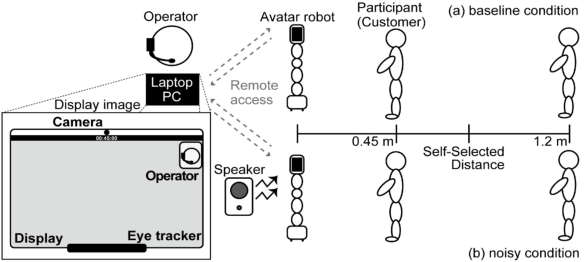
All combinations of the experimental conditions were tested. Six customer service conditions were evaluated, comprising three distance and two noise (with and without noise) conditions. The order of trials was randomized for each customer. The experimental conditions are summarized in Figure 1.
Figure 1: Experimental conditions and eye-tracking setup.
During the mock customer service interactions, speech data were collected from both customer and operator as audio recordings and transcribed text. In addition, the operator’s gaze behavior on the operation screen was recorded using an eye tracker (Tobii Pro Nano, Tobii Technology). After each trial, subjective evaluations were collected for customer service quality (0–100), stress level (0–100), and perceived distance to the interaction partner (ranging from 1 = far to 5 = close). Participants were instructed that higher customer service quality scores indicated better performance, whereas higher stress scores indicated greater perceived stress. The areas viewed by the operator during the customer service interaction were also analyzed. The area where the customer’s facial expressions could be observed corresponded to the gaze area shown in the “Display image” section of Figure 1. The proportion of viewing time spent on this area was calculated.
The analysis procedure was as follows. Customer service quality, stress level, perceived distance, and the proportion of time spent viewing the area where the customer’s facial expressions could be observed were calculated.
For each outcome measure, a linear mixed model was constructed with experimental condition (six levels: 0.45-m/no-noise, 0.45-m/noise, 1.2-m/ no-noise, 1.2-m/noise, preferred-distance/no-noise, and preferred-distance/ noise) as a fixed effect, with customer participant as a random effect. A compound-symmetry covariance structure was assumed for the repeated measures within participants. When a significant effect of experimental condition was observed, post hoc multiple comparisons were performed using Bonferroni correction. All statistical analyses were conducted using IBM SPSS Statistics, version 30.
RESULTS AND DISCUSSION
The mean preferred distance was 0.86 ± 0.11 m. The minimum and maximum values were 0.70 m and 1.10 m, respectively, indicating that the preferred distance tended to be closer to the 1.2-m condition.
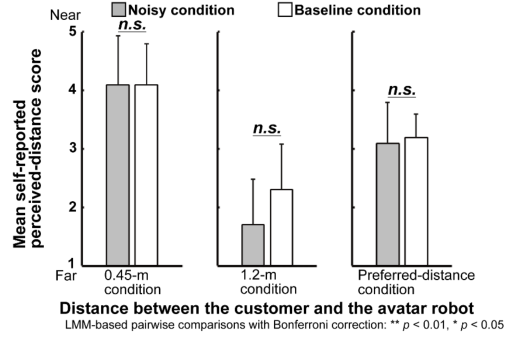
Figure 2 shows customer evaluations of customer service quality (Figure 2(a)), stress level (Figure 2(b)), and perceived distance (Figure 2(c)). Linear mixed-model analysis revealed significant effects of the experimental conditions on customer service quality (F(5,45) = 6.601, p < 0.001), stress level (F(5,45) = 26.963, p < 0.001), and perceived distance (F(5,45) = 28.119, p < 0.001). However, Bonferroni-corrected multiple comparisons revealed no significant differences in perceived distance between the noise and no-noise conditions within each distance condition (p > 0.05).
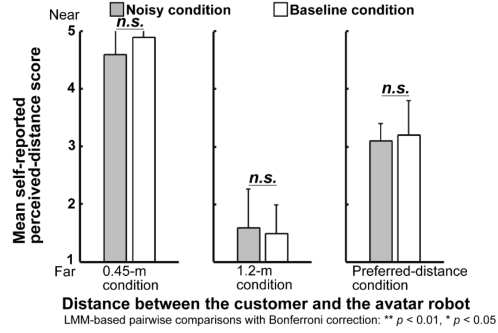
Figure 3 shows the operator’s evaluations of customer service quality (Figure 3(a)), stress level (Figure 3(b)), and perceived distance (Figure 3(c)). Linear mixed-model analysis revealed significant effects of experimental conditions on customer service quality (F(5,45) = 3.881, p = 0.005), stress level (F(5,45) = 57.929, p < 0.001), and perceived distance (F(5,45) = 53.817, p < 0.001). As with the customer evaluations, Bonferroni-corrected multiple comparisons revealed no significant differences in perceived distance between the noise and no-noise conditions (p > 0.05).
(a) customer service quality
(b) stress score
(c) perceived distance to the avatar robot
Figure 2: Customers’ self-reported ratings of customer service quality, stress level, and perceived distance under each experimental condition.
(a) customer service quality
(b) stress score
(c) perceived distance to the customer
Figure 3: Operators’ self-reported ratings of customer service quality, stress level, and perceived distance under each experimental condition.
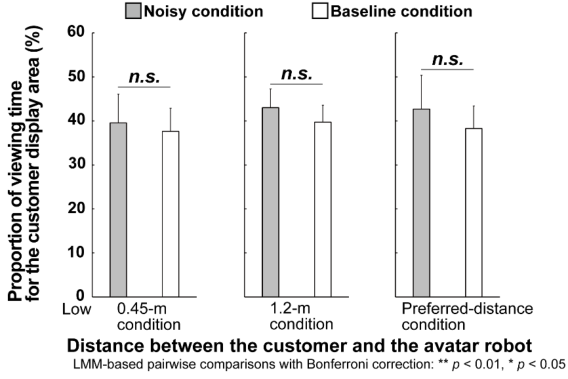
Figure 4 shows the proportion of viewing time spent on the display area where the customer’s facial expressions could be observed. Linear mixed- model analysis revealed a significant effect of experimental conditions on the proportion of viewing time (F(5,45) = 2.930, p = 0.023). However, Bonferroni-corrected multiple comparisons revealed no significant differences among the experimental conditions.
Figure 4: Proportion of viewing time spent on customer display area across experimental conditions.
Fitzgerald et al. (2024) reported that speech comprehension accuracy may be maintained under babble-noise conditions despite increased cognitive workload. Therefore, in this study, the listening effort required for speech comprehension may also have increased under noisy conditions, contributing to higher subjective stress levels. The effects of noise on service experiences have also been examined in previous studies. For example, Yeung et al. (2021) conducted a scenario-based study examining whether noisy environments can reduce customer satisfaction. Yeung et al. examined three categories of sound: background, physical, and situational sounds, and developed eight scenarios based on the combinations of these factors. Participants read restaurant service scenarios and evaluated customer satisfaction. The results indicated that background sounds, physical sounds, and responses to situational sounds influenced customer satisfaction. Although actual service interactions in noisy environments were not examined by Yeung et al., they suggested that unpleasant acoustic environments may reduce customer satisfaction. In addition, the relationship between speech communication and interpersonal distance have been examined in previous studies on verbal communication. Miles et al. (2023) reported that when background noise was introduced during conversations between participant pairs, individuals rapidly adjusted both their interpersonal distance and speech level. They also showed that these compensatory behaviors depended on posture, such as standing and sitting. Furthermore, communication breakdowns increased substantially when the
noise level reached ~78 dB SPL. These findings suggested that with increasing environmental noise, speakers attempted to maintain communication via compensatory behaviors like reducing interpersonal distance and increasing speech level.
Previous studies conducted by our research group have shown that customers experienced lower stress levels when the interpersonal distance between themselves and the avatar robot was relatively large (Chikai et al., 2025). This finding is consistent with those reported by Clauzel and Riché (2015), who examined the effects of physical distance between service providers and customers. In their study, interpersonal distance among service providers, customers, and other customers was classified into four interactional situations: intrusion, conviviality, discretion, and coldness. Clauzel and Riché investigated the effects of these socio-spatial relationships on visit duration, spending, and service experiences. Their results indicated that excessively close physical proximity (intrusion) reduced the customers’ length of stay, suggesting that overly close interpersonal distances may hamper the service experience. In contrast, in this study, self-reported stress levels were found to increase under noisy conditions for both customers and the operator. In particular, self-reported stress scores differed significantly between the noise and no-noise conditions under the 1.2-m condition. One possible explanation is that, although greater interpersonal distance may provide psychological comfort under quiet conditions, it may make verbal communication more difficult in noisy environments. Therefore, the listening effort required for speech comprehension may increase, contributing to higher subjective stress.
Therefore, the findings of this study suggested that, under noisy conditions, listening effort and difficulties in verbal communication may contribute to subjective stress in addition to the effects associated with interpersonal distance. In particular, the psychological benefits of greater interpersonal distance observed under quiet conditions may not be maintained in noisy environments.
Yeung et al. (2021) described physical sounds as those generated by facilities and equipment within a service environment. Such sounds are comparable to the airport crowd noise used in this study. Our findings suggested that these environmental sounds may also increase subjective stress during avatar- mediated remote customer service interactions. In addition, the concept of situational sounds discussed by Yeung et al. (2021) is closely related to the socio-spatial relationships examined by Clauzel and Riché (2015). Situational sounds are generated by the presence and behaviors of other people in a service environment, and their effects may vary with interpersonal distance. Taken together, these findings suggested that physical distance is not only a spatial factor but may also indirectly influence the acoustic characteristics of service environments.
However, an important distinction should be noted. Whereas previous studies have been primarily focused on human–human interactions, our research was focused on the physical distance between customers and avatar robots. Consequently, the psychological effects associated with interpersonal
Effects of Customer-Side Environmental Noise on Interactions 371 distance may differ depending on whether the interaction partner is a person or a robot. Therefore, future studies should focus on investigating how customers perceive and respond to physical proximity when interacting with a robot rather than a human service provider.
Finally, the limitations of this study should be acknowledged. Because only one operator participated in the experiment, a larger sample of operators is needed to examine operator-related effects. Furthermore, individual differences among operators may also influence remote service interactions and should therefore be considered an additional factor. Future research should be focused on examining environmental factors as well as operator- related individual characteristics.
CONCLUSION
In this study, airport crowd noise was introduced as a customer-side environmental factor in a mock remote customer service environment to investigate its effects on avatar-mediated customer service interactions.
- Subjective stress increased under noisy conditions for both customers and the operator. - No significant differences were observed in the proportion of viewing time spent on the customer display area across experimental conditions. - Under noisy conditions, listening effort and difficulties in verbal communication may have contributed to subjective stress.
These findings suggested that customer-side environmental noise should be considered when designing avatar-mediated customer service systems. In future studies, these findings will be used to develop guidelines for avatar robot placement and service environment design in practical service settings.
ACKNOWLEDGMENT
This study was supported by the Small/Startup Business Innovation Research Program, Ministry of Land, Infrastructure, Transport and Tourism (MLIT), Japan. We would like to thank all study participants and staffs of the avatarin Inc.
REFERENCES
Chikai, Watanabe, Ho, Park, Murakami, Koike, Ma and Tsutsu. (2025). Remote Customer Service Interaction Using Avatar Robots: The Influence of Interpersonal Distance and Operator’s Visibility. In: Tareq Ahram, Waldemar Karwowski and Jay Kalra (eds) Human Factors in Design, Engineering, and Computing. AHFE (2025) International Conference. AHFE Open Access, Volume 199. AHFE International, USA. https://doi.org/10.54941/ahfe1006880. Clauzel, A., and Riché, C. (2015). Socio-spatial distance during the service delivery
process: The case of restaurants. Recherche et Applications En Marketing (English Edition), Volume 30, No. 2, pp. 5–29.
Fitzgerald, DeDe, and Shen (2024) Effects of linguistic context and noise type on speech comprehension. Frontiers in Psychology. Volume 15. https://doi. org/10.3389/fpsyg.2024.1345619. Hall, E.T. (1966) The Hidden Dimension, Doubleday Publishing Group. Miles, Weisser, Kallen, Varlet, Richardson and Buchholz. (2023). Behavioral dynamics
of conversation, (mis)communication and coordination in noisy environments, Scientific Reports. Volume 13, 20271. doi: 10.1038/s41598-023-47396-y. Yeung, Chen McCain, Lolli and Larson. (2021). The Influence of Background Sounds, Physical Sounds, and Managers’ Proactive Customer Service Regarding Situational Sounds on Customer Satisfaction in the Restaurant Industry. Journal of Small Business Strategy, Volume 31, Issue 5, pp. 64–74. https://doi. org/10.53703/001c.29831. Watanabe, K. (2023). “Augmented telework with avatar technology: Impact on
workplace and required actions,” in A Research Agenda for Workplace Innovation: The Challenge of Disruptive Transitions, Edward Elgar, Oeij, Dhondt, McMurray (Eds.). pp. 51–66. Watanabe, K., Ho, B.Q. (2023), “Avatar-mediated service encounters: Impacts and research agenda, ” The Service Industries Journal, Vol. 43, Issue 3-4, pp. 134–153. https://doi.org/10.1080/02642069.2023.2169277.
SEARCH THE AHFE DIGITAL BOOKSTORE BY ISBN
Explore the complete digital volume
Human Factors in Design, Engineering, and Computing
Read this individual research paper free through the original publisher, or explore the full digital proceedings book.