Kentaro Watanabe, Bach Ho, Mai Otsuki, Yusuke Kishita, Maiko Kobayakawa (2022). Human augmentation technology for teleworking in service/non-service industries: a survey in Japan. In: The Human Side of Service Engineering. AHFE Open Access, vol. 62, pp. 16–20. https://doi.org/10.54941/ahfe1002535
Telework has been widely accepted in industries as an effective means for business continuity and employee wellbeing in response to the COVID-19 pandemic. However, its application is limited to specific types of jobs such as office work. The expectation toward digital technologies to overcome emerging risks is even accelerating under the influence of COVID-19. Specifically, human augmentation technologies (HAT) are anticipated to realize a new type of teleworking called augmented teleworking, which could create rich service experiences without physical contacts. However, the actual needs for HAT for teleworking are still understudied. This study aims to clarifies the needs and potential impacts of HAT for teleworking through the web questionnaire survey to workers across different industries and locations in Japan. The result implies that HAT to overcome access barriers and pursue reality in teleworking are anticipated and teleworking experiences would promote the needs for HAT.
Telework has been adopted as a major, effective means for business continuity and employee wellbeing in response to the COVID-19 pandemic (Milasi et al., 2020). Through this crisis, a flexible workstyle including telework seems to be more widely accepted and it is reported that urban workers even attempt to leave cities seeking for a better place for living (Pew Research Center, 2021). However, teleworking with conventional technologies such as a video mee- ting system is applicable to limited types of jobs such as office work. This technology gap seems especially evident in service industries. In service resea- rch, utilization of digital technologies in service practices has been attracting attention (van Doorn et al., 2017; De Keyser et al., 2019; Ostrom et al., 2021). In response to the pandemic, the demands for technology to ove- rcome emerging risks are even growing (Heinonen and Strandvik, 2020). Among such digital technologies, human augmentation technologies (HAT)
Human Augmentation Technology for Teleworking in Service/Non-Service Industries 17
to enhance service capabilities such as virtual reality (VR) and robotic avatars are anticipated to tackle challenges of COVID-19 by making telework appli- cable to a broader range of workplaces, and then to create richer experiences without physical contacts (Watanabe et al., 2020; Ho et al., 2022). Noneth- eless, the actual needs of HAT for teleworking or “augmented teleworking” (Watanabe et al., 2020) are still understudied.
This study aims to investigate the needs and potential impacts of HAT for teleworking across industries and locations. For this purpose, we conducted a web questionnaire survey to workers in Japan.
RESEARCH METHOD We conducted a web questionnaire survey in August 2021, Japan. The target respondents were workers (both full-time and temporary), categorized by two criteria: location (urban/countryside) and industry (service/non-service). We defined urban workers as those living in cities with over 100,000 population and countryside workers as the others. The service/ non-service categoriza- tion was based on the Japan Standard Industrial Classification (MIC, 2013). For the four sample groups, we first asked the current and desirable frequ- encies of teleworking. Then we asked the needs for 10 types of functions realized by HAT for teleworking as below, with the five-Likert scale.
- F1: Visualize emotional changes of the remotely located person on voice- /video call - F2: Touch/move/control items by a remotely controlled robot - F3: Interact with customers/employees in a virtual work environment - F4: Recognize body movements of remotely located persons as precisely as in the face-to-face setting - F5: Smell/(in case of food) taste remotely located things - F6: Experience a remote location with audio and visuals in VR as if you present at the site - F7: Recognize the health status of a remotely located person - F8: Create tools or materials for work with a 3D printer outside of the workplace - F9: Let their own virtual/robotic avatars interact with others - F10: Confirm the task procedure with glasses displaying task information These functions were extracted in the workshop with experts of HAT, which aimed to develop a technology roadmap for HAT at work.
RESULT
In this survey, 2,696 valid responses were obtained, including 661 urban- service workers, 664 urban-non-service workers, 662 countryside-service workers and 709 countryside-non-service workers.
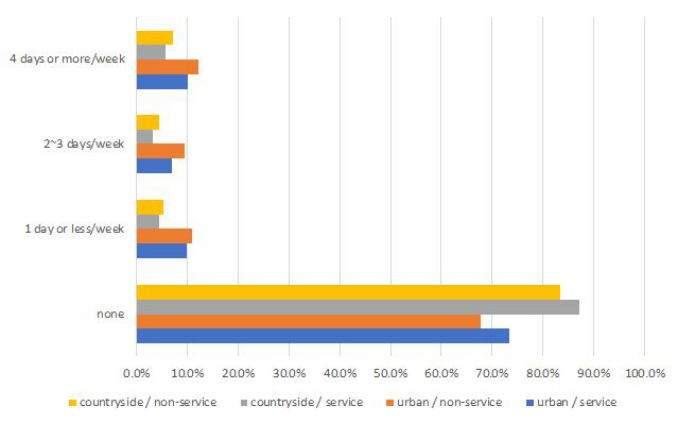
The current frequency of teleworking of each group are shown in Figure 1. According to the result of the Kruskal-Wallis test and the post-hoc compari- son test with the Bonferroni adjustment, two urban worker groups did and
Figure 1: Current frequency of teleworking.
even needed more teleworking than countryside worker groups with signi- ficant differences (p<.05). Interestingly, there were no significant differences in teleworking practices and needs between service and non-service worker groups in each location.
The needs for HAT for teleworking were rather modest, but the techno- logies such as remote health monitoring (F7), task instruction by augmented reality (F10) and tele-presence (F6) were more expected. The respondents also showed reluctance in use of several technologies such as emotion recognition (F1), virtual workplaces (F3) and autonomous avatars (F9).
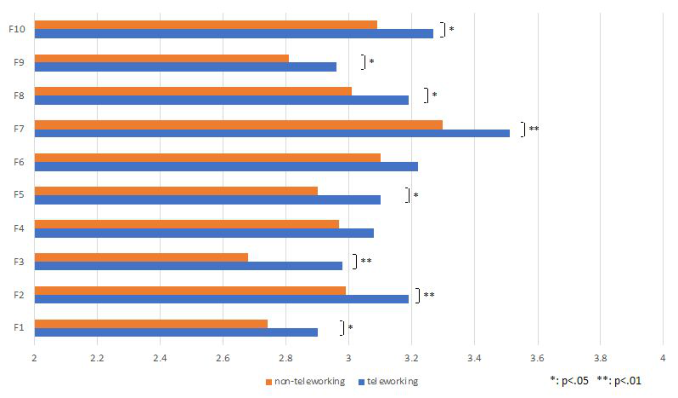
No significant differences were observed among the needs for HAT from service/non-service and urban/countryside groups. Meanwhile, the experi- ence of teleworking brought some differences in technology needs. The teleworkers in non-service industries have higher needs for every function than the non-teleworking workers with the significant differences (t-test, p<.05). The teleworkers in service industries also showed higher needs for HAT with significant differences, except the ones related to tele-presence (F4 and 6) without significant differences as shown in Figure 2.
CONCLUDING DISCUSSION The higher demand for teleworking from urban workers has been com- monly reported and is reasonable considering the higher population density in urban areas which causes more physical contacts with others while com- muting and working. It is an interesting result that no significant differences were observed between service/non-service worker groups about the status of teleworking and the needs for HAT, considering that workers in service indu- stries tend to need more human-to-human interactions at work. This may be
Human Augmentation Technology for Teleworking in Service/Non-Service Industries 19
Figure 2: HAT needs for teleworking (service industry, with/without teleworking).
because the categorization of industries was too simple. More detailed com- parative analysis among different industries needs to be considered for the future study.
The current analysis implies that the needs for HAT rather depend on the experience of teleworking. The respondents in every group expressed their willingness of more frequent teleworking, which would be a driver of the use of HAT. The needed functions in the survey result such as F6, 7 and 10 reflect the practical needs in teleworking which come from the limited modality in communication with conventional technologies. According to the categorization of needs for HAT by Ho et al. (2022), the technologies to overcome access barriers and to pursue reality could gain popularity from the current teleworkers.
On the contrary, working in a virtual workplace (F3) was less popular espe- cially for non-teleworkers, but became more acceptable through teleworking experiences. This could be a practical implication for the introduction of the metaverse concept at work. The technologies aiming to go “beyond reality” in the categorization by Ho et al. (2022), such as emotion recognition (F1) and autonomous avatars (F9) were also less popular. This may be caused by the concern about unintended negative impacts and ethical conflicts. It will be also important to address such ethical issues in implementation of HAT at work (Watanabe et al., 2020).
It is also interesting that teleworking experiences did not bring significant differences to the needs for tele-presence (F6 and 9) in service industries. These needs, either high or low may be evident for them, but more detailed analysis will be needed for further discussion.
This study is still at a preliminary stage. We will conduct further study including scenario development for augmented teleworking and case studies of HAT at work for clarifying its business, ergonomic and ethical impacts to workers, customers, and the whole work/service systems.
ACKNOWLEDGMENT
This research was funded by the Japan Prize Foundation (program name: Japan Prize Heisei Memorial Research Grant Program 2021).
REFERENCES
De Keyser, A., Köcher, S., Alkire, L., Verbeeck, C. and Kandampully, J. (2019), “Frontline Service Technology Infusion: Conceptual Archetypes and Future Research Directions.” Journal of Service Management, 30(1), 156–183. Heinonen, K. and Strandvik, T. (2020), “Reframing Service Innovation: COVID-19
as a Catalyst for Imposed Service Innovation.” Journal of Service Management, 32(1), 101–112. Ho, B.Q., Otsuki, M., Kishita, Y., Kobayakawa, M. and Watanabe, K. (2022), “Human Augmentation Technologies for Employee Well-Being: A Research and Development Agenda.” International Journal of Environmental Research and Public Health, 19(3), 1195. MIC (2013), Japan Standard Industrial Classification (Rev. 13, October 2013) Stru-
cture and Explanatory Notes Index. https://www.soumu.go.jp/english/dgpp_ss/se ido/sangyo/san13-3.htm. Milasi, S., González-Vázquez, I. and Fernández-Macías, E. (2020), Telework in the EU before and after the COVID-19: Where We Were, Where We Head to. https://ec.europa.eu/jrc/sites/jrcsh/files/jrc120945_policy_brief_-_covid_and_t elework_final.pdf. Ostrom, A.L., Field, J.M., Fotheringham, D., Subramony, M., Gustafsson, A.,
Lemon, K.N., Huang, H.M. and McColl-Kennedy, J.R. (2021), “Service Resea- rch Priorities: Managing and Delivering Service in Turbulent Times.” Journal of Service Research, 24(3), 329–353. Pew Research Center (December, 2021), Americans Are Less Likely than before COVID-19 to Want to Live in Cities, More Likely to Prefer Suburbs. https://www.pewresearch.org/social-trends/2021/12/16/americans-are-less-likel y-than-before-covid-19-to-want-to-live-in-cities-more-likely-to-prefer-suburbs/. van Doorn, J., Mende, M., Noble, S.M., Hulland, J., Ostrom, A.L., Grewal, D.
and Petersen, J.A. (2017), “Domo Arigato Mr. Roboto: Emergence of Automated Social Presence in Organizational Frontlines and Customers’ Service Experiences.” Journal of Service Research, 20(1), 43–58. Watanabe, K. et al. (2020), Augmented Telework -Technologies for a New Workstyle in a Post-Corona Society. https://unit.aist.go.jp/harc/en/PDF/200420_harc_augme ntedtelework_en.pdf.
LISTED IN THE AHFE DIGITAL BOOKSTORE CATALOGUE
Explore the complete digital volume
The Human Side of Service Engineering
Read this individual research paper free through the original publisher, or explore the full digital proceedings book.
ISBN 978-1-958651-38-4
Explore this ISBN in the AHFE Bookstore ↗Listed in the July 2026 bookstore catalogue; search by ISBN to confirm current availability · Digital book purchase optional