Sophia Frank (2025). Co-Creation in Academic Education: Enhancing Future Skills for the Service Sector. In: The Human Side of Service Engineering. AHFE Open Access, vol. 182, pp. 19–27. https://doi.org/10.54941/ahfe1006402
The integration of innovative teaching formats is pivotal in equipping students with the future skills necessary for the service sector. This paper explores the impact of academic education on family-run small and medium-sized enterprises in rural regions. Through a detailed case study, we examine how students engage in co-creation and training activities with local businesses as part of a course. The study focuses on three critical dimensions: "Collaboration", "Skill Development", and "Practical Application".In the realm of "Collaboration", we analyze the dynamics between students and business owners, highlighting the mutual benefits and challenges encountered. Regarding "Skill Development", the paper evaluates the enhancement of students' competencies in areas such as problem solving, communication, and innovation. Under "Practical Application", we assess the applicability and effectiveness of the teaching format in other scenarios, examining its sustainability and impact on educational outcomes.By providing a comprehensive evaluation of these dimensions, the paper aims to offer insights into the design of educational programs that foster essential skills for the service sector, ultimately contributing to the development and sustainability of small and medium-sized enterprises in rural areas.
The development of future skills – competencies that allow individuals to solve complex problems in a self-organized manner in highly emergent contexts and to be able to act (successfully) – is becoming increasingly important in a rapidly changing world (Ehlers, 2020). In the service sector in particular, digitalization, societal transformation, and global challenges such as climate change and the growing polarization of society are driving change at an accelerating pace. Companies must continuously adapt to remain competitive. Value creation increasingly depends on interaction and collaboration between multiple organizations (Roth, 2020). While large corporations in urban innovation hubs often have access to extensive networks of knowledge sources and consulting services, small and medium- sized enterprises (SMEs) in rural areas face unique challenges. In structurally
weak rural regions, low population density, long distances to innovation actors, and limited financial resources make access to external knowledge and new technologies more difficult (Bundesministerium für Ernährung und Landwirtschaft (BMEL), 2023). Many SMEs lack not only the budget but also the experience or confidence to engage in consulting services and actively shape transformation processes. To address these challenges, collaboration with regional knowledge sources such as universities, technology transfer centers, or innovation networks represents a promising approach.
This paper examines, through a case study, how students acquire future skills within an academic learning format while simultaneously contributing to the innovative capacity of regional businesses through co-creation.
The present case study examines the course Stakeholder Management in Digitalization within the Bachelor’s program Applied Digital Transformation at Coburg University of Applied Sciences. This program is offered at an innovative teaching location in Kronach, a city in Germany with approximately 17,000 inhabitants. The site is characterized by an experimental and future-oriented teaching methodology aimed at testing new didactic concepts, developing practice-oriented learning formats, and simultaneously fostering the regional economy and society (Zagel et al., 2024). The program’s teaching concept is based on a sequential course system, where subject-specific courses are completed one after another, each lasting three weeks. Every course has a strong practical component, whether through case studies, collaborations with companies, or hands-on projects that students work on. This structure enables an in-depth engagement with the respective topics and promotes a practice-oriented and applied knowledge transfer. The Stakeholder Management in Digitalization course focuses on the challenges and strategies of stakeholder engagement in the context of digital transformation. Students analyze how various actors— ranging from businesses and public institutions to society—are involved in digitalization processes and explore methods for effective communication and participation.
METHODOLOGY
In order to understand how students acquire future skills within an academic learning format while simultaneously contributing to the innovative capacity of regional businesses through co-creation a case study was conducted. Based on (Eisenhardt, 1989), the object of research was defined, the case was selected, data was collected and analyzed in a systematic, iterative process, and the extent to which the results can be transferred or generalized to other teaching formats was evaluated. For the analysis of this case study, various qualitative data sources were used to gain a comprehensive understanding of the teaching and learning processes as well as the practical interaction. A central foundation was the course preparation materials, which served to trace and critically reflect on the methodological approach to teaching Stakeholder Management in Digitalization and associated Future Skills. Additionally, specific documents related to the preparation of interviews, insights from preliminary discussions, as well as follow-up conversations with
Co-Creation in Academic Education: Enhancing Future Skills for the Service Sector 21
owner of the small enterprise and the students were analyzed. Furthermore, the written learning reflections of the students who conducted the interview with the owner of a hair salon were examined. These reflections provided insights into the extent to which the students were able to deepen their knowledge and further develop their methodological competencies through direct practical engagement. To show which future skills were acquired as part of the course, the NextSkills Framework (Ehlers, 2020) is used as an example as it is well established and at the same time is still being researched, presents important skills in a clear way and provides a brief definition for each skill.
CASE STUDY In the winter semester of 2024/25, the course Stakeholder Management in Digitalization was taken by fifth-semester students in the Applied Digital Transformation Bachelor’s program at Coburg University of Applied Sciences. The course spanned three weeks in November 2024 and pursued two central learning objectives: first, to equip students with in-depth knowledge of stakeholder management in the context of digitalization, and second, to foster awareness of interdisciplinary competencies, which were also actively developed throughout the course. The course was designed to be interactive, combining theoretical foundations with practical applications. Students first worked in small groups and as a whole class to explore key concepts and methods of stakeholder management. They then conducted interviews with industry partners from various sectors to analyze their specific challenges in digital transformation and their stakeholder strategies. Based on these insights, students developed creative and practice-oriented solutions.
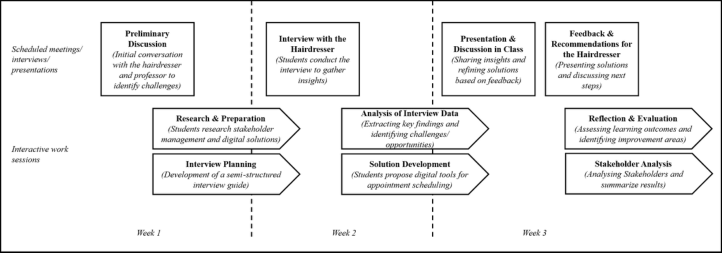
This case study focuses on a specific practical project within the course: collaboration with a small hair salon in Kronach: Two students prepared a semi-structured interview with the salon’s sole proprietor, who had not yet implemented any digital solutions in her business operations. A preliminary discussion with the hairdresser and the supervising professor of the course revealed that the business owner faced significant challenges in customer accessibility. Since she spends her entire working hours in the salon, she has little capacity to respond to customer inquiries or efficiently manage appointment scheduling. She recognized that this issue could become more pressing in the future as more customers prefer or even rely on digital communication channels. The student-prepared interview included general questions about stakeholder management within the hair salon, as well as targeted questions and suggestions for potential digital solutions for appointment scheduling. Drawing on their prior research and preparatory discussions, the students identified various digital tools that could offer a simple and practical solution for the hairdresser. After conducting the interview, the students analyzed and presented their findings to the class. They also developed a detailed presentation outlining different software options and operational approaches for digital appointment scheduling, ensuring that the hairdresser, as a key stakeholder, was at the center of their
22 Frank
proposed solutions, with her needs and concerns considered. Finally, the students shared their findings and recommendations with the hairdresser and discussed potential next steps. The specific phases of the course are shown in Figure 1. The reflection on this case provides valuable insights into how students can not only acquire subject-specific knowledge through applied learning but also develop collaborative skills and a deeper understanding of the challenges of digital transformation in small businesses. The following chapters will analyze how this teaching approach fosters collaboration and competence development and explore the extent to which the didactic concept can be transferred to other contexts.
Figure 1: Phases of the course stakeholder management in digitalization.
Collaboration The course was not about co-creation in the sense of company and customer, but nevertheless involved a joint, iterative development of a solution taking customer needs into account - between students, the owner of a service company and the professor of the course. This form of co-creation was based on a mode of collaboration characterized by personal contact, which is described below.
As mentioned above, the course was an interactive event, which already implies that people interact or work together in it. The professor acted less as a knowledge mediator than as a coach, guiding the students through the process of working on tasks, applying methods and reflecting. The preliminary discussion between the professor and the hairdresser created an initial basis of trust for the collaboration so that the interview could be conducted by students with the hairdresser in a focused and targeted manner. Other students from the group were available throughout the process (guided by the professor) to review the results and provide feedback. The learning reflections show that the students are even interested in working with the hairdresser beyond the course.
The collaboration described above presented several challenges: Firstly, the students first had to learn such a free and practice-oriented way of working (or, in the case under consideration here, adapt to it again as they already had experienced some formats like that). For this, it helps as a teacher
Co-Creation in Academic Education: Enhancing Future Skills for the Service Sector 23
to explain as well as possible what the working mode will be like and to clarify the mutual expectations of all parties at an early stage. In this case, communication took place in analog form, as the owner of the hair salon did not have any digital tools or skills, which was also a challenge. Care was therefore taken to document verbal agreements promptly in writing and make them available to all students to ensure that work could continue. The biggest challenge in this setting was finding joint appointments at which the hairdresser could afford to interrupt her work or use her day off and at the same time the students were present in the course. The teaching mode has one drawback: because the course only lasted three weeks, the follow up of the collaboration is dependent on the voluntariness and initiative of individual students or the continuation with other students the next period.
Nevertheless, the type of collaboration in the course also had advantages: as soon as the working method and all questions relating to it were clarified, there was great potential for shaping and finding ideas. In line with Deci and Ryan’s self-determination theory, a good mixture of experiencing competence, autonomy and social integration was observed in this case (Deci & Ryan, 2000). The “coaching” provided by the professor was very well received by the students and regularly utilized for further work on their own topic. In this way students could work in a supportive environment which is an important factor for motivation (Ambrose, 2010). With such an experience of personal responsibility and trusting collaboration, students are probably more willing to try out new forms of collaboration (including with external parties) or accept feedback in the future.
Skill Development The course “Stakeholder Management in Digitalization” provided students with a hands-on opportunity to develop Future Skills according to the NextSkills Framework (Ehlers, 2020). The written reflections of the students clearly show that they were able to consciously or implicitly train various competencies throughout the project. The findings from the analysis of the learning reflections are used as examples in the following text. These competencies can be divided into three groups based on the degree to which they were explicitly promoted in the course.
1) Consciously Trained Future Skills in the Course: These competencies were explicitly taught in the module and applied in practice.
Problem Solving and Decision Making: The students had to address the problem of a hairdresser struggling with appointment management and develop a digital solution. This required a structured approach to problem analysis and decision-making. For example, one student describes in their learning reflection how applying methods such as the “Stakeholder Mapping Method” and the “Influence-Interest Matrix” helped him structure the stakeholder management process and helped them make decisions.
Collaboration: The project work was carried out as a team effort with a clear division of tasks. Additionally, the co-creation process stimulated mutual learning experiences. One student highlights that the project “strengthened his teamwork skills.”
24 Frank
Communication: The students conducted a semi-structured interview with their stakeholder, which required new communication skills. One student reports that he was previously unfamiliar with this interview structure but now plans to apply it in future projects.
Transformational Competence: The students learned to understand and sustainably shape digital transformation processes for small businesses. They also reflected on the scalability of such solutions for larger enterprises. One student notes that implementing digital solutions in small businesses is “significantly more rewarding” than in large corporations with rigid structures.
2) Indirectly Developed Future Skills: These competencies were not directly taught but developed as a byproduct of the course tasks.
Innovation Competence: The students had to develop a creative solution for the digitalization of a hair salon, ensuring both functionality and feasibility. One student highlights that he “gained a better understanding of the potential of digitalization” through the project.
Self Competence & Self-Determination: The students extensively reflected on their own learning process and the significance of their experiences for their professional future. One student realizes through the module that he “prefers working with small businesses”because he can have a greater impact there. The other student notes that the knowledge gained in the course will be essential for his future career in project management.
Reflective Competence: Due to the examination format—writing a learning reflection—students were also trained in reflecting on their own learning process, goals, and expectations.
3) Implicitly Trained Future Skills: These competencies were not explicitly defined as learning objectives in the module but developed through reflection and practice.
Systems Competence: The students had to deal with the interconnectedness of different actors and the complexity of stakeholder processes. One student compares the small hair salon to a large corporation and reflects on how stakeholder management changes depending on the size of the organization.
Digital Competence: The task involved planning a digitalization project, helping students enhance their understanding of digital solutions and assess their potential for businesses. One student emphasizes that digital platforms “significantly improve communication with stakeholders.”
On the one hand there were various challenges when teaching future skills in this teaching format: different levels of metacognition among the students and the existing (or non-existing) knowledge about their own learning processes are not always immediately recognizable or immediately remediable for a teacher. Therefore, sequences on learning theory should also be inserted and it should be ensured that the students have understood the learning objectives in the course (Waldherr & Walter, 2022). Another challenge, which also became apparent when analyzing the material, is that the individual skills cannot always be clearly separated from one another and it is therefore difficult to consider or even evaluate them in isolation (Ehlers et al., 2024). Most future skills can rarely be trained explicitly, but are practiced through constant repetition, practical application or exchange with
Co-Creation in Academic Education: Enhancing Future Skills for the Service Sector 25
others. In the brevity of the course, it is not possible to turn someone with no experience in interview techniques or communication into a professional in this field.
On the other hand, teaching formats with a focus on future skills training (in addition to teaching specialist knowledge) offer the opportunity to train and raise awareness of skills that may become relevant for students in the future. The awareness of this alone encourages many students to learn. Not only for this module, but also in other areas. This can then be built on in subsequent courses.
Practical Application A central aspect of this case study is the question of the extent to which the investigated format of co-creation between students and small companies in rural regions can be transferred to other teaching situations. In the following, we will first show which factors contributed to the success of co-creation in the case. This is followed by an assessment of the general transferability and a description of which prerequisites can be helpful.
The successful implementation of co-creation in the case studied is based on several factors. Firstly, the group size played a decisive role: small groups enabled intensive collaboration and a high level of interaction between the participants. Secondly, the teacher was obviously motivated and committed to carrying out this teaching format. Their explicit mission to establish innovative teaching formats and to have an impact on the region through university activities was a key prerequisite for the successful implementation of the co-creation approach. Thirdly, a clearly defined objective contributed significantly to the success, as it provided the participants with a clear orientation and structured the process. The project also benefited from good contacts with companies, a factor that is particularly common at universities of applied sciences in Germany. The short distances between the university and regional stakeholders facilitated cooperation and ensured the practical involvement of all participants.
In principle, the success factors mentioned can also be transferred to other teaching situations, although certain framework conditions may need to be adapted.
In terms of group size, there are several options: either the number of practice partners is increased or the student groups that work together on a project are enlarged. As this only makes sense to a certain extent, different roles (e.g. observer or project leader roles) could also be assigned within the student groups.
Targeted further training for teachers is an important aspect of promoting the implementation of new teaching formats. Teachers must be familiarized with the concepts, methods and scientific findings of modern didactics to be able to successfully design appropriate formats like for example the findings of (Deslauriers et al., 2019). Finally, universities should create spaces for experimentation in which new teaching formats can be tested and further developed. If there is a lack of contact with companies, it is often up to the teachers themselves to establish and develop this contact. Funding programs
26 Frank
for knowledge and technology transfer initiated by the university can help here. In addition, legal protection regarding intellectual property may be necessary, especially if innovative concepts or products are developed in co- creation projects. In addition, increased support through start-up support services could be useful in order to transfer promising results from co-creation into further commercial exploitation processes.
In summary, it can be said that the success factors in this case can serve as guidelines for the development of similar formats. However, systematic support through legal and institutional frameworks is necessary to ensure sustainable implementation in different contexts.
CONCLUSION
This case study highlights the benefits of co-creation in academic education, particularly in fostering future skills relevant to the service sector. By engaging students in practical, real-world projects with small businesses in rural areas, the study demonstrates how experiential learning can enhance competencies such as problem-solving, communication, and stakeholder management. The collaboration between students, business owners, and educators created a dynamic learning environment where theoretical knowledge was applied directly to real challenges.
A key takeaway is that such educational formats not only benefit students by providing hands-on experience but also offer tangible value to businesses, especially those with limited access to digital expertise. In this case, students helped a hair salon explore digital appointment scheduling solutions, demonstrating how even small interventions can drive meaningful digital transformation. The iterative, trust-based collaboration proved to be a motivating factor for both students and business owners, reinforcing the importance of autonomy, competence, and social integration in learning.
However, the study also revealed limitations, such as the challenge of sustaining engagement beyond the course duration and the difficulty of ensuring long-term implementation of solutions. Additionally, the small sample size and subjective interpretation of reflections highlight the need for further research and replication in different contexts.
Overall, the findings support the idea that academic programs should integrate practical, skill-based learning experiences to prepare students for evolving industry demands. Universities, especially those in rural areas, can leverage such initiatives to strengthen local economies while enhancing student employability. Future research should explore strategies to institutionalize these approaches, ensuring their sustainability and scalability in higher education.
ACKNOWLEDGMENT
The authors would like to thank the students of Applied Digital Transformation who made their learning reflections available and Coburg University of Applied Sciences for making it possible to try out innovative teaching formats in Kronach, Germany.
Co-Creation in Academic Education: Enhancing Future Skills for the Service Sector 27
REFERENCES
Ambrose, S. A. (Ed.). (2010). How learning works: Seven research-based principles for smart teaching (1st ed). Jossey-Bass. Bundesministerium für Ernährung und Landwirtschaft (BMEL). (2023). Was bieten
ländliche Regionen und wo sind die Herausforderungen? Ländliche Regionen im Fokus. Deci, E. L., & Ryan, R. M. (2000). The “What” and “Why” of Goal Pursuits: Human Needs and the Self-Determination of Behavior. Psychological Inquiry, 11(4), 227–268. https://doi.org/10.1207/S15327965PLI1104_01 Deslauriers, L., McCarty, L. S., Miller, K., Callaghan, K., & Kestin, G. (2019).
Measuring actual learning versus feeling of learning in response to being actively engaged in the classroom. Proceedings of the National Academy of Sciences, 116(39), 19251–19257. https://doi.org/10.1073/pnas.1821936116 Ehlers, U.-D. (2020). Future Skills: Lernen der Zukunft - Hochschule der Zukunft.
Springer Fachmedien Wiesbaden. https://doi.org/10.1007/978-3-658-29297-3 Ehlers, U.-D., Eigbrecht, L., Horstmann, N., Matthes, W., Piesk, D., & Rampelt, F. (2024). Future Skills für Hochschulen: Eine kritische Bestandsaufnahme. In Future Skills lehren und lernen: Schlaglichter aus Hochschule, Schule und Weiterbildung. https://www.stifterverband.org/sites/default/files/2024-06/future_ skills_fuer_hochschulen_kritische_bestandsaufnahme_vorveroeffentlichung.pdf Eisenhardt, K. M. (1989). Building Theories from Case Study Research. The
Academy of Management Review, 14(4), 532. https://doi.org/10.2307/258557 Roth, A. (2020). Piloting in Open Innovation Labs – A Challenge for Local Ecosystems. In A. Fritzsche, J. M. Jonas, A. Roth, & K. M. Möslein (Eds.), Innovating in the Open Lab (pp. 3–10). De Gruyter. https://doi.org/10.1515/ 9783110633665-001 Waldherr, F., & Walter, C. (2022). didaktisch und praktisch: Methoden und Medien
für die Präsenz- und Onlinelehre (3, überarbeitete und erweiterte Auflage). Schäffer-Poeschel. https://doi.org/10.34156/9783791053080 Zagel, C., Stübinger, J., Haase, S., & Grosch, C. (2024). Future Skills studieren? Ein Erfahrungsbericht. In Future Skills lehren und lernen: Schlaglichter aus Hochschule, Schule und Weiterbildung (Vol. 2). Stifterverband Für Die Deutsche Wissenschaft e. V. https://www.stifterverband.org/sites/default/files/ 2024-11/future_skills_lehren_und_lernen.pdf
LISTED IN THE AHFE DIGITAL BOOKSTORE CATALOGUE
Explore the complete digital volume
The Human Side of Service Engineering
Read this individual research paper free through the original publisher, or explore the full digital proceedings book.
ISBN 978-1-964867-58-8
Explore this ISBN in the AHFE Bookstore ↗Listed in the July 2026 bookstore catalogue; search by ISBN to confirm current availability · Digital book purchase optional