Sarah Haase (2024). Future Skills and (generative) AI – new era, new competencies?. In: The Human Side of Service Engineering. AHFE Open Access, vol. 143, pp. 178–184. https://doi.org/10.54941/ahfe1005096
Generative Artificial Intelligence (AI) becomes increasingly important. This is why it is crucial to develop skills that complement and exploit the capabilities of AI. The question is what kind of skills individuals will need in the coming years, especially as it is important to use AI tools appropriately. Companies have realised that it is vital to constantly requalify their employees by setting up training programmes. Universities are proposing modules to teach their students how to work with e. g. ChatGPT and researchers as well as institutions are trying to develop competence frameworks. In our paper, we take a closer look at the Digital Competence Framework for Citizens (DigComp 2.2) and the Artificial Intelligence Competences framework (AIComp), two competency models developed to face the challenges focussing on the competence elements for non-technical learners.
Everything is changing every time. We are living in an era, where the rapidness of transformation can become overwhelming. One reason for this accelerat- ing pace of change are global developments, such as technologization and digitalisation. The latter one has revolutionized industries and is leading to significant advancements and changes in how businesses and individuals work. It enables the easy access, sharing, and manipulation of information, as well as the development of innovative technologies and services. One of the most important evolutions these days is artificial intelligence (Hu, 2023). With OpenAI launching ChatGPT in 2023, generative AI applications are springing up, promising users easing their lives. We can see now that there are fears and hopes related to generative AI. On the one hand, studies pre- dict that certain job profiles might be replaced by generative AI (McKinsey, 2023). On the other hand, new job profiles will increase, and innovative pro- cesses can be accelerated (Bremen, 2023). To cope with these developments, different strategies come into play. Companies not only upskill but start to reskill their employees and managers (Tamayo et al., 2023). And universities are setting up new degree programs and modules, educating students skills they will need in the future – AI related future skills. But what are these skills?
Future Skills and (Generative) AI – New Era, New Competencies? 179
What Are Future Skills?
Before examining digital and especially AI related Future Skills, we will briefly look at Future Skills in general.
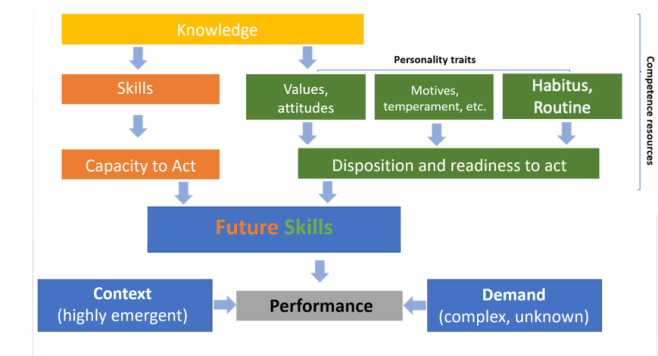
Yet, there is no common definition of the Future Skills concept. In 2019, the European Commission published a paper, counting eight key compe- tencies for lifelong learning, pointing out that they are a combination of knowledge, skills, and attitudes (K-S-A). Whereas knowledge encompasses the established concepts, facts, figures, ideas, theories, principles, and prac- tices related to a field of work or study, skills refer to the ability to use knowledge and expertise to execute tasks and address challenges. Attitudes are relevant as they include values, ambitions, and priorities (European Commission, 2019).
According to Ulf Ehlers, Professor for Educational Management and Life- long Learning at the Baden-Wurttemberg Cooperative State University in Karlsruhe, “Future Skills are competence constructs with special content pro- files” (Ehlers 2020: 53). He is proposing the following definition: “Future Skills are competences that allow individuals to solve complex problems in highly emergent contexts of action in a self-organised way and enable them to act (successfully). They are based on cognitive, motivational, volitional, and social resources, are value-based, and can be acquired in a learning process” (Ehlers, 2020: 53).
Figure 1: Competence structure model for Future Skills (Ehlers, 2020).
Future Skills stand for so-called action competences (Ehlers, 2020), a new category, especially relevant where rapid social changes are on the agenda. They are not to confound with skills as such that are not particularly future- orientated but part of the Future Skills profiles. Therewith, key competences, defined by the European Commission and Future Skills are comparable, as they both consists of the component’s knowledge, skills, and values/attitudes.
The Stifterverband for the German economy and McKinsey & Company are speaking about “cross-industry skills, abilities and characteristics that will be used in all areas of professional life and beyond in the next five years” (Stifterverband/McKinsey, 2021: 3). This very general definition specifies,
180 Haase
different than the others, a timespan. By pointing out that Future Skills are only relevant in the upcoming five years and might change later, the authors show their awareness of a fast-moving society, causing unknown changes. It is also important to bear in mind, that Future Skills are not necessarily new, unprecedented skills but those that will gain in importance in the future. We will see that some competencies are long known.
Digital Future Skills Digital Future Skills are relevant in all above-named publications. The Euro- pean Commission describes digital competence as “the confident, critical, and responsible use of, and engagement with, digital technologies for learn- ing, at work, and for participation in society. It includes information and data literacy, communication and collaboration, media literacy, digital content creation (including programming), safety (including digital well-being and competences related to cybersecurity), intellectual property related questions, problem solving and critical thinking” (European Commission, 2019: 10).
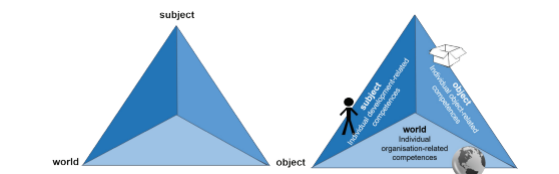
Ehlers Future Skills model divides the organisation-, object- and subject- related category, each category having a certain number of different Future Skills profiles (Ehlers, 2020).
Figure 2: Three dimensions of Future Skills (Ehlers, 2020).
Within the object-related category, we find the digital literacy skill profile, which contains “the ability and disposition to use digital media, to develop them in a productive and creative way, the capacity to critically reflect on its usage and the impact media have on society and work, both for private and professional contexts, as well as the understanding of the potentials and limits of digital media and their effects” (Ehlers, 2020: 81).
The Stifterverband and McKinsey do also create categories, e.g. the techno- logical as well as digital competencies category. Technological competencies are needed to design and efficiently use established as well as new tech- nologies. Required skills are e. g. software development, knowledge of data analytics and AI. Digital competencies however are describing skills, enabling people to find their way in a digitalised environment and actively take part in it (Stifterverband/McKinsey, 2021).
What we see is that, four years ago, there was no particular focus on (gen- erative) AI skills outside of a specialised group of experts. It was more about the intelligent use of everyday digital technologies.
Future Skills and (Generative) AI – New Era, New Competencies? 181
Future Skills and AI – Two Frameworks This changed especially with the emergence of (generative) AI tools. Different frameworks have been developed to give advice what kind of competencies, individuals increasingly need. We will look at the EU DigComp 2.2, the central digital competence model in the European Union and the AIComp model, set up by Ehlers et. al.. These frameworks do not target an exclusive group of people having a specific background but are made for all individuals interested in Future AI skills. It is obvious that depending on the profes- sion one has, certain Future Skills might become more relevant than others (Kaya et al., 2023).
The DigComp 2.2 – The Digital Competence Framework for Citizens The Digital Competence Framework for Citizens, DigComp, supplies a com- mon language to find and describe the key areas of digital competence. It is a tool for e.g. citizens, policymakers, and educational institutions to improve digital competence in our society (Vuorikari et al., 2022).
In 2022, the European Commission published version 2.2 of the Dig- Comp complementing former versions to illustrate new focus areas, espe- cially emerging technologies such as systems driven by artificial intelligence (Vuorikari et al., 2022). To participate effectively in the digital world, the authors are referring to the already mentioned components of knowledge, skills, and attitudes (K-S-A). Besides, the framework organizes digital compe- tencies into five areas: (1) Information and data literacy, (2) communication and collaboration, (3) digital content creation, (4) safety, and (5) problem solving. The following skills for interacting with AI systems align with these areas:
1. Information and data literacy is emphasizing the ability to find, retrieve, evaluate, and manage information effectively. This is crucial for under- standing and working with AI. 2. Communication and collaboration are essential competencies, highlight- ing the importance of interacting through digital technologies, sharing through online spaces, and collaborating with others, including multidis- ciplinary teams working on AI projects. 3. Digital content creation highlights the skills necessary for creating, edit- ing, and managing digital content, which are critical when working with AI technologies. 4. Safety demands critical thinking as it aids in navigating digital environ- ments securely. Ethical understanding addresses the responsible use of digital technologies, including considerations of privacy, security, and dig- ital wellness. Security awareness underlines the importance of protecting personal data and dealing with digital identity, which are critical when interacting with AI systems that process vast amounts of personal and sensitive information. 5. Problem solving is reflecting the ability to name needs and technological responses, resolve conceptual problems, and creatively use digital tech- nologies to solve complex issues, including those posed by AI systems (Vuorikari et al., 2022).
182 Haase
A knowledge base, including an understanding of AI concepts, and how AI technologies can be used safely and effectively as well as attitudes involving the willingness to engage with digital technologies in a responsible and crit- ical manner, are essential. Besides, DigComp 2.2 gives concrete learning and employment scenario examples for each competence. Although generative AI as a term is not specifically singled out, the document extensively covers the interaction with AI systems, including understanding their capabilities and limitations, ethical considerations, and the ability to critically engage with AI technologies. It emphasizes the necessity for citizens to develop a comprehen- sive set of digital competences to use AI technologies safely and effectively, which implicates an understanding and interaction with generative AI as part of the broader AI ecosystem.
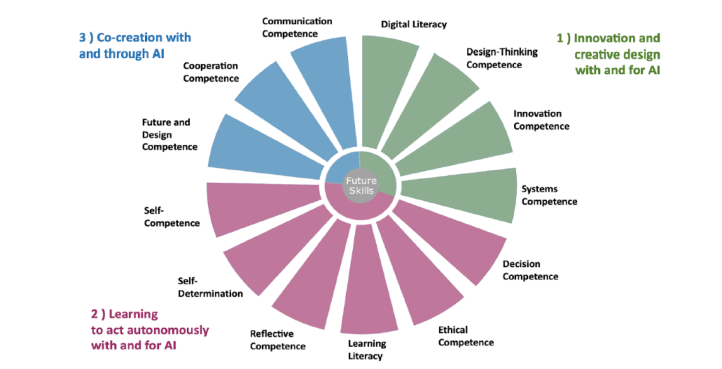
The AIComp Model The AIComp model, developed in 2023 through the projects KI-Campus and KI-Campus Hub Baden-Wurttemberg, is based on a survey of over 1600 professionals in Baden-Wurttemberg on competencies needed in an AI-influenced professional and personal life. It highlights AIComp as the first German competency structure model addressing competencies crucial for thriving in an AI-integrated world. Important Future Skills “include, for example, the ability to collaborate with AI systems (distributed cognition) in creative problem solving or the ability to analyse and interpret large amounts of data” (Ehlers et al., 2023: 230). Besides, to elaborate the framework, the authors collected international research papers in German or English deal- ing with AI-related competences. A substantial number of these papers have been published in 2022, showing again the rising importance of AI compe- tencies after 2020 (Ehlers et al., 2023). In total, the authors have detected 167 competence-items, they have coded, clustered, and assigned to the com- petence dimensions K-S-A. The result is a model, consisting of three areas divided in thirteen different future skills-profiles.
Figure 3: AI-related areas and Future Skills profiles (Ehlers et al., 2023).
Future Skills and (Generative) AI – New Era, New Competencies? 183
These thirteen profiles were consilidated in a further step and reduced to 12 profiles. “Individual structural elements were supplemented or sum- marised. Some areas of expertise were named and delineated differently, some descriptions were clarified and modified” (Ehlers et al., 2024: 35). Figure 3 is nontheless significant. We see that the area (2) “Learning to act autonomously with and for AI” is the largest one, which suggests the assumption that these Future Skills are crucial for navigating a future where AI plays a central role in various aspects of life and work. Some Future-Skills profiles cover the ones, determined in the DigComp 2.2, e.g. ethical or com- munication competence. Others are different such as the Design Thinking competence. The AIComp does not explicitly name “generative AI” but dis- cusses AI’s broad competences and implications extensively. It focuses on the need for individuals to adapt to AI-infused environments, emphasizing com- petences like innovation, ethical considerations, and system understanding. The document suggests a comprehensive approach to embracing AI technolo- gies, which by extension includes generative AI, for innovative solutions and critical engagement within social and organizational contexts.
CONCLUSION
Yet, there is no common definition neither for Future Skills in general nor for Future AI Skills specifically. Nonetheless, various frameworks like the European Commission’s digital competences and the AIComp model, try to detect future competencies essential for navigating an AI-influenced world. As a first step, it is certainly beneficial, to learn the differences between AI, machine learning, large language models, generative AI, and Chatbots. This is not explicitly mentioned in the named documents but should be considered as a necessary basis.
The two competence frameworks are useful references, when asking what kind of Future Skills will become increasingly significant interacting with AI systems. While the AIComp focuses on the competences needed to nav- igate and contribute to an AI-influenced world without explicitly naming generative AI, the DigComp 2.2 document outlines digital competences that directly reference the capabilities and considerations surrounding AI, includ- ing aspects that would involve generative AI, like content creation, ethical implications, and data management. Both documents highlight the impor- tance of understanding, interacting with, and ethically considering AI’s role in society and individual lives. One might have thought that data and dig- ital literacy are becoming the most important skills. But soft skills such as critical thinking, problem solving, and adaptability are also increasingly important.
Although both frameworks are helpful, the following competencies could be added or emphasized. A more detailed exploration of the technical liter- acy needed to interact with, manage, and perhaps even customize generative AI tools could be beneficial. This includes understanding data models, basic programming for AI, and the principles of machine learning that underpin generative AI.
184 Haase
Skills for collaborating with AI systems as partners in creative and problem-solving processes could be highlighted more. This involves under- standing how to guide AI in generative tasks, interpreting its outputs, and integrating AI contributions into human-led processes.
Given the rapid evolution of AI technologies, a stronger emphasis on the importance of continual learning, adaptability, and resilience could be ben- eficial. This includes strategies for staying updated with advancements and integrating new knowledge e.g. intelligent prompting into one’s skillset and practice.
As a conclusion, we can say, it is likely that the most successful people in the age of AI will have a combination of technical and soft skills that allow them to adapt to a rapidly changing technological landscape.
REFERENCES
Bremen, J. M. (October 30, 2023) Accelerating Innovation Through Generative AI.
Forbes Website: Accelerating Innovation Through Generative AI (forbes.com). Ehlers, U.-D. (2020) Future skills - The future of learning and higher education, Wiesbaden: Springer based on the so-called German version doi: 10.1007/978- 3-658-29297-3. Ehlers, U.-D., Lindner, M., Sommer, S., & Rauch, E. (2023) AICOMP - Future
Skills in a World Increasingly Shaped By AI. Ubiquity Proceedings, 3(1): 230–239. doi: 10.5334/uproc.91. Ehlers, U-D, Lindner, M., Rauch, E. (2024) AICOMP. Future Skills für eine von KI beeinflusste Lebens- und Arbeitswelt. Forschungsbericht 1: Theorie, methodisches Design und Ergebnisse der KI-Kompetenzstudie 2024. Next Education Website: https://next-education.org/de/research-series/aicomp-forschungsbericht-1/ European Commission. (2019) Key Competences for lifelong learning. Luxembourg:
Publications Office of the European Union, doi: 10.2766/569540. Hu, K. (February 2, 2023) ChatGPT sets record for fastest-growing user base – analyst note. Reuters Website: ChatGPT sets record for fastest-growing user base - analyst note | Reuters. Kaya, M.-F., Zirnig, C., Blaurock, M., Zechiel, F. and Schoop, M. (2023) An Integra-
tive Model of AI Competencies for Business Students and Where to Acquire Them. Wirtschaftsinformatik 2023 Proceedings. 38. https://aisel.aisnet.org/wi2023/38. McKinsey & Company. (August 25, 2023) What is the future of Generative AI? An early view in 15 charts. McKinsey Website: What is the future of Generative AI? | McKinsey. Schüller, K., Busch, P., Hindinger, C. (2019) Future Skills: Ein Framework für
Data Literacy – Kompetenzrahmen und Forschungsbericht. Arbeitspapier Nr. 47. Berlin: Hochschulforum Digitalisierung. doi: 10.5281/zenodo.3349865. Suessenbach, F., Winde, M., Klier, J., Kirchherr, J. (2021) Future Skills 2021. 21 Kompetenzen für eine Welt im Wandel. Diskussionspapier 3. Stifterverband/ McKinsey. Stifterverband-Website: Future Skills 2021 | Stifterverband. Tamayo, J., Doumi, L., Goel, S., Kovacs-Ondrejkovic, O., Sadun, R. (September-
December 2023). Reskilling in the age of AI. Five new paradigms for leaders – and employees. Harvard Business Review. pp. 58–65. Vuorikari, R., Kluzer, S. & Punie, Y. (2022) DigComp 2.2: The Digital Competence Framework for Citizens-With new examples of knowledge, skills, and attitudes. Luxemburg: Publications Office of the European Union. doi: 10.2760/115376.
LISTED IN THE AHFE DIGITAL BOOKSTORE CATALOGUE
Explore the complete digital volume
The Human Side of Service Engineering
Read this individual research paper free through the original publisher, or explore the full digital proceedings book.
ISBN 978-1-964867-19-9
Explore this ISBN in the AHFE Bookstore ↗Listed in the July 2026 bookstore catalogue; search by ISBN to confirm current availability · Digital book purchase optional