Jennie Lai, Qin Jing, Nancy Jiang, Stella Yi (2026). Designing Perimenopause Care Using Disaggregated Data for Asian American Women. In: Human Factors in Design, Engineering, and Computing. AHFE Open Access, vol. 238, pp. 466–472. https://doi.org/10.54941/ahfe1008279
The "Design for All" principle often reflects the needs of a general population rather than specific needs of those not represented in data. For Asian American (AsA) women's health, biases stem from grouping diverse population groups from over 50 countries into a single category. Moreover, to our knowledge, no health technology platform provides culturally tailored perimenopause care for this diverse population. Through Jobs-To-Be-Done research with AsA women and clinicians, we identified differences in awareness of specific symptoms, access to culturally tailored information, and preferences for care plans beyond Western hormonal therapy. These insights informed a platform featuring guided self-assessment, personalized health reports, and an AI-powered health assistant. Our work demonstrates how disaggregated data can translate from principles to practice by surfacing meaningful insights on symptom profiles and care options for AsA women at the population group level while giving them transparency and control over their data.
The “Design for All” principle emerged from the Universal Design movement of the 1970s (Mace, 1985). In practice, it often defaults to a general population and ignores the specific needs of those who are not represented in data, e.g., women, communities of color, or non-Western health contexts (Costanza-Chock, 2020). Costanza-Chock (2020) argues that the design process must center on the marginalized communities: “The rhetoric of ‘designing for everyone’ or ‘universal design’ too often obscures the ways that design processes and outputs systematically benefit members of dominant groups”.
In the context of Asian American (AsA) women’s health, these biases stem from grouping diverse population groups from over 50 countries of origin, speaking more than 100 languages, into a single “Asian” category. The Association of Asian Pacific Community Health Organizations (AAPCHO) identifies data aggregation as the key barrier to equity (AAPCHO, 2024). When data is disaggregated by race and ethnicity, it becomes apparent that AsA populations have significantly different social,
Designing Perimenopause Care Using Disaggregated Data for Asian American Women 467 migration and behavioral risk factors that impact health outcomes depending on their country of origin. For example, Asian Indian and Filipino Americans have higher risk of mortality due to heart disease, Japanese Americans have higher risk for pancreatic cancer, and Korean Americans experience a higher incidence of gastric cancer (Obra et al., 2021).
This paper embraces that data disaggregation is a pathway to advancing health equity. We demonstrate how disaggregated data can inform the design of culturally tailored perimenopause care through Jobs-To-Be-Done research with AsA women and clinicians, and present a technology platform that translates these insights into practice.
BACKGROUND
Why Data Disaggregation Matters Data disaggregation for the AsA population refers to breaking down generalized datasets into specific population groups based on ethnicity, country of origin, or language (AAPCHO, 2024). Aggregated data combines different ethnic groups (e.g., Asian Indians, Filipinos, Koreans) into a single “Asian American” category and masks meaningful differences in health access, preferences, and risks. Disaggregated data is critical for identifying disparities and tailoring interventions to specific community needs.
How Data and Stereotypes Influence Health Outcomes Yi et al. (2022) describe how poor data quality and racialized stereotypes shape AsA health. Three pervasive stereotypes (the model minority, healthy immigrant effect, and perpetual foreigner) perpetuate the perception that AsA populations do not experience health disparities. The model minority myth was invented as anti-Black messaging in the 1960s by portraying AsA populations with high academic achievement and hard work ethic, which drives a wedge between them and other communities of color. The healthy immigrant effect assumes that immigrants are inherently healthier despite lower socioeconomic status. The perpetual foreigner stereotype suggests AsA populations are “unassimilable” regardless of citizenship or generation. These stereotypes, combined with poor data quality, lead to a mutually reinforcing cycle. The results demonstrating low health risks among AsA communities are reinforced by researcher implicit bias. It ultimately leads to inaction and justification for AsA communities to not have a “seat at the table” for health disparities conversations.
What Healthcare Providers, Researchers, and Technology Platforms Can Do To break this cycle, healthcare systems must improve data collection by capturing granular demographic data and involve community stakeholders in identifying meaningful categories for collection, analysis, and reporting (AAPCHO, 2024). Obra et al. (2021) recommend culturally tailored care that extends from provider-patient dyads to provider-patient-family relationships to align with cultural decision-making structures.
Technology platforms can leverage available data on specific AsA population groups to address these challenges at scale through personalized care that reduces stigma through culturally adapted communication and raises awareness of unique health risks. They can also address accessibility barriers, particularly when healthcare providers may hold unconscious biases or are unfamiliar with Asian cultural health practices. Our work demonstrates how taking an approach that respects differences across AsA communities and leverages disaggregated data can inform the design of such a platform for perimenopause care.
STUDY DESIGN Jobs-To-Be-Done (JTBD) Framework
To better understand the diverse and unique experiences of women in menopause transition, we leverage the JTBD framework for product design and research. Clayton Christensen developed the JTBD framework to anchor product innovation on the underlying reasons why customers want to “hire” a product or service to get a “job” done. It is a theory that helps innovators understand how and why people make decisions (Christensen Institute, n.d.). It explores the functional, emotional, and social contexts behind decisions to uncover unmet needs.
The Women’s Experience We first applied the JTBD framework to understand women’s experiences in menopause transition with a focus on their functional, emotional, and social contexts (Lai and Ranjan, 2026). The research identified a “Purpose- Driven” segment motivated by the functional outcomes of feeling healthy and preferring to focus on their health goals rather than perimenopause. These participants showed stronger motivation when their health goals aligned with emotional and social benefits, such as feeling less alone with their experiences or keeping up with a demanding career.
Notably, the Chinese and Korean American participants were less aware that their unique symptom profile (joint pain, forgetfulness) was related to perimenopause. Beyond not knowing where to seek reliable health information, these women were hesitant to share symptoms with family and friends due to the cultural stigma around aging. They wished their healthcare providers had been more proactive in educating them on the perimenopause symptoms and recommending treatments tailored to their preferences, such as lifestyle modifications or Traditional Chinese Medicine (acupuncture), rather than hormonal therapy alone. While we focused initially on capturing the experiences of Chinese and Korean American women, we will continue to explore additional AsA populations in future work.
The Clinician Experience We then applied the JTBD framework to understand clinicians’ experiences caring for AsA women in menopause transition. Participants included primary care physicians and board-certified obstetrician-gynecologists (OB-GYNs).
Designing Perimenopause Care Using Disaggregated Data for Asian American Women 469 The research identified a “Community Builder” segment motivated by building trust with patients from diverse backgrounds in language, culture, and health literacy, while personalizing care based on patient preferences.
As part of the research, we gathered clinician feedback on a health report template designed for AsA women. The report provides an overview of women’s perimenopause symptoms and key questions to discuss with their healthcare providers.
PRODUCT DESIGN FOR DISAGGREGATED PERIMENOPAUSE CARE Key Design Considerations
Based on JTBD insights, we designed a platform with three key features as a proof-of-concept for the Chinese American population group. First, a guided self-assessment form collects symptom severity and user profile data with “Why we ask” explanations for sensitive questions like race and ethnicity. Second, the platform generates a personalized health report with culturally tailored content based on language and population group. Third, an AI-powered health assistant provides a safe space for sensitive inquiries and surfaces health insights relevant to users’ specific backgrounds. To maintain clinical integrity, the architecture incorporates a multi-agent safety layer with large language model (LLM) judges designed to trigger medical escalation paths when high-risk scenarios are detected.
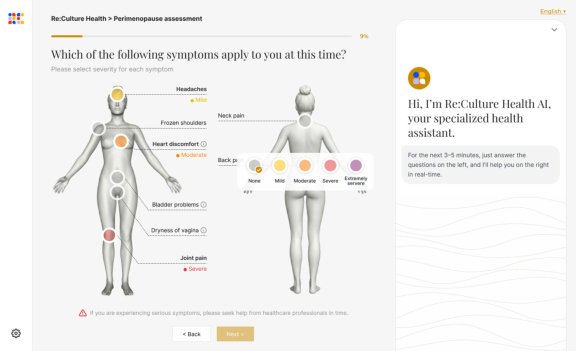
Self-Assessment Form The self-assessment form collects information on four health topics: (1) perimenopause symptom severity using the standardized Menopause Rating Scale (Heinemann et al., 2004); (2) health history and lifestyle to ensure the health information is both safe and effective; (3) health preferences to inform personalized care plans; and (4) user profile data to surface peer- reviewed studies and health insights that are most relevant to the individual. Figure 1 shows the guided data collection interface for perimenopause symptoms.
Figure 1: Guided self-assessment form. (Source: Author’s own work).
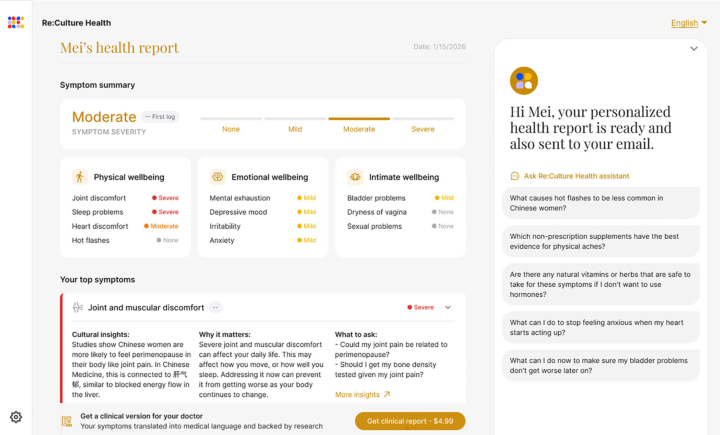
Personalized Health Report The health report personalizes information based on the user’s language, ethnicity, health history, lifestyle, and preferences. An AI-powered health assistant addresses cultural stigma by providing a safe space for questions. The assistant prioritizes safety by grounding responses in vetted medical literature to ensure accuracy. Culturally tailored communication is achieved via system prompt engineering, ensuring that the tone and communication style aligns with users’ expectations. Figure 2 shows the symptom summary and health assistant to answer questions in real time.
Figure 2: Personalized health report and health assistant. (Source: Author’s own work).
DISCUSSION
This work demonstrates how disaggregated data can translate from principles to practice in health design. Our JTBD research revealed “Purpose-Driven” women are motivated to understand their unique symptoms and turn them into health goals so they can live a healthy, productive life. By collecting, analyzing, and reporting data at the population group level, our platform surfaces meaningful insights on symptom profiles and care options in users’ preferred language. Women have full agency over how they use their health report (whether to facilitate conversations with providers, explore information through the health assistant, or both) before deciding on the next step. “Community Builder” clinicians revealed opportunities to design culturally tailored reports that help providers better understand symptoms and treatment for their AsA patients.
Given the sensitive nature of collecting race and ethnicity data, health technology platforms must give users full transparency and control over their data. It is equally important to acknowledge what we don’t yet know: how immigration, language fluency, and socioeconomic factors influence
Designing Perimenopause Care Using Disaggregated Data for Asian American Women 471 health outcomes. Our platform addresses this by being explicit about data limitations. For example, the AI-powered health assistant provides provenance transparency by citing the sources behind each response, while the multi-agent safety layer enables the system to flag responses where clinical evidence is limited for specific subgroups. This approach builds trust while avoiding potentially biased findings for diverse individuals.
LIMITATIONS The goal of this research is to validate an early proof-of-concept that disaggregated data can surface culturally tailored insights and translate them into design. Our findings come from formative Jobs-To-Be-Done research with a small sample of AsA women and clinicians, and we have not yet evaluated the platform’s effect on health outcomes or behaviors. The current design aims to learn from Chinese American women first before validating the approach with more population groups. Future work will expand to additional population groups, test the end-to-end product experience, and assess health outcomes and behaviors over time.
CONCLUSION
Despite an estimated ~2 million AsA women ages 30 to 55 in or approaching menopause transition, we are not aware of any health technology platform that provides culturally tailored perimenopause care for the multitude of diverse groups in this population. As Obra et al. (2021) noted, “beyond equity is an aspiration toward personalized, culturally competent precision medicine, which values each person in their culture, socioeconomic background, their similarities and differences”. Our approach employs a generalizable process that may be utilized to provide specific and culturally tailored guidance to AsA women in the menopause transition.
Disaggregation at the race, ethnicity, and language level is necessary, but future work must address social determinants of health. As users build trust with the platform over time, we envision deeper personalization where users maintain full control over how their data informs their care. We believe this approach could extend to other underserved communities experiencing health disparities. When done responsibly, designing for specific communities can inform more equitable approaches for other underserved populations. Rather than building for everyone, we need to build for those who have been underserved by the healthcare system to advance health equity.
REFERENCES
Association of Asian Pacific Community Health Organizations (2024) Data disaggregation: Principles, promising practices, and lessons learned to advance health equity. Technical Report. San Francisco, CA: AAPCHO. Available at: https:// aapcho.org/wp-content/uploads/2024/06/2024.05.14-AAPCHO-Disaggregated- Data-Publication_Final.pdf (Accessed: 2 February 2026).
Christensen Institute (n.d.) Jobs to be done theory. Available at: https://www.
christenseninstitute.org/theory/jobs-to-be-done/ (Accessed: 2 February 2026). Costanza-Chock, S. (2020) Design Justice: Community-Led Practices to Build the Worlds We Need. Cambridge, MA: MIT Press. Heinemann, K., Ruebig, A., Potthoff, P., Schneider, H.P., Strelow, F., Heinemann, L.A.
and Do, M.T. (2004) ‘The Menopause Rating Scale (MRS) scale: A methodological review’, Health and Quality of Life Outcomes, 2, art. 45. doi: 10.1186/1477- 7525-2-45. Lai, J. and Ranjan, R. (2026) ‘Applying Jobs-To-Be-Done framework to design AI applications for women in menopause transition’, in Stephanidis, C., Antona, M., Ntoa, S., Margetis, G. and Salvendy, G. (eds.) HCI International 2025 – Late Breaking Papers. Communications in Computer and Information Science, vol. 2772. Cham: Springer. doi: 10.1007/978-3-032-12767-9_15. Mace, R. (1985) ‘Universal design: Barrier free environments for everyone’, Designers
West, 33(1), pp. 147–152. Obra, J.K., Lin, B., Đoàn, L.N., Palaniappan, L. and Srinivasan, M. (2021) ‘Achieving equity in Asian American healthcare: Critical issues and solutions’, Journal of Asian Health, 1(1), art. e202103. doi: 10.59448/jah.v1i1.3. Yi, S.S., Kwon, S.C., Suss, R., Đoàn, L.N., John, I., Islam, N.S. and
Trinh-Shevrin, C. (2022) ‘The mutually reinforcing cycle of poor data quality and racialized stereotypes that shapes Asian American health’, Health Affairs, 41(2), pp. 296–303. doi: 10.1377/hlthaff.2021.01417.
SEARCH THE AHFE DIGITAL BOOKSTORE BY ISBN
Explore the complete digital volume
Human Factors in Design, Engineering, and Computing
Read this individual research paper free through the original publisher, or explore the full digital proceedings book.