Yichen Tian, Zimo Chen, Shuai Zhang (2026). Parametric Design of HEV Intake Grilles Through Traditional Pattern Translation Based on FCM and XGBoost. In: Human Factors in Design, Engineering, and Computing. AHFE Open Access, vol. 238, pp. 484–497. https://doi.org/10.54941/ahfe1008281
As automotive electrification accelerates, hybrid electric vehicles (HEVs) still need to retain intake grilles, which support heat dissipation, brand recognition, and emotional expression. Based on Kansei Engineering, fuzzy c-means clustering (FCM), XGBoost regression, and semantic translation of traditional patterns, this study proposes a parametric design method for HEV intake grilles. First, 60 HEV front-face samples and 12 Kansei descriptors were collected, and user evaluation with FCM clustering was used to extract three Kansei dimensions: Intelligent Order-Transparency, Oriental Elegance, and Dynamic Strength-Stability. Second, the grille was decomposed into five types of design features, each containing six discrete categories, and three XGBoost regression models were built separately. The 12-fold cross-validation results show that the test-set R² values of the three dimensions are 0.928, 0.967, and 0.950, while the RMSE values are 0.260, 0.239, and 0.216, indicating good predictive performance. On this basis, 7,776 design combinations were predicted and ranked, and the segmentation, curves, overlap, direction, density, and boundary relationships of ice-crack, ruyi-cloud, and scale patterns were transformed into grille generation rules. Taking the scale pattern as an example, this study demonstrates the application of the workflow in the parametric translation of traditional patterns and provides a methodological reference for mapping user Kansei needs, grille morphological features, and the compositional rules of traditional patterns.
Automotive electrification is changing front-face design paths. Battery electric vehicles often adopt closed front ends, whereas hybrid electric vehicles (HEVs) still need real intake and heat-dissipation passages, so the grille must simultaneously support thermal management, brand recognition, and emotional expression. Previous studies have shown that headlamps, grille scale, and opening ratio affect brand recognition, perceived power, and product preference, and that perceptions of automotive form show certain cultural differences (Ranscombe, Hicks, Mullineux & Singh, 2012; Windhager et al., 2012; Landwehr, McGill & Herrmann, 2011; Shen, Matsubara, Wilson & Nagamachi, 2000). However, existing studies on new energy vehicles often
Parametric Design of HEV Intake Grilles 485 discuss front-face styling in broad terms and lack targeted analysis of the relationships among HEV grille functional constraints, Kansei needs, and cultural expression.
Kansei Engineering can translate users’ subjective impressions into design attributes (Nagamachi, 1999). Related studies have applied online data mining (Lai, Zhang, Mao, Liu & Chen, 2022), RST-BPNN (Chen, Feng & Li, 2024), RST-SVM (Chen, Tian, Zhou & Wu, 2025), and SSA-XGBoost (Kang, Wan & Li, 2026) to emotional prediction for new energy vehicle exteriors and other design objects. FCM (Bezdek, Ehrlich & Full, 1984) is suitable for handling overlapping membership among Kansei descriptors, while XGBoost (Chen & Guestrin, 2016) can describe nonlinear effects among discrete morphological variables. These methods improve design prediction and interpretation, but their results mostly remain at the level of modern styling feature combinations and have not yet been connected to the generative rules of traditional patterns.
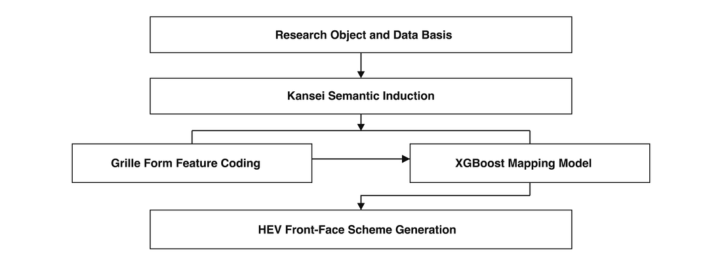
Research on traditional patterns has shifted from graphic reproduction toward rule generation driven by shape grammar, parametric coding, and Kansei evaluation (Ma, Du & Yao, 2023; Hu, Xie, Yuan, Lv & Xiong, 2021; Hou, Gou, Chen & Chu, 2023; Chen & Guan, 2025). When applied to automotive grilles, however, such translation must also satisfy constraints including opening ratio, structural continuity, scale gradation, and boundary connection. Therefore, based on 60 HEV front-face samples and 12 Kansei descriptors, this study uses FCM to extract Kansei dimensions, builds XGBoost regression models using five types of grille features, and transforms the compositional rules of ice-crack, ruyi-cloud, and scale patterns into parametric generation rules. The subsequent detailed design practice uses the scale pattern as an example. The aim is to establish a continuous mapping among user Kansei needs, grille morphology, and traditional culture. The overall workflow is shown in Figure 1.
Figure 1: Research framework.
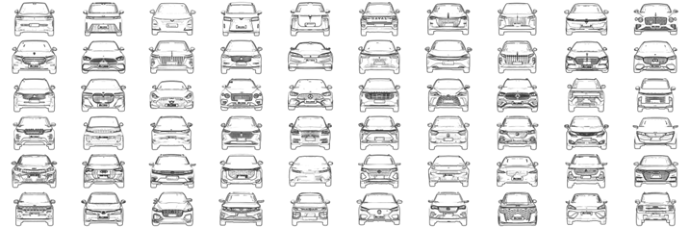
KANSEI SEMANTIC STUDY OF HEV FRONT FACES This study selected 60 HEV front-face samples for Kansei evaluation and morphological analysis. To reduce the influence of brand preference and body color on evaluation, all samples used a unified frontal composition,
scale, and white background, and were numbered from 1 to 60 according to their order in the questionnaire. Line drawings of the 60 HEV front-face samples are shown in Figure 2.
Figure 2: Representative line drawings of HEV front-face samples.
One hundred participants completed the Kansei questionnaire, and 96 valid responses remained after 4 invalid responses were excluded. The overall Cronbach’s alpha was 0.86 (>0.70), indicating good internal consistency and suitability for subsequent FCM clustering analysis.
The questionnaire evaluated 60 front-face samples using 12 Kansei descriptors on a 1–7 scale. For each sample, the scores for each Kansei descriptor were averaged to form a 60 × 12 Kansei evaluation matrix, which was used for FCM clustering and Kansei dimension induction. An excerpt of the matrix is shown in Table 1.
Table 1: Excerpt of the Kansei evaluation matrix.
Table available in the original PDF paper.
Sample Tech. Fut. Trans. Order Orient. Exq. Lux. Recog. Stable Power Dyn. Frnd.
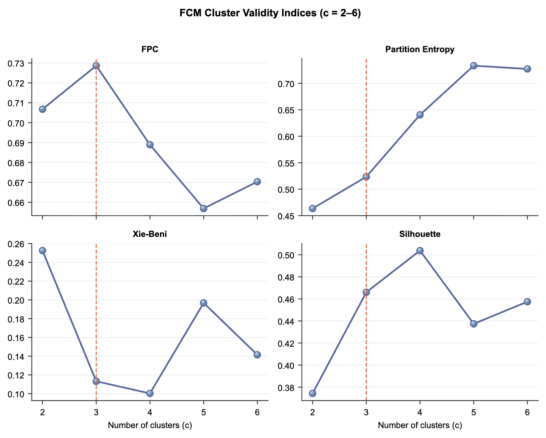
S60 6.280 6.242 5.456 6.030 3.945 5.044 4.604 5.748 5.113 5.341 5.472 3.694 Before clustering, the score vector of each Kansei descriptor across the 60 samples was standardized using Z-score normalization to reduce the effect of mean differences among descriptors on distance calculation. To avoid the influence of subjectively specifying the number of clusters, the number of clusters was first set to c = 2, 3, 4, 5, and 6, and the 12 Kansei descriptors were clustered with FCM. The validity of different clustering schemes was evaluated using FPC, Partition Entropy, the Xie-Beni index, and the silhouette coefficient. The results show that when c = 3, the FPC value is 0.729, higher than that of the other schemes, indicating relatively clear membership relationships among the Kansei descriptors under the three-cluster partition. Partition Entropy is 0.523, suggesting a low level of fuzzy uncertainty in
Parametric Design of HEV Intake Grilles 487 the clustering result. The Xie-Beni index is 0.113, indicating a good balance between intra-cluster compactness and inter-cluster separation. The hard- partition silhouette coefficient is 0.466, showing that the three descriptor groups have a certain degree of distinction in the evaluation space. Although c = 4 has a slight advantage in the Xie-Beni index and silhouette coefficient, the additional category mainly represents a further split of boundary descriptors and is difficult to interpret as a more stable Kansei semantic category. Therefore, considering clustering validity, semantic interpretability, and the subsequent correspondence with traditional pattern translation, this study finally adopts the three-cluster scheme. In the final FCM clustering, the fuzziness coefficient m = 2.0, the maximum number of iterations is 500, and the convergence threshold is 1 × 10⁻⁷.
Figure 3: FCM validity indices under different numbers of clusters.
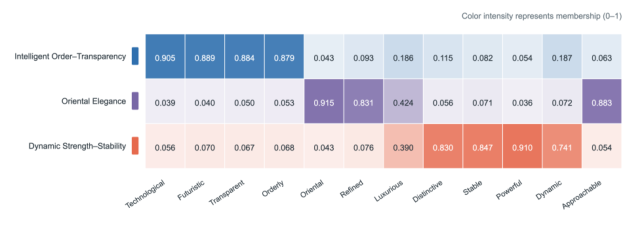
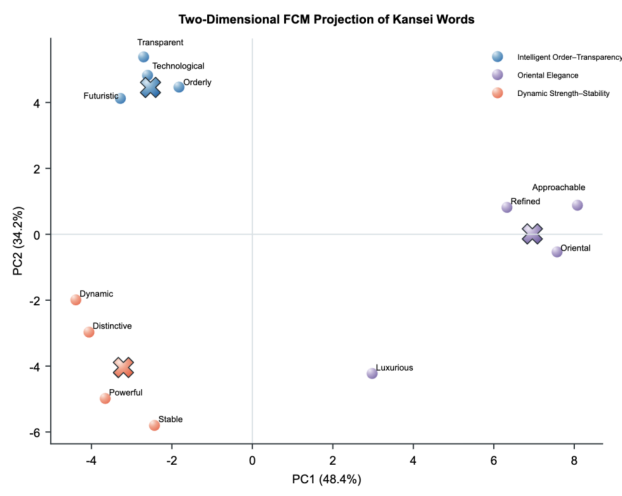
The FCM clustering used the maximum membership degree of each Kansei descriptor as the basis for classification, and the clusters were named according to the shared semantics of the descriptors within each group. As shown in Figure 4, the membership degrees of technological, futuristic, transparent, and orderly impressions in the first cluster are close to or higher than 0.879. Together, they express technological foresight, structural order, and visual openness, so this cluster is named the Intelligent Order-Transparency Dimension. Oriental, exquisite, luxurious, and friendly impressions mainly belong to the second cluster. Their meanings focus on Oriental aesthetics, detail quality, and a soft and approachable visual experience, so the cluster is named the Oriental Elegance Dimension. Among them, the membership of luxurious impression in the second and third clusters is relatively close, indicating that its perception is related not only to refinement and elegance but also to stability and strength. Recognizable, stable, powerful, and dynamic impressions have high membership in the third cluster and jointly present
clear identification, structural stability, and dynamic tension; therefore, this cluster is named the Dynamic Strength-Stability Dimension. These results show that the 12 Kansei descriptors can be summarized into three Kansei dimensions with clear semantic differences, which can serve as evaluation indices for subsequent grille morphology analysis and predictive model construction.
Table 2: FCM clustering results of kansei descriptors.
Parametric Design of HEV Intake Grilles 489 The two-dimensional PCA projection was used to assist observation of the distribution relationships among the three categories in a plane. PC1 and PC2 in the PCA are not Kansei dimensions obtained by clustering, but two comprehensive coordinate axes compressed from the original 60-dimensional evaluation data. PC1 explains 48.41% of the evaluation variation, and PC2 explains 34.22%; together they explain 82.63% of the information, which is sufficient to present the main difference structure among the Kansei descriptors. Figure 5 shows that the three descriptor groups form relatively clear regions in the PC1-PC2 plane, indicating that the FCM clustering results have good intuitive interpretability.
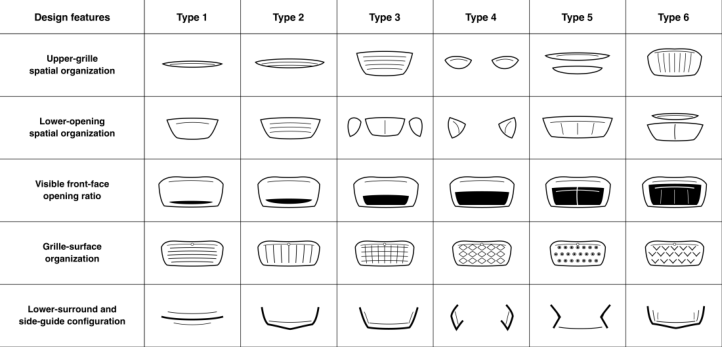
GRILLE MORPHOLOGICAL FEATURES AND XGBOOST MAPPING MODEL Based on the 60 HEV front-face samples, this study summarizes front- face morphology into five types of design features: upper-grille spatial organization, lower-opening spatial organization, visible front-face opening ratio, grille-surface organization, and lower-surround and side-guide configuration. According to component positions, opening scale, and surface organization differences, each feature is further divided into six typical forms and coded sequentially as Type 1 to Type 6. The detailed classification is shown in Figure 6.
Figure 6: Classification of HEV front-face design features.
After naming the Kansei dimensions, this study further constructs mapping models from grille design features to Kansei evaluation. The model inputs are five types of grille design features: upper-grille spatial organization, lower- opening spatial organization, visible front-face opening ratio, grille-surface organization, and lower-surround and side-guide configuration. Each feature is encoded using discrete categories from 1 to 6. The model outputs are the scores of the three Kansei dimensions obtained after FCM clustering, namely Intelligent Order-Transparency, Oriental Elegance, and Dynamic
Strength-Stability. Independent XGBoost regression models are built for the three dimensions.
For the XGBoost modeling data, a second questionnaire survey was conducted. After 6 invalid responses were excluded, the remaining valid responses were used for model construction. The overall Cronbach’s alpha was 0.83 (>0.70), indicating suitability for subsequent XGBoost training and analysis.
After completing the morphological coding of the samples, the five design- feature codes of the 60 samples were merged with the questionnaire mean scores of the three Kansei dimensions to form the XGBoost modeling matrix. The first five columns of the matrix represent upper-grille spatial organization, lower-opening spatial organization, visible front-face opening ratio, grille- surface organization, and lower-surround and side-guide configuration, while the last three columns represent the scores of Intelligent Order-Transparency, Oriental Elegance, and Dynamic Strength-Stability. The complete data are shown in Table 3.
Table 3: Data matrix for the XGBoost models.
Table available in the original PDF paper.
Sample 1 2 3 4 5 Intelligent Order- Transparency
Oriental Elegance
Dynamic Strength-Stability
1 1 1 2 5 1 4.982 1.944 1.909
2 1 2 3 6 4 5.376 2.500 2.766
3 3 3 4 3 4 4.386 5.850 4.015
… … … … … … … … …
58 3 1 5 4 2 6.419 4.951 1.392
59 2 6 3 1 4 2.974 3.508 4.977
60 3 3 3 3 3 3.740 6.475 3.717
The XGBoost models use a shallow-tree structure to reduce the risk of overfitting under small-sample conditions. The model objective function is set to reg:squarederror, n_estimators is set to 800, max_depth is set to 1, learning_ rate is set to 0.09, subsample is set to 0.90, colsample_bytree is set to 0.90, and the L2 regularization parameter reg_lambda is set to 0.05. Model outputs are retained to three decimal places. The dependent variables of the three Kansei dimensions are taken from the sample means of the questionnaire evaluation, with a scale range of 1–7; model training, cross-validation, and prediction of all design combinations use this data structure directly.
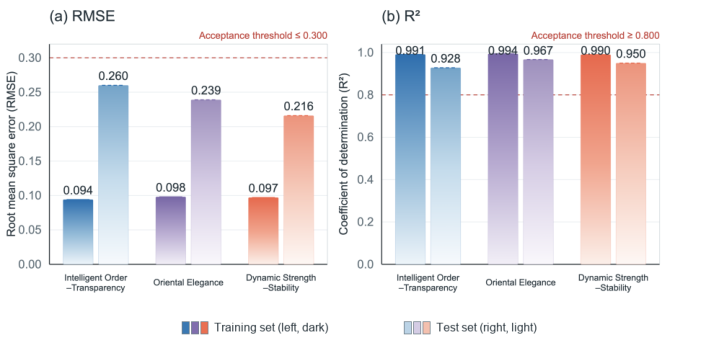
To examine the predictive stability of the models, this study uses 12-fold cross-validation. Because the total number of samples is 60, each fold uses 55 samples as the training set and 5 samples as the test set. After the 12-fold cycle, each sample obtains one test-set prediction. The model evaluation metrics include RMSE and R². RMSE represents the average error between predicted values and actual Kansei scores, with smaller values indicating more accurate prediction. R² represents the model’s ability to explain changes in Kansei scores, with values closer to 1 indicating better fitting performance.
Table 4 shows that the test-set RMSE and R² of the Intelligent Order- Transparency Dimension are 0.260 and 0.928; those of the Oriental Elegance Dimension are 0.239 and 0.967; and those of the Dynamic Strength-Stability Dimension are 0.216 and 0.950. The test-set R² values of all three dimensions are greater than 0.900, and the RMSE values are less than 0.300, indicating that the models can predict users’ Kansei evaluations corresponding to different grille morphology combinations. The training-set RMSE values are 0.094, 0.098, and 0.097, respectively, showing good fitting ability for existing samples. At the same time, the test-set indicators remain at a high level, suggesting that the models do not simply memorize the training samples but have a certain degree of generalization ability.
Figure 7: XGBoost model performance comparison.
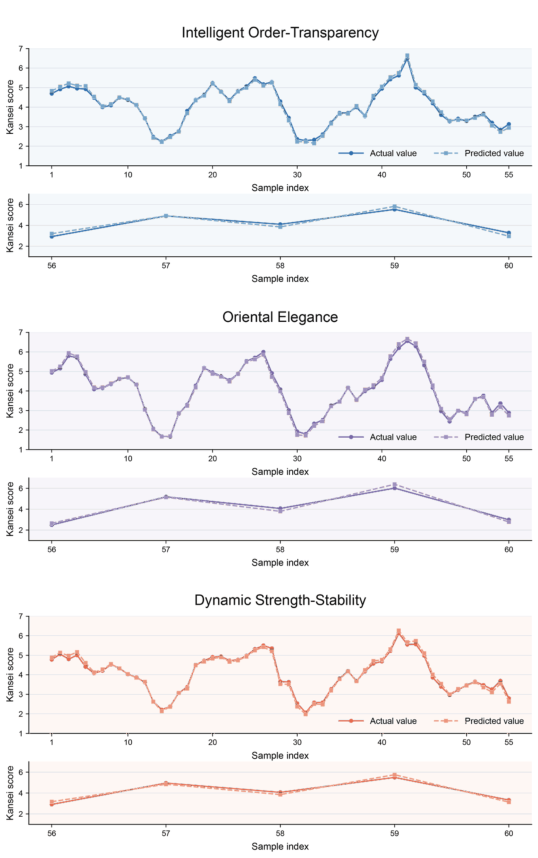
To observe model prediction effects more intuitively, this study plots line charts of the training and test sets for the three Kansei dimensions. In each chart, the upper part compares observed and predicted values for the training set, while the lower part compares observed and predicted values for the test set. If the predicted curve follows the variation of the observed curve well, the model can be considered capable not only of fitting the training samples but also of achieving a certain level of generalized prediction.
Figure 8: Observed and predicted values for the three Kansei dimensions.
The three groups of line charts in Figure 8 show that the predicted and observed curves of the three Kansei dimensions have generally consistent trends. The training-set curves show a high degree of fit, indicating that the models can learn the relationship between the morphology of existing samples and their Kansei evaluations. The test-set curves show certain deviations at local peaks and low values, but the overall trends remain consistent, indicating that the models do not merely memorize the training data and can effectively predict samples not included in training.
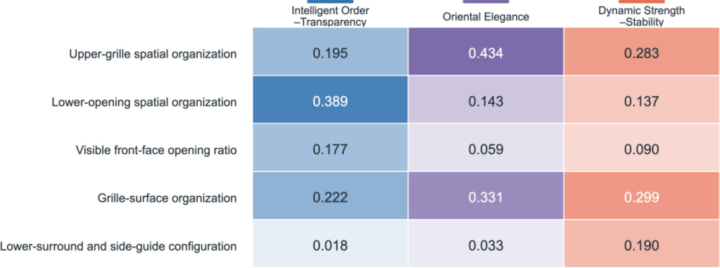
To identify the key morphological control factors for different Kansei dimensions, the importance of each design feature in the three XGBoost models is further compared. The results are shown in Figure 9 and Table 5.
Lower-surround and side-guide configuration The feature-importance results show that the Intelligent Order-Transparency Dimension is most strongly influenced by lower-opening spatial organization, with an importance of 0.389, followed by grille-surface organization and upper-grille spatial organization, with importances of 0.222 and 0.195, respectively. The Oriental Elegance Dimension is mainly influenced by upper- grille spatial organization and grille-surface organization, with importances of 0.434 and 0.331. The Dynamic Strength-Stability Dimension is mainly influenced by grille-surface organization, upper-grille spatial organization, and lower-surround and side-guide configuration, with importances of 0.299, 0.283, and 0.190. These results indicate that different Kansei goals correspond to different morphological control priorities: transparency and order depend more on opening organization and surface rhythm; Oriental elegance depends more on the coordination between the upper grille and surface organization; and strength and stability depend more on the combined effect of surface organization, upper grille, and lower-surround structure.
After model validation, this study enumerates all combinations of the five types of design features. Because each design feature contains six categories, the complete design space includes 65 = 7,776 combinations. After inputting these combinations into the trained XGBoost models, predicted values are obtained for the Intelligent Order-Transparency, Oriental Elegance, and Dynamic Strength-Stability dimensions and ranked according to the three
Kansei goals, providing morphological bases for the translation of ice-crack, ruyi-cloud, and scale patterns. The prediction results of the three dimensions all form continuous distributions, and the high-scoring combinations retain distinguishable ranking differences.
For the Intelligent Order-Transparency Dimension, the highest predicted combination is C0392, with a predicted value of 6.236. It can serve as the morphological basis for translating the ice-crack lattice pattern by using heterogeneous polygonal subdivision, opening rhythm, and density gradation to strengthen technological, futuristic, transparent, and orderly impressions. For the Oriental Elegance Dimension, the highest predicted combination is C3111, with the combination code 3-3-3-3-3 and a predicted value of 5.899, making it suitable for combination with the continuous curves, curled boundaries, and flexible decorative rhythm of ruyi-cloud patterns. For the Dynamic Strength-Stability Dimension, the highest predicted combination is C7174, with a predicted value of 6.417, making it suitable for translation through the repeated overlap, directional arrangement, and structural support logic of scale patterns. Overall, the optimal combinations of the three dimensions present different morphological feature configurations, providing clear design bases for subsequent traditional pattern translation.
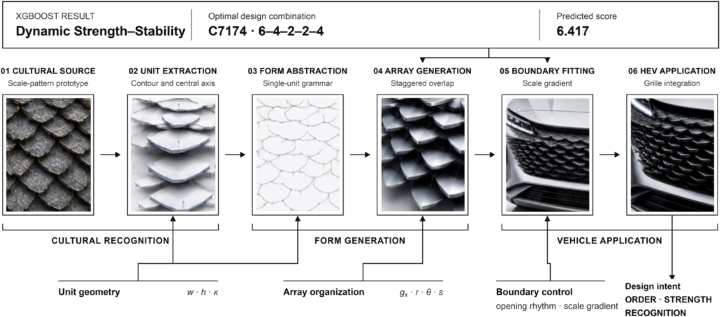
HEV FRONT-FACE DESIGN PRACTICE BASED ON PARAMETRIC TRANSLATION OF SCALE PATTERNS To illustrate the application of the model prediction results in styling design, this study selects the C7174 combination, which has the highest score in the Dynamic Strength-Stability Dimension, for scheme design. Its code is 6-4-2-2-4, corresponding in sequence to Type 6 upper-grille spatial organization, Type 4 lower-opening spatial organization, Type 2 visible front-face opening ratio, Type 2 grille-surface organization, and Type 4 lower-surround and side-guide configuration. Its predicted value is 6.417. The Dynamic Strength-Stability Dimension emphasizes recognizability, stability, power, and dynamism. Scale patterns have formal characteristics of continuous overlap, clear direction, and structural stability, which correspond well to these perceptual features; therefore, they are selected as the pattern source for this design.
Figure 10: Parametric translation process of the scale pattern.
Parametric Design of HEV Intake Grilles 495 During the design process, the basic compositional relationship of the scale pattern is retained, rather than directly applying its surface motif. First, the outer contour curve and central axis are extracted from a single scale element to form the basic unit. Then, unit morphology is controlled by width w, height h, and curvature k, while arrangement is controlled by horizontal spacing gx, vertical overlap ratio r, and deflection angle θ. A row-by-row scaling coefficient s is used to adjust the dimensional variation of units within the grille boundary. Each row adopts a half-unit offset overlap, openings are retained between adjacent units, and unit scale and spacing gradually contract according to the grille outline. In this way, the original overlapping order of the scale pattern is used to organize the grille rather than covering the grille surface as a complete pattern, as shown in Figure 10.
Figure 11: HEV front-face design proposal generated through scale-pattern translation.
Figure 11 shows an example of an HEV front-face design generated based on the above rules. The scale units are arranged in the upper grille area and maintain continuous relationships with the through-type light strip, side air guides, and lower intake opening. The units extend from the center toward both sides, their sizes decrease with the grille outline, and the offset overlap creates clear horizontal layering and an outward-extending tendency. The overall form aims to present stable, strong, and recognizable visual characteristics, serving as a feasibility demonstration of the prediction results for the Dynamic Strength-Stability Dimension. The proposal retains the compositional characteristics of the scale pattern and explores its application as a rule for generating grille morphology.
CONCLUSION
This study focuses on Kansei evaluation and styling design of HEV front intake grilles. User evaluations were used to analyze the different impressions produced by grille morphology, and the results were then used to screen design combinations and conduct traditional pattern translation. First, through Kansei evaluation and FCM clustering, the 12 Kansei descriptors were summarized into three dimensions: Intelligent Order-Transparency, Oriental Elegance, and Dynamic Strength-Stability. Second, five types of grille features from 60 samples were coded, and XGBoost was used to build prediction models between morphological features and Kansei evaluation. Preferred schemes for each dimension were then identified from 7,776 combinations. Finally, using the C7174 combination of the Dynamic Strength-Stability Dimension as an
example, the unit outline, offset overlapping relationship, scale variation, and opening rhythm of the scale pattern were transformed into grille composition rules, and a parametric generation process and full front-face design example were completed. The final scheme aims to demonstrate a feasible path from model prediction results to concrete design through order, strength, and cultural recognition. This study provides a methodological reference for the front-face design of Chinese brand HEVs and demonstrates the application potential of traditional pattern compositional rules in modern automotive front-face generation.
REFERENCES
Bezdek, J. C., Ehrlich, R., & Full, W. (1984). FCM: The fuzzy c-means clustering algorithm. Computers & Geosciences, 10(2–3), 191–203. Chen, T., & Guestrin, C. (2016). XGBoost: A scalable tree boosting system.
Proceedings of the 22nd ACM SIGKDD International Conference on Knowledge Discovery and Data Mining, 785–794. Chen, Z., Feng, H., & Li, Y. (2024). A front face design of new energy vehicles based on rough set theory and backpropagation neural network. Kansei Engineering, 145, 67–77. Chen, Z., & Guan, L. (2025). A study on the emotional prediction and application of
Ming-style Luohan beds integrating Kansei Engineering and integration theory: An exploration of furniture innovation from the perspective of contemporary aesthetics. In C. Stephanidis, M. Antona, S. Ntoa, & G. Salvendy (Eds.), HCI International 2025 Posters (pp. 191–201). Communications in Computer and Information Science, 2527. Springer. Chen, Z., Tian, J., Zhou, H., & Wu, D. (2025). Toward symmetry in accessible restrooms design: Integrating KE, RST, and SVM for optimized emotional- functional alignment. Buildings, 15(9), 1567. Hou, X., Gou, B., Chen, D., & Chu, J. (2023). A semantic data-driven knowledge base
construction method to assist designers in design inspiration based on traditional motifs. Advanced Engineering Informatics, 56, 101987. Hu, T., Xie, Q., Yuan, Q., Lv, J., & Xiong, Q. (2021). Design of ethnic patterns based on shape grammar and artificial neural network. Alexandria Engineering Journal, 60(1), 1601–1625. Kang, X., Wan, H., & Li, S. (2026). Combining Kansei Engineering and SSA-
XGBoost for new energy vehicle front-face form design. Journal of Engineering Design, 37(5), 1992–2030. Lai, X., Zhang, S., Mao, N., Liu, J., & Chen, Q. (2022). Kansei engineering for new energy vehicle exterior design: An internet big data mining approach. Computers & Industrial Engineering, 165, 107913. Landwehr, J. R., McGill, A. L., & Herrmann, A. (2011). It’s got the look: The effect
of friendly and aggressive ‘facial’ expressions on product liking and sales. Journal of Marketing, 75(3), 132–146. Ma, Y.-M., Du, H.-M., & Yao, H. (2023). On innovative design of traditional Chinese patterns based on aesthetic experience to product features space mapping. Cogent Arts & Humanities, 10(2), 2286732. Nagamachi, M. (1999). Kansei Engineering as a consumer-oriented product
development. Journal of the Japanese Society for Quality Control, 29(4), 19–27. Ranscombe, C., Hicks, B., Mullineux, G., & Singh, B. (2012). Visually decomposing vehicle images: Exploring the influence of different aesthetic features on consumer perception of brand. Design Studies, 33(4), 319–341.
Parametric Design of HEV Intake Grilles 497 Shen, W., Matsubara, Y., Wilson, J., & Nagamachi, M. (2000). A cross-cultural study
of vehicle front mask design using Kansei Engineering approach. Proceedings of the Human Factors and Ergonomics Society Annual Meeting, 44(33), 6-372–6-375. Windhager, S., Bookstein, F. L., Grammer, K., Oberzaucher, E., Said, H., Slice, D. E., Thorstensen, T., & Schäfer, K. (2012). ‘Cars have their own faces’: Cross-cultural ratings of car shapes in biological (stereotypical) terms. Evolution and Human Behavior, 33(2), 109–120.
SEARCH THE AHFE DIGITAL BOOKSTORE BY ISBN
Explore the complete digital volume
Human Factors in Design, Engineering, and Computing
Read this individual research paper free through the original publisher, or explore the full digital proceedings book.