Qi Kong, Buzhou Tang (2026). Postpartum Women’s Experiences With Digital Health Resources and Support Needs: A Qualitative Study and Design Implications. In: Human Factors in Design, Engineering, and Computing. AHFE Open Access, vol. 238, pp. 498–506. https://doi.org/10.54941/ahfe1008282
Digital health resources have become an important means for postpartum women to access health information and support, yet existing resources may not fully align with their everyday needs and patterns of use. This study explored postpartum women’s experiences with digital health resources and the challenges and support needs arising from their use. Semi-structured interviews were conducted with 12 women within 12 months postpartum and analyzed using thematic analysis. Eight interrelated themes were identified. Women drew on different support sources according to their needs but still had to verify information, assess its credibility, and adapt general advice to individual circumstances. Use was constrained by limited time, energy, caregiving demands, and the effort required for continued engagement. Participants described reassurance and worry in their use of digital resources, the involvement of digital information in family caregiving discussions, and limited space for their own interests in parenting-oriented digital environments. Based on these findings, four design implications are proposed: organizing support around different needs; structuring information around its sources, applicability, and actionable guidance; enabling low-burden, interruptible interactions; and supporting women’s control over the presentation and scope of parenting-related content.
Life after childbirth involves physical recovery, infant care, and changes in family roles and daily routines. Alongside caregiving responsibilities, women need rest, emotional support, and attention to their own health (Finlayson et al., 2020). Digital resources offer access to information and opportunities for support (Hanach et al., 2024). However, women may encounter conflicting information, content with limited relevance to their individual circumstances, and demands on their time and effort when using these resources (Hanach et al., 2024; Ng et al., 2024).
Postpartum Women’s Experiences With Digital Health Resources and Support Needs 499 Here, digital health resources include health-related apps, social media, online communities, group chats, and general-purpose artificial intelligence (AI) tools used for postpartum health and caregiving.
Building on existing research, this study draws on postpartum women’s accounts to explore how they use and experience digital health resources in everyday life and to inform the design of postpartum digital support. Through semi-structured interviews with women in the first year after childbirth, the study addresses two research questions: RQ1: What are postpartum women’s experiences with digital health
resources? RQ2: What support needs and challenges emerge from these experiences?
RELATED WORK
Postpartum Support Needs Women’s needs after childbirth extend beyond infant care to their own health and adjustment. A qualitative meta-synthesis highlighted maternal confidence and autonomy, adaptation to changing relationships, and physical and emotional wellbeing as important aspects of women’s postnatal experiences (Finlayson et al., 2020). More recently, a scoping review categorized women’s postpartum needs into four areas: support, sharing, care, and preparation for the postpartum period (Sendas and Freitas, 2024). Together, these studies suggest that postpartum support should consider women’s own wellbeing and everyday circumstances alongside infant care.
Experiences With Digital Health Resources Digital health resources can facilitate access to information and support, while also introducing uncertainty and additional demands. Hanach et al. (2024) found that postpartum women valued immediate access to information, convenience, and online support, but also described stress and anxiety associated with conflicting information and pressure to follow health recommendations.
Research spanning preconception, pregnancy, and the postnatal period further highlights the importance of contextual relevance and the effort required for use. Lee et al. (2023) identified expectations for personalized support, information relevant to individual circumstances, and access to local healthcare resources. A subsequent analysis of the same interview dataset found that data-entry demands, steep learning curves, and lengthy onboarding could hinder continued use (Ng et al., 2024). An analysis of a digital helpline and online forums found that general parenting support seekers primarily raised childcare concerns, whereas mothers experiencing postpartum distress more often described interpersonal problems and a lack of support (Yao et al., 2023). Together, these findings suggest that digital health resources should be considered not only in terms of the information and support they provide, but also in relation to women’s circumstances and the effort required for use.
500 Kong and Tang Building on these studies, the present study examines women’s accounts of using different digital health resources in everyday postpartum life, focusing on the support needs and challenges arising from their use.
METHODS
Study Design This exploratory qualitative study used semi-structured interviews to investigate postpartum women’s experiences with digital health resources, the challenges arising from their use, and related support needs. The Person- Based Approach (PBA) informed the early needs exploration and the focus of the interviews, with particular attention to users’ perspectives and everyday circumstances (Yardley et al., 2015).
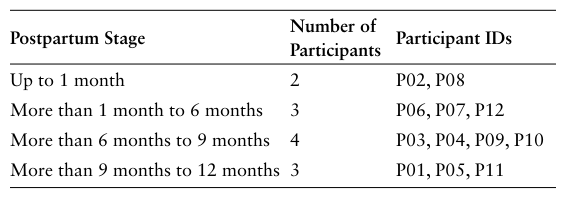
Participants and Data Collection Participants were recruited through social media. Eligibility criteria included being aged 18 years or older, being within 0–12 months postpartum, being able to participate in an interview in Chinese, and having experience using smartphones and relevant digital resources. The final sample comprised 12 women, including both first-time mothers and mothers with previous child-rearing experience. Participants’ postpartum stages at the time of the interview are summarized in Table 1.
Online audio interviews were conducted in Chinese and lasted approx imately 20–40 minutes. The interviews covered postpartum experiences, help-seeking behaviors and sources of support, experiences with digital health resources, and needs and expectations regarding digital support. Participants consented to audio recording and the use of anonymized quotations. Audio recordings were transcribed. The transcripts were cross-checked against the corresponding audio recordings and anonymized. Each participant received CNY 30 as an incentive.
Table 1: Participants’ postpartum stage at the time of interview.
Data Analysis The interview data were analyzed using thematic analysis (Braun and Clarke, 2006). The researcher repeatedly read the transcripts to familiarize themselves with the data and generated initial codes related to digital resource use, support needs, and challenges arising from these experiences. Codes were compared across interviews, and related codes were grouped
Postpartum Women’s Experiences With Digital Health Resources and Support Needs 501 to develop candidate themes reflecting patterns of meaning relevant to the research questions. Candidate themes were iteratively reviewed against the coded extracts and the full dataset, refined, and named, yielding eight final themes. All coding and interpretation were conducted by one researcher. The findings across the eight themes were subsequently synthesized to identify key design issues and inform the development of design implications.
RESULTS
Thematic analysis generated eight themes concerning participants’ experiences with digital health resources. For clarity of presentation, these themes are organized into four related areas: support seeking and information evaluation; adaptation and implementation of digital health advice; benefits and burdens of digital resource use; and digital resources in family and personal life.
Support Seeking and Information Evaluation Theme 1. Seeking and coordinating multiple sources of support. Participants drew on different sources of support depending on their concerns and needs. Online exchanges with other mothers were valued for shared experiences, whereas AI was used for more direct answers. When group discussions produced multiple suggestions that were difficult to assess, participants sometimes turned to professional care. Disclosure also shaped resource choice; for example, one participant avoided discussing urinary leakage in group chats because of embarrassment and privacy concerns (P04).
Theme 2. Verifying and evaluating digital health information. Participants still needed to assess the credibility of accessible information by comparing sources, considering professional backgrounds, and identifying commercial motives. As one participant explained, “I really can’t tell what is genuine and what is there to sell products” (P05). Another repeatedly asked AI tools for supporting references and compared responses across platforms, describing this verification process as time-consuming (P12).
Adaptation and Implementation of Digital Health Advice Theme 3. Adapting health advice to individual circumstances. General advice did not always clarify what applied to a particular mother or baby. When investigating frequent night waking, one participant encountered several plausible explanations and treated them as possible directions for further observation and adjustment (P05). Another reported that an AI tool continued to respond using her baby’s previous age, requiring her to restate the current age when seeking advice (P07).
Theme 4. Real-world constraints on implementing health advice. Relevant advice was not always feasible within everyday caregiving routines. One participant described postpartum recovery concerns but struggled to make time for related activities. Regarding AI-based exercise guidance, she said,
502 Kong and Tang “Doubao can guide me, but I don’t think I can keep it up” (P04). Doubao is a conversational AI assistant. She described irregular schedules, household tasks, and fatigue as constraints on her ability to follow such guidance.
Benefits and Burdens of Digital Resource Use Theme 5. Reassurance and concern associated with digital health information. Participants described both reassurance and concern in their encounters with digital resources. One participant said that exchanges with other mothers made her feel more at ease because she could see that children developed differently (P03). However, the same participant also described greater concern when her preterm baby had not reached age-based developmental milestones presented in an app. Another participant described AI explanations of postpartum recovery as reassuring (P07).
Theme 6. Balancing perceived benefits and effort in using digital health resources. Tracking functions were regarded as useful but required continued input. One participant gradually reduced the information she recorded, retaining mainly feeding and sleep data (P11). Another stopped tracking because she found the repeated recording burdensome: “I used it at first, but then I stopped. There was too much to keep recording over and over” (P06).
Digital Resources in Family and Personal Life Theme 7. Family negotiation around digital health information. Digital information was incorporated into existing family discussions and disagreements about infant care. One participant described family members sharing different online sources and consulting AI when they held different views, referring to the tools as a “judge” (P12). Another participant described involving her husband in family negotiation and later asking a doctor trusted by her mother-in-law to explain a caregiving issue during a child health visit (P10). These accounts show how digital information was used alongside interpersonal and professional sources within ongoing family negotiation.
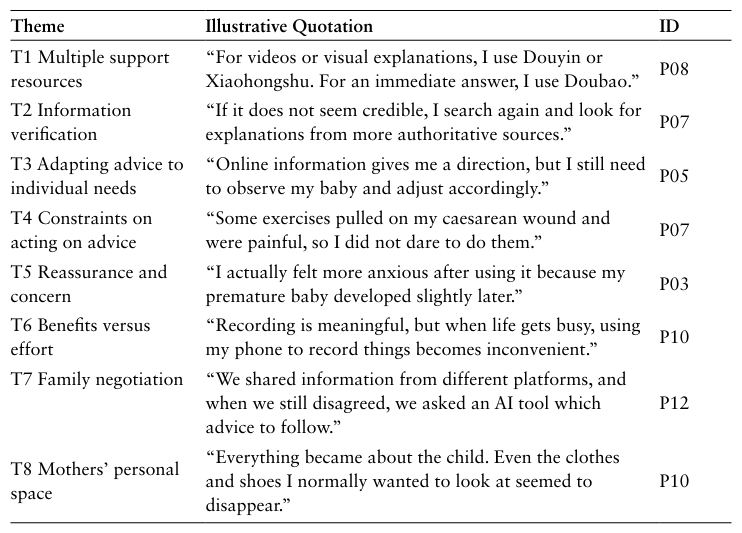
Theme 8. Space for mothers’ own lives within child-rearing-oriented digital environments. Some participants used digital media for relaxation and personal time, such as watching television dramas after caregiving tasks (P05). At the same time, participants described repeated exposure to child-related content during their digital media use. One participant said that repeated child-related videos reminded her of her baby’s crying and made her feel more irritated (P03). Another described her feed as increasingly dominated by child-related material, making her own interests harder to encounter and leaving her feeling that her life was “shut inside a little box” (P10). Illustrative quotations for the eight themes are presented in Table 2.
Table 2: Illustrative quotations for the eight themes.
Note. Douyin is a short-video social media platform; Xiaohongshu is a lifestyle-oriented social media platform; Doubao is a conversational AI assistant.
DISCUSSION
Building on the eight themes identified in the Results, we discuss key issues concerning support-source selection, information evaluation and applicability, practical feasibility, family negotiation, and mothers’ own needs. Overall, the findings suggest that the value of digital support depends not only on access to resources, but also on whether support sources, information, and interaction demands fit women’s specific needs and everyday circumstances.
Different support sources served different needs and had different boundaries. However, drawing on multiple resources did not eliminate the need to evaluate and interpret the information they provided. Li et al. (2025) found that perinatal women valued trustworthiness and relevance to their needs when evaluating maternal health information. Consistent with this, participants in our study described considering not only whether information was credible, but also whether it was applicable to their own or their infant’s circumstances. Thus, access to more information did not necessarily reduce the need to judge whether that information was relevant and applicable.
The practical value of digital support was also shaped by postpartum caregiving conditions. Ng et al. (2024) identified time and data-entry demands as barriers to sustained use of maternal digital health tools. Our findings further distinguish between the effort required to use a resource and the feasibility of acting on its advice. A tool may be easy to operate while its recommendations remain difficult to implement under fatigue, fragmented time, or unpredictable caregiving routines. The coexistence of reassurance
504 Kong and Tang and concern in our findings is consistent with Hanach et al. (2024), who reported stress associated with conflicting information and pressure to follow health recommendations.
Digital information was used alongside interpersonal and professional sources in ongoing family caregiving discussions. These accounts point to the need to support communication across different caregiving views, rather than assuming that access to information alone produces agreement.
Finally, the findings highlight mothers’ own needs within parenting- oriented digital environments. Finlayson et al. (2020) found that women valued regaining their own health and wellbeing, autonomy, and an integrated sense of identity during the postpartum period, while their practical and self- care needs could become secondary to infant needs. Recent HCI research has also emphasized the importance of designing postpartum technologies that account for women’s broader lived contexts, preserve user agency, and avoid adding further technological burden (Grimme et al., 2026). In our study, participants described infant- and parenting-related content occupying much of their digital attention, while their own recovery, rest, and non-caregiving concerns received less attention. These findings suggest that postpartum digital support should not focus solely on providing more parenting information, but should also leave room for women’s own recovery and personal priorities.
Together, these findings shift attention from resource availability alone toward the work of judging, using, and negotiating digital support within everyday postpartum life. These issues provide the basis for the design implications presented in the following section.
DESIGN IMPLICATIONS Drawing on these findings, we propose four design directions for postpartum digital health support.
Organize clear, navigable support pathways. Interfaces should organize support options around different needs and clarify the roles and boundaries of digital tools, peers, professionals, and family support. Users should be able to move between relevant options and share information for family caregiving discussions, without assuming that information sharing alone produces agreement.
Support information judgment and contextual application. Information should clearly present its sources, supporting evidence, and applicability conditions, alongside practical next steps. General guidance should be distinguished from situations requiring individualized assessment. Explanations of uncertainty and individual variation should help users interpret recommendations without presenting general expectations as universally applicable.
Design low-burden, interruptible, and resumable interactions. Systems should minimize repetitive input, make tracking optional, retain relevant context, and enable easy resumption after interruptions. Beyond reducing interaction effort, suggested actions should account for fatigue, limited time, and everyday caregiving constraints.
Postpartum Women’s Experiences With Digital Health Resources and Support Needs 505 Give mothers control over parenting-related content. Users should be able to adjust, reduce, or temporarily pause parenting-related recommendations. Content choices should also accommodate mothers’ own recovery, wellbeing, and non-caregiving interests, allowing them to determine the focus of their digital engagement.
These design directions are grounded in the qualitative findings and require further evaluation through prototype development and user testing.
LIMITATIONS The findings reflect the experiences of 12 postpartum women recruited through social media in China. Future research could explore postpartum women’s experiences in other sociocultural contexts.
CONCLUSION
This study explored postpartum women’s experiences with digital health resources through semi-structured interviews with 12 women. The findings suggest that access to information did not remove participants’ need to assess its credibility and applicability to their circumstances. Digital support should also account for interaction demands and the feasibility of acting on advice within everyday caregiving constraints, while recognizing mothers’ own recovery and personal priorities. These findings informed four design directions concerning support pathways, information presentation, low- burden and resumable interaction, and mothers’ control over parenting- related content. These directions remain untested. Future work should examine their feasibility and usefulness through prototype development and user testing with women in varied postpartum circumstances.
ACKNOWLEDGMENT
The authors thank all participants for generously sharing their time, experiences, and perspectives in this study.
REFERENCES
Braun, V., and Clarke, V. (2006). Using thematic analysis in psychology. Qualitative Research in Psychology, 3(2), 77–101. doi: 10.1191/1478088706qp063oa. Finlayson, K., Crossland, N., Bonet, M., and Downe, S. (2020). What matters to
women in the postnatal period: A meta-synthesis of qualitative studies. PLOS ONE, 15(4), e0231415. doi: 10.1371/journal.pone.0231415. Grimme, S., Benedetti, A., Spoerl, S. M., Boll, S., and Koelle, M. (2026). Navigating postpartum: Exploring lived and professional perspectives to inform supportive technology design. In Proceedings of the 2026 CHI Conference on Human Factors in Computing Systems (CHI ’26), Article 660, 1–18. Association for Computing Machinery. doi: 10.1145/3772318.3791707. Hanach, N., Saqan, R., Radwan, H., Baniissa, W., and de Vries, N. (2024). Perceived
experiences and needs of digital resources among postpartum women in the United Arab Emirates: Qualitative focus group study. Journal of Medical Internet Research, 26, e53720. doi: 10.2196/53720.
506 Kong and Tang Lee, V. V., Vijayakumar, S., Ng, W. Y., Lau, N. Y., Leong, Q. Y., Ooi, D. S. Q., Su, L. L.,
Lee, Y. S., Chan, S.-Y., Blasiak, A., and Ho, D. (2023). Personalization and localization as key expectations of digital health intervention in women pre- to post-pregnancy. npj Digital Medicine, 6, 183. doi: 10.1038/s41746-023-00924-6. Li, B., Jin, N., Wang, Y., Hou, X., Meng, J., and Zhang, Y. (2025). Perinatal women’s perception of maternal health information quality on digital media: Scoping review. Journal of Medical Internet Research, 27, e67620. doi: 10.2196/67620. Ng, W. Y., Lau, N. Y., Lee, V. V., Vijayakumar, S., Leong, Q. Y., Ooi, S. Q. D.,
Su, L. L., Lee, Y. S., Chan, S.-Y., Blasiak, A., and Ho, D. (2024). Shaping adoption and sustained use across the maternal journey: Qualitative study on perceived usability and credibility in digital health tools. JMIR Human Factors, 11, e59269. doi: 10.2196/59269. Sendas, M. V., and Freitas, M. J. (2024). The needs of women in the postpartum period: A scoping review. Midwifery, 136, 104098. doi: 10.1016/j.midw.2024.104098. Yao, X., Mikhelson, M., Micheletti, M., Choi, E., Watkins, S. C., Thomaz, E., and
de Barbaro, K. (2023). Understanding postpartum parents’ experiences via two digital platforms. Proceedings of the ACM on Human-Computer Interaction, 7(CSCW1), Article 107, 1–23. doi: 10.1145/3579540. Yardley, L., Morrison, L., Bradbury, K., and Muller, I. (2015). The person-based approach to intervention development: Application to digital health-related behavior change interventions. Journal of Medical Internet Research, 17(1), e30. doi: 10.2196/jmir.4055.
SEARCH THE AHFE DIGITAL BOOKSTORE BY ISBN
Explore the complete digital volume
Human Factors in Design, Engineering, and Computing
Read this individual research paper free through the original publisher, or explore the full digital proceedings book.