Xue Xiong, Lin Li (2023). Analysis of User Interaction Behavior on Sina Weibo under the Context of Intelligent Technology. In: Usability and User Experience. AHFE Open Access, vol. 110, pp. 327–334. https://doi.org/10.54941/ahfe1003206
As one of the prevailing social media in China, Sina Weibo maintains its position by utilizing artificial intelligence technology in recent years. This study explores the interaction behaviors of Sina Weibo users in terms of following, commenting, and reposting by social network analysis and discusses the intelligent technology applied on the platform in order to understand the characteristics of user behavior under intelligent background. Based on analysis of data collected from Sina Weibo, it has been proved that the density of the following relationships between users is not particularly close and users' following behavior tends to be "related" or "interest-based"; A small number of users are highly followed and a few posts attract many comments; users' reposting activity tends to be more frequent than commenting. The user's behavior has certain characteristics under the intelligent background. We believe that this study has a certain reference value for the development of social media, and can provide some insights into the interaction design and user experience design under the influence of intelligent background.
Launched in 2009, Sina Weibo is a popular social media platform that allows users to share short messages, images, videos, and other content with their fol- lowers. It is often compared to Twitter due to its similar format of short posts or “micro-blog”. As of the end of 2021, Sina Weibo has over 570 million monthly active users and is heavily used in China for news, entertainment, and social networking.
The development and success of Weibo are partly due to artificial intellige- nce technology (AI), which enables it to offer its users better services and user experience while maintaining its position as one of the leading social media platforms in China. According to the report (Wang, 2022), Sina Weibo has been utilizing AI in multiple areas such as content recommendation, comment review, and user behavior analysis.
The academic community has conducted in-depth theoretical and empi- rical studies on user interaction on social media and has made some achie- vements. Kuehl demonstrates the feasibility of an automated prioritization and quantification of customer needs from social media data. The research
findings can provide valuable insights into demand stimulation and moni- toring (Kuehl et al., 2020). Alattar uses Artificial Intelligence in order to find out what causes users’ mood changes on social media, which can help decision-makers to take necessary actions (Alattar and Shaalan, 2021).
In recent years, the application of intelligent technology has made the study of user interaction in social media an engaging topic. Thuraisingham discus- ses the role of both AI and Cyber Security for social media systems including the benefits of AI as well as protecting social media systems (Thuraisingham, 2020). Mehta uses explainable artificial intelligence (XAI) to detect social media hate speech. XAI has flexible and multifaceted potential in hate spe- ech detection by deep learning models (Mehta and Passi, 2022). In the context of business marketing, the increasing interest in Artificial Intelligence (AI)’s impact on Social Media Marketing (SMM) creates new opportunities to be captured by software developers. Micu is exploring artificial intelligence tech- niques’ applicability in social media marketing (Capatina, Micu and Micu, 2018). Argan examines the behavior of social media users toward AI-based advertisements (Argan et al., 2022). His study provides content producers, social media practitioners, marketing managers, the advertising industry, AI researchers, and academics with many insights into AI advertising. However, there is little research to explore the specific characteristics of user behavior in the context of AI.
Weibo takes users and microblogs as its fundamental basis, with users following, commenting, reposting, and other interactive behaviors as the indicators of interaction rate. One of the purposes of intelligent technology applied on the platform is to facilitate interaction among users. Therefore, the research questions of this paper are: what are the characteristics of inte- ractive behavior among Weibo users? Could intelligent technology be used to explain users’ behavior characteristics?
Generally speaking, users establish a huge social network through intera- ctive behaviors such as following, commenting, reposting, and giving likes. Therefore, this study applies social network analysis to investigate Weibo users’ interactive behaviors in terms of following, commenting, and reposting and then analyses the impact of user behavior performance under intelligent technology. We believe the results of this study can provide valuable refe- rences for the design of social media interaction and user experience in an intelligent context.
DATA COLLECTION This paper uses the software Python to crawl user-related information accor- ding to a certain crawling strategy. The sampling method is snowball. In this study, by randomly capturing a user node, the information of its fans is automatically retrieved, and then the information of the fans’ fans is retrie- ved. After multiple rounds, a total of 29105 node information, 72508 user relationship information, and 55561 Weibo information are crawled on 20 March 2023. To ensure the accuracy and authenticity of the analysis, text pre- processing is carried out by removing some meaningless or duplicate words
Analysis of User Interaction Behavior on Sina Weibo 329
and symbols. Next, visualization software Gephi is used for data analy- sis. User behaviour is visualized and analyzed, and then their behavioural characteristics are discussed.
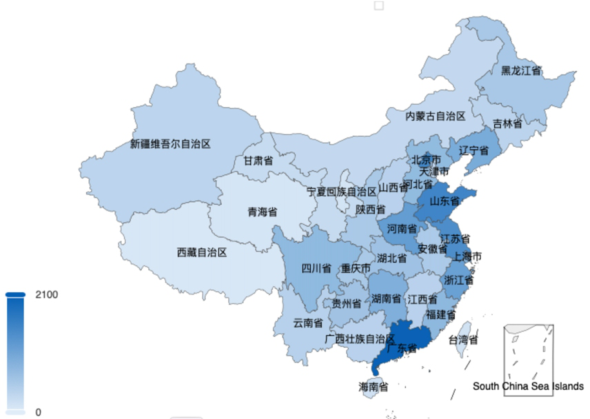
ANALYSIS OF USER BEHAVIORS The sample analysis results show that there are 17762 female registered users and 11343 male registered users in the data we obtained, indicating that Weibo is more popular among females. According to the regional heatmap (Figure 1), Weibo users come from all over the country but are mainly from economically developed areas in eastern China. Guangdong Province has the largest number of users (2060), followed by Shandong Province (1527) and Beijing City (1506). It is found that there is a certain correlation between the user numbers and the regional economic level. The eastern parts of China have a higher level of economic development and therefore possess better internet infrastructure, which causes people there to have more proactive attitudes toward social connection and entertainment on Weibo.
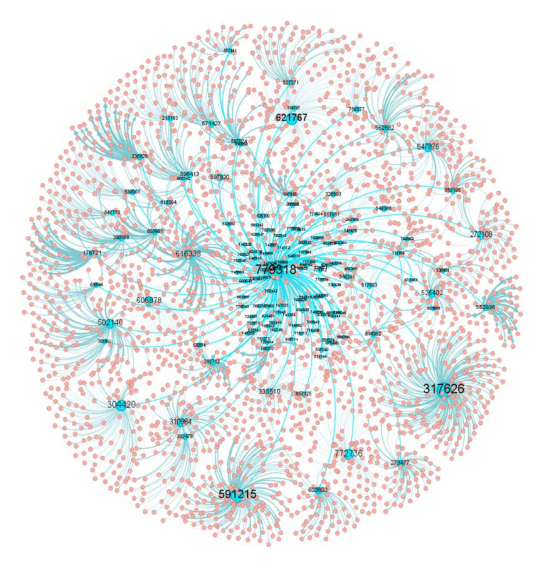
Next, the team analyses users’ following, commenting, and reposting acti- vities. To avoid information overload, a random selection of 3249 data on the following relationship was used to form a matrix for the analysis of user’s following performance. Figure 2 visualizes the relationship of “who is following who?”. The randomly selected user in the center is connected to its followers through edges, revealing the network topology, structure, and density. The network density of the diagram is 0.915%, indicating that the density of the following relationships between users is not particularly close, and there are some isolated nodes. “Following” is one of the most important social functions of the platform, which allow users actively sub- scribe to other users’ accounts and also interact with them. Based on AI
Figure 1: The heat map of the Weibo user region source.
330 Xiong and Li
Figure 2: The network diagram of Weibo users’ following relationship.
matching and recommendation technology, users’ following behaviour tends to be “related” or “interest-based”, showing the selective following tende- ncy. Users’ following behaviour will also be included in the recommendation algorithm. Based on the analysis of users’ following behavior, the recommen- dation system will continuously optimize the recommendation strategy and recommend relationships or bloggers that users may be interested in.
The research also conducts an out-degree and in-degree analysis of the overall collected data to further explore users’ behavior. Out-degree refers to the number of accounts a user follows, while in-degree refers to the num- ber of followers a user attracts. In our study, the maximum out-degree is 20,000 and the maximum in-degree is 17,873,000. After studying the list of users in the database, it is found that most accounts show imbalanced out-degree and in-degree, with the out-degree significantly greater than the in-degree, indicating that most people subscribe to a large number of accounts on the Weibo platform rather than be followed. Some users use the platform mainly for information acquisition, followed by access to celebrities, social connection, self-presentation, and entertainment (Hwang and Choi, 2016). This can explain why the majority of users follow more people than they are followed.
Additionally, it is considered that influential users who are highly follo- wed have a privileged position in the field or they are content producers or institutions. For example, the “celebrity-fan” relationship is considered an
Analysis of User Interaction Behavior on Sina Weibo 331
important component of the Weibo ecosystem. Public celebrities with a high in-degree and low out-degree enjoy powerful influence. AI can recognize the text, images, and other content posted by celebrities, and categorize and label them so that these popular users and content can be repeatedly promoted, which makes them gain more followers’ attention.
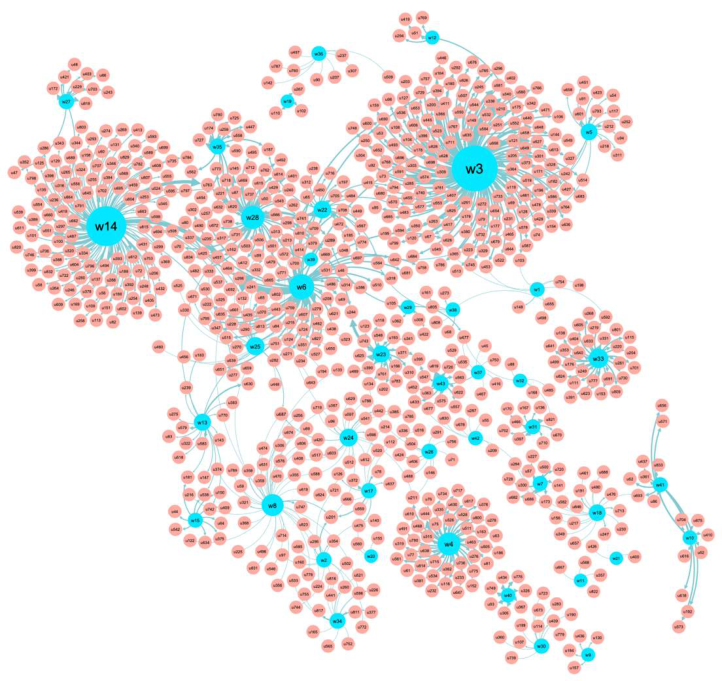
Commenting is one of the main forms for Weibo users to interact. This research extracts the Weibo comment as a matrix of 1001 * 835 for analysis. As shown in Figure 3, the central node represents microblogs, while the red node represents users. The comment network density is 2.178%, which is higher than the following relationship network density. Figure 3 reveals that users tend to gather to evaluate and discuss a few microblog messages. In par- ticular, the posts W3, W14, and W28 have received a relatively large number of comments, while most other posts are in a state of minority attention. In the microblog world, comment has the characteristics of real-time, openness, and diversity, making it easy for people to pay attention to and find resona- nce with hot news. This is due to the inherent desire of human nature for
Figure 3: The network diagram of Weibo users’ commenting relationship.
332 Xiong and Li
social interaction and the influence of AI content distribution, which con- stantly pushes information that may generate participation and discussion among some potential users (Alsini, Huynh and Datta, 2021).
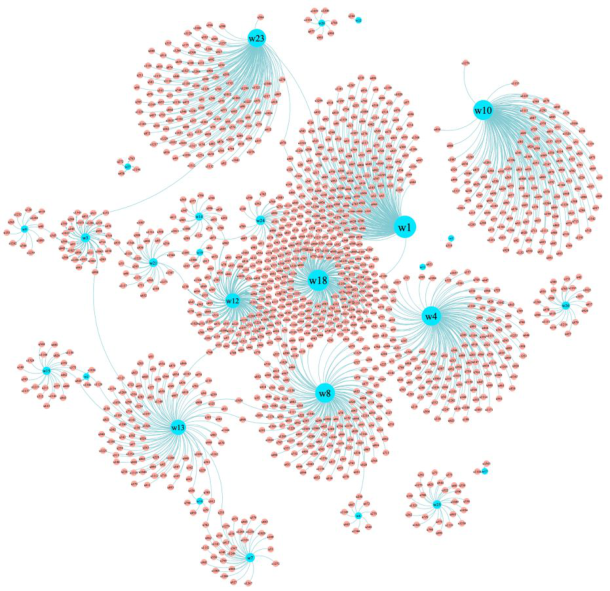
The researchers randomly selected 1365*1120 posts reposted multiple times as the matrix, with the center node representing posts and the red nodes representing users. The network density of reposting is 2.874%. Although the overall repost network is relatively sparse, certain posts such as W23, W10, and W18 (in Figure 4) promote users actively to share the posts, suggesting that some information can attract people’s attention and promote their repo- sting behavior. Microblog messages with pictures or posted by verified users are more likely to be reposted (Guan et al., 2014). In addition, there are a few posts that are shared by common users. This is probably based on common interests, and on the other hand, it is because of frequent interactions among users on social networks (Guan et al., 2014). For example, when a user repo- sts a weibo message, other users may see it and engage in interactions such as commenting, giving likes, and reposting. These interaction behaviors may trigger more users to repost the same posts, leading to multiple pieces of information being reposted by common users. What is more, according to network density data, users’ reposting behavior tends to be more frequent than commenting activities, indicating that people tend to share information
Figure 4: The network diagram of Weibo users’ reposting relationship.
Analysis of User Interaction Behavior on Sina Weibo 333
rather than create one. Through being reposted repeatedly by others, creators of posts can enhance their popularity.
CONCLUSION
The research examines user interaction behaviors in terms of following, commenting, and reposting by conducting social network analysis and also discusses the related AI technology applied on the Sina Weibo platform, which affects users’ behavior. The density of the following relationships betw- een users is not particularly close and users’ following behavior tends to be “related” or “interest-based”; Only a small number of users are highly follo- wed and a few posts attract many comments; users’ reposting activity tends to be more frequent than commenting. As information publishers, dissemi- nators, and sharers on Weibo, users’ interactive behaviour can have certain characteristics under the intelligent background.
The development of social networks is dynamically changing with tech- nological innovation, and users’ interactive behavior is closely related to platform technology. Future social media services will become increasingly personalized and customizable. Research on user interaction can help under- stand how users respond to the platform and how technologies affect their user experiences. It is believed that this study has a certain reference value for enhancing user engagement, and also provides some insights into the inter- personal interaction design and user experience design with the influence of intelligent technology.
ACKNOWLEDGMENT
The authors would like to thank their supervisor, Professor Zhiqiang WU, for his support and the WUS lab at Tongji University.
REFERENCES
Alsini, A., Huynh, D. Q. and Datta, A. (2021) ‘Hashtag Recommendation Methods for Twitter and Sina Weibo: A Review’, Future Internet, 13(5), p. 129. Available at: https://doi.org/10.3390/fi13050129 Argan, M., Dinc, H., Kaya, S., Argan, M. T., 2022. Artificial Intelligence
(AI) in Advertising: Understanding and Schematizing the Behaviors of Social Media Users. ADCAIJ-Adv. Distrib. Computing Artif. Intell. J. 11, 331–348. https://doi.org/10.14201/adcaij.28331 Alattar, F., Shaalan, K., 2021. Using Artificial Intelligence to Understand What Causes Sentiment Changes on Social Media. IEEE Access 9, 61756–61767. https://doi.org/10.1109/ACCESS.2021.3073657 Capatina, A., Micu, A. and Micu, A.-E. (2018) Exploring Artificial Intelligence
Techniques’ Applicability in Social Media Marketing. Guan, W. et al. (2014) ‘Analyzing user behavior of the micro-blogging website Sina Weibo during hot social events’, Physica A: Statistical Mechanics and its Applicati- ons, 395, pp. 340–351. Available at: https://doi.org/10.1016/j.physa.2013.09.059 Hwang, H. S. and Choi, E. (2016) ‘Exploring Gender Differences in Motivations for
Using Sina Weibo’, KSII Transactions on Internet and Information Systems, 10(3). Available at: https://doi.org/10.3837/tiis.2016.03.029
334 Xiong and Li
Kuehl, N., Muehlthaler, M., Goutier, M., 2020. Supporting customer-oriented marketing with artificial intelligence: automatically quantifying customer needs from social media. Electron. Mark. 30, 351–367. https://doi.org/10.1007/s12525-019- 00351-0 Mehta, H. and Passi, K. (2022) ‘Social Media Hate Speech Detection Using Explai-
nable Artificial Intelligence (XAI)’, Algorithms, 15(8), p. 291. Available at: https://doi.org/10.3390/a15080291 Thuraisingham, B., 2020. The Role of Artificial Intelligence and Cyber Security for Social Media. 2020 IEEE International Parallel and Distributed Processing Sym- posium Workshops (IPDPSW) 1–3. https://doi.org/10.1109/IPDPSW50202.2020. 00184 Wang, J. (2022) Artificial intelligence technology innovation empowers Weibo con-
tent understanding and distribution, Xinhuanet. Available at: https://www.xinhua net.com/culture/20221130/ad72c8b2795a4976a044964135df418d/c.html
LISTED IN THE AHFE DIGITAL BOOKSTORE CATALOGUE
Explore the complete digital volume
Usability and User Experience
Read this individual research paper free through the original publisher, or explore the full digital proceedings book.
ISBN 978-1-958651-86-5
Explore this ISBN in the AHFE Bookstore ↗Listed in the July 2026 bookstore catalogue; search by ISBN to confirm current availability · Digital book purchase optional