Lei Wang, Jiangping Chu, Lei Wu (2026). Crew Cognition Management (CCM): A Comprehensive Design Methodology for Civil Aircraft. In: Human Factors in Design, Engineering, and Computing. AHFE Open Access, vol. 238, pp. 622–632. https://doi.org/10.54941/ahfe1008294
The increasing level of automation in civil aircraft has profoundly altered the nature of flight crew duties. However, higher automation has not diminished the requirements for human-machine coordination; on the contrary, it imposes even greater demands on the flight crew's cognitive monitoring and takeover capabilities in complex failure scenarios. Analysis indicates that the majority of human-factors-related operational errors in the flight deck stem from the flight crew's insufficient understanding and lack of predictive cognition regarding the behavior of automated systems, which in turn gives rise to cognitive biases upon sudden state changes or faults, ultimately resulting in decision-making or operational errors. To address this issue, this paper proposes the theoretical framework of Crew Cognition Management (CCM), which takes crew cognitive resources as its core and focuses on the flight crew's comprehension, prediction, and co-construction of shared cognition regarding aircraft state. Drawing on representative aircraft design cases, the paper analyses the differences in crew cognition under distinct design philosophies, and elaborates on how, with crew cognitive resources as the driving factor, an integrated four-dimensional design—spanning aircraft function design, flight manual compilation, training system development, and operational safety management—can be realized. This theoretical framework is intended to steer highly automated civil aircraft away from isolated "automation function design" toward a comprehensive "human-machine cognitive co-design." It is proposed as a novel theoretical underpinning for human-factors-oriented forward design in the civil aircraft domain, with the design objective of mitigating the categories of human error potentially induced by automation and, ultimately, supporting operational safety. The framework is primarily theoretical at this stage; its practical effectiveness still needs to be evaluated with flight crews or simulator scenarios.
The evolution of civil aircraft has, to a large extent, been characterized by the continuous elevation of automation capability. The introduction of automated systems into the flight deck was originally intended to reduce flight crew workload, minimize human error, and enhance flight safety. The shift from accident profiles once dominated by mechanical failures to those now predominantly attributable to human factors partly corroborates the
Crew Cognition Management (CCM): A Comprehensive Design 623 efficacy of automation in improving aviation safety. Nevertheless, a series of major air disasters over the past two decades reveals that the enhancement of automation capability cannot be simply equated with a linear improvement in flight safety, nor has it entirely eliminated human error—on the contrary, automated systems have, under certain circumstances, induced entirely new categories of human error, with consequences even more severe than the very errors automation sought to prevent (Sarter et al., 1997).
This paradox has been repeatedly validated in multiple recent air disasters. In October 2018 and March 2019, two Boeing 737 MAX aircraft crashed within a mere five months of each other, claiming 346 lives in total. Accident investigations identified a fatal design flaw in the Maneuvering Characteristics Augmentation System (MCAS) as the direct cause of both crashes. The operating logic and behavior of this system fell outside the flight crew’s understanding of the Boeing 737 series’ control architecture, trapping the crew in a “human-machine contest” dilemma. Both disasters have been characterized as quintessential cases of human-machine interaction failure (David et al., 2026) (Eshun et al., 2024). The 2009 Air France AF447 crash stands as another archetype: following pitot tube icing that caused autopilot disengagement, the three crew members stripped of automated assistance, lost situational awareness of the aircraft’s actual state and ultimately stalled into the ocean. The investigation report explicitly noted that the aircraft’s system response upon automation loss failed to ensure that the flight crew could execute the required corrective actions (BEA, 2012).
The above cases expose a deeper issue: the proximate cause of these accidents was not only automation, but rather a cognitive disconnect between the flight crew and the automated systems. Consequently, how to ensure that the flight crew possesses a thorough understanding of, accurate prediction of, and effective management capability over automated systems has become a theoretical and practical imperative in the aviation safety domain. Accordingly, this paper proposes the CCM theoretical framework, with the aim of steering the design of future civil aircraft away from isolated “automation function design” and toward a comprehensive “human-machine cognitive co-design.”
THE COGNITIVE BOUNDARY IN THE FLIGHT DECK EICAS/ECL System: Automation-as-Tool Information Presentation
The alerting and procedure presentation approach characterized by the Engine Indication and Crew Alerting System (EICAS) and the Electronic Checklist (ECL) has become the mainstream avionics architecture in a new generation of civil transport aircraft, with typical applications spanning the Boeing B777, B787, Gulfstream G700, and the domestically produced C919 aircraft, among others.
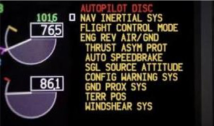
Taking the EICAS/ECL system of the Boeing B787 as an illustrative example: in addition to engine indication, EICAS is primarily responsible for presenting alerting information to the crew (see Figure 1). Fault messages are processed by the system and displayed according to three urgency priority
levels—Warning, Caution, and Advisory—and, within the same level, in chronological order of occurrence. The crew must, on the basis of the alerting information presented by EICAS, comprehend the current aircraft situation, establish situational awareness, make disposition decisions, and select the procedural tasks to be executed.
Figure 1: Illustrative diagram of crew alerting system window on the B787 EICAS.
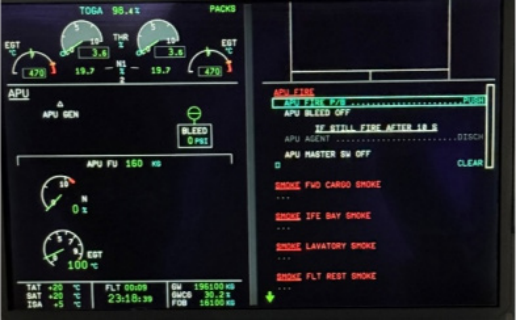
When the crew completes task selection and begins executing procedures, the ECL system provides an electronic checklist presentation (see Figure 2). Its automation features-such as closed-loop sensing of checklist items-couple the crew’s actual actions with system state: once the crew completes a corresponding action, the ECL system confirms item completion based on system state, thereby reducing memory and cross-check workload at the execution tier (Linskens et al., 2021). This design trait of the ECL system can be characterized as: “decoupled at the decision end, strongly coupled at the execution end.”
Figure 2: Boeing 787 ECL page.
Figure available in the original PDF paper.
The fundamental information organization relationship under this architecture comprises: system presents information, crew comprehends the situation and selects procedures and crew executes procedures.
The crew’s information-processing and decision-making load during the initial fault phase is somewhat higher, yet this architecture preserves a vital capability within crew cognition: the crew remains the decision-maker under all circumstances, required to analyse the overall operational context, with the automation system serving merely as a tool that furnishes the necessary information. This human-machine decision interface remains invariant regardless of whether the scenario is simple or complex—a property of particular significance in complex cascaded-fault or superimposed-fault scenarios.
Crew Cognition Management (CCM): A Comprehensive Design 625 ECAM System: Automation-Dominant Information Presentation
The Electronic Centralized Aircraft Monitor (ECAM), as the core architecture of the flight crew alerting system across Airbus A320-series and subsequent aircraft, is a centralized fault-monitoring and alerting mechanism dominated by the automated system (Liu Changhua and Xu Yajun, 2004) (see Figure 3).
Figure 3: Illustrative diagram of A350 ECAM.
The ECAM system can provide necessary information directly pertinent to the highest-priority fault—including system page, alert message, and crew actions. The advantage of this architecture resides in reducing the crew’s initial information-processing and decision-making load. Compared with the EICAS/ECL system, ECAM substitutes for the crew a portion of the information-processing and decision work—that is, the automation directly supplies the crew with the fault information that demands priority handling.
The basic information organization relationship under the ECAM architecture comprises: System presents information, System processes and provides procedures and Crew comprehends and executes tasks.
This automation-dominant information presentation mode is particularly well-suited to single-fault or limited, logically unambiguous fault scenarios. Under such conditions, the automation’s information filtering and procedure prioritization can substantially reduce crew cognitive load, allowing the flight crew to allocate scarce cognitive resources primarily toward monitoring aircraft state and executing critical tasks. However, the fact that the system assumes a greater share of information processing and decision work also gives rise to latent problems: when the actual operational state exceeds the automation’s preset fault logic, whether the system-organized cognitive pathway still allows the crew to intervene and take timely control?
The November 2010 Qantas QF32 incident further illuminates this issue: after an A380 suffered a severe uncontained engine failure, debris damaged fuel tanks and portions of the wiring; the crew was simultaneously confronted with multiple ECAM messages, interdependent system states, and mutually
contradictory procedural steps. The accident investigation report revealed that after following the ECAM “read-and-do” procedure for over 50 minutes, the crew still could not establish adequate situational awareness; ultimately, the captain made the decision to discontinue ECAM execution, manually analyzed the available system states onboard, and thereby achieving a safe return and landing (ATSB, 2010).
This event can be regarded as a salient case of crew cognitive resource management mismatch in a highly automated environment. When the complexity of the fault state exceeded the envelope of the automation’s logic, the flight crew nonetheless remained obligated to assume responsibility for system-state integration and operational decision-making—yet, the automation’s information presentation, having ceased to be applicable, could no longer furnish the cognitive resource guarantees the crew required for effective takeover.
Divergence of Crew Cognitive Boundary The EICAS/ECL and ECAM systems represent the two most emblematic alerting information presentation set in the modern civil aircraft flight deck. Within aviation engineering practice, a certain tendency exists to regard ECAM as a categorically more “intelligent and advanced” technical architecture than EICAS/ECL—a reductionist inclination that lacks due consideration of the two systems’ underlying design philosophies and ergonomic-cognitive disparities.
In reality, with accident statistics showing no significant safety divergence attributable to architectural differences (Boeing, 2026), the two systems represent distinct design orientations: the ECAM system leans toward reducing the crew’s information-organization and processing burden through automation; the EICAS/ECL retains the crew’s task-organization and decision- making authority, thereby sustaining the crew’s cognitive engagement with the overall operational situation. The former’s principal advantage lies in efficiency and initial workload mitigation; the latter’s principal advantage lies in flexibility under complex conditions and consistency of the cognitive interface. This also surfaces a core question in automation design: Which portion of the human’s work should automation actually replace?
THE CCM THEORETICAL FRAMEWORK The Core Cognitive Structure of CCM
The work of the flight crew in the modern automated flight deck is, in essence, the construction and dynamic calibration of cognitive consistency among three elements—crew resources, aircraft state, and task objectives—and, on that basis, the determination of the crew’s intervention strategy toward the automated system.
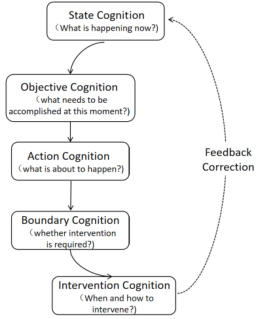
This paper classifies the crew cognitive resources required in automated- system-involved aircraft operations into the following five interrelated tiers (see Figure 4):
Figure 4: The five-tier structure of CCM.
1) State Cognition: Cognition of the current state; the cognitive starting point of the flight crew’s situational awareness. The state cognition encompass aircraft state, human state, and environmental state, mapping onto the four elements of the human-factors SHEL model. Within this mapping, human error typically arises from one or more “mismatches” at the human-software, human-hardware, human-environment, or human-liveware interfaces (Chen Bang, 2024).
Human cognition operates at two levels: first, self-perception, such as psychophysiological state, workload level, and execution precision; second, cognition of the collaboration state—including task allocation, communication effectiveness and other coordination factors.
In the highly automated environment in flight deck, state cognition furnishes the informational foundation for subsequent judgment and decision-making. A deviation in the crew’s state cognition may propagate to the downstream cognitive linkages, potentially producing a cascading mismatch across them.
2) Objective Cognition: its core lies in accurately answering the operational-decision question of “what needs to be accomplished at this moment.” Flight tasks exhibit pronounced dynamic evolution, therefore, the specific control actions currently executed by the automation do not equate to the ultimate objective of flight operations.
The crew’s objective cognition must distinguish between what the system is doing and what truly needs to be achieved. This discriminative capacity is especially critical in complex off-nominal scenarios. In the Qantas QF32 incident, the ECAM system’s preset automation logic could not autonomously adapt to the genuine operational objective, producing a transient deviation in the crew’s objective cognition: in the initial post-fault phase, the crew’s task objective had been to complete the ECAM-prescribed procedures; only after more than 50 minutes of ECAM handling did the crew clarify their true objective—abandon ECAM adherence, and exploit the available onboard system resources to accomplish a landing. This demonstrates that objective cognition is the prerequisite for downstream cognition tiers.
3) Action Cognition: The predictive dimension within crew cognition, functionally positioned at the forward-looking judgment of “what is about to happen.” Within the SHEL analytical framework, at the hardware and software levels, the crew must predict how the automated system will evolve its behavioral state; while at the human level, the crew must anticipate the subsequent operational trajectory of fellow crew members.
Examined from the human-factors-engineering perspective on automation design, the requirement of “predictable and unambiguous” system behavior under airworthiness provision 25.1302(c)(1) directly corresponds to the action cognition tier—i.e., the crew’s need to predict the future behavior of the automated system (FAA, 2013). As further articulated in AC 25.1302-1, the crew must know “what the system is about to do next”; if system behavior is not predictable, the crew cannot, on the basis of current state and control inputs, infer the system’s next response (FAA, 2013). Even if the crew maintain correct state cognition and objective cognition, they will nonetheless be trapped in a passive-follow state owing to their inability to form an accurate prediction of automated behavior—thereby degrading human-machine coordination effectiveness and progressively eroding the crew’s proactive command over the entire event’s development.
4) Boundary Cognition: A judgment-tier built upon the sufficiency verification of the preceding cognitive chain—whether the boundary necessitating an active crew intervention has been reached. This boundary encompasses not only the system-vs-human handoff boundary (disengaging automation and reverting to manual takeover), but also the crew-task boundary that cuts across the traditional two-pilot duty allocation.
In the highly automated flight deck, if the cognitive chain remains incomplete and the crew misjudges the current state as sufficiently covering task completion, the crew’s intervention timing will be directly delayed, allowing the automated system to continue running in conditions that exceed its suitable operating envelope or the crew’s cognitive coverage.
Boundary cognition is therefore proposed as an extension of Endsley’s classical “perception-comprehension-projection” situational-awareness framework (Endsley, 1995), and is offered as a conceptual addition that CCM seeks to contribute to human-factors cognitive theory. Whether this addition yields measurable benefits remains an open empirical question.
5) Intervention Cognition: The decision-execution tier following boundary cognition, functionally positioned to answer two tightly coupled core questions—”when is intervention required” and “how should intervention be executed”.
In lower-automation flight deck, the flight crew remains continuously embedded in the control loop, exercising sustained monitoring and frequent correction of the system; intervention behavior itself constitutes a routine component of operations, and the crew’s intervention cognition is thus maintained at a consistently high level.
The highly automated flight deck, by contrast, exhibits a different operational signature: the flight crew may remain in a low-intervention state across extended time spans, with normal system operation heavily reliant on the autonomous execution of automated functions—a pattern
Crew Cognition Management (CCM): A Comprehensive Design 629 especially pronounced in long-endurance flights. Against this backdrop, “re-intervention” itself evolves into a process demanding elevated cognitive preparation; the crew must maintain a greater reserve of intervention cognition to accomplish the role transition from monitor to manipulator.
Accordingly, the intervention cognition, in essence, is the crew’s dynamic reconfiguration of task relationships based on their integrated cognition of the operational situation. Within this process, the crew must adjust task allocation, role boundaries, and coordination modes, so that the entire “human–automation–task” system re-attains a stable state of fit under the revised operating conditions.
THE CCM-ORIENTED COMPREHENSIVE DESIGN SYSTEM CCM in Aircraft Function Design
Compared to traditional flight deck human-machine interaction design revolving around function allocation, CCM introduces a complementary design-evaluation criterion: after automation has substituted for certain manipulative functions formerly performed by the flight crew, does the system design still preserve for the crew the cognitive foundation necessary to accomplish complex, unanticipated tasks, and does it still support the crew in appropriately intervening in system behavior? This is precisely the requirement imposed upon the five-tier cognition.
The CCM design-evaluation criterion is highly consistent with the philosophy introduced in FAR/CS 25.1302 about “crew intervention capability” and “predictability of system behavior” which requires that the automated system should not only execute its prescribed functions but also afford the flight crew a clear comprehension of system state, system intent, and system limitations—so that timely and correct intervention decisions can be made when necessary. The “cognitive sufficiency” evaluative perspective advanced by CCM is intended to serve as a systematic response and theoretical articulation of that provision at the human-factor level, constituting a theoretical basis for human-factors-oriented design in the civil aircraft domain.
CCM in the Flight Manual System The cognitive hierarchy inherent in current flight manual architectures may not represent an optimal classification; nevertheless, CCM establishes a novel paradigm for flight manual development and refinement. Specifically, decisions regarding the inclusion and presentation format of technical information shall extend beyond manual scope and functional attributes to encompass an evaluation of the information’s position within the crew cognitive chain—namely, the specific tier of crew cognitive capability that the information is intended to instantiate.
Distinct cognitive tiers impose distinct requirements on information organization, technical depth, and presentation timing. This dimension will not only reduce content redundancy and boundary ambiguity across the individual manuals, but also aid in the establishment of a clear demarcation between flight manuals and the underlying design technical documentation.
CCM in Training System Construction The modern civil aircraft flight training system has evolved from the early model—centered on the transmission of manipulative skills—into a competency-based systematic training architecture. The core framework of this architecture integrates CBTA (Competency-Based Training and Assessment) and EBT (Evidence-Based Training), fused with methodological instruments such as TNA (Training Needs Analysis), KSA (Knowledge-Skills- Attitude) analysis, and CRM (Crew Resource Management) (MacLeod, 2025) (CAAC, 2021). The core task of the civil aircraft training system is to construct the flight crew’s “operational toolbox”.
The CCM theoretical framework, within training-system development, defines the cognitive pathway by which the flight crew “reaches into the toolbox” during operations. From the standpoint of cognitive-capability development, the design of high-value training scenarios should: 1. determine which cognition the crew needs to establish; 2. design which state changes may disrupt or challenge that cognition; 3. observe whether the crew can promptly detect the cognitive mismatch and re-establish correct cognition; 4. evaluate whether their decisions and actions rest upon a cognitively sufficient foundation. Traditional evaluation fixates on whether the procedure was correctly completed; CCM proposes to additionally examine whether the crew executed the task upon a correct cognitive foundation. The incremental value of this additional evaluative dimension is a hypothesis to be tested.
CCM in Operational Safety Management With the evolution of aviation safety investigation methodology, human factors have progressed from an auxiliary attribution perspective in accident analysis to an indispensable core analytical dimension. The ICAO, in its technical conference deliberations on Human Performance, observed that the improvement of technical reliability has rendered human factors the focal point for further safety gains (ICAO, 2012); moreover, ICAO statistics indicate that approximately 75% of accidents involve human factors (ICAO, 2010).
CCM contributes a complementary analytical dimension to operational safety management oriented toward human-factors analysis: it treats the crew cognitive process as an independent object of inquiry. This perspective shifts the analytical center of gravity from “the behavior itself” to “the cognitive foundation underlying the behavior”—probing what the crew knew, what they did not know, at what juncture they formed (or failed to form) the critical cognition, and whether the automated system, the flight manual, and the training system each furnished the necessary support at every link of cognitive formation. This analytical dimension is intended to supply a cross- aircraft-type, cross-event cognitive analytical language which enables safety investigations not only to identify “at which link the breakdown occurred,” but also to answer “why a cognitive rupture emerged at that particular link”, thereby furnishing more targeted grounds for training improvement, manual optimization, and system design revision.
Crew Cognition Management (CCM): A Comprehensive Design 631 Implementation Pathway of the CCM System
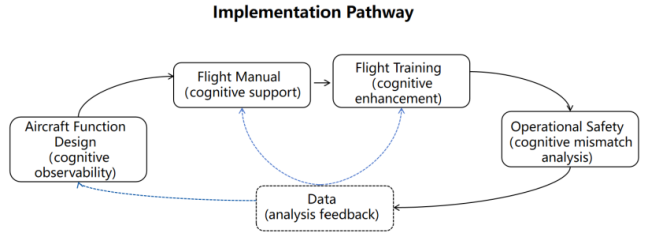
The CCM theoretical framework enables the formation of a complete closed loop of “Design - Flight Manual - Training - Operation - Data - Design/ Flight Manual/Training” (see Figure 5), whereby the cognitive performance at the operational end can be fed back to evaluate the design quality of the entire technical system. Accordingly, this cognitive closed loop is proposed to distinguish CCM from purely descriptive models of the crew cognitive process and to position it as a candidate unified cognitive framework for civil aircraft design. If validated, it would upgrade human factors from a passive response confined to the operational phase to an active constraint running through the entire aircraft life cycle.
Figure 5: Application of CCM in comprehensive design of civil aircraft.
CONCLUSION AND FUTURE WORK Centered on the construction and application of the CCM theoretical framework, this paper has systematically examined the flight crew’s cognitive process within the highly automated flight deck, and the implementation pathways of that framework across the comprehensive chain of aircraft function design, flight manual compilation, training system development, and operational safety management.
Looking ahead, under the developmental trajectory of the intelligent flight deck, with the progressive introduction of highly intelligent human-machine interface paradigms and even AI-assisted decision systems, the objects of crew cognition will extend from automated systems to intelligent agents possessing autonomous decision-making capability. In turn, the connotations of “automation behavior prediction” and “capability-boundary cognition” within CCM will undergo profound transformation. Against the backdrop of multi-type heterogeneous fleet operations, CCM can serve as a theoretical instrument for establishment mechanisms to identify critical cognitive risk nodes in transition training.
In summary, this paper has proposed a CCM-oriented comprehensive design system for civil aircraft as a theoretical analytical framework intended to be both explanatory and engineering-operable. Future work should therefore prioritize operationalizing the five cognitive tiers into measurable constructs, developing scenario-based and simulator-based evaluation methods, and
testing the framework’s design objectives empirically. Its further refinement and empirical validation will constitute a research direction worthy of sustained attention in the aviation human-factors domain.
REFERENCES
Australian Transport Safety Bureau (ATSB). In-flight uncontained engine failure, Airbus A380-842, VH-OQA, [R]. ATSB Transport Safety Report AO-2010-089. Canberra: ATSB.4 November 2010. Boeing Commercial Airplanes. Statistical Summary of Commercial Jet Airplane
Accidents: Worldwide Operations [R] . Seattle, WA: Boeing, 2026. Bureau d’Enquêtes et d’Analyses pour la Sécurité de l’Aviation Civile (BEA). Final Report on the Accident on 1st June 2009 to the Airbus A330-203 Registered F-GZCP Operated by Air France Flight AF 447[R]. Le Bourget: BEA, 2012. CHEN Bang. Exploring Methods to Reduce Human Errors in Aviation Maintenance
from the Perspective of SHEL Model[J]. Technology Innovation and Application, 2024, 14(9): 29–32,37. Civil Aviation Administration of China. General Operation and Flight Rules [S].
CCAR-91-R1. Beijing: CAAC, 2007. § 91.5. Civil Aviation Administration of China. Implementation Methods for Evidence- Based Training (EBT) Pilot [S]. AC-121-FS-138. Beijing: CAAC,2021. David, L. P., Momoh, M. O., Sule, G., et al. Integrating Swiss Cheese and STAMP
Model: A Systemic Analysis of the Boeing 737 MAX MCAS and Redesign Response[J]. Journal of Techniques, 2026, 8(1): 1. doi: 10.51173/jt.v8i1.2733. Endsley, M. R. Toward a Theory of Situation Awareness in Dynamic Systems [J].
Human Factors, 1995, 37(1): 32–64. Eshun, E. A., Waters, S., & Amoako, R. O. Implicating Communication: An Analysis of the US House Committee on Transportation and Infrastructure’s Investigative Report of the Boeing 737 MAX Crises[J]. Journal of Contingencies and Crisis Management, 2024. doi: 10.1111/1468-5973.70006. Federal Aviation Administration. Installed Systems and Equipment for Use by the
Flightcrew [R]. Advisory Circular AC 25.1302-1. Washington, D.C.: FAA, 2013. International Civil Aviation Organization (ICAO). Human Factors [J]. ICAO Journal, No. 7. Montreal: ICAO, 2010. International Civil Aviation Organization. Human Performance [R]. AN-Conf/12-WP/20. Montreal: ICAO, 2012. Linskens, C. E., Reitsma, J. P., Borst, C., van Paassen, M. M., & Mulder, M. A Novel
Automated Electronic Checklist for Non-Normal Event Resolution Tasks [C]// AIAA Scitech 2021 Forum. Virtual Event: American Institute of Aeronautics and Astronautics (AIAA), 2021: 1–15. LIU Changhua, XU Yajun, Civil Aviation Flight University of China. Analysis of Technical Characteristics of Electronic Centralized Warning Monitoring System [J]. Journal of Civil Aviation Flight University of China, 2004,(2). MacLeod, N. Implementing Competency-Based Training and Assessment in Aviation
[M]. London: Taylor & Francis, 2025. Sarter, N. B., Woods, D. D., & Billings, C. E. Automation surprises[C]// G. Salvendy (Ed.), Handbook of Human Factors and Ergonomics (2nd ed.). New York: Wiley, 1997: 1926–1943. U.S. Government Publishing Office. 14 CFR § 25.1302 - Installed systems and
equipment for use by the flightcrew [S]. Washington, D.C.: Office of the Federal Register, 2013.
SEARCH THE AHFE DIGITAL BOOKSTORE BY ISBN
Explore the complete digital volume
Human Factors in Design, Engineering, and Computing
Read this individual research paper free through the original publisher, or explore the full digital proceedings book.