Cheng-Yong Huang (2021). An Investigation of Motorist Behavior in Taiwan. In: Advances in Human Aspects of Transportation: Part I. AHFE Open Access, vol. 15. https://doi.org/10.54941/ahfe100632
Taiwan is a group of islands located in East Asia on the northwest side of the Pacific Ocean. The area of these islands is 36,000 km2 and their total population is 23.37 million. A total of 7.1 million cars and 15 million motorcycles are registered. The combined number of motor vehicles is in line with the total population. On average, each person has at least one land vehicle. The number of motorcycles is twice that of cars. The Taiwanese news media have long reported that car drivers often strike motorcyclists passing from behind because they open their car doors improperly. This leads to injury or even death among motorcyclists. Human factors are the cause of this issue. In this study, we examined civil judgments on improper car door opening in district courts in 2010 and 2011. After collecting 43 cases of accidents caused by improper car door opening, we found that accidents occurred in counties and cities in western Taiwan with dense populations and poor public transportation, such as Taichung, Taoyuan, and Kaohsiung. Half of all motorcyclists involved in these accidents were severely injured, disabled, put into comas, or died. The drivers who caused these accidents each paid an average of approximately 100,000 zloty in reparations. Finally, we made ergonomic design suggestions for three types of accidents. For example, the left front doors of cars should be required to have two-stage opening methods. Left rear doors should be openable only from the outside. Roads in metropolitan areas should have temporary parking spaces for passengers to exit vehicles from the right side. In the future, we hope that these suggestions can be implemented in the ergonomic design of cars in Taiwan to avoid injury to motorcyclists.
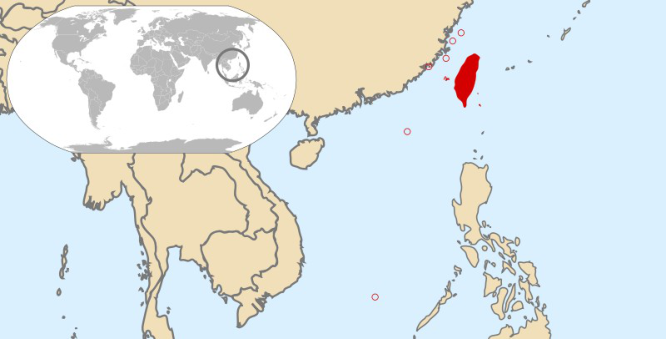
Taiwan is a group of islands located between the Ryukyu Islands and the Philippines in East Asia on the northwest side of the Pacific Ocean. The Eurasian continent is to the west across the Taiwan Strait. The area of Taiwan is approximately 36,000 km2, approximately one tenth that of Poland. The population of Taiwan was 23.37 million in 2013, approximately 2/3 that of Poland. The population density of Taiwan is 645 people per square kilometer, which is the 10th highest population density in the world. The population density of Poland is 122 people per square kilometer, which is the 115th highest population density in the world. Therefore, the population density of Taiwan is extremely high. The island of Taiwan is 70% mountains and hills. Terrain elevation varies substantially. Plains are concentrated in western Taiwan. The population distribution is uneven. The primary population centers are the three major metropolitan areas of Taipei, Taichung, and Kaohsiung. The population density in Taipei is as high as 10,000 people per square kilometer. It is an extremely crowded area. Therefore, transportation is a major issue in Taiwan.
Figure 1 shows Taiwan’s geographical location and population distribution.
The ratio of cars to motorcycles in Taiwan is radically different from that of Europe, America, and Japan. In Europe, America, and Japan, cars are the main form of private transportation, and motorcycles are rarely seen on the road. The motorcycles that do appear are heavy-duty motorcycles with greater engine displacement. However, Taiwan was still developing industrially in the 1950s and 1960s. The economic level of Taiwan was lower and Taiwanese people could not afford cars. Therefore, light motorcycles were the main form of transportation. Although the Taiwanese economy started booming later and the number of cars slowly increased, Taiwan is small and densely populated and riding distances are shorter. Therefore, Taiwanese culture remained focused on the motorcycle as the primary form of transportation. Figure 2 shows that all roads besides the highways are flooded with motorcycles.
Figure 1. Geographical location and population density of Taiwan.
According to statistics provided by the National Statistics, R.O.C. (Taiwan), approximately 15.14 million motorcycles and 7.18 million cars had license plates issued by motor vehicle offices in Taiwan at the end of 2012. The ratio of cars to motorcycles was approximately 1 to 2. The number of motorcycles was approximately twice that of cars. The combined number of motorcycles and cars was approximately equal to Taiwan’s total population. Therefore, in Taiwan, each person owns one land vehicle on average. Figure 2 shows traffic conditions in Taiwan.
Figure 2. Motorcycles are the main form of transportation for the residents of Taiwan.
Figure available in the original PDF paper.
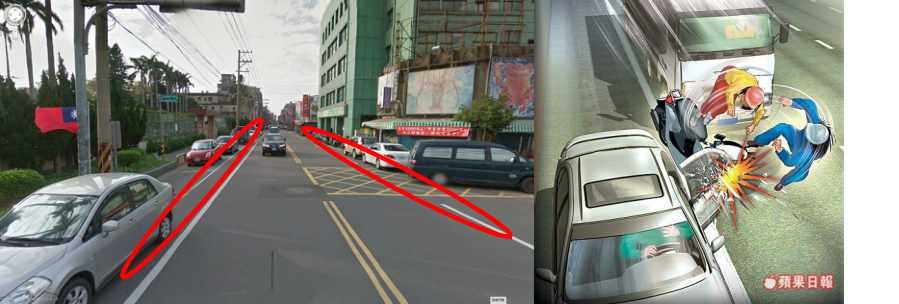
Although motorcycles far outnumber cars in Taiwan, the two forms of transportation do not have equal rights of way. The regulations of the Taiwanese traffic management department do not clearly explain and define the right-of- way relationship between cars and motorcycles. However, the sizes and speeds of travel of cars and motorcycles differ. Cars of larger size have higher average speeds on the road, whereas motorcycles of smaller size have lower average speeds. Therefore, their rights of way differ. Roads in Taiwanese cities are typically divided into fast car lanes, slow lanes for motorcycles, and parking grids. Only cars can drive in the fast car lanes, whereas both cars and motorcycles can drive in the slow lanes for motorcycles. The outermost area is for parking. Therefore, car drivers or passengers often open car doors inappropriately without paying attention to motorcycles to their rear. Thus, motorcycle drivers are unable to avoid collisions, which lead them to fall and suffer injuries. They may even be rear- ended a second time, resulting in death. In Fig. 3, the red circles represent the motorcycle’s driving range, which falls between the driving and parked cars.
Figure 3. Motorcycle driving range and accident occurrence.
Literature Review
Right of Way Right of way can be divided into right of passage on roads and priority on roads. Traffic Engineering Theory and Practice defines right of passage as the order of traffic priority on roads. For example, cars turning left must allow other vehicles to pass first and all cars must yield to pedestrians crossing the road and emergency vehicles. Zeng (1979) defined priority on roads as the priority to pass or cross roads given by the law to certain cars or pedestrians justified by traffic safety rules. Other people and vehicles are obligated to yield. Tsai (1995) defined right of way as drivers’ rights of passage at certain times and directions. Other cars and pedestrians do not interfere with a driver’s priority when roads have multiple users, regardless of whether the road has any traffic signs and signals. Cars and pedestrians interfering with this priority are in violation of traffic laws. If a traffic accident occurs, the liability falls on the party without the right of way or with lower priority.
Yan (2011) indicated that right of way is the road usage concepts that everyone knows. Road resources are limited and the roads used by the public are public property. Therefore, road usage rights must be distributed to promote operational efficiency and traffic safety. Right of way is the right of pedestrians and vehicles to use roads. Right of way has six purposes: 1. to help road users use roads correctly; 2. to help road users retain their rights; 3. to ensure road flow and guarantee the safety of road users; 4. to judge responsibility for accidents; 5. to train traffic law- abiding behavior among road users; and 6. to establish driving courtesy and order. Taiwan’s current de facto right- of-way norms generally plan lanes for motorcycles and slow vehicles on the outsides of general roads. This leads to insufficient driving space for motorcycles. At the same time, other cars, motorcycles, and pedestrians occupy the motorcycle and slow vehicle lanes (for purposes such as temporary parking by cars and motorcycles, taxis, buses pulling over to take passengers, and pedestrian movement). Therefore, motorcyclists must compete for the general lanes with larger vehicles. This leads to frequent traffic accidents. Therefore, this is a serious issue that demands indepth exploration.
Laws and Regulations According to The Judicial Yuan of The Republic of China Law and Regulations Retrieving System, improper car door opening involves Articles 276 and 284 of the Criminal Code of the Republic of China. Article 276 states that negligence that leads to death is punishable with a term of imprisonment of less than 2 years, criminal detention, or a fine of less than NT$2000. Article 284 states that negligence that leads to injury is punishable with a term of imprisonment of less than 6 months, criminal detention, or a fine of less than NT$500. Negligence that leads to serious injury is punishable with a term of imprisonment of less than 1 year, criminal detention, or a fine of less than NT$500.
Regarding civil matters, those who unlawfully infringe on the rights of others by accident or through negligence are liable for damages. This is a basic concept in tort liability for damages (as provided in the first section of Paragraph 1, Article 184 of the Civil Code). In general, victims in car accidents can request compensation, including for property damage (as provided in Paragraph 1, Article 193 of the Civil Code) and for non-property damage (that is, consolation money) (as provided in Paragraph 1, Article 195 of the Civil Code). As stipulated in the Civil Code of the Republic of China, the principle of full compensation is adopted for damages. Victims can request compensation for suffered damage (that is, active losses in property) or for lost profits (that is, a passive lack of increase in property) (as provided in Paragraph 1, Article 216 of the Civil Code).
Subparagraph 15, Article 112 of the Traffic Regulation stipulates parking times, locations, methods, and vehicle types. When certain institutions, such as highway competent authorities, urban road competent authorities, or police agencies, have special provisions, these should be followed. Cars should veer toward the right side of the road based on their anterior directions when parking. However, cars should veer toward the side of the road to park on one-way streets. The distance between the outer parts of the front and rear wheels on the right side of the car and the curb or pavement edge must not exceed 60 cm. Cars should follow the same regulations when stopping on the left sides of one-way streets. Cars that are temporarily parked or parked should note pedestrians and other vehicles before opening or closing car doors, and should let them pass first.
Investigation Accidents Over the Past Two Years
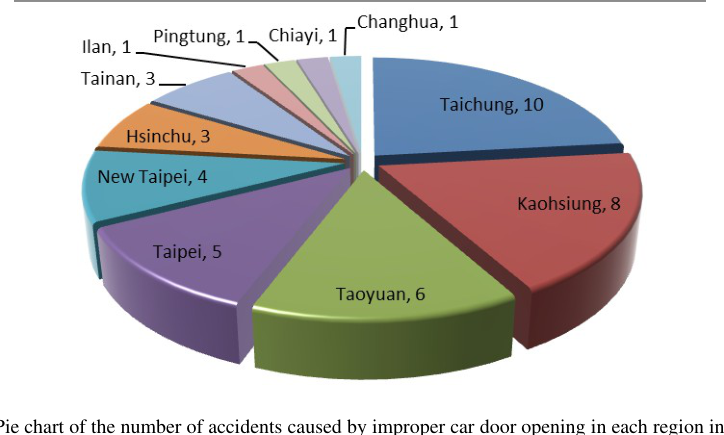
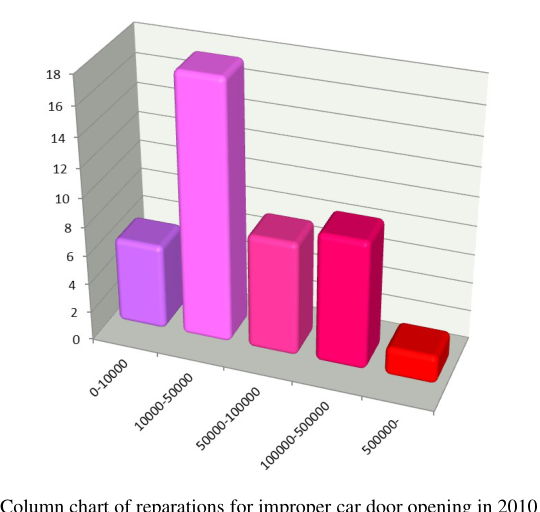
We used The Judicial Yuan of The Republic of China Law and Regulations Retrieving System with car door opening as a keyword and found a total of 43 civil judgments issued by district courts across Taiwan from 2010 to 2011. Table 1 shows these judgments. A total of 22 and 21 incidents occurred in 2011 and 2010, respectively. We collected the times, locations, injuries, and reparations for each traffic accident caused by improper door opening. Our results indicate that accidents were more likely to occur in metropolitan areas. Taichung City had the most accidents. Taiwan has three major metropolitan areas: Taipei, Taichung, and Kaohsiung. Taipei and Kaohsiung now have rapid transit systems. However, Taichung does not. Therefore, the residents of Taichung continue to rely on cars and motorcycles as their primary forms of transportation. Unsurprisingly, the greatest number of traffic accidents caused by improper car door opening occurred in Taichung. As for injuries to motorcyclists, light injuries occurred in 23 of the accidents. Serious injuries, disabilities, comas, and deaths occurred a combined total of 20 times. Therefore, roughly half of the motorcyclists who were in traffic accidents suffered severe injuries. The average reparation was 100,000 zloty. Table 2 and the pie chart in Fig. 4 show the number of occurrences in each county and city. Table 3 and the pie chart in Fig. 5 show the number and type of injuries. Table 4 and the column chart in Fig. 6 show the range and frequency of reparations.
Table 1. Accidents caused by improper car door opening between 2010 and 2011.
Table available in the original PDF paper.
Date Location Damage Reparation (Zloty)
Table 2. Number of accidents caused by improper car door opening in each region in 2010 and 2011.Figure 4. Pie chart of the number of accidents caused by improper car door opening in each region in 2010 andTable 3. Number and type of injuries caused to motorcyclists by improper car door opening in 2010 and 2011.Figure 5. Pie chart of the number and type of injuries to motorcyclists caused by improper car door opening in 2010 and 2011.
Figure available in the original PDF paper.
Table 4. Reparations for improper car door opening in 2010 and 2011.Figure 6. Column chart of reparations for improper car door opening in 2010 and 2011.
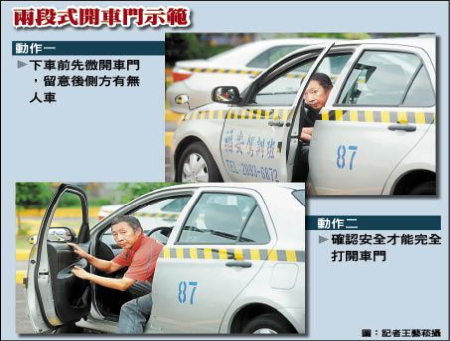
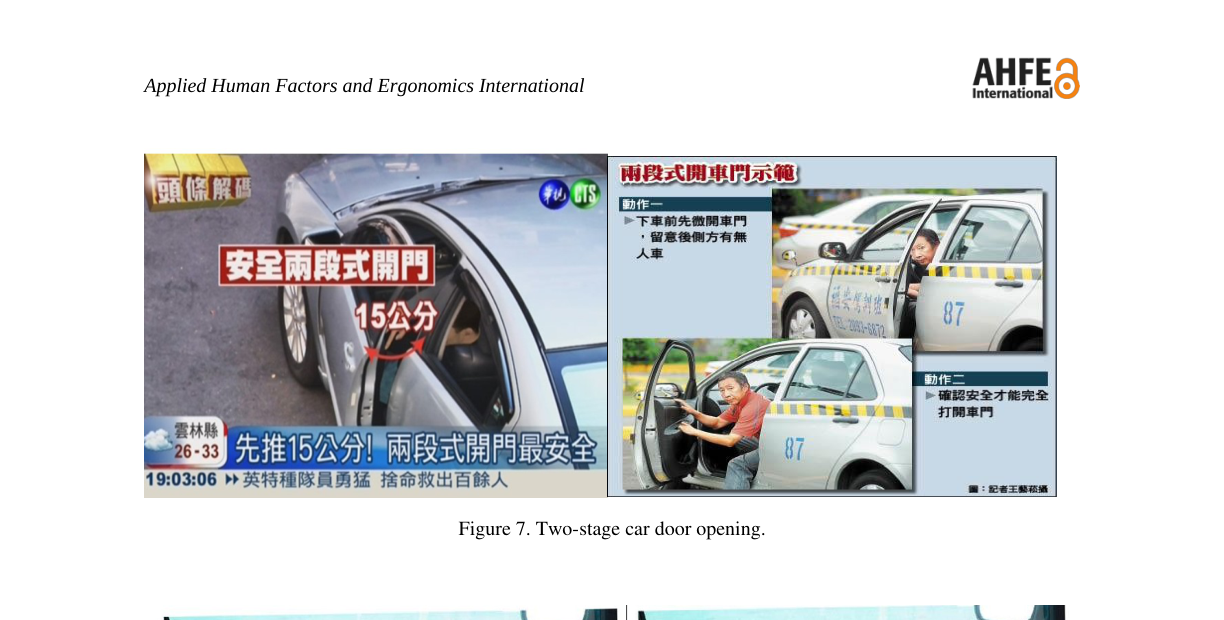
Current Responses in Taiwan to Improper Car Door Opening In Taiwanese society, few people have paid close attention to the issue of motorcyclist injuries caused by improper car door opening. Therefore, beginning in July 2013, two-stage car door opening, as shown in Fig. 7, was added to the driving test. When exiting their vehicles, car drivers must first push their doors 15 cm out and confirm that no vehicles are coming from behind them before opening their doors. If they do not do this, 8 points are deducted. This penalty is set to increase to 16 points in the future. Drivers who lose 32 points cannot obtain driver’s licenses.
In addition, the senior instructor at the Southern Region Training Center, Training Institute, Directorate General of Highways, M.O.T.C., proposed design changes for door lock positions in 2012. These changes would move door locks from their original positions near the steering wheel to a position near the center column. With these changes, drivers would have to turn toward the left rear, regardless of whether they use their left hands or their right hands to open their car doors. This would make it easier for drivers to notice vehicles coming from the rear, as shown in Fig. 8 (the left side is before these improvements and the right side is after).
Additionally, in 2011, a special production of the automotive division at National Kinmen Agricultural and Industrial Vocational Senior High School designed and installed safety warning lights for car doors. LEDs on the sides of car doors light up when the doors are open, providing a warning when car doors are opened at night, as shown in Fig. 9. Their experiments indicated that warning lights for car door opening can increase the notice of rear motorcyclists by approximately 10%.
Figure 7. Two-stage car door opening.Figure 8. Change in the position of car door locks.Figure 9. Alert from LED lights after car doors are opened.
Figure available in the original PDF paper.
Discussion
In 2010 and 2011, 19 district courts issued civil judgments involving improper car door opening. The results of our investigation revealed the following: 1. Virtually all of the traffic accidents caused by improper car door opening occurred in western Taiwan, which has relatively high population density. Additionally, accidents were more likely to occur in cities with relatively weak public transportation. For example, ten incidents occurred in Taichung City, eight in Taoyuan City, and six in Kaohsiung City. The incidents that occurred in these three counties and cities were half of the total. In contrast, in Taipei City and New Taipei City, which have the highest population densities in Taiwan, only five and four incidents occurred, respectively. Only one to three incidents occurred in other cities with lower population density in western Taiwan. 2. Approximately 46% of the motorcyclists who were injured in accidents suffered severe injuries, including death. Within the total, 9% died, 2% went into comas and entered vegetative states, 14% suffered disabilities, and 21% suffered severe injuries. Therefore, car manufacturers should place greater importance on accidents caused by improper car door opening injuring motorcyclists. 3. The perpetrators of these accidents were car drivers. When they carelessly opened their car doors and injured motorcyclists coming from behind, they had to pay reparations of approximately 100,000 zloty on average. The amount of reparations fell between approximately 10,000 zloty and 50,000 zloty in 18 of these cases, between 50,000 zloty and 100,000 zloty in 8 cases, and between 100,000 zloty and 500,000 zloty in 9 cases. These amounts are high in comparison to Taiwan’s average annual income of 53,000 zloty. When accidents occur, in addition to physical injuries, the psychological injuries sometimes suffered by victims and their family members are intangible and even more severe. Money cannot compensate for such injuries.
When investigating Taiwan’s responses to improper car door opening, we found that Taiwan continues to use formal advocacy to urge drivers to note the vehicles coming from behind them when opening car doors. This element has even been used for scoring in driving tests. In addition, ergonomic designs involving warning lights upon car door opening and changes to the positions of car locks have appeared. The concern that both the government and the people of Taiwan are beginning to place on this type of traffic accident is evident. These three types of response should be beneficial. Nevertheless, if Taiwan’s congested traffic situation does not change, traffic accidents caused by improper car door opening will persist.
The judgments in our investigation sometimes described the circumstances surrounding the traffic accidents caused by improper door opening. A number of these judgments provided detail on which car door was opened by the car drivers or passengers to cause the accidents, whereas others did not clarify this point. Therefore, we did not calculate the number of times each car door caused an incident. However, we did find that the primary reasons accidents occurred can be divided into the following three situations: 1. Drivers suddenly opened the left front doors (the majority of incidents). 2. Rear passengers suddenly opened the left rear doors (very few incidents). 3. Cars did not stop near the side of the road (more than 40 cm away) and passengers suddenly opened the right-side doors (few incidents). Liability claims typically included the drivers regardless of whether the accidents were caused by the drivers or their passengers.
Based on the results described above, we propose the following suggestions for the improper opening of car doors:
1. Public transportation must be constructed more actively in the Taichung, Taoyuan, and Kaohsiung metropolitan areas. In addition to environmental factors, public transportation can also help avoid traffic accidents caused by improper car door opening.
2. Insurers can plan car insurance for improper car door opening to reduce the reparations borne by car drivers when accidents occur.
3. Our investigation indicated that drivers who cause accidents are typically not injured and must pay high reparations. We believe that brainstorming by ergonomics experts and industrial designers would be bound to result in a number of feasible ideas and proposals in response to this issue. Therefore, we suggest that the design of left front car doors forces drivers to open car doors in two stages. This may be inconvenient for drivers and increase the time needed to open car doors, but it would help ensure the safety of rear motorcyclists.
4. We suggest that left rear car doors be openable only from the outside. By setting safety locks for door opening from within cars, passengers sitting in the left rear would be unable to exit cars on the left. This would help prevent accidents.
5. City taxes can be increased for parking grids within metropolitan areas. However, parking grids should not cover entire roads. Appropriate amounts of space should be provided for temporary parking to allow passengers to exit on the right. This would help prevent cars from stopping far from the roadside, which leads to collision and injury to rear motorcyclists.
Conclusion
In this study, we examined the injuries suffered by rear motorcyclists when car drivers open car doors improperly, a topic on which the Taiwanese news media frequently reports. We viewed this topic as an ergonomic issue. We investigated and collected civil judgments from 19 district courts in Taiwan using car door opening as our keyword. After filtering, we obtained 21 pieces of data from 2010 and 22 pieces of data from 2011. From this data, we made the following discoveries: 1. Traffic accidents caused by improper car door opening were concentrated primarily in regions in western Taiwan with denser populations and lower public transportation penetration, such as Taichung, Kaohsiung, and Taoyuan. 2. Half of the motorcyclists involved in this type of accident suffered severe injuries, disabilities, comas, and death. 3. Each instigating car driver had to pay approximately 100,000 zloty of reparations on average.
In addition, we made the following suggestions on ergonomic design for car drivers and passengers opening car doors: 1. Car door mechanisms should be used to force drivers to open their front left car doors in two stages. 2. Left rear car doors should be openable only from the outside. Passengers should not be able to open these doors from the inside. 3. Appropriate space should be provided on metropolitan roads for cars to stop temporarily and allow passengers to exit from the right side.
Subsequent studies can continue to investigate these human factors. Ergonomics experts and industrial designers should be gathered in Taiwan to design mechanisms for two-stage car door opening and door opening interfaces. We hope that the application of these proposals in Taiwanese car design can truly prevent accidents caused by careless drivers from injuring motorcyclists again.
REFERENCES
http://blog.nownews.com/blog.php?page=14&bid=894&tyid=A http://cnc44.km.edu.tw/book/content.php?id=9 http://daystar99.pixnet.net/blog/post/253585808 http://jirs.judicial.gov.tw/FJUD/ https://maps.google.com.tw/maps?hl=zh-TW&tab=wl http://stc.thb.gov.tw/teach-class/doc/201211/%E9%96%8B%E8%BB%8A%E9%96%80%E7%99%BC%E7%94%9F%E8%BB %8A%E7%A6%8D%E5%B0%8D%E7%AD%96.pdf http://www.libertytimes.com.tw/2013/new/jun/11/today-t2.htm http://www.motc.gov.tw/ch/home.jsp?id=35&parentpath=0,5 http://zh.wikipedia.org/zh-tw/%E8%87%BA%E7%81%A3 http://zh.wikipedia.org/wiki/%E5%8F%B0%E7%81%A3%E4%BA%A4%E9%80%9A Tsai H. S. (1995), “Traffic should pay attention to the basic principles - the right of way (in Chinese)”. Metropolitan
Transportation, Volume 81, pp. 4-9 Wang W. L. (1998), “Traffic engineering theory and practical (in Chinese)”, pp. 17-28. Yan S. L. (2011), “A Study on Using Traffic Control Facilities as the Solution to Conflict Points of Right of Way (in Chinese)”, Central Police University Institute of Traffic Management Thesis Zeng J. F. (1979), “Discuss pedestrian traffic priority (in Chinese)”, Semimonthly journal of Central Police University, Volume
259.
LISTED IN THE AHFE DIGITAL BOOKSTORE CATALOGUE
Explore the complete digital volume
Advances in Human Aspects of Transportation: Part I
Read this individual research paper free through the original publisher, or explore the full digital proceedings book.
ISBN 978-1-4951-2097-8
Explore this ISBN in the AHFE Bookstore ↗Listed in the July 2026 bookstore catalogue; search by ISBN to confirm current availability · Digital book purchase optional