Yemao Man, Monica Lundh, Thomas Porathe (2021). Seeking Harmony in Shore-based Unmanned Ship Handling - From the Perspective of Human Factors, What Is the Difference We Need to Focus on from Being Onboard to Onshore?. In: Advances in Human Aspects of Transportation: Part I. AHFE Open Access, vol. 15. https://doi.org/10.54941/ahfe100625
Publisher statistics will load when you open Metrics.
AHFE OPEN ACCESS OPEN ACCESS CONFERENCE PROCEEDINGS PAPER
Seeking Harmony in Shore-based Unmanned Ship Handling - From the Perspective of Human Factors, What Is the Difference We Need to Focus on from Being Onboard to Onshore?
Previous studies have discovered that the tacit but indispensable “ship sense” from seafarers is intensively involved in creating and maintaining “harmony” to assure the safety. The concept of “harmony” reveals the continuous balanced effect by tuning the ship to the dynamic environment under different situations that ship handlers strive for.While the notions of ship sense and harmony is originally created for onboard ship maneuvering, this paper extends it to the domain of shore-based control centers for unmanned ship handling from the perspective of human factors. With the loss of direct ship-sense, the harmony is also lost. This paper analyzes the challenges from having the operator onboard to onshore during ship maneuvering and explores the changing aspects of human factors we need to focus on, in order to facilitate shore-based ship-handlers to regain the harmony. The EU project Maritime Unmanned Ship though Intelligence in Networks (MUNIN) provides the context to conduct the focus group interview of participants with seagoing experience. The shifted human factors in shore-based unmanned ship handling are discussed. The results highlight several differential aspects in human factors that should be considered, such as situation awareness. It provides keys to design shore-based control center for remote monitoring and control in accordance with user-centered design principles.
During ship handling process, ship handlers have always been striving for a continuous balanced effect by tuning the ship to the environment under different situations. Previous studies (Prison, Lützhöft, & Porathe, 2009) have discovered that one tacit but indispensable gut feeling known as ship sense is intensively involved in ship handing for the safety of the vessel and people. When the bridge officer lacks visual reference, navigational instruments like the radar and the electronic nautical chart will be the main input source. However, when the weather gets tough, he will make use of ship sense to handle the ship in relation to the direction of the oncoming wave (Porathe, Prison, & Man, 2014). Sensing the ship’s movements, the bridge crew will maneuver the ship to achieve the goal of safety. Human Aspects of Transportation I (2021)
Ship sense has never been the magic word from the perspective of perception and cognition. During ship’s maneuvering, the information will firstly be gathered through ship handlers’ senses via different perception receptors. For example, the information could be the kinetic feeling of heaving, pitching, and vibration of the vessel, seeing the wave patterns, hearing the wind, wave slamming and engine sound (Prison et al., 2009) etc. Then the ship handler will deal with the perceived information to make sense of the situation, such as which information is crucial. By using his experience and skills, he will make the decision. Since the dynamic information comes from the environment and the vessel whose physical state is constantly changing, the ship handler has to cope with the fast- emerging tasks, such as slow down the speed or adjust rate of turn when feeling bank suction effect. The effective decision making and appropriate actions from personnel can only be achieved by successfully balancing the task demands and the human’s individual capabilities (Fuller, 2000). In the task of ship handling, there is a balancing act between the ship handler’s capabilities (based on his personal prerequisites) and the task demand (made up by the environmental prerequisites) conducted through his vessel (the tool) (Prison, 2013). That is the “harmony” between the ship and environment that ship sense serves for continuously to assure the safety (Prison, Dahlman, & Lundh, 2013).
While the concept of ship sense and harmony is originally created for onboard ship maneuvering, this paper extends it to the domain of shore-based unmanned ship monitoring and control from the perspective of changes in human factors. The three year 7th Framework EU project MUNIN (Maritime Unmanned Ship through Intelligence in Networks) has been investigating the feasibility of autonomous unmanned ship and prototype implementation of its shore-based control center since 2012. The motivation for MUNIN are presented as the strive for better working environment, reducing costs of transportation, the global need of reducing emissions, and increased safety in shipping (Porathe et al., 2014).
In MUNIN, the unmanned ship is one 200 meter long dry bulk carrier with intelligent Autonomous Ship Controller (ASC) system. The slow-steaming ship conducts collision avoidance without human interference during intercontinental voyages. Meanwhile, the ship is also constantly monitored by manned shore-based control center (SCC). The operations in SCC includes remote monitoring and remote control (Rødseth, Kvamstad, Porathe, & Burmeister, 2013), so SCC can decide when to intervene based on the status information sent from the ship, and also override ASC to make sure the ship is working under International Regulations for Preventing Collisions at Sea (COLREGS).
With the apparent changes made in the system, people are no longer maneuvering ship onboard but ashore. Nowadays, the maritime industry is facing more human factor issues (Han & Ding, 2013). Unmanned ship does not mean the resolution of all the problems behind human error or elimination of the human factors; on the contrary, it brings more questions concerning human factors in the SCC, because people need to be able to take full control over the ship at any time. For example, how do operators in the SCC perceive the ship’s movements and maneuver the ship without ship sense, if you consider the working environment is totally different in the SCC? There will be no physical connection between the human and the vessel, and no directly perceived information from the ship’s environment. Specifically, the visual perception of the environment, a vital sense in ship handling for bridge officers, will be lost. The important questions will arise: Are there going to be new human factor issues? Will the same human factors be applied as they do for the manned ship? If no, what factors behind ship sense onboard needs to be refactored to the shore side? How can we prioritize them to regain the harmony?
In fact, the missing sense and new way of human machine interaction indicates the importance and necessity to re- analyze how human factors are applied onboard and remote ship handling. This paper provides a preliminary insight of the human factor issues in shore-based unmanned ship handing and explores some influential aspects of human factors we need to focus on in order to facilitate shore-based ship-handlers to regain the harmony. Ten master mariner program students with experience at sea were invited to take part in the focus group interview. The purpose is to discuss the different actions taken onboard and ashore and further explore underlying important human factors in the context of MUNIN project. The results highlight several differential aspects in human factors that should be consider, refactored and prioritized. It also provides keys to design shore-based control center for remote monitoring and control in accordance with user-centered design principles. The purpose is to discuss the different actions taken aboard and ashore and explore underlying important human factors mainly in the context of MUNIN project.
METHDOLOGY The study adopts focus group interview (Kitzinger, 1995) as the main data collection approach.
Participants Ten undergraduate students in Chalmers University of Technology voluntarily took part in the focus group interview. The participants’ background was similar: they were studying the same master mariner program and they all had sea experience prior to the focus group interview, however not as officers. Their previous active time at sea varied between 9 to 33 months, average 16.5 months (the standard deviation is 7.2). Only one participant was Mexican-Swedish while the rest nine participants were all Swedish. Their age ranging from 22 to 41 years old, average 27 years old (the standard deviation is 7.2). One of the participants was female (10%) while the rest were males (90%). Out of the ten participants, only one person (10%) didn’t have ship maneuvering and navigation experience, the rest (90%) all had experience in ship handling in the bridge, either alone or under the supervision of the captain. 50% of the participants had the experience of remote ship monitoring or controlling, including in the simulation environment. Besides, 50% of the participants had been previously involved in ship or workplace design work (ships, systems, tools). 40% of the participants mentioned that they also had working experience in maritime- related activities at the same time as they studied, mainly being able seaman and working for passenger vessel.
Focus Group Interview Procedure The focus group interview took place at Chalmers University of Technology, Gothenburg, Sweden. All participants signed a written consent about the anonymous and ethical usage of their data in the academic research. The interview process was recorded by a voice recorder for further analysis after the interview.
The interview lasted for approximately two hours. Meanwhile, the focus group interview assistant was taking the field notes on the participants’ discussion. All participants were briefed about the MUNIN project with the idea of a dry bulk carrier sailing without helmsman and remote ship monitoring and control. The discussion was based on these constraints and conditions in the project described early this paper.
Firstly, the participants were asked to discuss the possible actions to execute ship-handling that would actually correlate with their past ship maneuvering experience: What actions will it take to monitor and maneuver the ship onboard today?
The replies from the participants were continually listed on the whiteboard. Then the participants were to discuss the onshore operators’ possible action, such as how to remotely monitor the ship and maneuver the ship in a shore-based control center: What actions will it take to monitor and maneuver the autonomous unmanned ship from a shore- based control center today?
With the actions and scenarios being discussed in both onboard and onshore situations, the participants were asked to identify the changing aspects of underlying human factors under these two circumstances: From the perspective of human factors, what is the difference when we shift ship handling from being onboard to being onshore?
Lastly, the participants were asked to prioritize the key aspects of the human factors that would require special attentions, especially in terms of designing work for the SCC.
Data Analysis After the focus group interview, the ordering scheme for the data with prioritized feature lists was initially created and summarized. Then the Lightweight Qualitative Data Analysis approach (Goodman, Kuniavsky, & Moed, 2012) was taken through by analyzing the audio recordings together with the field notes as well as the lists.
RESULT
Question 1: What actions will it take to monitor and maneuver the ship onboard today?
Based on each participant’s own experience, the replies were basically listed as follows:
Checking screen, radars, conning display, AIS for maneuvering
Looking outside the window (to get a feel for weather, wind, speed)
Feeling the sense of balance
Feeling waves, rolling, pitching
Getting an intuitive feeling of what the needs are and be less stressful
Feeling the ship (e.g. the ship’s performance when cargo is loaded, how is the ship’s sensitivity when turning) The majority of participants mentioned that they would use the navigational instruments in the bridge to see the status of the ship and the surrounding environment, e.g., “checking screens”, “radar”, “conning display” or “AIS” to make sure the ship was safe. However the most discussed key word was “feelings” that they perceived by looking outside of the window and experiencing “standing wave”, “rolling” or “sense of balance” with the vessel. The participants thought this was one important intuitive sense that kept their stress level down and even helped them to take corresponding actions more efficiently with regard to external environment, because “body reacted quicker than the instruments”. In terms of maneuvering, they thought one important aspect of the feelings was to sense their ship, e.g., “feeling the sensitivity of the ship” or “feeling the ship’s performance when cargo is fully loaded or not”.
Question 2: What actions will it take to monitor and maneuver the autonomous unmanned ship from a shore-based control center?
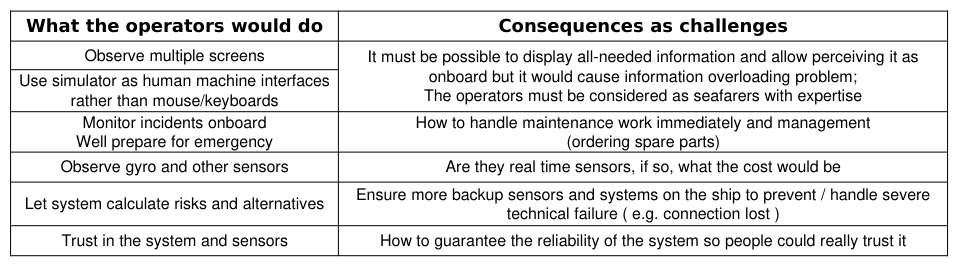
When the discussion turned to shore-based ship monitoring and controlling scenarios, the participates not only envisaged what the operators in the shore control center would probably do, but also pointed out the remote control was an unprecedented challenge for which they did not have the perfect solution (see Table 1).
Table 1: Actions and confronted challenges discussion concerning shore-based ship monitoring and controlling
Basically the actions that operators can do ashore were to observe the screens and perceive dynamic real-time information. Multiple human machine interfaces ashore was discussed compared to onboard ship-handing. Most participants deemed the simulator as the ideal human machines interfaces used in the shore control center, as “They don’t want a mouse button but a joystick handle”. In terms of sense, they anticipated there would be gyros and other senses that could simulate the feelings onboard. As more assumptions were proposed in the focus interview, the participants turned to list the leading consequences being onshore as the unprecedented challenges, e.g. maintenance work, economy cost, reliability of the system, etc. Meanwhile, the participants realized that “not the same human factors were needed” in both situations, the discussion moved on naturally to the main research question of the focus group interview:
Question 3: What aspects of human factors were different but worth our attention concerning navigating from ship to shore (see Table 2).
Table 2: The overview of changing human factors from ship to shore for ship handing Human Factors Presentation of these factors Voices
Table available in the original PDF paper.
"ship starts vibrating and pitching when changing the course a bit, but these senses are lost ashore"
Sense Visual, auditory, sense of smell, kinetic feeling, sense of balance
"Everything got closer ashore" "You may pay attention to parameters that don't matter or are wrong and you worry for nothing."
Mental model, decision making, situation awareness, information
"Receiving much more information but you can't discern
Perception - Cognition
overloading, stress, trust in the
what matters to you as you did onboard"
system "When you're onboard, fear is simulating but you're less
stressed ashore. Complacency. Maybe too relaxed."
Work space Working environment, ergonomics, hardware, software "Only rely on instruments ashore" "A big part of the ship work is maintenance" Maintenance Backing up systems, maintenance approach
"What happen if there is a malfunction or emergency" Risk Risk assessment, shifting risk "Risks for other boats around"
"Not that risky being onshore" "computer engineers for the operator ashore would be good
Organization Expertise, structure, roles,
since they monitor ships through computers. Seafarer
education/training
would not need that" Legal perspective Regulations, laws "Who is responsible if the ship is in international waters"
From the perspective of the majority of the participants, the most controversial question they would considered in priority, was the possibility to build the “the full proof system”, because they believed that it could be a big risk to solely rely on the shore-based monitoring system and therefore judge things from it. Except for the skepticism, they explicitly mentioned situation awareness as the most significant key to focus on when shifting ship handling from ship to shore followed by information overloading and organizational issues.
DISCUSSION
This section will discuss the inferences from the results and their implications.
Methodological discussion Focus group is used as the data collection method and is also used partially for the data analysis in this research. The reason to choose focus group is because it is suitable for identifying problems, seeking to solve problems from the stakeholders’ view with an exploratory research manner (Ivey, 2011). More importantly, it can provide insights into the sources of complex behaviors and motivations (Morgan & Krueger, 1993). The purpose of this research is to explore the key aspects of human factors with regard to maintain ship sense when shifting people from onboard maneuvering to shore-based monitoring. The target audience are 4th year master mariner program students with certain amount of navigational experience at sea. The average age is 27 years old and they are comfortable to use daily digitalized device, such as laptop, iPad, iPhone, etc. Therefore the focus group can provide the multifaceted opinions by looking deeper into their working experience and maneuvering behaviors, and seeking the affected human factors behind the explorative computerized solution in the shore-based control center. Although focus group cannot substitute usability test and observation of product in use to evaluate how efficiently people will use some certain product, it can underpin the research of the human factors in complex systems and provide values on which design direction would be widely accepted.
Designing the focus group interview elaborately to ensure the well structure is very important (Morgan, 1996) so the moderator controlled the topics to be discussed step by step and involved each individual participant as equally as it could. Following the discussion that went from actions onboard to ashore, the comparative analysis was conducted during the interview. It might not provide the “full picture” to all aspects that need to be covered within two hours, but it indeed afforded valuable insights on some discernible “tips of the submerged iceberg”, such as how the perception difference might shape the operators’ behaviors in the SCC, and what the main factors that hindered them from achieving high level of situation awareness.
However, focus group has limitation like other forms of data collection. Firstly it is not statistically significant samples(Goodman et al., 2012). Although the group participants have sea experience but they are far from experienced seafarers. None of them are bridge officers. Secondly, those whose view point is minority perspective may not be inclined to speak up or risk negative reactions (Patton, 2002). Besides, there are no fully-fledged proven solutions to be provided in front of the participants, thus it is hard to envisage what the SCC would look like at the end of the day. After all, in the exploration-oriented group discussion, the lack of the reference frame may lead the participants to some “limbo” state and therefore affect the discussion results. There is also one possibility that the participants see autonomous unmanned ship as one potential conflict with their career development, which might partially explain why the discussion was once deviated to the unfeasibility of the whole concept.
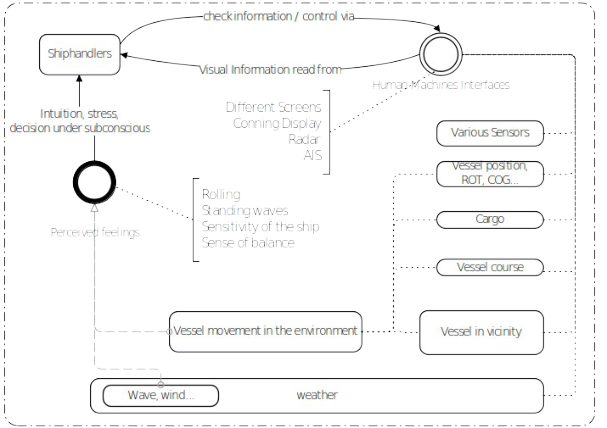
Results discussion The result from actions onboard provided by the participants indicates the “feeling” is very important in ship maneuvering. This tacit and gut feeling is interpreted as the ship sense which is seen critical for seafarers in ship maneuvering (Prison et al., 2009). Such feelings are strongly related to the kinetics that can tell the bridge crew the vital information more straightforwardly than the instrument screens: how the ship is behaving now and under what circumstances. It means the sensitivity the ship presents when reacting to the external environment (e.g. how the ship is reacting to the bank suction effect) and internal status (e.g. full cargo or not), as well as the constraints from the environment (e.g. weather, wind, wave) that the bridge crew must take into account in ship handling. The visual perception has significant weight in all the sensations. Ship status can be read and judged from the screens in the bridge in combination with the environment information that could be gained by looking side. Figure 1 presents the analysis results that how seafarers get visual information from navigational instruments while perceiving feedback coming from the environment and the movement of the vessel.
Figure 1. Ship-handlers gain visual information from bridge instruments while perceiving feedback coming from the environment and the movement of the vessel
From the perspective of human machine interaction, the seafarers are constantly “interacting” with both the vessel and the environment. Although the participants were more stressed under such circumstances, they expressed that they have the ability to discern the priority of information and act intuitively. However, the ability would become inability when people are located far away from the conducted vessel in a shore-based center. There will be no physical connection between the human and the vessel, and no directly perceived information from the ship’s environment. Specifically the visual perception and the kinetic feeling will be lost, which would truly jeopardizes ship sense.
The participants acknowledged that operating ashore would put the inevitable “feeling” in jeopardy, “the connection with the outside world is lost”, and therefore they proposed many ways to compensate such feelings or substitute such feelings in their reply. Some participants went for the simulation setup or visualization solutions so that the shore-based control center could mimic the ship sense. One typical suggestion is to use simulator as human machine interface, consequently the bridge crew can see the surrounded 3D visualized environment, provided that the sensors can transfer sensory information to shore in real time. One of the critical concerns is that visualization might not be able to provide enough situation awareness. For example, it does not resolve the problem caused by the loss of motion, as people do not move with the ship any more as they do onboard, thus they are not able to feel the tool they are operating. Some other participants turned to the sensors to seek alternatives for ship sense, as gyros can tell vibration, roll and heave. However, it is also confronted with usability issues as too much visual information might cause information overloading for the operators ashore.
With the previous discussion (treating onboard and onshore situations separately) as the underpinning blocks, the participants seemed to understand the topic more comprehensively and had contributed something more valuable in Table 2 – there are indeed several identified aspects of these changes in human factors that we must not ignore when shifting navigation from ship to shore. Except for the skepticism, the participants listed situation awareness as the most significant key to focus on. Situation awareness stands for three levels of information processing: perceiving information, understanding information and anticipating information (Endsley, 1988). When fulfilling the task of maneuvering, the information is gathered through seafarers’ senses via different perception receptors like the retina, which indicates the first level of situation awareness. Previous studies (Endsley, 1995) find that attention and working memory are the critical factors when people are interpreting things from environment into their mind. The concern from the participants perfectly match these critical factors in situation awareness, for example, “you may pay attention to parameters that don’t matter or are wrong and you worry for nothing”, and the notorious “information overloading” problem.
Mental model is seen as one important parameter to overcome such limits and decide the priority of information (Endsley, 2011). Concerning the task of remote monitoring and controlling ashore, the participants considered it as one process that was full of “complacency and relaxation” in their mentality, but they also anticipated the information overwhelming in the context - “receiving much more information but you can't discern what matters to you as you did onboard”. It is an important signal to infer that they have no existing mental model to adapt to the working pattern. They probably need one in the future but that might be very different from the existing mental model of one normal bridge officer to maintain the higher level situation awareness. Besides, maintaining situation awareness is even more challenging than creating situation awareness since it is required to keep users in the loop of the dynamic situation(Endsley, 2011).
Along with the described issues with respect to perception and cognition, the organizational problem is also considered as one prioritized aspect in the development of shore control center. It raises the questions like, what the role of the operators should be, what the difference would be compared with seafarers today, what regulations or rules were needed, how the training program should be tailored for them etc. The puzzle needs to be solved from multifaceted views.
Noticeably, maintenance is identified as one of most serious issue with no one onboard. It explained partially why participants asked for backup solutions in a full-proof system in the first place. The trust from the operators is there only because of the reliability, resilience and robustness of the system. However, there is hardly confirmed evidence to prove that unmanned autonomous ship could function with “fail-safe” guarantee during the whole voyage. Even it could be managed by the shore-based operators at any moment, the majority of the participants held skeptical attitude toward the concept of autonomous unmanned ship. Along with the LinkedIn Group discussion ("Unmanned ships on the horizon," 2014) , there has always been a problem with the acceptance of the concept of autonomous unmanned ship. The goal of the MUNIN project is not only to study the feasibility of unmanned ship and the shore- based control center, but also aim at improving sensor systems, cooperation work flow between ship and shore, maintenance procedures, reliability and cost-effectiveness. Those studies and research may also be used in the future concept that only removes partial seafarers from ship to shore and make the maritime industry more attractive and safer. Some key human factors onboard influencing safety have been identified, such as fatigue, automation, situation awareness, communication, decision making and teamwork (Hetherington, Flin, & Mearns, 2006). Automation is often introduced to reduce human error and work load, but it also shapes crew assessments and actions (Lützhöft & Dekker, 2002). Automation cannot simply replace human work with machine work and MUNIN is just the first step towards the artificial intelligence application at sea in the future. It has provided opportunities to explore the different presentation formality and facades of known human factor along with other emerging challenges under one new working model in the maritime domain.
CONCLUSIONS
The results from the focus group indicate the gap between the tasks that require adequate situation awareness to maintain ship sense and the inability of personnel ashore due to the lack of conventional sensory cues and appropriate organizational regulations and management for shore-based control center. The original “harmony” faces new challenges by reconstructing its constitutes (Prison, 2013), i.e., people, vessel, environment. Ship handlers still strive for a continuous balanced effect by tuning the ship to the environment, but in the remote control pattern. On one hand it might bring more risks in operations due to the lack of situation awareness and thus put harmony in jeopardy, but on the other hand, it suggests the approach to design the integrated system by studying the changes on various aspects of underpinning human factors. Through the deep analysis in the contextual nature of onboard and shore-based environment, the intrinsic variability of those applied human factors can be exposed for further human factors refactoring. What is going on ashore, how it is different and how it can be adapted to the human, the explorative research in the future unmanned ship is presenting to the industry unprecedented challenges as well as endless opportunities.
ACKNOWLEDGEMENTS
We gratefully acknowledge the financial support from MUNIN which is funded by the EU’s 7th Framework
Program under the Grant Agreement Number 314286.
REFERENCES
Endsley, M. R. (1988). Design and Evaluation for Situation Awareness Enhancement. Proceedings of the Human Factors and Ergonomics Society Annual Meeting, 32(2), 97-101. doi: 10.1177/154193128803200221 Endsley, M. R. (1995). Toward a Theory of Situation Awareness in Dynamic-Systems. Human Factors, 37(1), 32-
64. doi: Doi 10.1518/001872095779049543 Endsley, M. R. (2011). Designing for Situation Awareness: An Approach to User-Centered Design, Second Edition: CRC Press, Inc. Fuller, R. (2000). The task-capability interface model of the driving process. Recherche - Transports - Sécurité,
66(0), 47-57. doi: http://dx.doi.org/10.1016/S0761-8980(00)90006-2 Goodman, E., Kuniavsky, M., & Moed, A. (2012). Observing the User Experience, Second Edition: A Practitioner's Guide to User Research: Morgan Kaufmann Publishers Inc. Han, D. F., & Ding, S. (2013) Review of human factors in maritime system. Vol. 397-400 (pp. 679-682). Hetherington, C., Flin, R., & Mearns, K. (2006). Safety in shipping: The human element. Journal of Safety
Research, 37(4), 401-411. doi: DOI 10.1016/j.jsr.2006.04.007 Ivey, J. (2011). Focus Groups. Pediatric Nursing, 37(5), 251. Kitzinger, J. (1995). Qualitative research. Introducing focus groups. Bmj, 311(7000), 299-302. Lützhöft, M. H., & Dekker, S. W. A. (2002). On Your Watch: Automation on the Bridge. The Journal of Navigation, 55(01), 83-96. doi: doi:10.1017/S0373463301001588 Morgan, D. L. (1996). Focus groups. Annual Review of Sociology, 22, 129-152. Morgan, D. L., & Krueger, R. A. (1993). When to use focus groups and why Successful focus group: Advancing the
state of the art (pp. pp. 3-19). Newbury Park, CA: Sage. Patton, M. Q. (2002). Qualitative research & evaluation methods. Thousand Oaks Ca.: Sage. Porathe, T., Prison, J., & Man, Y. (2014). Situation awareness in remote control centres for unmanned ships. Paper presented at the RINA Human Factors in Ship Design and Operation Conference, London, UK. Prison, J. (2013). Ship sense - exploring the constituents of shiphandling. Chalmers tekniska högskola. Prison, J., Dahlman, J., & Lundh, M. (2013). Ship sense - striving for harmony in ship manoeuvring. WMU Journal
of Maritime Affairs, 12, 115-127. Prison, J., Lützhöft, M., & Porathe, T. (2009). Ship sense - what is it and how does one get it? Paper presented at the RINA Human Factors in Ship Design and Operation Conference. Rødseth, Ø. J., Kvamstad, B., Porathe, T., & Burmeister, H.-C. (2013). Communication Architecture for an
Unmanned Merchant Ship. Paper presented at the OCEANS - Bergen, 2013 MTS/IEEE. doi: http://dx.doi.org/10.1109/OCEANS-Bergen.2013.6608075 Unmanned ships on the horizon. (2014). Retrieved 2014-02-22, from http://www.linkedin.com/groupAnswers?
Advances in Human Aspects of Transportation: Part I
Read this individual research paper free through the original publisher, or explore the full digital proceedings book.
ISBN 978-1-4951-2097-8
Explore this ISBN in the AHFE Bookstore ↗Listed in the July 2026 bookstore catalogue; search by ISBN to confirm current availability · Digital book purchase optional