Hamish Mackie (2021). Redesigning Existing Urban Streets to Optimize Multiple Outcomes. In: Advances in Human Aspects of Transportation: Part I. AHFE Open Access, vol. 15. https://doi.org/10.54941/ahfe100631
This paper describes a programme of neighbourhood scale intervention research in Auckland New Zealand, with the aim of creating inherently safer streets that also enhance public health and community wellbeing. The research began with a study called Self Explaining Roads (SER) and a second, larger project called Future Streets is currently in progress. For the Self Explaining Roads study approximately 11 km of local and collector roads were modified within an existing suburban area using SER principles. A programme of evaluation found a 30% reduction in traffic crashes and an 80% reduction in crash costs three years following the SER intervention. Mean traffic speed for local streets reduced to 30 km/hr and speed variance reduced for all streets. Pedestrian outcomes also improved on local streets and distinct road user behaviour characteristics for the two road types were achieved, reinforcing the achievement of a successful SER intervention trial. A further intervention study (Future Streets) focusing more deliberately on active modes and public health outcomes, but still including SER principles, is currently in progress. A process of participatory design is being used to develop street changes in an intervention area. A control area has also been assigned and a range of road safety and public health measures will be carried out in both areas, before and after the intervention changes. The studies will hopefully lead to more informed decisions about the nature of urban street infrastructure investment in the future.
The social and financial burden of road traffic injury in New Zealand is high compared with other developed countries. This injury burden is exacerbated by chronic diseases such as obesity, diabetes and cardiovascular disease – all of which share physical inactivity (including a lack of walking or cycling for transport) as a risk factor. Road safety cannot be addressed in isolation from these other important public health priorities. Internationally, knowledge is scarce regarding optimal street interventions for improved road safety, wider health outcomes and their associated costs and co-benefits. This paper describes a programme of community intervention research in New Zealand, previously focusing on road safety (Self Explaining Roads) and currently taking a wider approach, including public health considerations, to re-design and streets and evaluate multiple outcomes (Future Streets).
The Self-Explaining Roads (SER) approach (Theeuwes, 1998; Theeuwes & Godthelp, 1995; Rothengatter, 1999; Weller et al., 2008) focuses on the use of road designs that evoke correct expectations and driving behaviours from road users, and ultimately safer roads. The SER approach utilizes visual characteristics of roads to influence drivers and focuses on three key principles of functionality, homogeneity, and predictability (van Vliet & Schermers, 2000) to create a safe and user-friendly road network. The SER approach ensures that road designs and associated behaviour match their intended function to minimise confusion and promote desired driver expectations. Homogeneity is provided through clearly defined road categories which prevent large differences in vehicle speeds, direction and mass within each hierarchy level. Predictability means that look and feel of roads within each category should be very consistent so that desired road user behaviour is consistently reinforced. In short, the SER approach focuses on making roads more user-friendly for all road users.
Future Streets seeks to understand how innovative urban street improvements can contribute to road safety and other interconnected social and health goals. The Future Streets research builds on SER principles to create road environments that are inherently safe and user-friendly for all road users, particularly pedestrians and cyclists, with a view to improving public health. It has a future focus and is intended to push streetscape planning and design boundaries beyond ‘business as usual’. Especially in ‘new world’ countries such as New Zealand, streets were not originally built with these considerations in mind and the main focus was on efficiently moving private motor vehicles. However, as a greater understanding of the link between built urban form and outcomes such as public health are considered, there may be a need to retrofit changes to existing streets to better reflect transport movements that support wider public health and other outcomes.
A SELF EXPLAINING ROADS TRIAL IN NEW ZEALAND A successful SER intervention study was recently carried out in New Zealand (Charlton et al., 2010, Mackie et al., 2012). In this study, a suitable trial and control area were chosen within the suburb of Point England in Auckland City and an SER process was followed to retrofit approximately 11 km of local and collector roads. A design speed of 30 km/h was chosen for local roads, which was given effect via a combination of trees planted in the centre of the road and landscaped “community islands” placed periodically at points along the curb sides to limit forward visibility. Roadmarkings were also removed to create a less formal environment. For local cross-roads, mountable central islands were installed without any signs or markings on the approaches, reflecting the less formal, low speed design of the location. For the collector road category, a higher design speed of 40 km/h was selected with a high standard of road delineation established as a category-defining feature. Centrelines and edgelines were added to the collector roads that lacked them and cycle lanes, pedestrian crossing points, and landscaped medians with pedestrian refuges were added.
Local roads before SER changes Distributor roads before SER changes
Figure 1. Changes in street design following a Self Explaining Roads design process
Figure available in the original PDF paper.
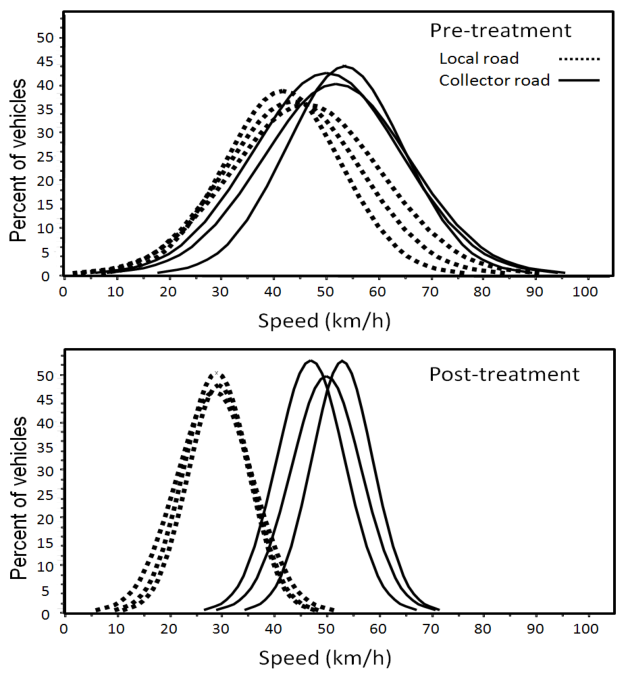
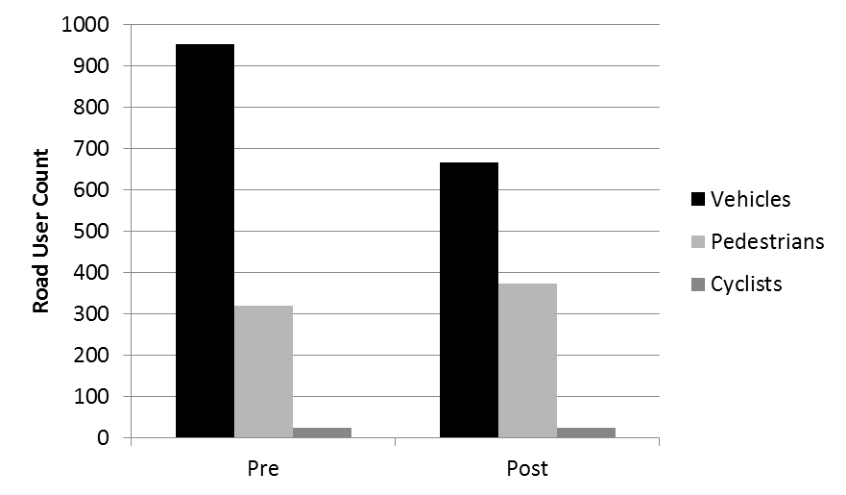
Pre and post construction measures included traffic speed and count data on the local and collector roads, a perceptions survey and structured video monitoring. Two key effects of the retrofitted roads were much lower traffic speeds on local roads (with a mean very close to the design speed of 30 km/hr) and much less variation in speeds on both local and collector roads. Another positive effect was the elimination of speeds over 70km/hr on collector roads, which were previously common. The perceptions survey also found that there was a closer match between actual and perceived safe speeds post SER construction. Preliminary analyses using 5-year pre and 3-year post construction crash data has shown that crashes numbers have reduced by 30% per annum and crash costs have reduced by 80% per annum, indicating a reduction in crash severity. There was also relatively greater (Figure 3) and more unconstrained pedestrian activity on local streets following the street changes.
Figure 2. Speed profile changes following SER street changes for local and collector roadsFigure 3. Road user activity on local streets following SER street changes
FUTURE STREETS Background During the SER project it became evident that there are potentially a number of other benefits, in addition to road safety, from more human centered street designs. Public health, environmental impacts and social cohesiveness may also benefit from improved streets if they lead to more pedestrian and cyclist behaviour on neighbourhood streets. While transport systems often have an economic focus based on the efficient movement of motorized vehicles, it may be that at a neighbourhood scale, the greatest overall economic benefits come from ‘livable’ neighbourhoods that promote physical activity through active mobility. Emerging evidence suggests that the safety benefits from SER type street changes are likely to at least be matched by health benefits from activities such as walking and cycling (Macmillan 2013). Other environmental and social outcomes may also benefit from such street changes. In particular, increasing physical activity through even small shifts to more cycling is likely to result in long-term health related savings. The combined safety, health and other benefits make a strong case for investment in more livable streets in cities and towns and would suggest a significant change in the focus of transport and health government authorities.
The aims of Future Streets are:
1. To demonstrate a process for community participatory design and implementation for Future Streets in Mangere, Auckland
2. To measure and describe the integrated road safety, health, environmental and social outcomes resulting from Future Streets implementation
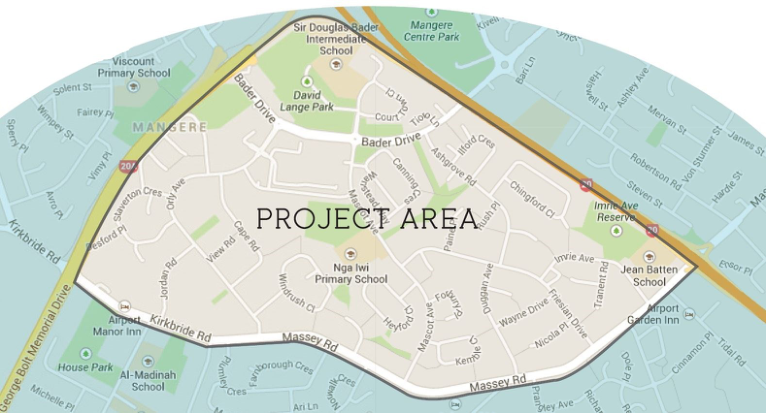
Future Streets design process The first step in the design process was to select project areas (intervention and control) within Auckland City. The intervention area is shown in Figure 4. Selection criteria included:
Urban form: Areas with comparable urban form were selected based on existing Auckland specific indices of connectivity, density and accessibility. Areas with higher street connectivity, dwelling density and destination accessibility were targeted for both the intervention and control areas.
Socio-demographic characteristics: Areas with high levels of social deprivation were shortlisted, to encourage social equity within the project. Poorer suburbs such as Mangere are more likely to experience high injury rates from traffic crashes (Hosking et al. 2013) and there is therefore a need to address road safety inequity.
Area size: The size of candidate project areas was 600-900 households in order to provide a resident population that is great enough for statistical purposes.
Randomisation: The intervention and control project areas were randomised in order to manage effects other than the Future Streets changes.
Community buy-in: A willingness by communities to participate in the research was also a key criteria. Without buy-in and partnerships from the local communities, the project would not be possible.
Using these area selection criteria, Mangere Central (South Auckland) emerged as the ‘intervention’ area while nearby ‘Mangere East’ emerged as the control area.
The previous SER project, the best evidence from the literature and a participatory community process are being used to develop the Future Street changes.The vision for the Future Streets intervention is: Mangere Central is safe and easy to travel around, especially by walking and cycling, and reflects local identity.
Figure 4. Intervention project area
The intervention involves retrofitting changes to Mangere Central streets with a focus on improving road safety and increasing opportunities for active transport links to destinations including public transport, schools, shopping centres and other facilities. Street changes will include innovative design elements, some of which will be new to New Zealand. The research programme has a future focus and is intended to push streetscape planning and design boundaries beyond ‘business as usual’. Examples of new and innovative project elements include:
- Best practice in community engagement and participatory design using human factors testing and community development principles
- Testing the concept of pedestrian and cyclist priority in local communities. This would start by making pedestrian and cycle routes, including off-road paths and parks, the first priority as part of a route hierarchy for local communities. It is proposed that this will yield the greatest overall economic benefit at a neighbourhood level, compared with larger scale transport infrastructure across the city and region, where vehicle mobility is currently linked to economic development
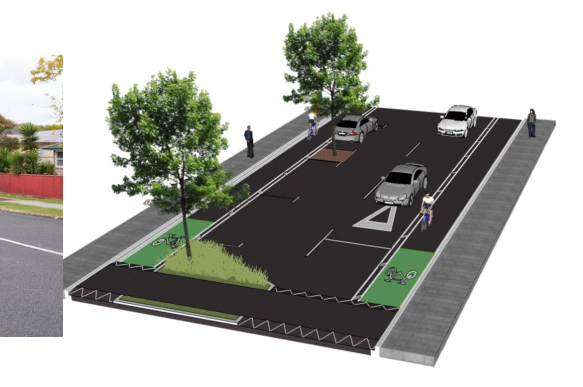
- Design approaches and elements that are new or not currently used in New Zealand, but have been successfully demonstrated overseas. Examples of potential design elements include ‘home zones’, pedestrian and cyclist priority by design at intersections, greenways, bike boulevards, partial closures (traffic but not cyclists and pedestrians) and further development of Self Explaining Roads principles for traffic speed management and ‘Self Explaining pedestrian routes’
- Design elements that have potential in New Zealand and may have been proposed but are not yet used commonly used in suburban situations. Examples include, buffered cycle lanes, sharrows, naked streets/shared spaces and further development of informal low speed roundabouts
- A community development approach to road safety, addressing related barriers such as personal safety, social inequalities and cultural identity. Opportunities for cultural artwork and other urban design elements will be explored as part of the street improvements.
Concept design work is currently in progress and will be complete by May 2014. The street changes are planned to be implemented in the 2014/15 New Zealand summer.
Figure 5. Example of an existing distributor road and potential street changes as part of the Future Streets project
The intervention and control sites will continue to be exposed to region-wide education, promotion and incentive programmes aimed at changing people’s transport behaviour. These will be considered “business-as-usual”. To investigate the specific effectiveness of infrastructure, Auckland Transport has agreed to exclude the use of intensive promotion programmes from the included areas until study completion, when they may be used to complement the intervention.
Evaluation Framework A range of quantitative and qualitative measurements will be carried out before and after the changes in both the intervention and control areas. Quantitative measures include physical activity (using pedometers and face to face interviews) including neighbourhood travel, mode of transport to work and school and recreation. Road traffic injuries, vehicle kms travelled, traffic speed and road user behaviour (vehicles, cyclists and pedestrians) will also be measured. Qualitative measures include interviews with children and adults within the areas.
System dynamics modelling will also be carried out to simulate the future effects of a region-wide application of Future Streets changes to understand the wider benefits and costs and aid strategic decisions about neighbourhood street design.
RESEARCH CHALLENGES There are a number of challenges associated with community infrastructure intervention research such as Self Explaining Roads and Future Streets. Invariably local government authorities are needed as project partners as their systems and funding are needed to supply the street changes that are needed for the research. For both projects, obtaining funding support for both the research and infrastructure changes in a coordinated manner was very difficult. For Future Streets, at the time of writing, there is still some infrastructure funding outstanding although it is likely that this will be remedied in the near future. Working with the local community to deliver street changes that may not be universally popular is another challenge, especially as some of the changes are not intuitively positive to some. Making changes to one area and restraining from making changes to a control area is also a significant practical and ethical challenge. To some degree this has been resolved by allowing ‘business as usual’ changes to happen in both areas and only Future Streets changes to happen in the treatment area. Also, for equity purposes, the control areas has been prioritized for intervention following the research.
CONCLUSION A programme of community infrastructure intervention research has been carried out and continues to progress in Auckland, New Zealand, with the aim of evaluating urban street designs that optimize road safety, public health and other outcomes. Findings to date suggest that significant road safety benefits may arise from more human centred urban street design. Current work seeks to understand road safety, public health and other wider benefits that, together, could signal a substantial economic rationale for urban street designs that differ significantly from current practice.
REFERENCES
Charlton, S.G., Mackie, H.W., Baas, P.H., Hay, K., Menezes, M. and Dixon, C., 2010. Using endemic road features to create self-explaining roads and reduce vehicle speeds. Accident Analysis and Prevention, 42, 1989–1998. Hosking, J., Ameratunga, S., Exeter, D., & Stewart, J. (2013) Social and geographical differences in road traffic
injury in the Auckland region. Produced for Auckland Transport. Mackie, H.W., Charlton, S.G., Baas, P.H., (2012). Road user behaviour changes following a Self-Explaining Roads intervention.Accident Analysis and Prevention. 50, 742-750. Macmillan A. Intervening in the trip to work. A system dynamics approach to commuting and public health
(submitted). Auckland: The University of Auckland; 2012. Rothengatter, J. A., 1999. Road users and road design. In G.B. Grayson (ed.), Behavioural Research in Road Safety IX (pp. 86-93). Crowthorne: Transport Research Laboratory. Theeuwes, J., 1998. Self-Explaining Roads: subjective categorization of road environments. In A. Gale (Ed) Vision
in Vehicles VI, (pp. 279-288). Amsterdam: North Holland. Theeuwes, J. and Godthelp, H., 1995. Self-explaining roads. Safety science. 19, 217-225. van Vliet, P., and Schermers, G., 2000. Sustainable Safety: A New Approach for Road Safety in The Netherlands.
Rotterdam, the Netherlands: Traffic Research Centre. Weller, G., Schlag, B., Friedel, T. and Rammin, C., 2008. Behaviourally relevant road categorization: A step towards self-explaining rural roads. Accident Analysis and Prevention, 40, 1581-1588.
Acknowledgements
The following organisations and people are key research and infrastructure delivery partners: Transport Engineering Research NZ (Peter Baas), Waikato University (Samuel Charlton), Auckland University (Alistair Woodward, Jamie Hosking and Joanna Stewart), Massey University (Karen Witten), Otago University (Alex Macmillan), AUT (Melody Oliver), Synergia (Adrian Field) and Auckland Transport (Matthew Rednall, Melanie Alexander, Chris Beasley, Duncan Rothwell, Keith Pauw, Karen Hay, Graeme Bean).
The Self Explaining Roads research was funded by the Foundation for Research Science and Technology and Future Streets research is funded by the Ministry of Business Innovation and Employment.
LISTED IN THE AHFE DIGITAL BOOKSTORE CATALOGUE
Explore the complete digital volume
Advances in Human Aspects of Transportation: Part I
Read this individual research paper free through the original publisher, or explore the full digital proceedings book.
ISBN 978-1-4951-2097-8
Explore this ISBN in the AHFE Bookstore ↗Listed in the July 2026 bookstore catalogue; search by ISBN to confirm current availability · Digital book purchase optional