Toshikazu Kato, Rikuto Fukada, Takashi Sakamoto, Toru Nakata (2026). Modeling Individual Differences in Motivational Responses for Personalized Support of Sustained Behavior Change Toward Well-Being. In: Human Factors in Design, Engineering, and Computing. AHFE Open Access, vol. 238, pp. 697–707. https://doi.org/10.54941/ahfe1008301
Sustained behavior change requires more than matching interventions to average group characteristics: it requires understanding personal characteristics, attitudinal responses, and actual behavior over time. Building on our earlier category-based interventions for exercise and sleep, this study examined the information needed to design personalized support. First-year students in the Faculty of Science, Engineering and Society at Chuo University participated in a common one-day English communication experience at Tokyo Global Gateway (TGG) on April 19, 2026. General characteristics and English-related attitudes were explored in 278 baseline respondents; longitudinal attitudes were analyzed in 137 respondents matched across three surveys, and changes in English contact outside university classes were assessed in 164 respondents matched between the first and third surveys. Baseline recognition of the importance of English was high, whereas enjoyment/interest and evaluation concern followed different temporal trajectories. Of 38 participants whose enjoyment/interest moved from below the neutral threshold to at least that threshold shortly after the experience, only 12 reported a higher category of out-of-class English contact at follow-up. These findings illustrate that favorable attitudinal responses do not correspond one-to-one with later behavioral increases. We propose a human-centered design perspective that distinguishes relatively stable personal characteristics, changing activity-specific attitudes, and current behavior, and that adaptively selects value-oriented messages, concrete action opportunities, and reflective feedback. This is an exploratory basis for future personalized intervention studies, not a causal evaluation of TGG or of the proposed support cycle.
INTRODUCTION: FROM GROUP-BASED INTERVENTIONS TO INDIVIDUAL RESPONSES For sustained activities such as exercise, sleep management, and learning, recognizing an activity’s value and intending to engage in it do not necessarily lead to action or continued practice. The gap between behavioral intention and action has been discussed extensively (Sheeran and Webb, 2016). The COM-B model likewise regards behavior as a function not only of motivation
but also of capability and opportunity (Michie et al., 2011). Intervention design therefore needs to examine not only whom to address and what to communicate, but also which attitudes change and whether the intended activity is actually undertaken.
A distinction has been drawn between targeting information to groups and tailoring it to individuals (Kreuter and Wray, 2003). Our previous research classified participants by exercise-related characteristics and attitudes and examined motivational support involving competition, praise, and visualization of progress (Kojima et al., 2024). In sleep research, responses to gain- and loss-framed messages differed across groups, but a clear increase in sleep duration was not observed (Ono et al., 2023). These experiences suggested that group-level profiles are informative yet may not sufficiently capture the combination of personal features and practical conditions that govern an individual’s behavior.
We therefore distinguish general personal characteristics from values and attitudes toward a specific activity; represent individuals using multidimensional scores in addition to group classifications; and examine attitudinal and behavioral responses to a common experience at the individual level. The empirical setting was a one-day English communication experience on April 19, 2026. Rather than estimating the average causal effect of an educational program, our objective is to identify what should be observed, how responses should be interpreted, and how the resulting information could inform personalized behavior-change support.
We address four research questions. RQ1: How can general characteristics and English-related values and attitudes be described along multiple dimensions? RQ2: How do different aspects of attitude change across three surveys following a common experience? RQ3: How do these changes correspond to later English-contact behavior, and how do baseline activity and class-related context affect interpretation? RQ4: What design principles for personalized messages, action opportunities, and feedback can be derived from these observations?
RESEARCH PERSPECTIVE AND ANALYTICAL STRATEGY Three Information Domains for Personalized Support
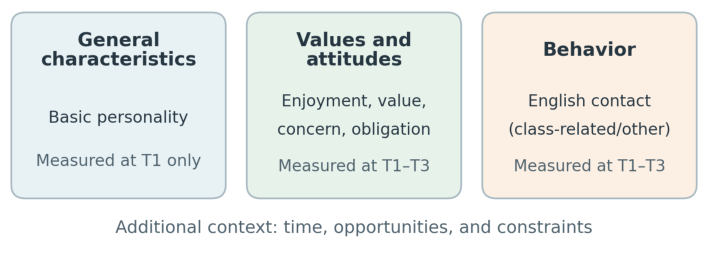
Figure 1 distinguishes three complementary information domains for designing personalized behavior-change support. The first comprises general personal characteristics (basic personality) that are assumed to remain relatively stable over the one- to two-month observation period and were measured only at T1. The second comprises activity-specific values and attitudes, including enjoyment, perceived importance, growth expectations, evaluation concern, and obligation. The third concerns actual engagement and behavior. The latter two domains can change and were assessed at T1, T2, and T3. The domains do not constitute a hierarchy or imply a one- way causal relationship. Time, opportunities, and competing activities are additional contextual considerations for designing support.
Figure 1: Three information domains and measurement occasions in personalized support.
PCA, Factor Analysis, and the Role of Classification We emphasize exploratory observation of multivariate response distributions before assigning respondents to predetermined psychological types. Principal component analysis (PCA) was applied separately to general characteristics and English-related attitudes to describe multiple directions of variation using respondent-level component scores (Jolliffe and Cadima, 2016). Exploratory factor analysis (EFA) was also used to investigate possible shared psychological structures. PCA and EFA serve different purposes; components are not treated as validated latent psychological factors.
Our methodological progression can be described as (i) joint classification of personality and activity-related attitudes, (ii) classification of the two domains separately, (iii) examination of variability within classes, and (iv) multidimensional descriptions using continuous individual scores. Group classes summarize the population, whereas component profiles preserve differences within a class. They are complementary representations; greater predictive performance of component scores is not assumed here.
COMMON TGG EXPERIENCE, SURVEYS, AND REANALYSIS Procedure and Record Linkage
Participants were first-year students in the Faculty of Science, Engineering and Society at Chuo University. They attended a one-day English communication program provided by Tokyo Global Gateway (TGG) on April 19, 2026. TGG is an immersive English-learning facility offering practical communication activities in simulated everyday settings. The common experience was situated between three questionnaire surveys: T1 (April 9–11), T2 (April 19–28), and T3 (May 1–29). Although many respondents completed T2 on the event day or the following day, intervals were not identical across participants. T1 included general characteristics, English-related attitudes, and English- contact behavior; T2 and T3 repeated the attitude and contact questions. General characteristics were not repeated because they were treated as relatively stable during this short interval, whereas attitudes and behavior were expected to change.
Only responses with research consent and matchable email identifiers were used. When an identifier appeared more than once within a survey wave, the latest timestamped response was retained. After deduplication, there were 278 respondents at T1 (280 records), 224 at T2 (227 records), and 186 at T3 (203 records). T1–T3 records were matched for 164 participants, and all three waves for 137. The 137 participants were used for attitude trajectories and attitude–behavior correspondence; the 164 with T1–T3 data were used for baseline-stratified behavioral changes.
Measures and Descriptions of Attitude Changes Twenty questions on general characteristics were administered only at T1; 34 English-related attitude questions were presented with identical wording on five-point scales at all three occasions. For exploratory descriptive purposes, the 34 items were grouped by content into seven provisional indices: enjoyment and interest, pleasure in learning and growth, perceived value and importance, evaluation concern and embarrassment, social recognition, course/graduation obligation, and skepticism about learning English. The mean of the relevant items was calculated for each respondent. These content- based indices are not presented as independently validated psychological scales.
For 137 matched participants, we summarized means and sample standard deviations (SDs) at each occasion and within-person changes over T1–T2, T2–T3, and T1–T3. SDs describe interparticipant variation at each survey, not uncertainty in a paired mean difference. Exploratory sign tests assessed the directions of T1–T2 changes across the seven indices, with Benjamini– Hochberg correction for multiple comparisons. For a descriptive state- transition analysis, enjoyment/interest scores below 3.0 were labeled “below neutral,” and scores of 3.0 or more “neutral or above.” This threshold reflects the midpoint of the five-point response scale, not a diagnostic boundary.
Behavioral Indicators and Correspondence Analyses Q35 measured self-reported time voluntarily spent encountering English in connection with university classes; Q36 measured corresponding contact outside class-related activities. Each referred to the preceding week and used eight ordered response categories. We analyzed categories as increased, unchanged, or decreased from T1 to T3, without interpreting category differences as equal intervals of minutes. Because the T2 recall period could include days before the event, the main behavioral comparison used T1 and T3. In the 137 respondents with all three surveys, enjoyment/interest state transitions over T1–T2 were cross-tabulated with Q36 changes over T1–T3; T1–T3 attitude transitions were also examined as a descriptive check. The underlying continuous scores and their changes remain relevant for future personalization models.
Modeling Individual Differences in Motivational Responses 701 Research Ethics
The study was conducted with the approval of the Research Ethics Committee for Research Involving Human Participants at Chuo University (Approval No. 2021-026(2)). Analyses used research-consented responses and reported results without identifying individuals.
RESULTS: MULTIDIMENSIONAL ATTITUDES AND BEHAVIORAL RESPONSES Multidimensional Characteristics and the Use of Classes
In the existing exploratory PCA of 278 baseline participants, multiple components were observed in both the 20 general-characteristic items and the 34 English-attitude items. The leading five components suggested by parallel analysis accounted for approximately 54.8% and 55.5% of the total variance, respectively. Item contributions suggested themes such as self-acceptance, time efficiency, family support, and competitiveness in the first domain; and enjoyment, growth, evaluation concern, course requirements, and recognition by others in the second. These labels are provisional interpretations of data- derived directions, not confirmed psychological factors.
Classes based on personality or attitudes can help describe population profiles, but the combination of scores within a class is not homogeneous. For example, 28 of the 278 baseline participants had item-group means of at least 3.5 for both enjoyment/interest and evaluation concern, illustrating that attraction to English and concern about making mistakes can coexist. The 3.5 cutoff is descriptive rather than a validated type boundary. When 20 personality items and 34 attitude items are clustered jointly, the difference in item counts may also distort relative weighting. Separately examining the two domains is therefore analytically useful. The emphasis is not on establishing a definitive cluster solution but on retaining multiple individual features for subsequent response analyses.
Different Trajectories Across Attitude Domains
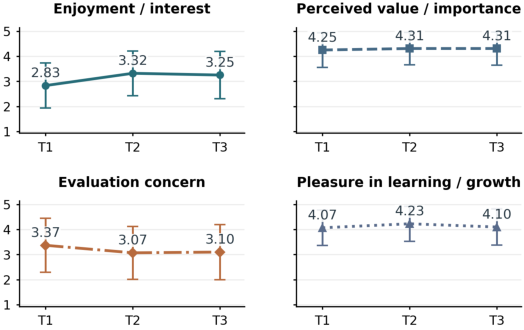
Figure 2 shows the three-wave means and SDs of four attitude domains for the same 137 respondents. Enjoyment/interest increased from 2.83 at T1 to 3.32 at T2 and was 3.25 at T3. Evaluation concern followed 3.37 → 3.07 → 3.10. In contrast, perceived value/importance was already high at T1 (4.25) and remained close to 4.31 at T2 and T3. Pleasure in learning and growth increased from 4.07 to 4.23 and then approached its initial level (4.10). Attitudinal responses to the common experience therefore had different trajectories across value, enjoyment, and concern.
Figure 2: Three-wave trajectories of four English-related attitude indices (n = 137).
Note. Points show item-group means; error bars represent ±1 SD between participants at each occasion. All panels use the same five-point response scale.
Within-person directions also varied. From T1 to T2, enjoyment/interest increased for 98 participants, decreased for 23, and was unchanged for 16. Evaluation concern increased for 33, decreased for 74, and was unchanged for 30. In exploratory sign tests across the seven indices, enjoyment/interest, evaluation concern, pleasure in learning/growth, and social recognition showed directional imbalances (Benjamini–Hochberg-adjusted q ≤ 0.005). These results do not imply that all respondents changed in the same direction; the key observation is variation across both people and attitude domains.
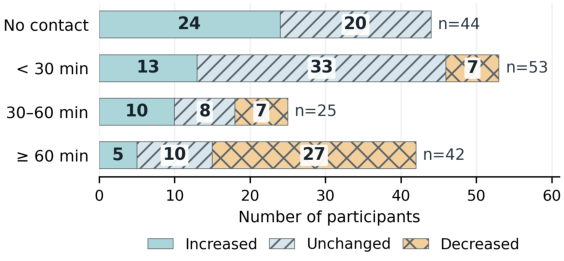
Out-of-Class English Contact and Baseline Engagement Among the 164 participants matched at T1 and T3, Q36 categories increased for 52, remained unchanged for 71, and decreased for 41. Figure 3 shows the counts stratified by baseline Q36 category. Among 44 respondents with no initial English contact, 24 moved to a higher category; among 42 reporting at least one hour initially, 27 moved to a lower category. Because respondents at the lowest category cannot decrease further, interpretation of changes necessarily depends on baseline engagement.
Figure 3: Changes in out-of-class English contact (Q36) by baseline contact level (T1– T3, n = 164).
Note. Stacked values are participant counts whose ordered Q36 response category increased, remained unchanged, or decreased.
Modeling Individual Differences in Motivational Responses 703 For the same 164 participants, Q35 (class-related English contact) increased for 99, was unchanged for 31, and decreased for 34. Of the 99 with increased Q35, Q36 increased for 35, was unchanged for 37, and decreased for 27. Class-related and out-of-class activities thus did not necessarily change in the same direction. This observation motivates consideration of actual opportunities and time allocation, although coursework, scheduling constraints, and their effects were not measured directly.
Initial Enjoyment, State Transitions, and Subsequent Contact We examined the association between early changes in enjoyment/interest and later changes in English contact. Among the 137 fully matched participants, 73 scored below neutral (<3.0) at T1; 38 of these moved to neutral or above (≥3.0) at T2, whereas 35 remained in the below-neutral range. Of 64 initially at neutral or above, 60 remained in that range and four moved below it (Table 1). Among the 38 who moved upwards across this threshold, Q36 categories subsequently increased for 12, were unchanged for 19, and decreased for seven. Q36 also increased for 11 of the 35 who remained below neutral. Thus, a favorable enjoyment transition did not map one-to-one onto later increases in out-of-class contact.
Table 1: Transitions in enjoyment/interest (T1–T2) and changes in out-of-class English contact (Q36, T1–T3; n = 137).
Table available in the original PDF paper.
Enjoyment/Interest Transition (T1–T2)
Q36 Increased
Q36 Unchanged
Q36 Decreased Total Below neutral → Neutral or above 12 19 7 38
Remained below neutral 11 19 5 35 Remained neutral or above 19 21 20 60 Neutral or above → Below neutral 0 1 3 4
Total 42 60 35 137 Note. The attitude transition is T1–T2, whereas the Q36 change is T1–T3. “Below neutral” is an item- group mean < 3.0; “neutral or above” is ≥ 3.0. Remaining in a category does not imply an unchanged numerical score.
Among the 60 who remained neutral or above in enjoyment, Q36 increased for 19, remained unchanged for 21, and decreased for 20: sustained enjoyment was not synonymous with increased engagement. Of the four who moved below neutral, none reported an increase in Q36 and three reported a decrease; the cell is too small to infer an adverse effect of the experience. In a descriptive check using T1–T3 enjoyment transitions, counts were 33 (below → neutral or above), 40 (remained below), 61 (remained neutral or above), and three (neutral or above → below), with a similar overall picture. Thresholds of 2.5 or 3.5 altered subgroup sizes. Therefore, dichotomization is used to communicate patterns, while continuous attitude scores, within- person changes, and baseline Q36 remain the preferred inputs for future support design.
DISCUSSION: IMPLICATIONS FOR PERSONALIZED SUPPORT DESIGN From Group Profiles to Combinations of Individual Characteristics
Regarding RQ1, separating general personal characteristics from activity- specific values and attitudes enabled multidimensional descriptions of features expressed to different degrees within each person. In terms of the distinction between targeting a group and tailoring to an individual (Kreuter and Wray, 2003), group classes can provide an initial overview, but different configurations within a group warrant attention. Self-determination theory also distinguishes qualities of motivation with different degrees of autonomy (Ryan and Deci, 2000). The decision not to collapse enjoyment, social approval, and course-related obligations into a single high/low motivation label is consistent with this perspective, although our provisional indices do not directly operationalize or validate its theoretical constructs. Classes and individual profiles should therefore be used as complementary information in support design.
Distinguishing Perceived Value, Attitudinal Responses, and Action Regarding RQ2 and RQ3, enjoyment/interest tended to increase and evaluation concern tended to decline near the common experience, but participants differed in baseline state and subsequent transitions. Moreover, none of these transition types was uniformly associated with increased English contact. Sheeran and Webb (2016) review the gap between behavioral intentions and action. Our questionnaires measured several attitudes rather than behavioral intentions themselves, but the broader concern that favorable psychological responses must be distinguished from actual enactment remains pertinent. This also resonates with our earlier sleep study, in which reported motivational responses did not translate directly into increased sleep duration (Ono et al., 2023).
The COM-B model highlights capability and opportunity alongside motivation (Michie et al., 2011). Although the present TGG survey did not directly measure time constraints or opportunities to use English, participants who remained below neutral in enjoyment, remained positive without increasing behavior, or moved to a less positive state raise different design questions. Should support clarify personal relevance, offer a psychologically safe practice setting, or help identify concrete opportunities to act? These are hypotheses derived from the observed distinctions, not effects established by this study.
From “What to Communicate” to “What is Feasible Now” As a bridge to RQ4, personalized support should be informed by the person’s characteristics, current attitudes and their changes, baseline behavior, and contextual feasibility, not only the content of an intervention message. For those who remain below neutral in enjoyment, revisiting relevance or attainable goals may be appropriate; for those who remain positive without
Modeling Individual Differences in Motivational Responses 705 increased contact, actionable opportunities and timing may matter more; for those becoming less positive, understanding the experience and potential psychological burden may be the priority. These examples extend the notion of tailoring (Kreuter and Wray, 2003) by incorporating state trajectories. The dichotomy in Table 1 is an interpretive aid; practical intervention rules should preserve multidimensional personal profiles and continuous attitude scores instead of relying solely on type labels.
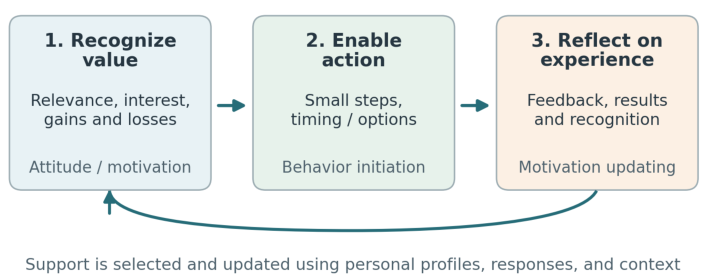
TOWARD HUMAN-CENTERED ADAPTIVE BEHAVIOR-CHANGE SUPPORT Building on these observations, we propose a recurring process for (1) helping individuals recognize an activity’s value and potential gains or losses, (2) identifying practical methods, moments, and opportunities for action, and (3) visualizing and reflecting on experiences and results to update motivation (Figure 4). This does not mean delivering all three interventions in the same sequence to everyone. The intended system would choose and revise the type of support based on baseline characteristics, repeatedly observed attitudes and behavior, and the person’s current context. This perspective is related to design principles for just-in-time adaptive interventions (JITAIs; Nahum- Shani et al., 2018).
Figure 4: Adaptive selection and updating of motivational support based on personal states.
Note. A proposed design concept for future evaluation; the TGG study did not test intervention effectiveness or dynamic motivational updating.
Future support options include value-oriented messages, small actionable goals, feasible opportunities and timing, safe environments for trying, and reflection on achievement. JITAI design calls for explicit tailoring variables, decision points, and decision rules (Nahum-Shani et al., 2018). Following these principles, we intend to specify explainable rules based on individual profiles and states, assess participant acceptability and feasibility, and compare common support against individualized support. Extension to well-being activities such as exercise, healthy eating, and sleep is envisaged, but activity-specific values, constraints, and opportunities will require
separate measures and intervention designs rather than direct transfer of English-learning indices.
LIMITATIONS AND NEXT STEPS This study followed participants who took part in the same TGG program; without a nonparticipating comparison group, it cannot establish a causal effect of TGG. Survey dates varied, particularly at T2 and T3, and English contact during the preceding week was reported retrospectively in eight ordered categories rather than as measured durations. Attrition or unmatchable records may have selected the longitudinal sample. The content- based attitude indices are exploratory, and reproducibility and comparability across waves require further validation. The 3.0 threshold is an illustrative use of the response-scale midpoint and does not capture all changes within categories. Future work will measure opportunities and personal context directly, retain continuous component and attitude scores, and evaluate adaptive intervention rules and actual behavior in prospective comparative studies.
CONCLUSION
Using questionnaires administered before and after a shared one-day English communication experience among first-year science-and-engineering students, we distinguished baseline personal characteristics, repeatedly measured English-related attitudes, and class-related and out-of-class English- contact behavior. Perceived importance was initially high, whereas enjoyment and evaluation concern followed different trajectories. Even when initial enjoyment and its subsequent state transition were distinguished, increases in out-of-class contact did not follow one-to-one. These observations illustrate why behavior-change support should move beyond average group profiles and consider coexisting personal characteristics, present attitudes, behavioral starting points, and change over time. The next research step is to test human- centered support that adaptively selects value-oriented communication, feasible opportunities, and reflection on experience.
ACKNOWLEDGMENT
This research was supported in part by a Collaborative Research Project of the Institute of Science and Engineering, Chuo University.
REFERENCES
Jolliffe, I.T. and Cadima, J. (2016) “Principal component analysis: a review and recent developments”, Philosophical Transactions of the Royal Society A, Vol. 374, No. 2065, Article 20150202. doi: 10.1098/rsta.2015.0202.
Kojima, T.S., Ono, S., Suzuki, A., Ogasawara, E., Takahashi, N., Nakata, T., Sakamoto, T., Sakaori, F. and Kato, T. (2024) “Motivation Assisting System for Physical Exercise Based on Classifying Users’ Attitudes”, in: Kansei Engineering and Emotion Research, CCIS, Vol. 2314, pp. 243–253. doi: 10.1007/978-981-97- 9910-7_20. Modeling Individual Differences in Motivational Responses 707
Kreuter, M.W. and Wray, R.J. (2003) “Tailored and targeted health communication: Strategies for enhancing information relevance”, American Journal of Health Behavior, Vol. 27, Suppl. 3, pp. S227–S232. doi: 10.5993/ajhb.27.1.s3.6.
Michie, S., van Stralen, M.M. and West, R. (2011) “The behaviour change wheel: A new method for characterising and designing behaviour change interventions”, Implementation Science, Vol. 6, Article 42. doi: 10.1186/1748-5908-6-42.
Nahum-Shani, I., Smith, S.N., Spring, B.J., Collins, L.M., Witkiewitz, K., Tewari, A. and Murphy, S.A. (2018) “Just-in-Time Adaptive Interventions (JITAIs) in Mobile Health: Key Components and Design Principles for Ongoing Health Behavior Support”, Annals of Behavioral Medicine, Vol. 52, No. 6, pp. 446–462. doi: 10.1007/s12160-016-9830-8.
Ono, S., Nambu, A., Kamada, K., Nakata, T., Sakamoto, T. and Kato, T. (2023) “Effects of Gain/Loss Messages on Reinforcing Motivation to Sleep”, in: Artificial Intelligence, Social Computing and Wearable Technologies, AHFE Open Access, Vol. 113, pp. 333–341. doi: 10.54941/ahfe1004206.
Ryan, R.M. and Deci, E.L. (2000) “Self-determination theory and the facilitation of intrinsic motivation, social development, and well-being”, American Psychologist, Vol. 55, No. 1, pp. 68–78. doi: 10.1037/0003-066X.55.1.68.
Sheeran, P. and Webb, T.L. (2016) “The Intention–Behavior Gap”, Social and Personality Psychology Compass, Vol. 10, No. 9, pp. 503–518. doi: 10.1111/ spc3.12265.
SEARCH THE AHFE DIGITAL BOOKSTORE BY ISBN
Explore the complete digital volume
Human Factors in Design, Engineering, and Computing
Read this individual research paper free through the original publisher, or explore the full digital proceedings book.