Turkan Hentati, Rosen Dimov, Oana Moldovan (2026). From Generic HMI to Driver-Adaptive Automation: Multimodal Feedback, Mode Awareness and Customized Takeover Timing. In: Human Factors in Design, Engineering, and Computing. AHFE Open Access, vol. 238, pp. 802–810. https://doi.org/10.54941/ahfe1008312
Current European regulations and guidelines for Human-Machine Interfaces (HMIs) in automated vehicles provide an important framework for safety evaluation, although some aspects can remain open by stakeholders from the automotive industry when translated into practical evaluation criteria. For instance, concepts such as “timely warning” do not always specify precise temporal thresholds, while assumptions based on an “average driver” may overlook substantial differences in cognitive processing speed, attentional capacity, expertise, and mode awareness. These considerations are particularly critical during transitions between manual and automated driving, where proportionate awareness of the current automation mode can contribute to inappropriate driver responses and delayed takeovers. This paper presents the experimental protocol of Use Case 1 (UC1-HMI) of the CERTAIN project, which applies an inclusive, driver-centred approach to investigate how adding haptic feedback to conventional audio-visual warnings influences mode awareness and Take-Over Request (TOR) performance, and how warning techniques should be quantitatively adapted to different driver profiles. In this experiment, fifty participants stratified by driving expertise (novice/experienced), age (including adults 60+) and neurocognitive diversity (including ADHD), with gender balance, complete a 2-hour simulator session covering manual driving, SAE Level 2 hands-on and Level 3 hands-off automation across a seven-step highway-to-urban transition scenario. Two warning conditions are compared between groups: audio-visual feedback alone versus audio-visual feedback combined with haptic stimulation. Data triangulate subjective measures (NASA-TLX, Technology Acceptance Model, comfort and trust ratings, mode-confusion survey), the E3D Incabin physiological monitoring system, and a video-cued walkthrough interview. The paper presents the protocol, the research questions, the expected outcomes in light of prior literature, and the next steps, a second design iteration informed by these findings, toward adaptive, evidence-based warning strategies that replace universal HMI thresholds with driver-adaptive ones.
Current HMI guidelines for automated driving frequently use imprecise language: the requirement that a warning be “timely”, for instance, is rarely translated into a defined number of milliseconds. Guidelines also tend to assume a single “average driver”, which fails to reflect real diversity in age, driving experience and cognitive ability. This is more than a drafting weakness: vague timing and a homogeneous user assumption lead to inconsistent implementations that may be adequately safe for some drivers while remaining dangerously unclear for others.
This weakness is most consequential during transitions between manual and automated driving. Inadequate awareness of the currently active automation mode is a recognised contributor to inappropriate driver responses and delayed takeovers (Kurpiers et al., 2020; Eom and Lee, 2022), and the cognitive demands of resuming control after a period of automated driving are well documented (Gold, Lorenz and Bengler, 2013). The novelty of this study lies in providing further insights to refine current regulations by considering different drivers profiles and supporting the maintenance of appropriate mode awareness and TOR specific timing. Use Case 1 (UC1- HMI) of the CERTAIN project addresses this gap directly: rather than proposing another universal warning standard, it investigates, empirically and per profile, whether adding a haptic channel to conventional audio- visual Take-Over Request (TOR) warnings improves mode awareness and takeover performance, and how warning timing and modality should be quantitatively adapted to the person behind the wheel.
Effective HMI design for this purpose must accommodate all users across age, experience and ability, following three core principles: flexibility (adapting interface behaviour to individual user needs and preferences), error tolerance (designing to prevent misuse and to recover gracefully from mistakes), and a manageable cognitive load (keeping information clear, intuitive and easy to process while driving). The practical implication is that novice drivers may require richer, multimodal alerts (visual, auditory and haptic together), while experienced drivers tend to prefer minimal, non- intrusive feedback: personalised HMI is therefore treated in this study not as an optional refinement but as a safety requirement.
Driver profiles investigated: To move from a single universal threshold toward driver-adaptive warning strategies, the study deliberately samples across the profiles most likely to respond differently to automation transitions: novice drivers, who lack a learned scanning pattern for the HMI and may need a longer, richer warning sequence; experienced drivers, whose over-learned expectations can make sparse feedback sufficient but also create over-reliance risks; older drivers (60+), for whom age-related changes in processing speed and attentional capacity can slow hazard detection and response (Haghzare et al., 2022); and drivers with ADHD, whose reduced monitoring of peripheral stimuli can delay the detection of a warning altogether (Reimer et al., 2010). Gender balance is maintained across all groups. Section 3 (Participants) details how this sample is distributed across the two experimental conditions (Group A: audio and Visual warnings; Group B: Audio, Visual and haptic warnings).
METHODOLOGY
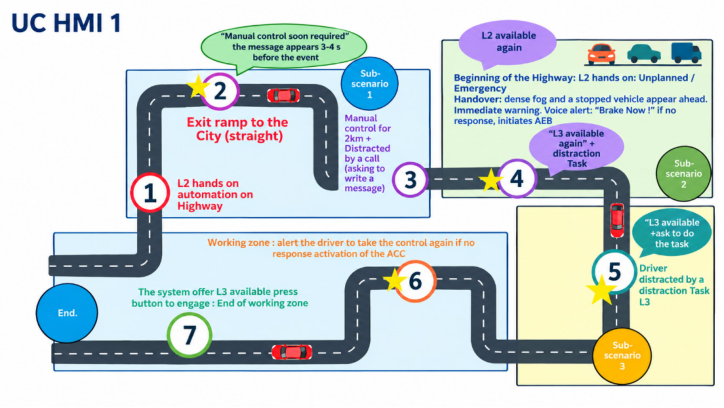
UC1 experimental scenario. The study scenario reproduces a highway-to- urban transition in a driving simulator, structured as seven consecutive steps, four of which require a warning to mention that an automation mode (L2 or L3) is available or a Take-Over Request when any of the three critical events appears (Figure 1). The Society of Automotive Engineers (SAE) automation mode, manual driving (MD), Level 2 (L2) or Level 3 (L3), is displayed on the HMI at all times.
Figure 1: UC1 scenario: seven-step highway-to-urban automation transition, and the two experimental warning conditions (Group A: audio-visual; Group B: audio-visual + haptic, * for the critical events).
The scenario begins with the vehicle in Step 1 under L2 hands-on automation on the highway. In Step 2, as the vehicle approaches the exit ramp toward the city, the HMI issues a “manual control soon required” message 3–4 seconds before the driver must resume manual driving. Step 3 keeps the driver in manual control for approximately 2 km while they are deliberately distracted by a distraction task asking them if they can do the task, reproducing a realistic secondary-task load. Step 4 introduces an unplanned, emergency handover: dense fog and a stopped vehicle appear ahead, triggering an immediate voice alert (“BRAKE Now!”) that is followed by Automatic Emergency Braking (AEB) if the driver does not respond. Step 5 returns L3 to availability while the driver is again distracted by a call, this time from an L3 state in which the driver may legitimately choose to respond to the call. Step 6 places the vehicle in a work zone, where the HMI alerts the driver to resume control if the adaptive cruise control (ACC) receives no response. Step 7 closes the scenario as L3 becomes available again and the driver presses a button to engage it.
From Generic HMI to Driver-Adaptive Automation: Multimodal Feedback 805 Experimental groups: Participants are randomly assigned to one of two warning conditions, experienced consistently across all seven steps of the scenario (between-subject design). Group A receives audio-visual warnings only (a voice alert combined with a visual HMI icon and message). Group B receives the same audio-visual warnings combined with haptic stimulation in the seat, delivered as an additional feedback channel during every warning or TOR event. We consider a successful TOR, when the driver responds appropriately within the required time, whereas a failed TOR corresponds to a delayed, incorrect, or absent response, triggering an appropriate system reaction such as an additional warning or automated braking. Comparing the two groups isolates the specific contribution of the haptic channel to mode awareness and takeover performance, independently of the audio- visual content itself.
Research questions: The protocol is designed to answer five linked questions. First, on warning timing: should a warning be issued in a cut-in scenario even while the current distance to the hazard is still nominally safe, and should timing be based on the driver’s expected reaction time rather than on distance alone? Second, on driver-adaptivity: do novice and experienced drivers require different warning lead times, and how do age and individual differences in reaction time and situation awareness modulate this need? Third, on modality: are two feedback channels sufficient, or does a third (haptic) channel add measurable value—and does multimodal redundancy improve takeover performance, or does it instead increase cognitive workload, distraction or annoyance? Fourth, on lead time: for a planned event such as a work zone, how far in advance should the driver be warned, and could an overly early warning instead cause forgetting, habituation or a decline in situation awareness? Fifth, on automation level: because an L3-to-manual takeover is plausibly more cognitively demanding than an L2-to-manual transition, should warning timing and modality themselves be adapted to the current automation level and to the driver’s real-time state?
Participants. The study recruits 50 participants, stratified by driving expertise (novice and experienced), age (including a dedicated 60+ subgroup) and neurocognitive diversity (including participants with ADHD), with gender balance maintained (50% male, 50% female) across groups. Each participant completes a single 2 hours session; the full protocol is run across two iterations, the second of which incorporates the HMI adjustments identified from the first round of testing (see Next Steps). The L2 automation functions exercised in the scenario correspond to production-grade ADAS features already available on current vehicles (e.g., adaptive cruise control with steering assist, lane centring, and forward-collision warning with automatic emergency braking), while the L3 hands-off automation segments of the scenario are emulated using the IDIADA driving simulator (IDIADA SIM), allowing the study to test automation levels not yet available in series production under controlled, repeatable conditions.
Ethics and data protection. All consent forms and GDPR-related documentation were reviewed and approved by IDIADA legal department. All participants will give written informed consent. The experimentation and the
interviews will be audio-recorded only with consent, and recordings will be deleted once transcribed. Transcripts will be pseudonymised with participant codes and will be retained until 5 years after the end of the project.
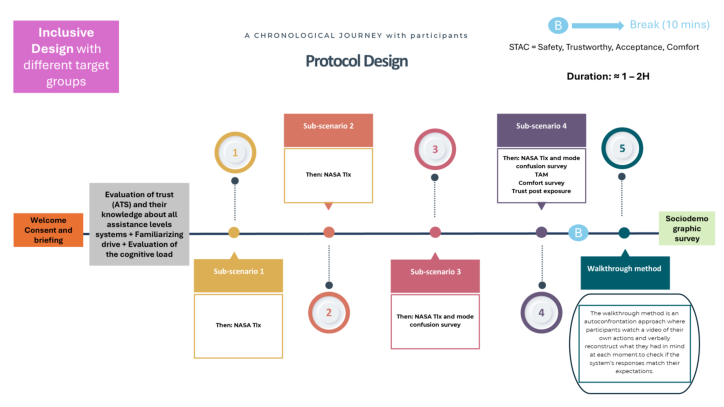
Protocol design. Each session follows the chronological, mixed-methods journey shown in Figure 2, lasting approximately 2 hours in total. After welcome, consent and briefing, participants complete a baseline evaluation of their trust in automation (ATS) and their knowledge of the different assistance levels, followed by a familiarisation drive and an evaluation of the initial cognitive load. Four sub-scenarios follow, each covering part of the seven-step UC1 scenario: sub-scenarios 1 and 2 are followed by the NASA Task Load Index (NASA-TLX); sub-scenario 3 is followed by the NASA- TLX; sub-scenario 4, preceded by a 10-minute break, is followed by the NASA-TLX, the mode-confusion survey, a Technology Acceptance Model (TAM) questionnaire, a comfort survey and a post-exposure trust rating. The driving phase closes with a video-cued walkthrough interview, and the session ends with a sociodemographic questionnaire.
Figure 2: Experimental protocol: chronological journey followed by each participant (≈ 2–3 h). STAC = Safety, Trustworthiness, Acceptance, Comfort.
Measures. Three complementary sources of data are triangulated throughout the protocol (Table 1): self-report questionnaires, continuous physiological/ behavioural monitoring through the E3D Incabin system, and a qualitative walkthrough interview.
Subjective measures. The NASA-TLX (Hart & Staveland, 1988) provides a multidimensional, self-reported estimate of workload after each sub- scenario; it is quick to administer and widely validated, but it reflects a retrospective, holistic judgement that can be influenced by recall and by the most recent or most salient event in the sub-scenario rather than by workload throughout. The mode-confusion survey and the TAM questionnaire (Davis, 1989) capture, respectively, whether participants correctly understood the
From Generic HMI to Driver-Adaptive Automation: Multimodal Feedback 807 active automation mode and their perceived usefulness and ease of use of the HMI both are direct, interpretable indicators of comprehension and acceptance, but, like all self-report measures, they are vulnerable to social- desirability bias and to participants rationalising their behaviour after the fact rather than reporting their in-the-moment experience. Cognitive load and trust ratings, taken before and after exposure, offer a simple pre/post comparison of subjective response to the system, at the cost of course, single- item granularity.
E3D Incabin system. Developed by E3D (Emotion3D), the Incabin system provides continuous, objective monitoring of driver state through blink rate, blink-duration variability, gaze distribution, percentage of eyes- on-road time, PERCLOS-based drowsiness estimation, hands-on/hands-off detection, and camera-based takeover-quality scoring. Its principal function is that it captures and analyses driver engagement and takeover behaviour continuously and objectively, independently of what participants later say or remember, which makes it particularly valuable for detecting mode confusion of the driver or disengagement that participants themselves may not consciously notice or accurately report. Its main limitations are that camera-based measures can be sensitive to a wide range of modalities in the vehicular environment, such as lighting conditions, eyewear, head pose and individual physiological variability (for example, baseline blink rate differences across age groups), and that, being purely behavioural, it cannot by itself explain why a given gaze or hands-on/off pattern occurred, which is precisely the gap the walkthrough interview is designed to close.
Walkthrough method. The walkthrough is an autoconfrontation technique in which participants watch a recording of their own actions during the drive and verbally reconstruct what they had in mind at each moment, allowing the researcher to check whether the system’s responses matched the driver’s expectations (Barbier and al, 2019). Its principal advantage is that it recovers the decision-making process and the reasoning behind a specific gaze shift, hesitation or missed warning, providing an explanatory layer that neither the physiological data nor a standard post-hoc questionnaire can offer. Its main limitations are that it is time-consuming to conduct and to analyse, that reconstructed accounts remain subject to memory decay and to reinterpretation once the participant has seen the outcome of the scenario, and that it can only be applied to a limited number of critical moments within the available session time rather than to the entire drive.
Table 1: Measures triangulated across the protocol.
Table available in the original PDF paper.
Measure Type Instrument(s) What it Captures Subjective / self- report
NASA-TLX, mode-confusion survey, TAM, comfort & trust ratings
Perceived workload, mode comprehension, acceptance, comfort and trust
Continuous driver state, engagement and takeover behaviour
Qualitative / explanatory
Video-cued walkthrough interview Reconstructed reasoning and expectations behind specific moments of the drive
EXPECTED RESULTS Expected outcomes are formulated against each research question and grounded in prior findings, without prejudging the study’s own results. Regarding warning timing, evidence that drivers need measurable time to regain situational awareness after disengagement (Gold, Lorenz and Bengler, 2013) suggests that TOR triggers based on the driver’s expected reaction time, rather than on distance alone, should shorten the interval between hazard onset and effective driver response, particularly in Step 4’s emergency handover. Regarding driver-adaptivity, gaze-behaviour differences documented in older drivers (Haghzare et al., 2022) and reduced monitoring of peripheral stimuli documented in ADHD populations (Reimer et al., 2010) support the expectation that the 60+ and ADHD subgroups will show longer detection latencies and require an extended warning lead time relative to younger, neurotypical experienced drivers.
Regarding modality, multimodal HMIs have been shown to balance faster hazard detection against subjective workload (Shi et al., 2024), and haptic feedback specifically has demonstrated positive acceptance for communicating urgency and direction during automation-level transitions (Peters et al., 2025); Group B is therefore expected to show improved mode awareness and takeover comprehension relative to Group A, especially for the 60+ and ADHD subgroups, though NASA-TLX scores should be examined for any accompanying increase in perceived workload, since redundant channels can raise, rather than lower, subjective effort if poorly timed. Regarding lead time, prior work on mode confusion (Kurpiers et al., 2020; Eom and Lee, 2022) suggests that a warning issued far in advance of a planned event, such as Step 6’s work zone, could paradoxically reduce vigilance through habituation, while a warning issued too close to the event risks the comprehension failures associated with insufficient processing time. Regarding automation level, transitions from L3 hands-off automation are generally expected to be more demanding than transitions from L2 hands-on automation, given the driver’s greater disengagement from the driving task at L3; this would support the study’s central hypothesis that a single, universal TOR threshold cannot serve every transition type (L3-to-MD, L2-to-MD, MD-to-L3, and so on) and every driver profile equally well.
NEXT STEPS The study is planned across two iterations. Findings from the first round of 50 sessions will be used to revise the HMI concepts warning content, timing and modality before a second iteration re-tests the revised design with a comparable sample, allowing the project to verify whether the changes made in response to the first round’s findings actually improve mode awareness and takeover performance, rather than merely reflecting a one-off observation.
Across both iterations, results from the three measurement sources will be triangulated rather than interpreted independently. Subjective reports (NASA-TLX, mode-confusion survey, TAM, comfort and trust) will be cross-checked against the objective, continuous data from the E3D Incabin
From Generic HMI to Driver-Adaptive Automation: Multimodal Feedback 809 system (gaze, PERCLOS, hands-on/off, takeover quality), and both will be examined alongside the reconstructed reasoning of the diver participants in the experiment obtained through the walkthrough interviews. Agreement across these three sources will be treated as convergent evidence for a given HMI requirement; divergence, for example, a participant reporting confident mode awareness in the questionnaire while the Incabin data show delayed hands-on-wheel response, will itself be treated as a finding, flagging a gap between declared and actual driver state that a single-method study would not detect. This triangulated evidence base is intended to move the project from the vague, universal thresholds identified in the Introduction toward concrete and effective warning strategies that are explicitly adaptive to driver profile, real-time driver state and automation-transition type.
CONCLUSION
Current HMI guidance for automated driving relies on imprecise timing language and an implicit average driver, a combination that this paper argues cannot support safe, inclusive design across the full range of automation transitions. UC1-HMI of the CERTAIN project responds with a driver- centred, multimodal protocol that compares audio-visual and audio-visual- plus-haptic warnings across a diverse, stratified sample of 50 participants, using a seven-step highway-to-urban scenario and a triangulated combination of subjective, physiological and qualitative measures. Across two design iterations, the study aims to produce empirically grounded, profile-specific TOR timing and modality parameters, supporting a shift from generic, universal HMI requirements toward driver-adaptive automation that remains safe, comprehensible and trustworthy for novice and experienced drivers, older adults and neurodiverse drivers alike.
ACKNOWLEDGMENT
This work was carried out within Use Case 1 (UC1-HMI) of the CERTAIN project (Resilient and Continuous Safety Assurance Methodology for CCAM and its HMI Components), funded by the European Union. Views and opinions expressed are those of the authors only and do not necessarily reflect those of the European Union or CINEA; neither the European Union nor the granting authority can be held responsible for them.
REFERENCES
Barbier, C., Guyonvarch, L., Guillaume, A., & Tattegrain, H. (2019). Is the selfconfrontation method applicable to Naturalistic Driving Studies? Safety Science, 119, 29–39. https://doi.org/10.1016/j.ssci.2018.11.005
Davis, F. D. (1989) “Perceived usefulness, perceived ease of use, and user acceptance of information technology”, MIS Quarterly, 13(3), pp. 319–340.
Endsley, M. R. (1995) “Toward a theory of situation awareness in dynamic systems”, Human Factors, 37(1), pp. 32–64.
Eom, H. and Lee, S. H. (2022) “Mode confusion of human–machine interfaces for automated vehicles”, Journal of Computational Design and Engineering, 9(5), pp. 1995–2009.
Gold, C., Lorenz, L. and Bengler, K. (2013) “Take over! How long does it take to get the driver back into the loop?”, Proceedings of the Human Factors and Ergonomics Society Annual Meeting, 57(1), pp. 1938–1942.
Haghzare, S., Campos, J. L. and Mihailidis, A. (2022) “Classifying older drivers’ gaze behaviour during automated versus non-automated driving: A preliminary step towards detecting mode confusion”, International Journal of Human–Computer Interaction, 39(12), pp. 2432–2449.
Hart, S. G. and Staveland, L. E. (1988) “Development of NASA-TLX (Task Load Index): Results of empirical and theoretical research”, in Hancock, P. A. and Meshkati, N. (eds.) Human Mental Workload. Advances in Psychology, 52. Amsterdam: North-Holland, pp. 139–183.
Kurpiers, C., Biebl, B., Mejia Hernandez, J. and Raisch, F. (2020) “Mode awareness and automated driving — What is it and how can it be measured?”, Information, 11(5), 277.
Lee, J. D. and See, K. A. (2004) “Trust in automation: Designing for appropriate reliance”, Human Factors, 46(1), pp. 50–80.
Nordhoff, S., Hagenzieker, M. P., Lehtonen, E. and Merat, N. (2023) “Instrument for the assessment of road user automated vehicle acceptance: A pyramid of user needs of automated vehicles”, arXiv preprint.
Peters, J., Anvari, B., Licher, J., Wiese, M., Raatz, A. and Wurdemann, H. A. (2025) “Acceptance and usability of a soft robotic, haptic feedback seat for autonomy level transitions in highly automated vehicles”, IEEE Transactions on Haptics, 18(1), pp. 58–72.
Reimer, B., Mehler, B., Wang, Y. and Coughlin, J. F. (2010) “A field study on the impact of variations in short-term memory demands on drivers’ visual attention and driving performance across three age groups”, Human Factors, 52(5), pp. 646–658.
Shi, X., Zhong, Y. and Liao, X. (2024) “Fostering user acceptance in shared autonomous vehicles: A framework for HMI design”, Multimodal Technologies and Interaction, 8(11), 94.
SEARCH THE AHFE DIGITAL BOOKSTORE BY ISBN
Explore the complete digital volume
Human Factors in Design, Engineering, and Computing
Read this individual research paper free through the original publisher, or explore the full digital proceedings book.